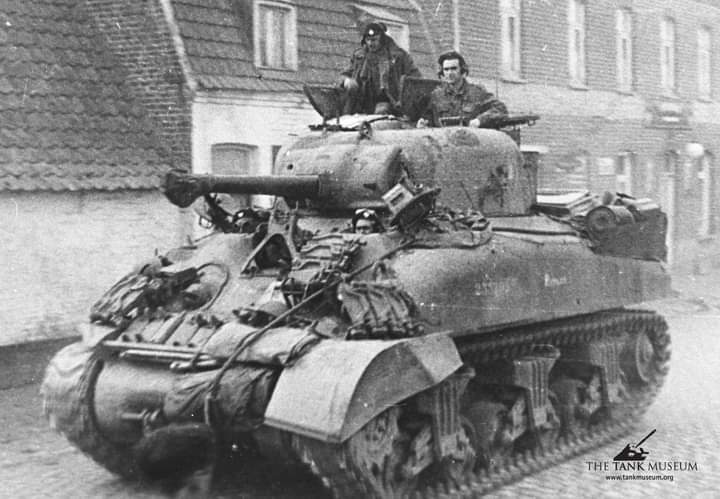
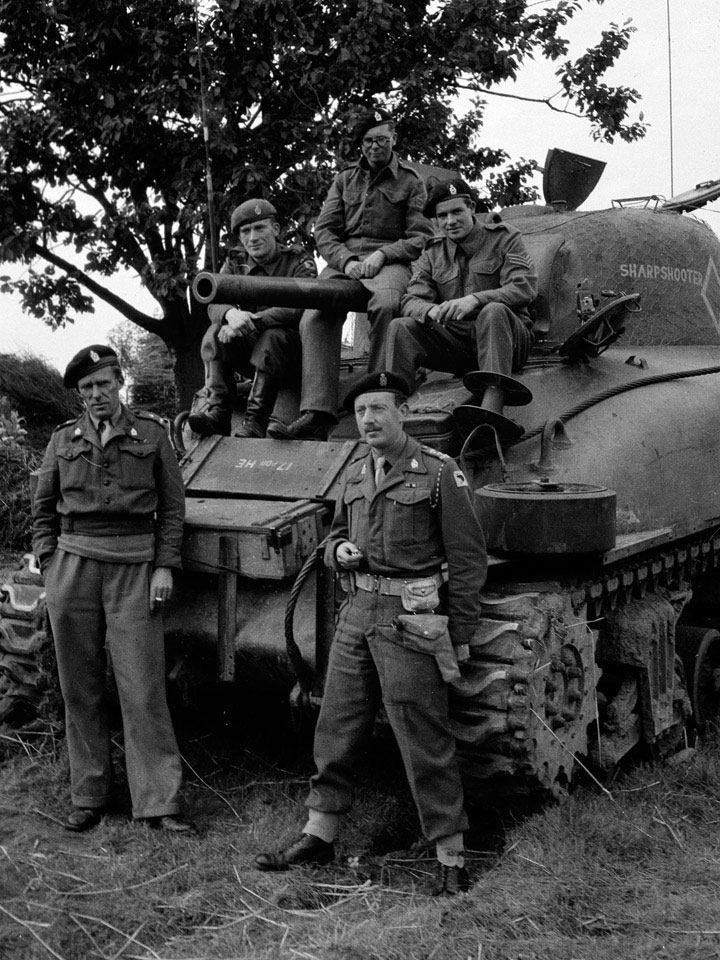
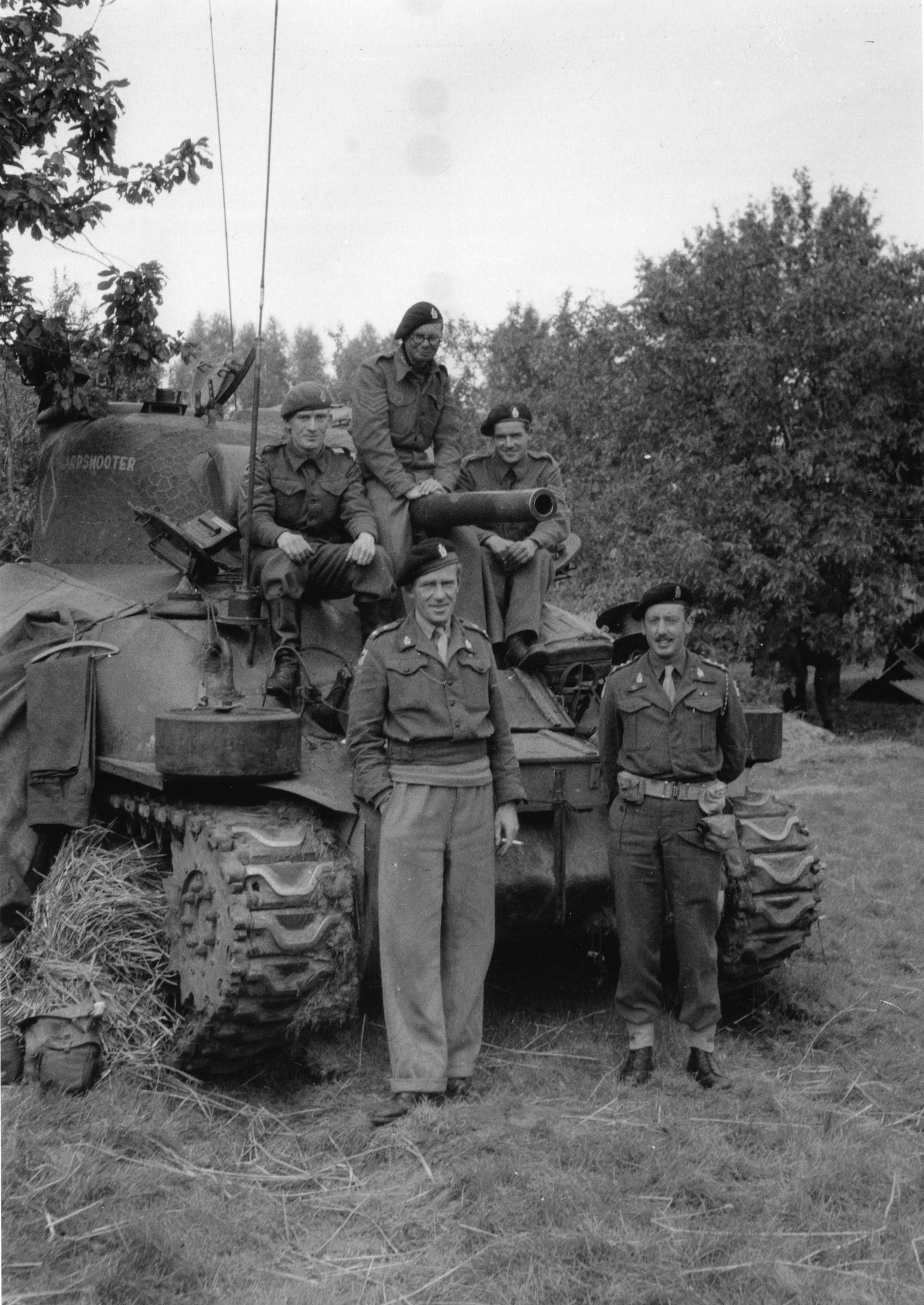
I might decide do one of these at some point. I’ve always like the British modifications to stowage, tool boxes, and other things like fire extinguishers etc….And the camouflage patterns on British Shermans were always really nice too.
I feel more comfortable doing the modification for the cast in armor myself. I don’t really like working with resin, I’ve done it before but I just don’t like it. I do use resin for things like stowage items but if I’m making one of these tanks I’ll just do the modification myself.
Just an observation and not complaining or anything but I did want to point this out about the Late production 76mm wet VVSS kit. When I first saw the images I immediately thought of the tank in this photo as having been the inspiration for the kit, which I think it is, even the brackets for mounting the armor plate to the cast hull are included in the kit. Here is the image that I think inspired one of the armor configurations included in the the Takom kit.
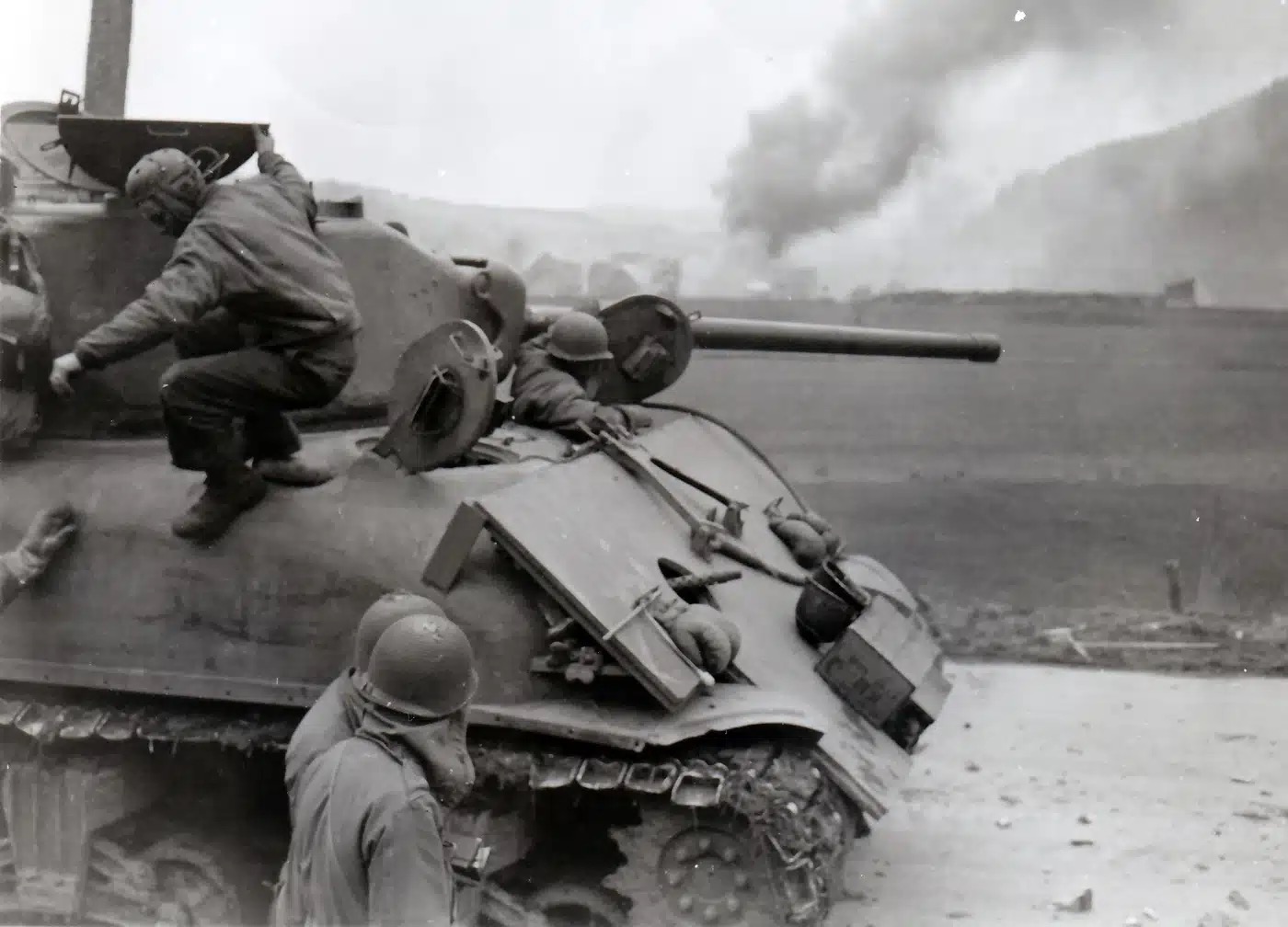
Here’s the rub. If you want to build this tank with the Takom kit, you’ll need some stuff not included in the box. Can’t tell for sure what kind of track this tank has because of all the mud, but it does have EEC. It also has an early turret with split loaders hatch that has been reversed because I suspect the commander of this particular tank was probably accustomed to the split hatch and wanted that hatch instead? The kit comes with the late turret with the oval loaders hatch and it doesn’t include the alternate tip for the gun without the muzzle brake, this tank just has a counter weight/thread protector.
The kit is wonderful and I’m by no means complaining and it does offer two alternate front configurations, you can choose sandbags or you can choose another armor plate option. BUT, if you choose this particular plate option, the rest of the kit in the box won’t build into this tank in the photo.
Im not a sherman expert (or a tank expert for that matter) but which was more common the easy 8 sherman or the m4a1
More common in a particular campaign? Maybe you mean in the Second World War as a whole? Perhaps you mean in postwar use?
The M4A3E8 represents the final production version of the M4A3 just like the M4A1E8 represents the final production version of the M4A1 so in terms of raw numbers those final versions were a drop in the bucket compared to all the earlier 75mm tanks produced earlier. Also the US standardized the M4A3E8 for it’s own personal use so that particular version doesn’t get exported to other countries meaning that the number of campaigns that version of the Sherman were fewer in WW2 but it also means that the M4A3E8 was still in service years later during the Korean War when other types of Shermans had all but disappeared from the US arsenal.
So the M4A3E8 was less common in WW2 over all since it mostly only served in the final 5 months of the ETO. That said it was more common in Korea and had longer more extended service with US forces than other types.
During WW2 and then post WW2 the M4A1 in all its versions went on to have extended service with a lot of other armies. I think the most famous versions among Sherman fans are probably the IDF M4A1E8s that were converted by France for the IDF to carry the French made 105mm, they are known as the M-51 and those tanks served in multiple different wars with the IDF, none in 56’ but many in 67’ and then a few reserve units in 73’
So I’m trying the best I can to answer your question without knowing what particular campaign or era you are referring to but if I’m assuming that you mean WW2 as a whole then the M4A1 in all it’s different types was more common than the M4A3E8 which only served at the end of the war.
The M4A1 also has a special place in the war being the second designation of the Sherman but actually the first one to go into mass production. The M4A1 came out from factories before the M4, the M4A2, the M4A3, and the M4A4. And probably because it was the first version to enter mass production one of the early versions of the M4A1 was also the first version of the Sherman to see combat in WW2 (El Alamein) as the very early batches of those were sent to British units in North Africa in late 1942 (?). Different versions of the M4A1 saw service in North Africa, the MTO, the PTO, and the ETO during WW2. None made it to Russia where the M4A2 was the primary type sent there. During WW2 the US was the primary user of the M4A1 since the British didn’t prefer the radial engine and they mostly used the diesel powered M4A2 and the longer M4A4 which had to be stretched to accommodate the massive engine in that type. The Ford engined M4A3 became the preferred US type and was the only type kept in US service after the war. The M4A1 ended up getting exported to build up the armies of friendly nations around the world, the French I think became the biggest user of the M4A1 and they in turn exported some to other countries too.
The radically French modified versions of the M4A1E8 which became the M-51 probably were the last Shermans to be in front line service anywhere around the world. I think I read that Israel sold several hundred of them to Chile(?) in the early 1980s and those were retired in either the late 1990s or the very early 2000s. I’m still learning about the South American Shermans, the UK sent a lot of Fireflies to Argentina (?) which where then converted to a 105mm gun too. But I believe those were retired well before the Chilean M-51s were. In Inda and Pakistan the M4A1 served in the civil war there in the 50s (?) and they used an upgunned 76mm version with a unique suspension system. I think late versions of the M4A1 with the 76mm gun also served in Uganda in 1969.
Sorry, that was lot…