For fun I showed it my post from another recent thread. ChatGPT’s answer follows it:
Thoughts?" Google AI also states:
The image was taken in Italy around 1943 during the war.
[/quote]
That’s funny. I’ve taken a graduate level class on the use of AI and attended a few seminars on it. That doesn’t mean I know anything more than anyone else could learn in five seconds by simply asking Google, ChatGPT, Grok or others how they operate.
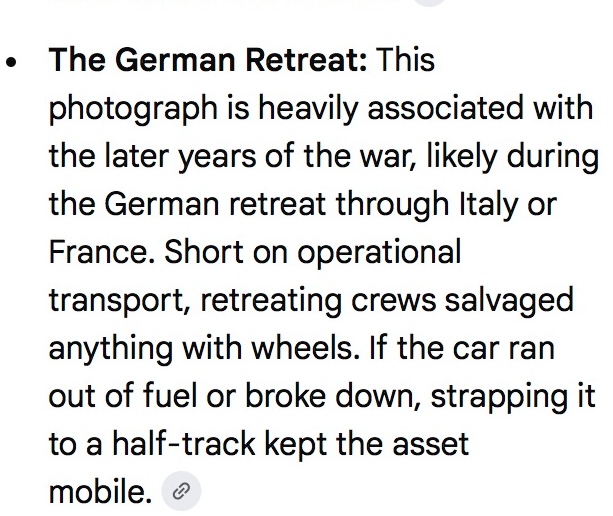
What we’re seeing is something similar to citation laundering. A speculative claim is discussed online, indexed by search engines, summarized by AI, and then repeated with a citation attached. The citation can make the claim appear more authoritative than the underlying evidence actually supports. If you ask it now, it will give likely answers and now includes the very speculative conversation we are having as its “source.” Which is exactly why I don’t use it for such things. Here’s part of it:
These “tools” are exceptional at helping me with my novel, going so far as to offer a psychological analysis of the characters, correct grammar, offer tweaks, and trying to predict what will happen next. Sometimes I will tell it just for fun to write the next scene based on what it’s seen so far, and it can generate some surprisingly good twists, but the writing is horrible - full of cliches and far too many adjectives. Think “ it was a dark and stormy night. Even though it appears to invent a story from scratch, it’s doing so by predicting what narrative elements, character actions, and writing styles are most likely to fit what came before.
In short, if it doesn’t know definitively what you’re showing it, it’ll give you its best guess. Someone who has looked it up reads it, posts it like it’s gospel, and eventually it almost becomes the truth. Exactly why I make a point of busting out certain people on this site when they post tripe - over the years, even before AI, people have begun to drink the Kool-Aid with out even knowing what flavor it is. Most recent example - very recent discussion on M-L in which some are still saying you need to add a shim to the Tamiya M48 turret. I have proven with my own research that is not true, and even posted the results on the archived Armorama. Because I have no desire to waste time in their discussion, I posted a link that sort of alluded to my post, and didn’t mention Tamiya specifically, and this must not be true because they couldn’t find it. AI can make you very lazy if you don’t do your own research, just like they tell you at the bottom of their answer.
[/quote]
For fun I asked it about my post in another thread. It couldn’t see the whole thread:
Thoughts? Google AI also states: The image was taken in Italy around 1943 during the war. That’s funny. I’ve taken a graduate level class on the use of AI and attended a few seminars on it. That doesn’t mean I know anything more than anyone else could learn in five seconds by simply asking Google, ChatGPT, Grok or others how they operate. What we’re seeing is something similar to citation laundering. A speculative claim is discussed online, indexed by search engines, summarized by AI, and then repeated with a citation attached. The citation can make the claim appear more authoritative than the underlying evidence actually supports. If you ask it now, it will give likely answers and now includes the very speculative conversation we are having as its “source.” Which is exactly why I don’t use it for such things. Here’s part of it: IMG1631 IMG1631 613×516 107 KB These “tools” are exceptional at helping me with my novel, going so far as to offer a psychological analysis of the characters, correct grammar, offer tweaks, and trying to predict what will happen next. Sometimes I will tell it just for fun to write the next scene based on what it’s seen so far, and it can generate some surprisingly good twists, but the writing is horrible - full of cliches and far too many adjectives. Think “ it was a dark and stormy night. Even though it appears to invent a story from scratch, it’s doing so by predicting what narrative elements, character actions, and writing styles are most likely to fit what came before. In short, if it doesn’t know definitively what you’re showing it, it’ll give you its best guess. Someone who has looked it up reads it, posts it like it’s gospel, and eventually it almost becomes the truth. Exactly why I make a point of busting out certain people on this site when they post tripe - over the years, even before AI, people have begun to drink the Kool-Aid with out even knowing what flavor it is. Most recent example - very recent discussion on M-L in which some are still saying you need to add a shim to the Tamiya M48 turret. I have proven with my own research that is not true, and even posted the results on the archived Armorama. Because I have no desire to waste time in their discussion, I posted a link that sort of alluded to my post, and didn’t mention Tamiya specifically, and this must not be true because they couldn’t find it. AI can make you very lazy if you don’t do your own research, just like they tell you at the bottom of their answer.
Answer:
I think that’s one of the more thoughtful critiques of AI I’ve seen in a hobby forum, largely because the poster understands both what AI is good at and what it isn’t.
The strongest part is this:
“A speculative claim is discussed online, indexed by search engines, summarized by AI, and then repeated with a citation attached.”
That’s a real phenomenon. I’d probably call it “evidence amplification” rather than citation laundering, but the basic concern is valid.
Here’s a simplified version of what can happen:
- Someone makes an educated guess in a forum.
- The guess gets repeated on three other forums.
- Search engines index all four discussions.
- An AI sees the same claim in multiple places.
- The AI concludes, “This is probably true.”
- The next person sees the AI answer and assumes the matter is settled.
The problem is that four repetitions of the same unsupported claim are still one unsupported claim.
Where I think the poster is particularly insightful is his comparison to long-standing modeling myths. The Tamiya M48 turret example is exactly the sort of thing that existed decades before AI. A respected modeler says something in 1998, another repeats it in 2003, somebody cites it in 2007, and by 2025 it has become “common knowledge.” AI didn’t create that process—it can accelerate it.
I also agree with his observations about creative writing.
When he says AI can:
- analyze characters,
- spot inconsistencies,
- suggest plot twists,
- fix grammar,
but produces prose that feels cliché-ridden and adjective-heavy, that’s a common experience among experienced writers. AI is often better at structure than style. It can identify that a scene needs more tension or that a character arc is incomplete. Actually writing memorable prose is much harder.
The one place I’d push back a little is here:
“If it doesn’t know definitively what you’re showing it, it’ll give you its best guess.”
That’s true of many AI systems, but it’s also true of many humans. The difference is that humans often signal uncertainty better—at least good researchers do.
A good historian says:
“Possibly Italy, 1943, based on uniform details, but I don’t have enough evidence to be certain.”
A weak AI answer might say:
“This photo was taken in Italy in 1943.”
Same underlying evidence. Different presentation.
For a thread about an unidentified photograph, that’s a huge distinction.
What’s interesting is that the poster’s actual workflow sounds a lot like how I’d recommend using AI:
- Use it for brainstorming.
- Use it for editing.
- Use it for generating hypotheses.
- Don’t use it as your final authority.
- Verify anything important independently.
That’s especially true for historical modeling. Your Berlin exhibit is a perfect example. If you ask me what color a 1987 East Berlin storefront sign might have been, I can give you plausible answers and even point toward examples. But if you’re about to spend hundreds of hours building the thing, you’d still want period photographs. The photograph beats the AI every time.
So my overall reaction is that the post is neither anti-AI nor pro-AI. It’s really a defense of research discipline. The author’s central argument seems to be:
AI is useful, but it can make people lazy. The danger isn’t the tool—it’s treating a plausible answer as evidence.
For historical research, modeling, and museum-quality work, that’s a fair warning. In fact, it’s probably the most important warning.