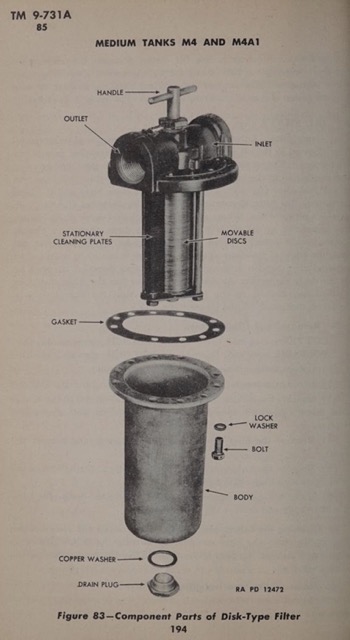
The reasons I’m skeptical are that first, the two spots of light that are on each of the items don’t seem right for springs, and second, M4/M4A1 Sherman fuel filters — according to the 1942 TM, anyway — aren’t glass but metal.
Springs that reflect light will have a line of small spots along the full length of the spring, one per coil, not a spot that’s larger than the wire thickness at one-third and another at two-thirds from the top. If the coils are closely together, that will look like a line of reflected light, especially if the photo is of poor resolution.
Per the TM, a radial-engined Sherman’s oil and fuel filters looked like this:
I can only imagine the cursing in Yiddish being thrown around in the motor pool, or in the field while wrenching on those old engines, trying to keep them operational with fewer and fewer parts available.
you start getting real creative when the work starts getting more complex.
Well the air-cooled radios did a real number because I think more of them caught on fire than were ever hit by the enemy and the multibank engines from Chrysler was a tuning and timing and maintaining cluster f. Trying to get those things synchronized was like trying to explain things to certain people impossible after 1948 they started to get rid of the the radials because of the fires and the problem with sand in the desert and other issues that made them impossible to maintain plus the fuel costs for the radios they were just guzzlers. The diesels dependable. Better torque and everything else and the ones that came with the multibank engine the a4s I think they were that we got from England and Europe which had been extended a few inches to fit the multibank we’re great for the diesel conversion. The others took longer.
Sorry about the punctuation mistakes here but I’m doing voice to text
Yeah, the Radial engines on the early Sherman’s were never designed for long-term usage in the desert. Diesels were more reliable in adverse conditions. And yeas, a Radial engine will suck on gas far more than a diesel.
I was transferred to this reserve unit after too much combat and this base was close to my home. I was an M107/110 and M109 driver, so I did minimal maintenance but I did help out and I was told by the old civilian mechanics that were prepping the old Sherman base stuff that timeline.. but when the guy turning the wrench I’d in his seventies … But those same guys taught me hot to drive Shermans which is a totally good time..
Here is my 2 cents… (And AI). The mine roller is in the stowed, transport position. Shermans also towed them “Out of” the field they just searched because of the better gear ratio’s going forward than reverse.
The Half track in the second phot would be the unit commanders transport.
Nice picture though. Love to see a diorama based on the scene.
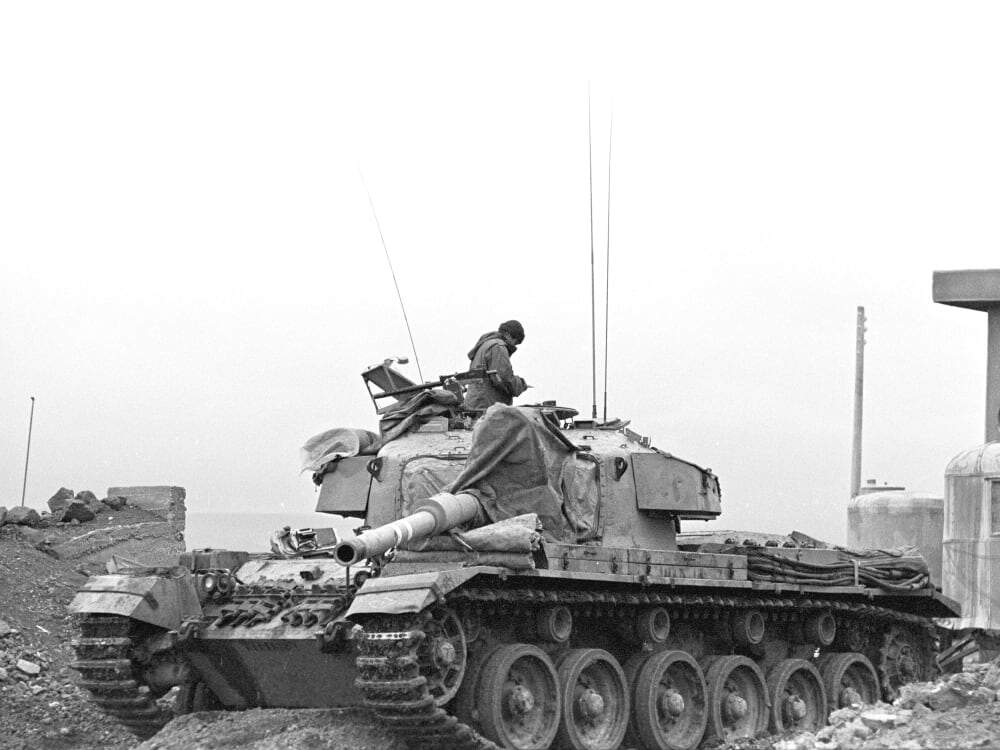
The tank in the photo with the unknown items on the engine deck, has the air filters for the radial engine under the overhang, though. That’s why I’m thinking it has that engine, and therefore would have the fuel/oil filters for it, too.
Edit: I read up on IDF Shermans a bit in Tom Gannon’s Israeli Shermans Second Edition[1] and it’s clear from photos that radial-engined Shermans were the norm in the IDF long after the 1948 war. Pretty much all photos of them in the 1950s where the engine deck is visible show the typical M4/M4A1 style, and there are also a decent number of M4A4T tanks among them — that is, M4A4s that were re-engined with radial engines in France, and got the same type of engine deck as the M4/M4A1. On page 187, the book states:—
The first Cummings diesel engines arrived in 1962.
Tiptree: Barbarossa Books, 2017; ISBN 978-1-84768-023-5 ↩︎
After the 1956 war they got rid of them as fast as they could replace the engines. More caught on fire due to the radial engines then we’re hit by anything..
That fits with the Cummings being introduced in 1962, I’d say, and would date the photos at the top of this thread to probably the 1950s. When did Centurions come in?
According to the Wiki (which may be wrong); the first Centurions, or “Sho’t Meteors” started in IDF service in 1959 and saw action during both the Six-Day War and Yom Kippur War. The “Sho’t Kal” variant entered service in 1970 and differed in that the “Kals” replaced the factory Rolls Royce Meteor engines and Merritt-Brown Z51R transmissions with American made Continental AVDS1790-2ACdiesels, along with Allison CD-850-6A transmissions.
And within the “Kal” series, you have the different upgrades; like the “Alef”, “Bet”, “Gimel” and “Dalet”, which was the last update of the “Sho’t Kal” series, in 1984.
I forgot that the first photo in this topic, the one with the Centurion towing the Sherman towing the roller, has a re-engined Sherman – so that would be post-1962 anyway
The halftrack in the other photo has the machine gun mounting in place of the right windshield, which would help date the photo of the Sherman hull with the radial engine, but I can’t find when that gun mounting was introduced.
There are a couple of front/side views of these “Strange Shermans” in one or two of the old Concord books on Middle-East wars, and some very good ones on the YKW archives opened 2-3 years back.
As an aside, I must say enjoying a lot the first-hand comments by Robert-Goldman on whatever IDF thing. Thank you!
I got to watch that exact operation in progress back about 30 years ago but they were using a big piece of weighted chain link fence towed behind a truck. The section of fence was wide enough that a person couldn’t just jump over the cleared area. It was the same “system” used to groom the infield on a baseball diamond. There were also a couple of guys watching from the front of the truck, looking for footprints made since the last pass.
After gathering the various pieces of information and examining the photos more closely, one of the most plausible scenarios, in my opinion, is as follows: decommissioned Sherman tanks were used to resurface the roads connecting the strongpoints of the Bar-Lev Line in order to detect any infiltration during the War of Attrition.
In my research I have stumbled across many names and designations, some challanging accepted identifications. However I believe this is what was officially reffered to as “Sherman Mifltezet”, which means Sherman Monster.
Some claim the Mifletzet was the moving target Sherman but I oppose this theory based on 1973 documents which tell a different story.
The purpose of this vehicle was to carry mineclearing equipment.
I hope after I am done with current projects I will be able to find more information