Iowa Class Engine Room #3 Model for BB62 Permanent Display

That’s a very interesting quasi-philosophical issue regarding modelmaking that you’ve touched on. I’m sure most of us have been there – so much effort to reproduce something perfectly, and then tripped up by an unwelcome/overlooked detail.

I think you’ve taken the right path. The vast majority of the audience wouldn’t even notice, they’re seeing it for the first time and processing everything else that’s 100%. The few (if any) who do spot the compromised solution would – I like to think – immediately understand or empathise with the reason why and say nothing. And even if they were determined to score a silly point by pointing it out, nobody else would care. Myles, rest assured I’ll stay shtum – this entire project is off-the-scale brilliant.

4 Likes

Tim! Thanks! I needed that. It helps to have folks put all this in perspective.

I got all of today’s punchlist items completed and even some more. The new prints were successful, the parts were cleaned, post-cured and painted ready for assembly tomorrow. I used the vinyl cutter to cut more striping for the output prop shaft from this engine room and applied the vinyl to the part. I added the double-sided, foam, servo-tape to the bottom of all the “concrete” support block, and cut and installed with epoxy the conduit tubes that now continue down all the way to the bottom of the mounting blocks. I printed out and coated the pipe identifying decals and will apply those over the next few days.

You only see a little bit of the output prop shaft from the gear box, but it’s there and I had to add it.

Here’s what you see on the ship. There is a sheild around the prop shaft-bulkhead seal that obscures part of the striping. I’m not including the shield.

I didn’t like the open bottom of the lube oil settling tank, so I closed it up with styrene and then painted it today.

Here’s the new work platform that will be glued directly to the evaporator platform, and the little legs tie to part of the main gear box.

And here’s another batch of floor grates. The doubling of the outside perimeter wall worked in preventing any damage during support removal.

Tomorrow should be another productive day.

7 Likes

It is a sickening feeling when you have put so much effort into a model and then find out you’ve made an error.

A few years ago I super detailed a 1/35 M88A1, to include not only a full interior and aux generator, but I cut open the engine compartment, created all the access hatches, making everything movable, and the created EVERYTHING inside the entire engine compartment…with the exception of the engine and transmission/final drive itself.

I then proceeded to follow the Squadron/Signal book and paint the entire thing in the NATO 3 Color scheme.

NOT cross checking with my official paint guide.

The COLORS in the illustration were WRONG!

What the illustration showed as Brown, was supposed to be Green, what was shown as Green was supposed to be Black, and what was shown as Black was supposed to be Brown. And becaise of the relative percentages of each color, it is NOTICEABLY wrong.

Because of all the fine detail in all the working hinges and the actual venting of all the louvers, there is no masking technique to use to re-spray paint without destroying the hinges or getting all the colors into the white engine bay.

So the kit remains hidden away in a box on the off chance that I decide to completely tear it apart, rebuild it and try and re-paint it.

Your decision to just leave things is absolutely the right one as painful as YOU know it to be.

2 Likes

I’m a creative model maker, but not a perfect one. I admire folks who make stunningly perfect models, especially on things like transparent parts. I have a couple of close model building friends here in Louisville who I classify as building “Perfect” models and they usually win in shows, so others agree with me. But, my models show that a human built them with some human failings. A long time ago and far, far away, I was building Pocher 1/8 scale models for the man who imported them into the US. He paid me $100 a car to build them, and I built many of them. He told me that he couldn’t pay me more because he was giving them away as demo models to hobby retailers, and I believed him.

After about four years of doing this, I was at a little specialty shop in the NewMarket area of Philadelphia that sold die cast and model cars, and she had several Pocher cars built up for sale in show cases. I asked her where she got them and she said she buys them from this man. I then saw a little glue smear on the back window of a T50 Bugatti and I recognized that smear. It was MY SMEAR. I found out then that he’d been selling these cars the entire time. I ended my relationship with him and started building for private clients who this women was nice enough to steer me to. My fee went from $100 to $400 per car, and this was 1980, so that was a reasonable fee. All because I recognized one of my “non-perfect” models.

Now onto today’s work….

The new floor add-on connecting the evaporator deck to the main gear box is grated and ready for installation. It’s a shame that I finally figured out how to print perfect grates at the last one I need to do… Oh well. If some other Iowa battleship wants an engine room, I have it figured out.

I trimmed the key list graphics and glued them back to back using the 3M Transfer Tape. I will use the same method to glue it the rear inside face of Plexiglass after the case is built. That way, the kay will be visible from both sides.

And here’s the new work platform on the lower level. I’ll paint it tomorrow.

Tomorrow’s another day…

9 Likes

Not much to show today, but I did get stuff done. Painted the new work platforms, repainted the low and high pressure turbine cases, painted the new piping and glued the main air ejector to its angle bracket that will hold it to the bulkhead.

And I have a picture of the completed base from my friend Bryant, and, as usual, it’s a piece of furniture. All the finishes and sanding are done, but it has to cure for a week before he can ship it. It’s coming at the perfect time since I’m almost done messing with all the subassemblies and am ready to start putting together an ENGINE ROOM.

7 Likes

You do such wonderful work! Wow!

Well… thank you!

Not much to show today, but I did get stuff done. Painted the new work platforms, repainted the low and high pressure turbine cases, painted the new piping and glued the main air ejector to its angle bracket that will hold it to the bulkhead.

And I have a picture of the completed base from my friend Bryant, and, as usual, it’s a piece of furniture. All the finishes and sanding are done, but it has to cure for a week before he can ship it. It’s coming at the perfect time since I’m almost done messing with all the subassemblies and am ready to start putting together an ENGINE ROOM.

4 Likes

Randy, somehow, I deleted your nice comment… Thank you for it.

All of the punchlist items up to getting the base from Bryant are done. That means I have a week where nothing’s going to happen on the engine room. Today I did all the decaling and touchup painting. I made the hookups for the power supply and the power switch and tested it with the main steam line which has 3 LEDs on its bottom. There’s nothing left to do until I actually start tying down all the assemblies to the base and that doesn’t happen until the model is secured to the base.

NJ ERP Punchlist 09-11.png

Decals designate the output RPMs of the main propulsion system.

NJ ERP Power Train Decals.jpg

I was unhappy with how the decal looks on the main reduction gear, but don’t know what to do about it. I used flat paint on the gear box and didn’t want to gloss coat it before applying the decal. That was probably a mistake.

I applied decals to the pass-thru prop shafts from ERs 1 & 2.

NJ ERP Prop Shaft Decal.jpg

Again the flat paint was a problem. I applied some Testor’s Dullcoat to them to help blend them in, but it’s still not my best work.

The cross-over pipe is identified with its steam flow pressure and direction.

NJ ERP Main Propulsion Decals.jpg

And all the main pipes to and from the auxiliaries are identified the same way. The piping on the 1:1 ship is also identified similarly, so I’m following the prototype.

NJ ERP Piping Decals Done.jpg

And I got the power supply and switch all tied into the power distribution board, so they’re ready for install as soon as the baseboard arrives.

NJ ERP Power Wiring Ready for Install.jpg

So… work is paused for about a week. I will clean up the shop a bit, and then have some more mundane home maintenance projects. There’s some water areas that are in need of some caulking…

8 Likes

I got a commission 3D printing job which got me back into the shop. I’m still working on some nagging punchlist items. One of these was the mismatch in levels between the two turbines and its effect on the crossover pipe. I also didn’t like the very small surface area I had to glue said pipe in place. To remedy that I made round spacers and fill pieces for the two junctions.

This one is for the LP turbine…

And a broader one for the HP turbibe outlet.

Then a massive problem arrived. The LP turbine was sitting low and needed shimming so it matched the elevation of the main gear box LP inpu shaft. I made the spacer out of laminated styrene (as I used on the LP pipe spacer) and after glue set, shaped the edges so they looked decent. I also needed to further flatten the LP’s bottom surface. This when the trouble hit. Unbeknownst to me, I had voids in the part that contained un-cured resin. I was aware about voids being potential trouble, but when I designed this part early in the project, I inadvertently created some. The wasn’t an issue until I put the turbine on the belt sander an opened up the voids spilling raw resin all over the bottom and up the sides.

I had to remove it using 99% Isopropyl alcohol and it started to eat into the nice repaint job I did last week and made a complete mess of this finished part. I put the part into the post-cure chamber to harder any liquid resin still remaining. The side with the “10s” on it (denoting the location of the astern turbines) and decided to remove the vinyl letters so i could sand down the damage and repaint without worrying about them. I set up the vinyl cutter and just cut some more. Like 3D printing, having the vinyl cutter means I can fix screwups without to much hassle. I then remasked and airbrushed white to restore the turbine. Alls well that ends well and it looks okay. If worse came to worse, I could have reprinted the entire turbine, but wasn’t looking forward to that.

Here’s the spacer…

And the refurbished turbine. I had to remove the LP RPM decal and have extras of that also, and will replace all graphics elements tomorrow.

I also printed a copyright plate to be attached directly on the model, not on the name plate. I did them in differnt colors. Any favorites. You can’t see it, but that’s two different shades of gold.

The wooden base is shipped and I’ll recieve it on Monday. Then the real fun begins. I am still anxious about locating all the mounting pins on all the various legs and columns to permanently mount all this stuff.

4 Likes

First up, I applied the Copyright nameplate with 3M Transfer Tape. I don’t know if it’s legal, but it adds a sense of importance to the work.

NJ ERP MM Copyright Plate.jpg

Working on the last punchlist items… I knew that the fit between the turbines and the gear box needed some work and now was the time to do it. One problem was the LP shaft in the gear box was not long enough to reach the turbine, especially now that the turbine is actually almost a half inch more forward that I thought. I had printed a new torque tube to accomodate this, but the shaft needed lengthening. It wouldn’t have mattered, but the tube is cut away so intrepid viewers can see the shafting inside. Instead of fussing trying to add length to the 3D printed pinion shaft, I found a piece of brass tubing that just slipped over. Problem solved. All I had to do was make it look like steel. I used Bare Metal Foil to give it a silver coating. I could have painted it, but this way was cleeaner and faster.

\NJ ERP LP Shaft Extension.jpg

With the shaft now the correct length I was able to finish painting the torque tubes with the red cutaway edges and then epoxy them to the gear box end covers. I’m not going to worry about gluing it to the turbines. The glue surface there is rather skimpy.

NJ ERP Torque Tubes Epoxied.jpg

With everything just fitted up for measurement purposes, here’s how the torque tubes look when sitting properly.

NJ ERP Torque Tubes Fit.jpg

I tried the cross-room bridge to see how it aligned and it laid in very nicely. Remember, all of this stuff gets fastened AFTER the bare model is attached to the base.

NJ ERP Cross-Room Bridge Fit.jpg

I also removed the bad decal from the top of the MRG, repainted and applied new numbers and decal. This time, I faced it in the same reading direction as the graphics on the turbines. I had it reversed before and it bugged me. Another thing that’s really bugging me is that the Mission Models Dark Ghost Gray doesn’t match the previous bottle that I used for a lot of the apparatus. It’s leaning towards purple. I can’t seem to match the color gray that I used many months ago. It’s so different that I’m thinking about repainting the rest of the gear box to match. I’m trying these paints, but am not happy. If you don’t add the polymer additive, the paint is very fragile, all pigment and little binder. I’m using Pledge with Future as the acrylic binder. They sell their own additive, but you can get a lot of Future for the same price. I used GlossCoat before applying the decal and then Dullcoat after the decal set and it’s a much better looking job than before.

NJ ERP New Decals on MRG.jpg

We went out to dinner tonight and while driving the car I realized that I didn’t add any information about the horsepower output from the turbines. I’m going to add that. Also, according to UPS, the wooden base arrives on Monday. Next week is going to be interesting…

10 Likes

Limited time today, but milestone anyway. First up, I repainted the entire gear box. I will reapply the numbers and decals next session. The paint now meets my expectations.

And the milestone is the base arrived perfectly.

I plopped the model on it just to make sure that all my measurements were correct. Thankfully, everything works!

Tomorrow it the Jewish New Year so I won’t be in the shop, but I will on Wednesday. I will be taking the base to General Rubber and Plastics to have them measure for the plexiglass. When the order is made, I will start the process of making the base and the model ready to be joined. After joining, I will be mounting everything that will make it an engine room. Stay tuned. We are rounding the final turn.

13 Likes

Stunning work with the usual in depth attention to detailing. Another great binge catch up.

1 Like

Even I periodically binge read my threads. I sometimes forget all the turmoil I endure to create this stuff… kind of like childbirth.

With the base in hand, I took it to General Plastics and Rubber here in Louisville. I’m glad I did. I am getting the plexiglass CNC router cut. This produces a very smooth square edge that requires very little cleanup before glue up. The CNC machine is digital and can work to three decimal places. This enabled me to get the end pieces correctly sized. Reason? The 3/16" plexiglass is actually .177" not .188". They were able to spec the actual measurement of 14.374" to cut the end pieces do they will fit pefectly square within the two long side pieces, letting the top fit exactly over all four sides. If I attempted to do this over the phone, it would not have work. We were able to measure directly from the base.

Even better, the price was $10 less than the material for the 5" gun case and it’s actually a bigger job. I don’t know why this is, but I’m not complaining.

I got the base back to the shop and got to work on it. First up was setting up the model’s location on the base. I eyeballed it and used use a square and masking tape to demark one side and end. I placed some gravity clamps onto the model to hold it in place, and then with a slim transfer punch, located the five lighting lead locations onto the wood surfface.

This image shows the pin pricks where the lighting permitted.

I drilled the holes with an ample brad point drill and then flipped the base over to work on the bottom. I put some felt and cardboard under the base to protect the finish.

I installed the power supply and secured the power cord with some cable clamps. I drilled some pilot holes for the screws and put some tape to set the drill depth. The main plank is 3/4" thick so I set the drill depth to half of that.

To mount the power switch I crafted a brass mounting plate. I prepared the 15/64" drill for drilling brass and used a clearance drill for the small, flat-head brass screws that would hold the plate and switch in place. I had to do it twice. When I cut the countersink on the thin brass sheet I went too deep and enlarged the opening so far that screw fell through. My 2nd attempt was more successful. I’m preparing all the power circuitry now when there’s no model on top. After the model’s built and plexiglass case is attached, I will lay it over on one side and tie into all the LED wires into the circuit board. It will be the last act before the model is declared complete.

This time I was smart and had Bryant cut all the slots in the base before I got it.

Tomorrow, I’ll mount the circuit board on some plastic standoffs and the bottom will be done for now. Then I’ll flip it back over, remove the backing film on the servo tape, align the model on the tape lines and permently adhere the model to the base… and then the fun will really begin.

10 Likes

This post covers two days. Yesterday, I finalized attaching ALL the electrical components below the base. What’s left will be the very last task performed, after the case is built and mounted, when I turn it on its side and attach all the field LED leads to the circuit board. It’s AFTER the case is on to protect turning the model on its side.

I flipped the base over and got ready to permanently affix the model to the base. Flipping the bare model on its side, I peeled the backing film off the double-sided, foam servo tape. This stuff holds like crazy and, unfortunately, holds its backing film with equal force. This image represents almost an hour’s effort. A couple of the faux dry dock blocks popped off due to all the manhandling and had to be reattached. Slowly, I started to get a bit better at getting the backing off without either pulling off the foam tape or breaking off the blocks.

Once all were open, I carefully held the model against the masked lines and pressed the model onto the base. I was rewarded with an extremely firm adhesion. I could probably lift the entire base by pulling up the model, but resisted the temptation for fear of catastrophe if I was wrong. Each block may not be that strong, but 24 of them have a lot of collective power.

​I’m glad I chose to go with the dry dock blocks. It made it more understandable (to me) on how to fasten the model to the base.

Today I went to General Rubber & Plastics to pick up the cut Plexiglass. It was supposed to be cut next week, but they were early and I’m happy. Monday, my good model buddy, Chris Bowling, is coming over to lend a hand, and having a master builder like him around to help with the case glue up is great. All the pieces look like they fit pefectly. When you’re in a model contest where Chris has an entry, the best you can do is 2nd.

Back in the shop for a short session, I added some horsepower decals to the model. Having the RPM numbers without the horsepower numbers seemed incomplete. I also added the latest RPM decal to the repainted MRG top.

There’s not enough clear space on the HP turbine itself, so I put the decal adjacent to it.

i still have to add a new number “12”, which will happen on Monday after the decal is fully set.

Now to the next very challenging task. Arranging and marking the location of all the units and their mounting pins. I’ve chosen to do this by re-using the floor template sheets. I added the holes for the main condenser piping and will situate all the units in their exact final locations. First thing was setting up some 3º guidelines to ensure that the MRG/HP and main condensers are all rotated on that bias. Then I laid on the TG unit AND the work platform that spans the gap between them. This platform (and others) are critical in spacing out many of the unit positions on the model. I got it in position where it looked right. I couldn’t nest it into the I-beam TG frame because the TG is proud of the surface by the height of the mounting pins. They will be sunk in holes when in final position. This entire exercise is to locate those pin holes.

I had to trim the lenght of the big lube oil filter’s piping since it was restricting my ability to move the TG unit fore and aft for final positioning. Their length was just an approximation anyway. I don’t really know where the pipes go on the ship. They’re under the floor plates.

So… the task is to locat these kind of things on the template, make holes in the template and then spot them on the actual floor. I chose to do it this to keep as much damage off the real floor as possible. To complicate things I’ve created two different kinds of mountings. Oh well.

Monday will be taken up with building the show case, and further work on equipment locationing.

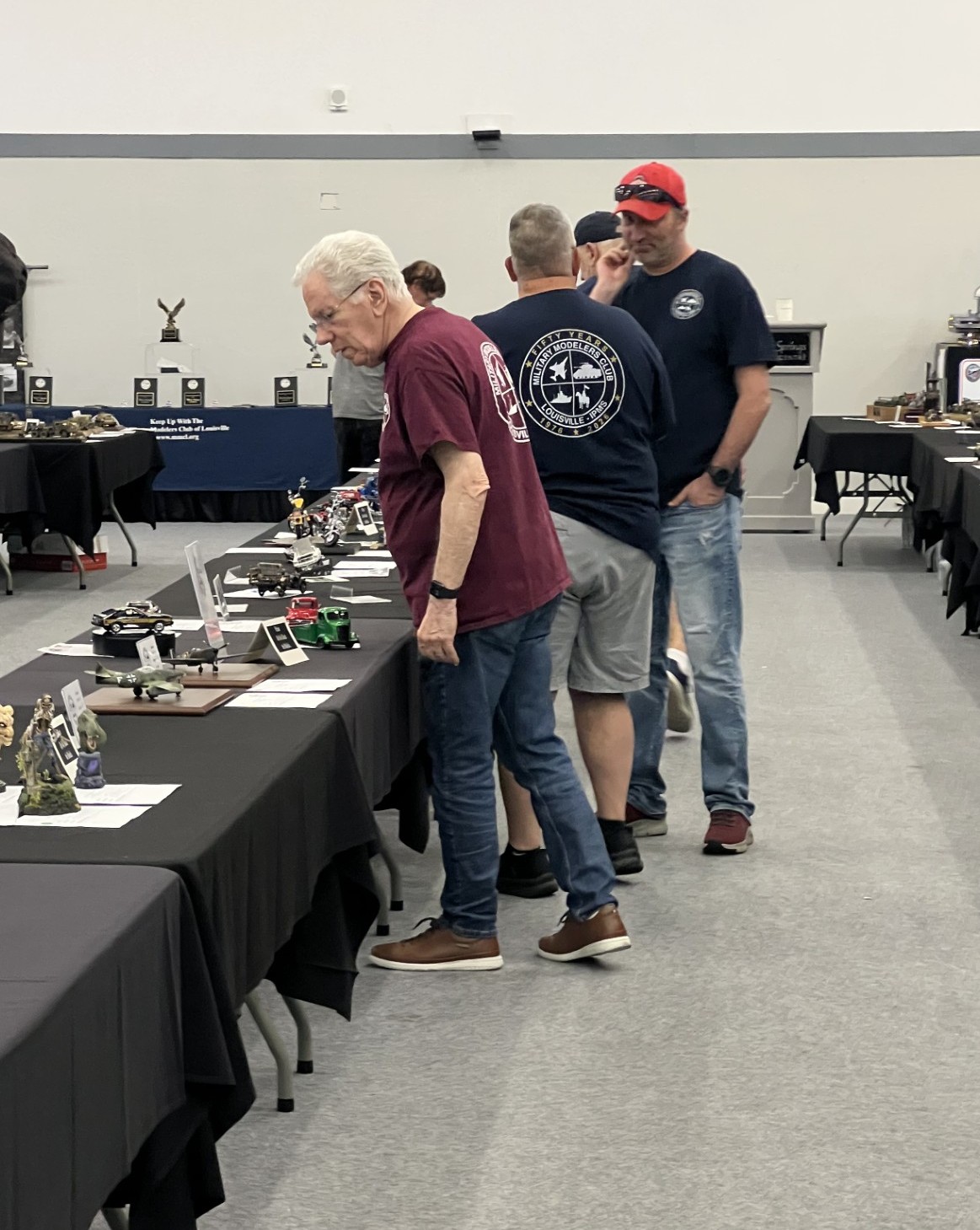
Everyone have a nice weekend. Weather here in Louisville will be spectacular. Tomorrow is my model club’s annual judged exposition. Our club, the Military Modelers Club of Lousiville, is celebrating its 50th anniversay and the two founders are still members. One, Brian Bunger, is the propietor of one of the best hobby shops in the USA, Scale Reproductions, Inc. He’s an avid and masterful model builder himself and the shop reflects his love of the hobby. The club has many fabulous builders and I’m very proud to be in their company.
11 Likes

So good to see you at the show!

Great time with wonderful folks. Looking forward to seeing more of your work as this reaches completion.

3 Likes

It’s really nice to have visual proof that I was actually judging models at the Miltary Modelers Club of Louisville, annual exposition this past Saturday. Thanks for sharing the pic!

Today was a major milestone day! My friend and master-modeler, Chris Bowling, — he’s standing behind me in the picture of the show—came over to lend a hand. And boy did I need it. It took too experience builders to pull it off. To give you a taste of what Chris can do, this was his entry at the model exposition. It started as a paper model kit of the launch platform and crawler, and then after about 4 months of intense efforts. The shuttle Atlantis is a Revell kit that is greatly enhanced. Scale is 1:72.

We located all the untis with columns and drilled all their mounting holes. We intalled, permanently, the main condenser and main reduction gear foundation. And then started installing more things that go around it. Everything was installed with 5-minute epoxy and they are very secure. We probably spent an hour getting the turbogenerator unit positioned and settled down to the correct depth once all the pin holes were cleared of any interference from the plastic lattice that laid below.

Intially, we used the paper template to mark hole locations, but found that the paper was fouling the pin holes making it hard to settle down to full depth. When all of the columned platforms had their mounting holes confirmed, I permanently installed the main condenser. This was a 3-step process. First, the condener pump was CA’d on the tapered pipe end, and then the main body was epoxied to the hold floor. Before gluing, Chris sanded the oxide red to provide a good gluing surface. Epoxy set in 5 minutes and then I glued on the startboard end. The handwheel on the big gate valve just bumped the bulkhead, but we could still get the condenser correctly located. The LP turbine foundation was CA’d to the supports flanking the condenser.

When cured, we located and marked the positioning for the MRG foundation and did the same sanding job. The foundation was spoxied and held in place with gravity clamps. The HP foundation was help lavel and clamped to the bulkhead while curing.

At this point Chris had to leave and I continued adding the starboard #1 prop shaft bearing and the lube purifier foundaion with epoxy. The seal bearings are not glued in yet.

I also glued in the separate steam powered lube pump which has been floating around on the parts table for a long time.

I had to relieve some of the bearing bores in the MRG to get the gear coveres to lie flat. I then epoxied the gear covers with the reduction set installed and clamped with lots of clamps. Gear box will be installed next.

Chris helped me and finished sanded all the glue edges on the plexiglass in preparation for glue up tomorrow. I can do that without help. Chris is returning next monday to help some more.

It’s really exciting that this is actually reaching this point. It’s going rather fast.

9 Likes

Dug into building the enclosure today. I thought I was doing everything right this time. It is my 5th clear case build, so I should be getting better at it. I’m almost there…

The plexiglass is sitting on a wet towel and I wiped down all the surfaces after peeling off the protective film. This is supposed to kill any static charge. It generally worked. I was very diligent in applying the masking tape to hold it all together. The cutting measures that we determined were perfect. I started with Tamiya tape, but it didn’t exert enough pull holding the parts in alignment. I substituted 3m Blue Tape and it worked better. What didn’t work so well was when I filling a pipette to transfer liquid solvent to the needle tipped bottle. I had my reservoir at the back of the table and after I filled the pipette and attempted to bring to the bottle it unloaded a splash onto the interior plexiglass. It happened again I had a spurt come from the needle applicator. I didn’t touck the solvent and let it evaporate. It didn’t mar it too badly. Luckily, one area is where the key is going and won’t be visible. The other areas of trouble was a little bit of seepage under the tape. I’m not sure what to do about that. I will let it cure totally over night and see what I can do tomorrow. I have plastic polishing materials. The case fit nicely. And I did mount the key with 3M Transfer Tape. The key is double sided and it can read from both sides of the case.

The glue up of the upper main reduction gear case when very well. Today I glued up some more for the lower part of the asembly and will put the unit into the model next session.

The rest of the session was spent wrestlng the startboard floor and the evaporator/main gauge panel decking to play well together. They weren’t! Chris and I spent a lot of time yesterday trying to align the flooring with the columns and locate the pin holes. Today, nothing fit and I had to do more surgery cutting away portions of the flooring so the columns could find their respective holes. I think I got it figured out at the end of the session and will get it all buttoned down next session.

I’m thinking about model #4 and could most likely do the steering gear. I did a quick drawing and scaling of the rudder and, yest, it can be printed on my printer as a single part. That helps a bit. As with the engine room, the project will hinge on getting good drawings from John Miano. John owns many microfilm reels of all the New Jersey’s engineering.

11 Likes

Since many of you have been following my pursuits in model making, you also know that I often have to deal with calamities. Yesterday was no exception. That said, progress was made. First the progress. I got the starboard floor in and the evaporator decking that sits over it. I installed the lube oil purifier and the lube oil settling tank. And most importantly, I got the main reduction gear installed. I also spent a lot of time finally getting the turbines and MRG shafts to align properly.

Before I got started, I needed to adapt how I was supporting the model to have access to the bottom. In addition to getting all this stuff positioned and glued propperly, I have to feed all the LED leads down through the base. I took another stool of the same size, screwed a board across it to match the height of the other, and clamped the model across the two leaving a gap wide enough to expose the entire underside of the base. Notice the protective paper I was thoughtful enough to put over the delicate woodwork. What you can’t see is the one end (left end) that I didn’t do this, based on the erroneous assumption that it was such narrow area, what could possible damage. Hmmm….you can see where I’m headed here.

Gravity clamps ATTEMPTED to hold the floor in place while epoxy was curing. See that exposed wood…

To hold the upper level in place I also used gravity clamps (not shown). Then two things happened. One of the angle blocks fell off and dinged the wood base. And then the extension nozzle on the CA bottle blew off and a huge glob a medium viscosity CA landed directly on the wood. I wiped it, but it did damage the finish requiring work to restore. And to make matters worse, a thread of epoxy ended up on the base as well. All this because I was stupid enough to leave one area exposed. I can fix all of this damage, but I didn’t need the extra work.

​Notice that the floor legs ended up off the hold floor. Nothing I could do could get them in proper position. The floor was bumping into some part of the MRG structure. What madeit so frustrating was the time Chris and I spent aligning everything before gluing down the MRG foundation. And yet something had to have move about 1/8 to 3/16" to narrow the flooring space. I have two choices. Leave it as it and just hope people don’t fixate on it—like I am, or rip out the floor and redesign it so it can be inserted in sections and fit around the columns, which aren’t going anywhere. I’m going to do the redesign and see if it makes sense to do.

Gluing down the MRG started by gluing in the lower portion. Again, gravity clamps help it in place until epoxy set.

When set, I added the bull gear and then screwed (not glued) the upper works in place. One corner was sitting high and the tiny screw was stripping the resin threads so I added some more and it’s holding. It was much easier screwing this together than epoxying. I thought of doing both, but the screws seemed to be holding well. The turbines and crossover pipe and not permanently installed yet.

To get the LP turbine to align I had to add another 1/8" shim on the bottom. Again, I don’t know why this shift happened. Previous fitting sessions had it aligning without this shim. A similar issue occured with the HP turibine, It was interfering with the torque tube and I had to grind off part of the HP Shaft and surrounding shell. I also had to slightly modify the HP frame, but as you can see by the above, they are aligned really well.

I permanently installed the strbd prop shaft including its bulkhead seals. And did the same for the MRG prop shaft seal. That’s all done!

Here’s a view across the back of the MRG and a comparable view of the real thing. The resemblance is deliberate and gratifying.

I just noticed that the lower foundation is gray not red. In my engine room it’s now RED!

​The lube oil settling tank is in and the pipes lead down below… somewhere.

And lastly, here’s an overview shot of the assembly so far.

There’s some more touchup painting on that extra shim under the LP turbine and then I’m gluing down both turbines and the crossover. BTW: that crossover fit was one of the key parameters that I had to hit. Another thing that did not go wrong.

No work today. It’s Yom Kippur. Work will begin tomorrow.

11 Likes

I am reminded of the “90-90 Rule of Project Scheduling”: The first 90% of the project takes the first 90% of the time, and the last 10% takes the other 90%. I’m gratified that you were able to recover from the accidents, and I look forward to being able to see it and your 16” and 5” displays when I get the opportunity to visit the New Jersey.

3 Likes

I wish you well over the Fast. Wow talk about “What could possibly go wrong?” but it looks like you were equal to the challenge, bravo. Mind-boggling construction.

3 Likes