I cannot speak for the SECDEF, but practically all decisions should involve meetings, reports, studies, and even visits to the plants, workers, Soldiers, manufacturers, and the people involved. Did the SECDEF do that? Did he or didn’t he? What factual basis was the decision based on besides cost-cutting and removing “legacy-themed AFVs?” I think the media or the US Army said that the M10 was too heavy, not the SECDEF.
The SECDEF also cut the 155mm M109 ERA and the Remote Combat Vehicle (RCV) Family which was supposed to support and escort the dismounted troops from the XM30, the M2 Bradley replacement. The argument is that the SECDEF wants to fast-track the M1E3 and XM30 by cutting the other AFV programs, so it’s not about weight, the Breaking Defense article seems to suggest that the SECDEF wants “Innovative and transformative” weapons and not “Same old hat legacy AFVs.” But when the War in Ukraine shows that both sides and throwing practically every kind of “legacy AFV” that they can get their hands on, the M10 Booker makes sense to field for US Airborne and Light Infantry divisions that use the Infantry Squad Vehicle.
What should have occurred is to find a way to remove the M10’s bolt-on armor and fill those bolt holes with (example) lightweight plastic heads and washers. Then build a vehicle/robot that can handle, haul, and screw in the armor plates as fast as possible. But somehow, the US Army didn’t want to deal with the fact of adding or removing bolt-on armor to lighten the M10’s weight and passing that on to the SECDEF or USAF. The truth is that practically all of these Mobile Protected Firepower vehicles come with the bolt-on armor installed. I have seen very few photos of MPFs with the armor off (no photos of the add-on armor off on the M10 Booker), and I wonder if the bolt rods will be showing like dangerous rebars, able to impale someone. If so, make even hollow lightweight plastic or wooden chipboard armor to cover those bolt rods like a second lighter skin than composite armor plate. But I believe, like any add-on, the bolt rods can be removed also, even if it is a timely and tedious process.
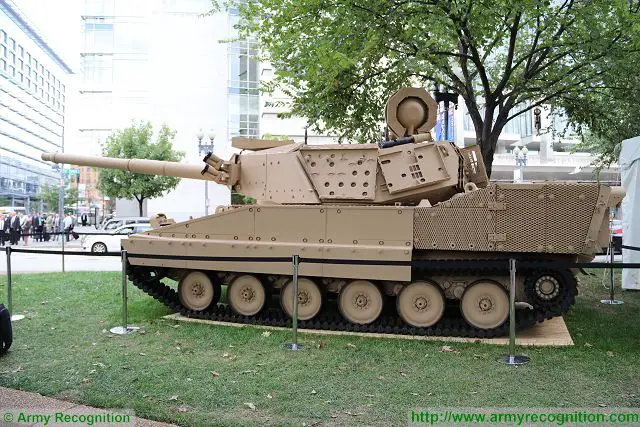
This is the BAE M8 AGS with I believe some turret bolt-on armor panels OFF. You can see how it looks like. The M10 Booker should look the same. Why the US Army doesn’t train with and transport M10 Bookers with the bolt-on armor OFF is beyond me. Someone is not communicating properly somewhere about M10 tank weight able to shed off the outer layer of add-on armor to reduce its weight down from 42 tons.
BAE’s M8 AGS with some bolt-on armor OFF as evident by the turret holes and the rear hull mesh side skirt screen. Removing the outer layer of armor reduces the weight of the M8 AGS, and the M10 Booker should have the same general principle (I’m assuming).



 to the small vicious rodents
  that eat the eggs


