The manufacturer’s user handbook began gloomily with the words “ we take you into our confidence”, and went on to list sixteen major defects known to exist at the time of going to press, ranging from the suspension to final drive assembly, main and steering brakes, tracks, engine and clutch.
—Bryan Perrett, The Churchill (London: Ian Allan, 1974; ISBN 0 7110 0533 8), pp. 126–127.
The Osprey book I have on the Churchill mentions that briefly and states that the factory managed to fix most of the problems with in the next year or so to their credit. I think this was common on both sides as the war progressed.
Another consideration for the timing of the manufacture and painting of these Tigers is that contemporaneous with the Axis move to reinforce Tunisia the Germans had been conducting Fall Blau, the operation into the Caucuses to capture the oil fields since Summer 1942. Fall Blau had been in the planning for months, and part of that involved factory orders to paint newly manufactured AFVs in appropriate camouflage for the high desert regions of the Caucasian steppes. The time lag between changing / issuing production orders is generally weeks, if not months, so the decision to paint new production Tigers in high desert colors was made long before the need to send forces to Tunisia.
So, the Tigers that were shipped to Tunisia were very likely originally intended to be deployed to the southern Soviet Front with camouflage colors that were selected as most appropriate for those locations. That the colors were also suitable for Tunisia was largely just serendipity.
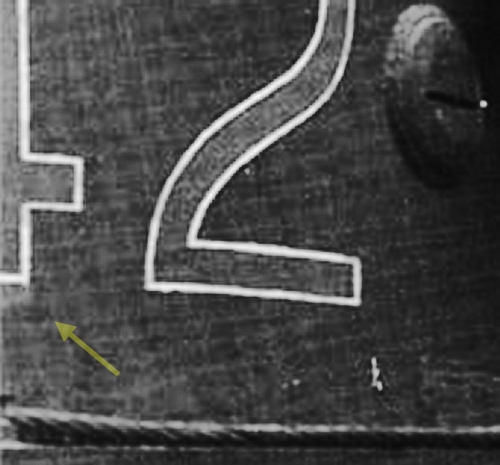
I will say that if you examine the photo of 142 parading in Bizerte (was it?), you can clearly see the careful hand painting around the numerals and the different color inside the white outlines.
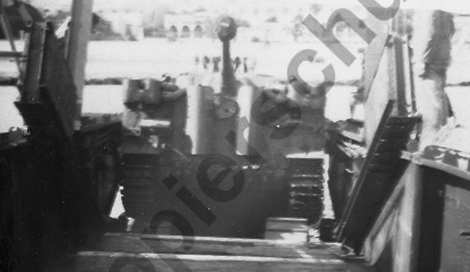
142 got special treatment. It was unloaded from its Marinefahrprahm on the beach at Le Goulet. Photographs are the evidence.
From there it was driven into Tunis and posed for photos beside the theater - a well known location. The message was “We have this tank serving in Africa already”.
And those photos of a clean “142” show the slightly different fill colour that you discuss.
I believe that the colour inside its digits is RAL8000, the brown base colour of the scheme, and the surrounds are RAL 7008. The patch of brown that seems to leak out at the bottom of the digit, does suggest that somebody hand-painted up to the edge of the digits.
Thank you all for the wealth of information. I forgot that fall blau was going on at the same time and honestly didn’t realize the Caucasus had a desert like terrain. I vaguely remember dragon having a panzer IV with a grey base and dunkagelb paint scheme because of the changes in terrain but I could be mistaken.
These are all things to take into consideration, thank you!
If I remember correctly, this was done by Adolf himself. There is a mention about this in Tigers in Combat 3. There were no identical Tigers in the beginning as they were designing and developing the vehicle (and writing the manuals) while producing.
All of the African Tigers belonged to Panzerarmee 5 and were based in Northern Tunisia.
They rarely saw sand. In their first months of deployment, their biggest environmental problem was the rainy season, which shut down most military activities for weeks.
Okay. You did see where I put Afrika Korps in quotes, which is how I had seen it often rendered in error online, thank you. I am perfectly aware that there were no DAK Tigers, hence my references to modeling, campaign and other errors.
Most people don’t, but the evolution was something like this:
February 1941: Deutsches Afrikakorps created
August 1941: DAK made part of Panzergruppe Afrika
January 1942: Panzergruppe Afrika renamed to Panzerarmee Afrika
October 1942: Panzerarmee Afrika renamed to Deutsch-Italienische Panzerarmee (or Armata Corazzata Italo-Tedesca)
December 1942: LXXXX. Armeekorps in Tunisia renamed to 5. Panzerarmee
February 1943: Italian 1ª Armata formed from Deutsch-Italienische Panzerarmee and Italian XX and XXI Corpo d’armata; Heeresgruppe Afrika formed from 5. Panzerarmee and 1ª Armata
@Jakko I think I only ever call it the DAk because of a lack of studying it as deeply as well as didn’t the cuff titles all day Afrika Korp for veterans of that campaign? Or was that only for the original units sent over?
Good question. I haven’t studied it as much as I like and I have a deep interest of that theater of operations, but I’m sure some units were transferred from DAK to Panzer Armee 5 during the formers retreat towards southern Tunisia to fight the allied Torch landings; but did they keep their cuff titles if they even had them at that point?
Google some images using the terms “WWII German Army and Bactrian Camels.” Lots of scenes that you might confuse with North Africa and the Middle East.
Much of the trans-Caucasian, northeastern Caucasia and Azeri regions consist of semi-deserts, xeric shrublands (and I had to look that word, xeric, up!) and desert-like steppes. A lot of it looks very similar to Tunisia. To be sure, that’s not the only kind of terrain in that part of the (then) Soviet Union, but it predominates the main routes of advance for Fall Blau until the final whisps of German units reached the mountains.
At any rate, I believe that the preparations for Fall Blau included changes in production specifications for factory painting of newly produced AFVs intended to be used on southern Eastern Front (which serendipitously also suited North Africa and eventually Tunisia). Given the lead times for such orders to be acted on and the newly manufactured AFVs to be transported to the Eastern Front, these painting change orders would likely have been issued in the early spring of 1942. Keep in mind that Fall Blau was the strategic priority of effort for the German military for 1942, so all other areas of operation and units would have been receiving material diverted from production mostly targeted for Fall Blau.
At any rate, someone could probably follow the primary source documentation to determine precisely when the orders to change the factory painting of AFVs to accommodate the planned operations in southern Russia. However, I strongly suspect that any new production AFVs that were sent to Tunisia in two-color camouflages (and IIRC, there were two variations of these) were so painted as a result of the specification changes intended to support Fall Blau, which just happened to also work for the Tunisian landscape (along with some small numbers also sent earlier to the Afrika Korps in the eastern Sahara).