National Security Journal article on WHY the M1 will continue to evolve.
“ The drone era didn’t kill the tank; it killed sloppy tank employment”.
correct.
Absolutely
I think if the Ukrainians had more robust shorad resorces things would be different
For thier Armored formation and us and our NATO allies wouldnt fare any better
And the same goes for the Russians im surprised they dont employ thier ZSU-23-4 Shilka or thier Tangusta to protect thier armor is it me or is mobile ADA to protect the mech brigades a thing of that past and what let us down this path to phase out very same mobile air defense artillery that protects those mech brigades,
I don’t know, not a knock on UA armor, they are doing a great fundamentally changing everything about how they fight with lots of unknown equipment. I think we and NATO might have fared slightly better knowing the equipment and understanding the western style fighting fundamentals.
The game changer is the drone. Without it the Russians would just pound tanks with battalions of artillery. Drones are as tough on artillery as on tanks.
Personally, I think the drones hitting soft targets in Russia are doing more to make Russians oppose the war than the meat grinder in Ukraine. They’re seeing refineries and airbases blow up and it’s scary.
It’s not really a story on the M1E3 than a story on the history of the M1 Abrams. It’s a good story (articles are called “stories” these days), and it is an opinion piece.
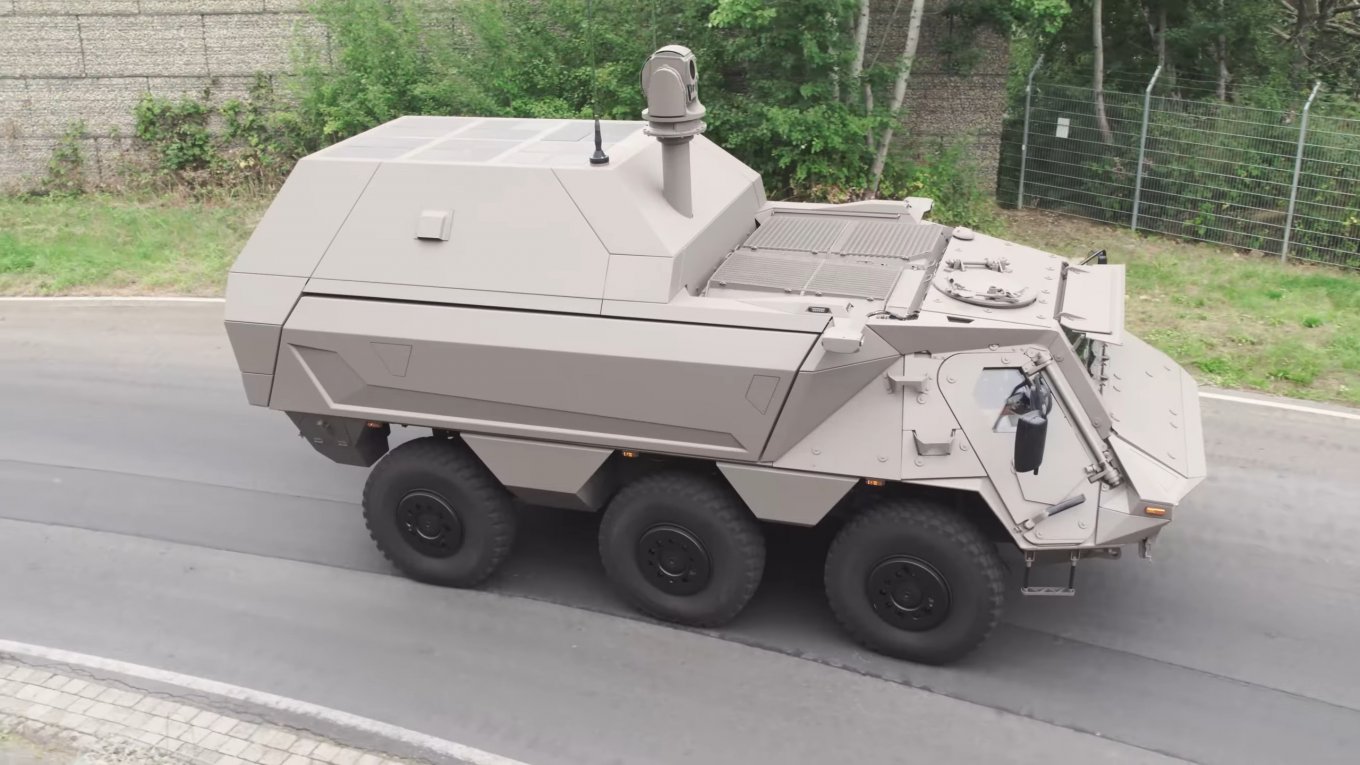
That said, are tanks obsolete? No…but I do wonder if the turret is even required. A M1E3VLS with vertical launch missiles occupying the turret basket, no turret with gun, and the crew of three sitting in the hull may be more capable than a M1E3 with a 120mm main gun. Picture the hull of the M1E3 without a turret and a VLS bank of missiles like a warship where the open turret hole is. An AI low-profile RWS machine gun on a telescopic sensor pole for targeting and tracking can occupy the center of the turret hole for close-in defense as the missile launchers are ringed around the machine gun. New concepts need to be created to adapt to changing battlefield conditions.
Interesting idea, not sure how the VLS would work but maybe a bank of APKWS or hydra in a smaller setup than the TOS. A few attached to the tank battalion. Could even bring but the LAD turret modified to fix the Abrams for anti drone operations. Either could be a crew of two.
The challenge I continue to see is the cost of missiles compared to a 120mm round. Carrying 20 hellfire missiles would be great but at what cost? When we go to war we will relearn what the Russians did in the Ukraine. You will rapidly use up your “futuristic” munitions, far outpacing manufacturing. So a years worth of heavy combats material reserve needs to me maintained. That sounds super expensive. I could see an M1A1 hull fitted with 20 Hellfire missiles in a launcher and a 30 mm chain gun
The missile is definitely more expensive.
About US $4000 for a 120 mm HE round?
What if some or even most of those explosive charges
were delivered by a drone? A guided HE round that can loiter,
attack targets behind obstacles preventing line-of-sight shooting,
a HE round that can be re-targeted after being launched.
The drone would cost less than $4k and a few pounds of high
explosive are relatively dirt cheap. If shrapnels are needed the
drone needs to be a bit more powerful, shrapnel can be bought
at the hardware store or from a scrap merchant.
US M829A4 APFSDS is ~$10K/round
Javelin is $80k-$240k/round.
The Javelin has a “spam in a can” version that was tested. But fitting the VLS is not just stuffing a tube assembly into the open turret. It will be closed, there will be electronics, and reloading will be hazardous. It’s a system, not just a missile.
Speaking of placing missiles inside the turret basket of a turretless M1E3, look what just released…a 24 VLS JAGM Fuchs by Rheinmetall!
Many years ago, I was in a Navy course as an introduction to naval warfare; they had a guest lecturer, Lieutenant Lane, RN, who’d gotten off the HMS Coventry after it was bombed by the Argentines during the Falklands/Malvinas conflict. One of the more amusing points he raised was that, out of all of the Exocets fired by the Argentines, the only ones that functioned correctly – launched, flew to and hit their targets, and detonated – were the MM40 model, which comes in a sealed launch canister; apparently if you let Argentine aviation mechanics ‘maintain’ air-launched Exocets, something gets done wrong and they fail in use.
Artillery (unless it is an expensive PGM) is not particularly good against modern tanks.
If the tank is disabled, Artillery can be bad. Sub munitions can disable a tank.
Having spent a lot of my military service within a guided weapons troop, what occurred to me was the minimum effective range on a missile. Others will know what that is for the various weapons out there. Also they are vulnerable to counter measures in their various forms and I say this as a lover of missiles. Having also served 7 years on MBT and having fired APFSDS rounds there isn’t a lot capable of stopping one of those rounds once it’s on it’s way and it’s deadly right out of the barrel. Just my personal opinion, I imagine people with far more intellect than I would think differently.
Standard dumb shell: $3000 to $5000 ? (mass produced)
BONUS shell, two submunitions: $40k per shell (mass production could cut costs a little)
Could have 35 km range, well beyond APFSDS range.
Javelin $80k-$240k/round, 4 km range?
If targets are reasonably close to each other (moving in a convoy) one shell could take out two vehicles. Best case scenario: an almost certain kill for the cost of 4 or 5 standard dumb shells.
Time to target (over 40 seconds to 35 km??) is important so maximum range might not be very useful. A tank doing 60 km/h (on road) moves close to 700 meters in that time. Some predictive shooting would compensate for part of that position error. Drones or other airborne eyes would
improve targeting. Tanks move slower in terrain (depending on the type of terrain).
Define reasonably close, first. NO assumptions. Guided HE rounds cost how much? Loitering rounds are no longer dumb. They require a mechanism to keep them in the air at a height where they can “see” the target (if autonomous), or delivery of a new set of targeting instructions. Retargeting a loitering artillery round requires computing power, volume in the warhead/buss, and $$$$.
-
A GPS-guided 155mm round, costing around $68,000 to $125,000 per shell, with a precision that can hit within 30 feet of a target.
-
Laser-guided rounds and those using a precision guidance kit, like the M1156, are also expensive and can cost up to $150,000 per round, though the cost can be less than the Excalibur depending on the specific model and upgrades.
-
Unguided shells are much cheaper, costing between $500 and $800 each, but their accuracy is limited to about 100 meters at 18 miles. A 120mm HE round (have you looked at MPAT for goodness’ sake) is going to cost more because acceleration in tank gun tubes is ferocious, and the components are much sturdier/costlier. HE rounds are rather thin walled, and such a round my suffer structural damage fire at 1,600+ m/s, compared to an HE round at about 1,000 m/s.
How close with a dumb round is close enough? Now, assess your use of dumb rounds in the context of this:
That is the result of a US M795 HE rounds fired DF (direct fire: looking over the gun tube) at a range described as point-blank. Not that range matters for a PD-fuzed round. So, even if your convoy is “close” (really close), the impact of a 155mm HE on the hull of the MBT is problematic. If the dumb round just fall in/around the formation, buttoned up tanks are going to move out of the impact area. And btw, tactical formations are at least 50m between vehicles, and usually 100m. Big space, small target for each dumb round.
But wait! There are these: SMArt artillery warhead made by Rheinmetall and their partner Diego.
This process involves a neat warhead:
The two submunitions are shown, the lower one cutaway. Both are EFPs. They use IR and millimeter radar to find (sic) their target.
They cost over $100,000 each according to the consortium KNDS. At that cost, one is great for use against a static SP. But firing enough to destroy a company of MBTs (11-14 depending on MTOE) is rather expensive, yes? Rounds like this are used for HVT/HPT (high-value/high-payoff targets), and other loitering munitions like Switchblade are
- Cost effective (value spent/value of target destroyed)
- Man and light vehicle portable
- Has a Javelin warhead
- Optical and AI targeting
- It still costs ~$80,000 plus
- Can be locally deployed rapidly, as opposed to the length/time of a kill chain for a precision artillery warhead.
So far, the ability to defeat a tank probably requires an EFP, precision delivery (drones do just fine), the ability to aim not only precisely but in the last moments of terminal flight, and a warhead big enough to kick the door open on impact.
We see lots of pics of tanks targeted by drones where the drone flies in an open hatch. We see screens (hard and soft), and other stopgap features (COPING). COPING is like hoping: not as good a plan, but it works to some limited extent.
The solution to protection is manifold:
- masking of all signatures: audible, IR/thermal, optical, form-shifting (BAE has done it), and RF.
- Hard-kill systems that can intercept incoming artillery. Iron Dome specifically targets, rockets, artillery, and mortars. These systems will improve
- Dumb artillery is best used against dumb targets: troop masses, buildings, thin-skinned logistics and administrative systems, CPs/TOCs, whatnot.
So, it’s a lot more complicated than you might think. I can only encourage to look at these systems and understand how MANY are not “cheap”.
The BONUS footprint would work just fine if the shell arrives with that accuracy.
The submunition hits the top of the target, the submunition searches the area it arrives over and locates targets. The shell itself only needs to get within those 100 meters.
I used the word dumb in only one context: old fashioned artillery shells which are
fire-and-forget. Once they leave the tube it is all ballistics and influence from weather.
I never said loitering munitions are dumb, far from it.
Same with drones, can loiter, can carry sufficient punch at a relatively low cost.
Getting enough loitering munitions or drones in the air in time to take out 11 to 14 MBT’s will not be easy either. Getting the Switchblade 18 miles out to the target at sprint speed (100 or 115 mph, I don’t know if it can keep that speed for 18 miles) takes 1/10th of an hour or 6 minutes.
Assume we know where the targets are and we have continous eyes on them to follow movement. Targets can move further in 6 minutes but the drones can find them since the operator is in the loop, same for the Switchblade. Continuous surveillance means that the drone or switchblade will not have to search for a long time.
BONUS or similar round flies to the target area, I’ll take your word for 100 meter CEP at that range, in roughly 1.5 minutes (very rough estimate).
Continous surveiilance allows for some predictive shooting, especially if tanks move along a road (funneled by terrain and or mines or fear of mines). Even if they move over open fields the tanks will probably not move randomly like a flock of chicken searching for grains.
Which system has the advantage of reaction time?
Is artillery near enough when they are needed?
Are there enough drones or Switchblades in the area?
Are there eyes-in-the-sky to detect movement on “the other side”?
Drones killing tanks:
In the Ukraine war the Russian tank crews have a tendency to leave their tanks when the first drone comes knocking or when they get stuck for some reason.
They know what happens when the n:th drone finally penetrates.
The usually leave the hatches open in their hurry to get clear from the blast
radius of the impending turret launch.
Taking out a “mobile shed” takes some drones to remove the “shed” protection and get to the topsides of the tank.


