Chasing a bobtail - urban local diorama with a GP38-2

Who doesn’t like see a train rolling along?
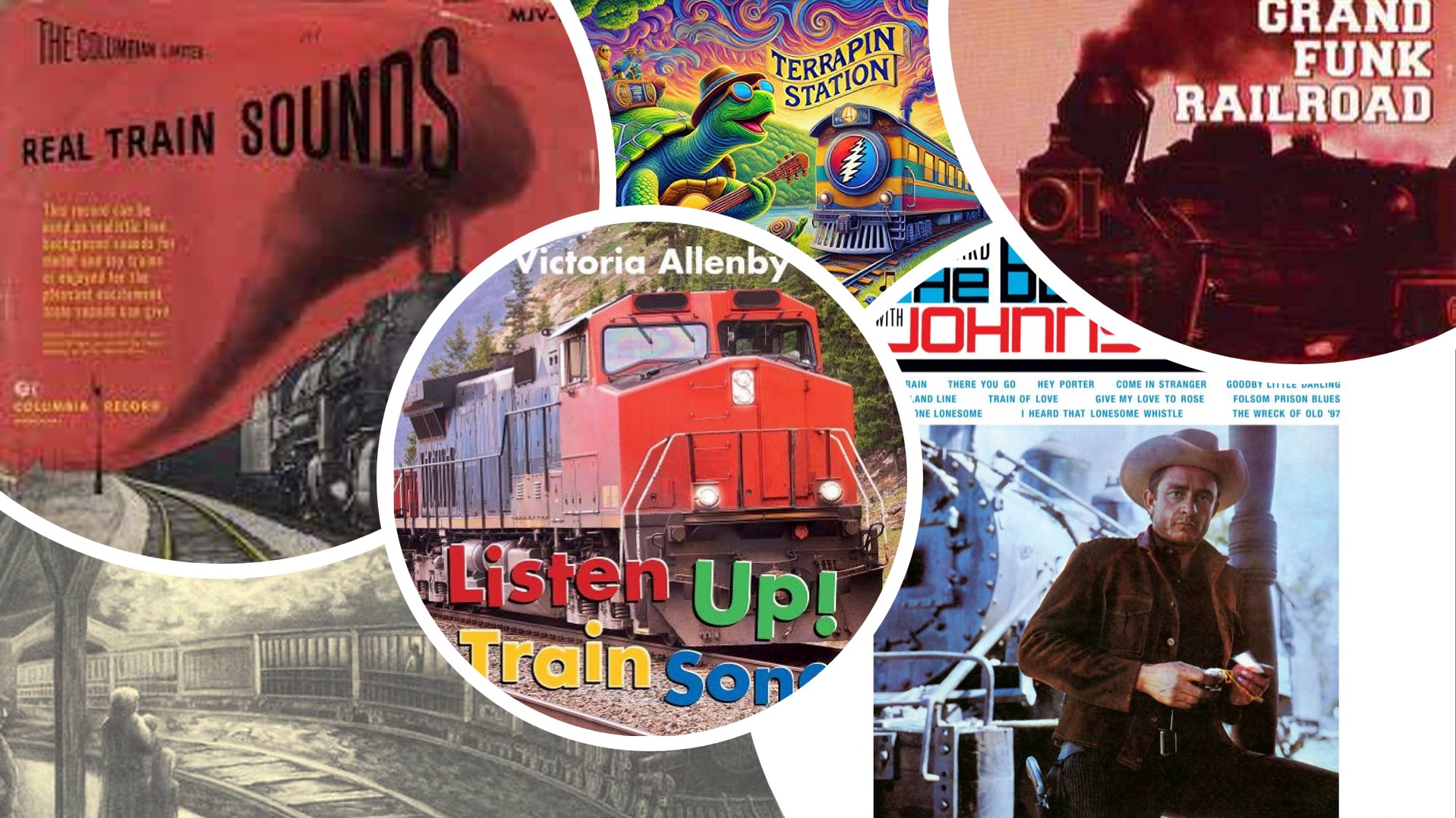
Nobody, that’s who! :grinning_face_with_smiling_eyes:

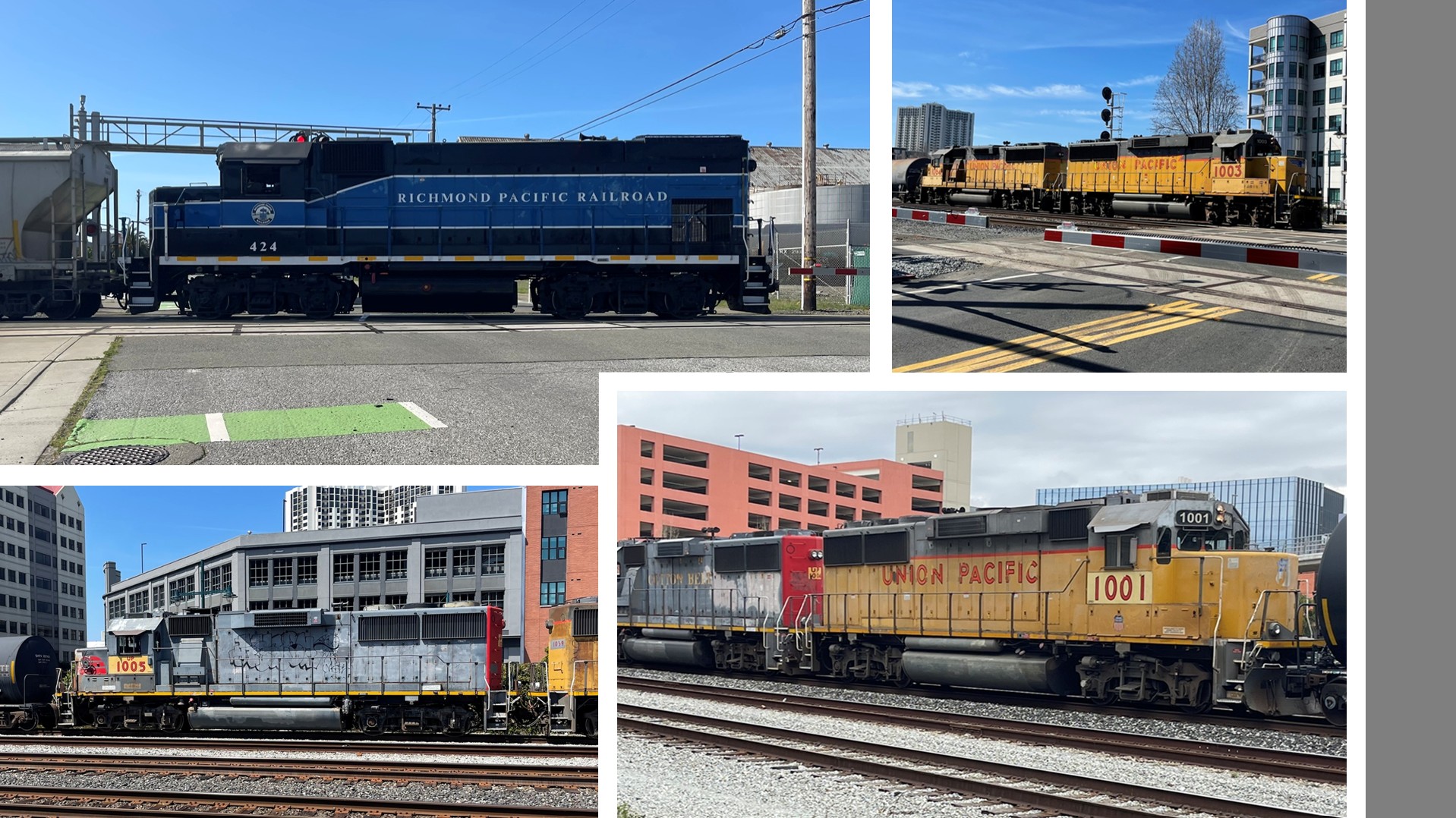
And as it turns out, there are lots of trains rolling around here. For this project, I’m focusing on locals, and specifically, like shown here, various GPs. The GP15 in the upper left is used by a local shortline, while the GP60s used by UP, though I see some BNSF now and then.
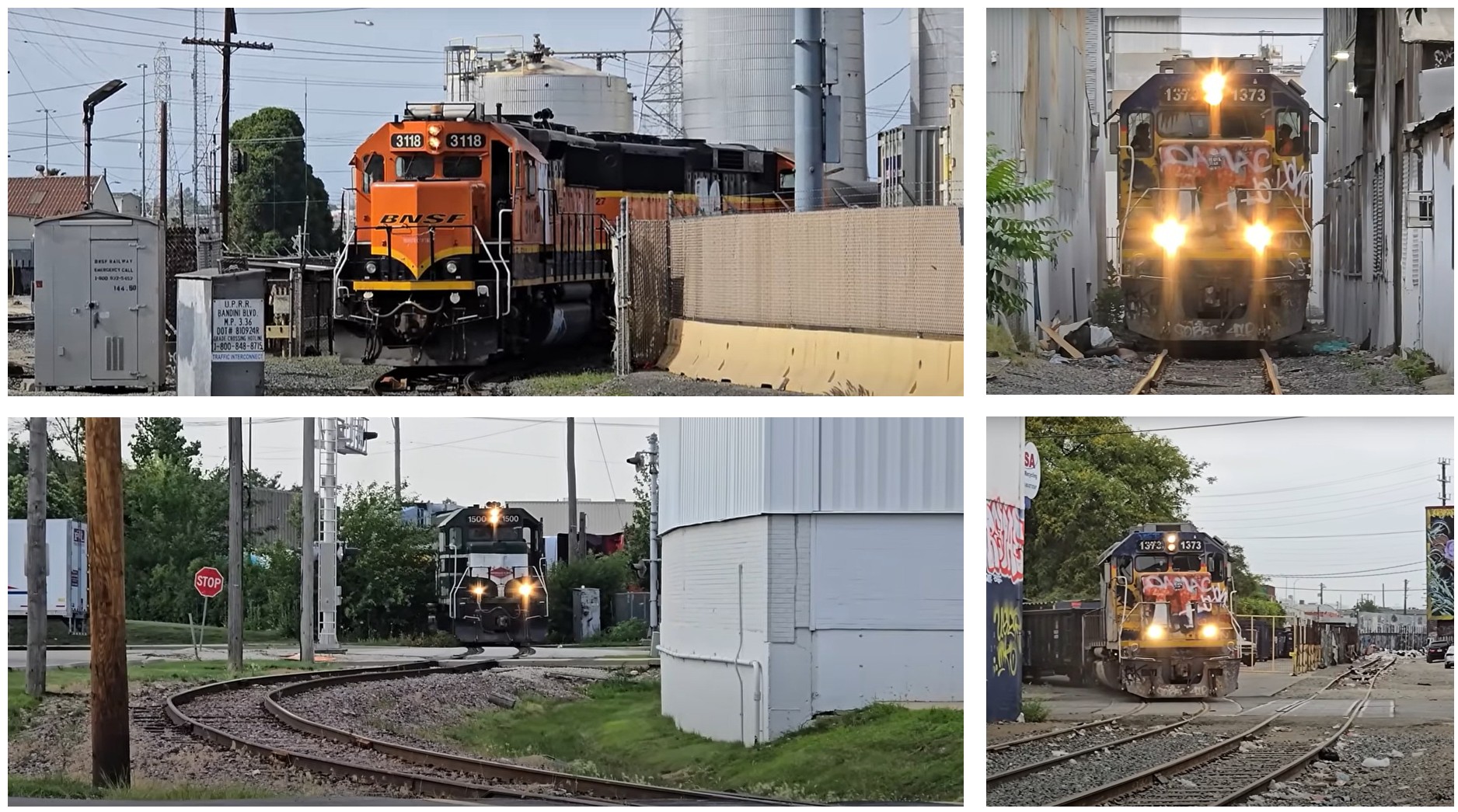
The idea for the dio is to model a GP38-2 rolling along in the narrow rights of way, which are generally short spurs, fronted by buildings
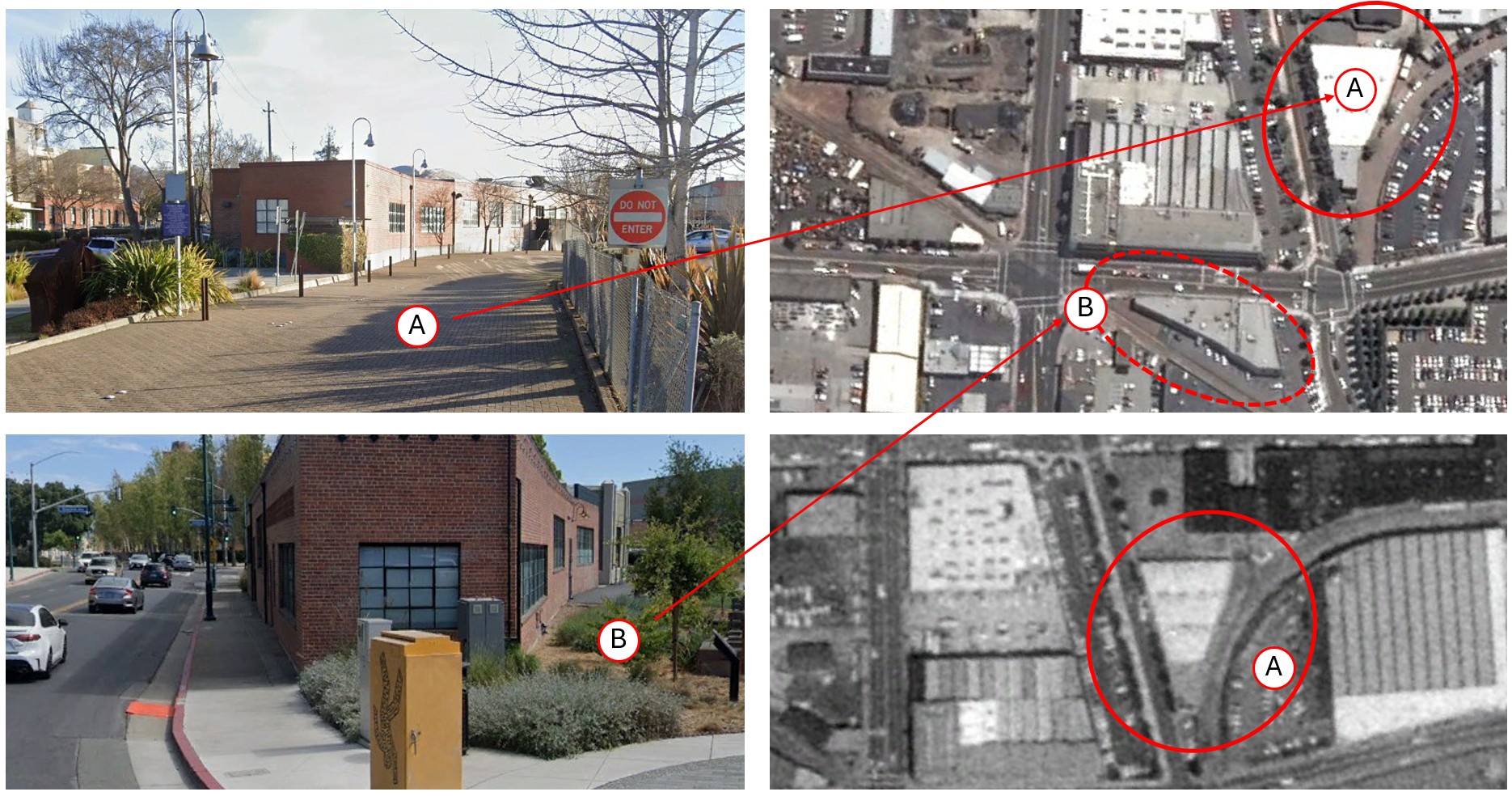
Looking at local examples, now being reused, you can see wedge shaped buildings, designed to allow spurs to work their way around
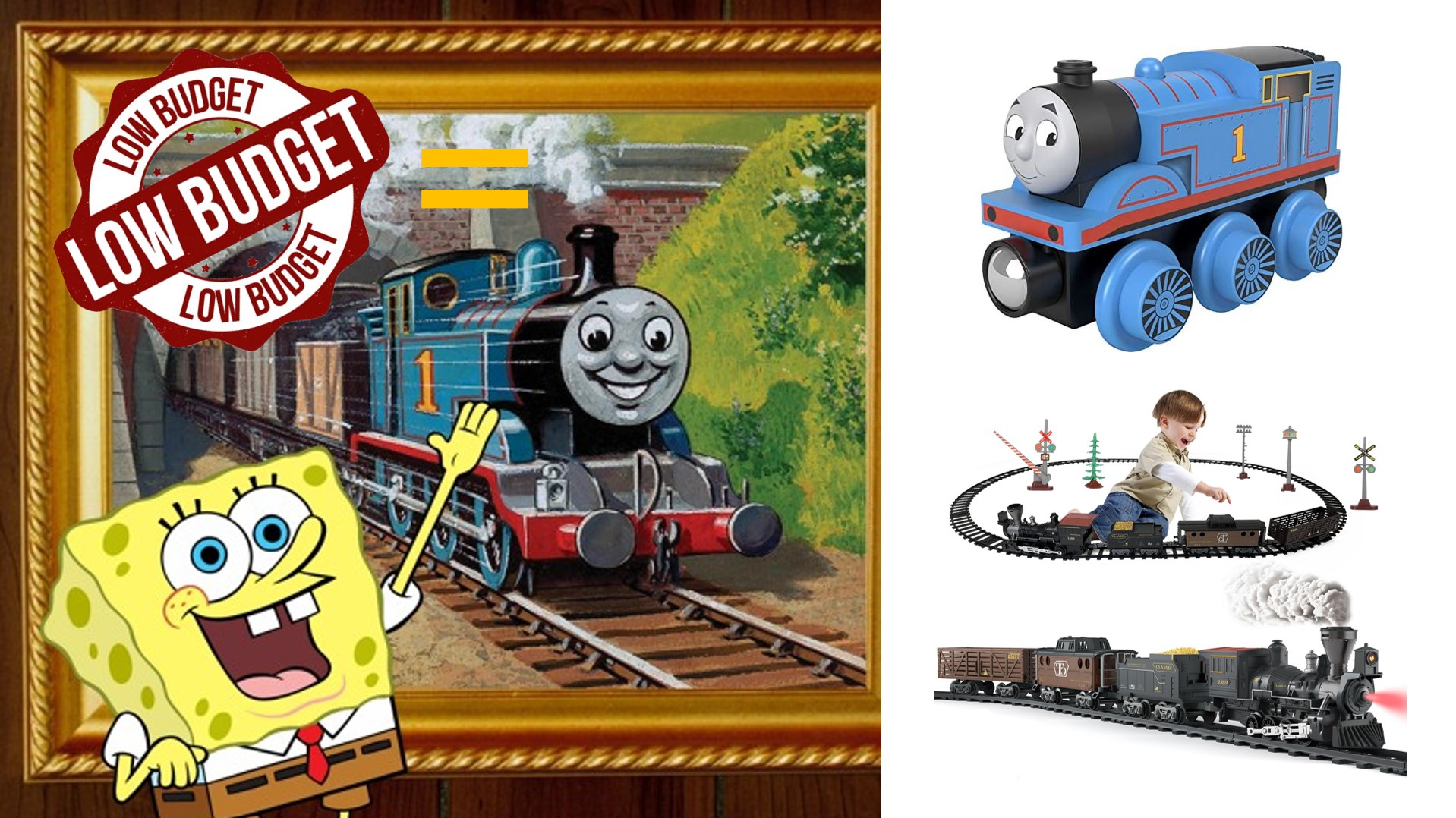
But, right off the bat, I ran into a problem, which is that while high quality locos are available, they are pretty expensive, and way too expensive to be used in a dio. And less expensive versions are not great, and I don’t want this to look like a toy train when it’s done! This is serious business!! :grinning_face_with_smiling_eyes:

So I went onto EBAY and purchased the least expensive loco I could find, which happened to be a Lionel GP38-2. It’s not great, but not bad either - but, I’ve discovered that it is something of a proportional model - that is it’s basically to scale, but not exactly proportionally correct. And, it has/had awful pilots and handrails! again, great for some family fun! Less great for we hobbyist who worry about this stuff! :grinning_face_with_smiling_eyes: :grinning_face_with_smiling_eyes:

I’m guessing this is the case because maybe it was built for who it is for? maybe someone who wants a train that gets used once a year, rolling around a Christmas tree? or for someone just starting out? as it is durable and simple - again fine for who it’s for. Unlike HO scale locos which are supported by vast amounts of super detailing parts and kits, well not so much in O, hence, lots of reworking underway and to come.
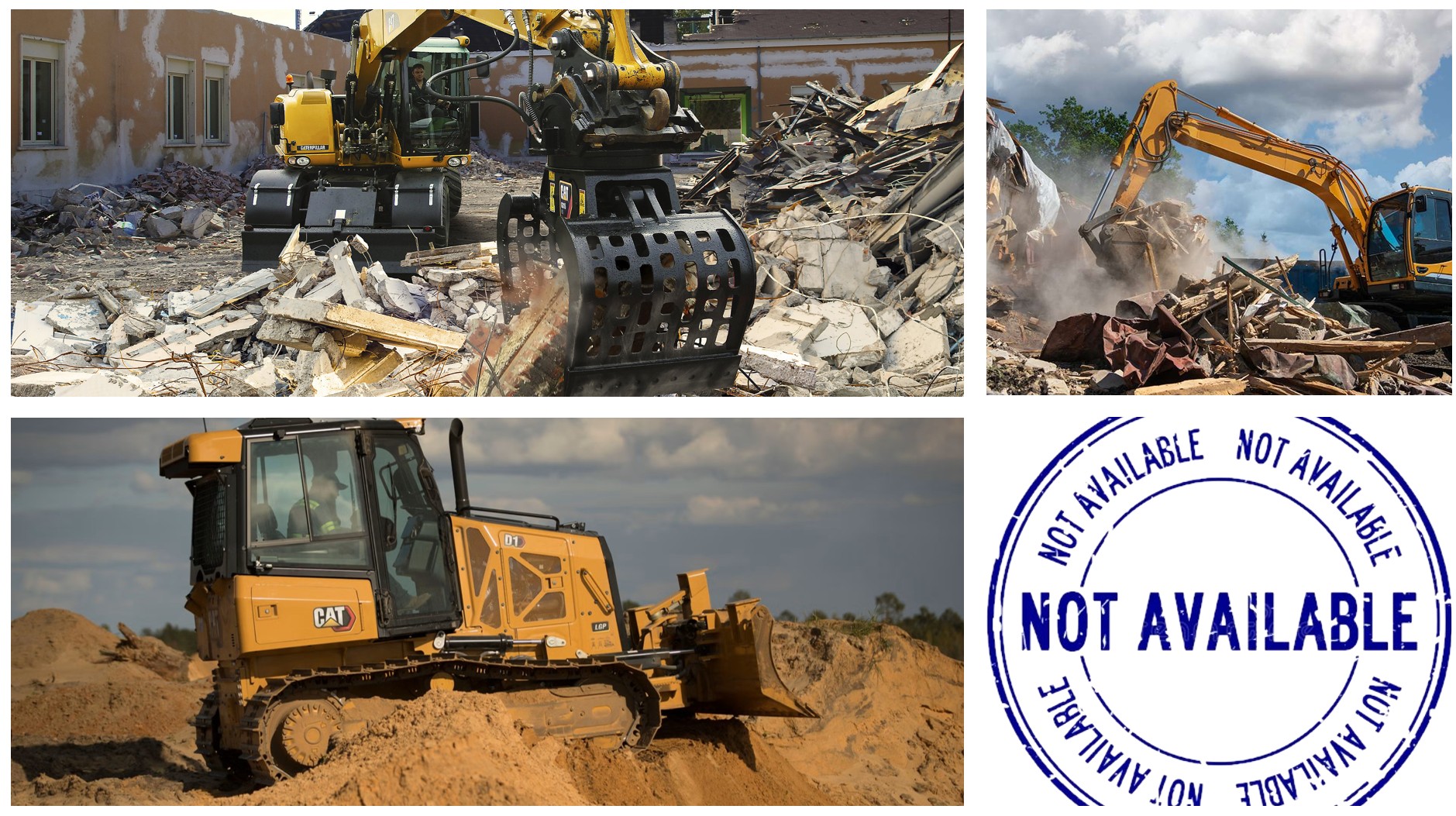
And, despite there being lots of model aircraft in 1/48, a few WWII era vehicles, and some overtly “cute” vehicles, not much is available in terms of modern civilian vehicles - so, something else that will need to be addressed as we go along.

And of course, this will need a base - perfect. Despite being 1/48 scale, and not proportionally exact, these parts are huge! And I want to show the loco pulling at least one car. With this in mind, I concluded that I’d reuse about half of a base from a big old project that I’ve been steadily picking apart anyway. This aught to be interesting, so fingers crossed this works out.
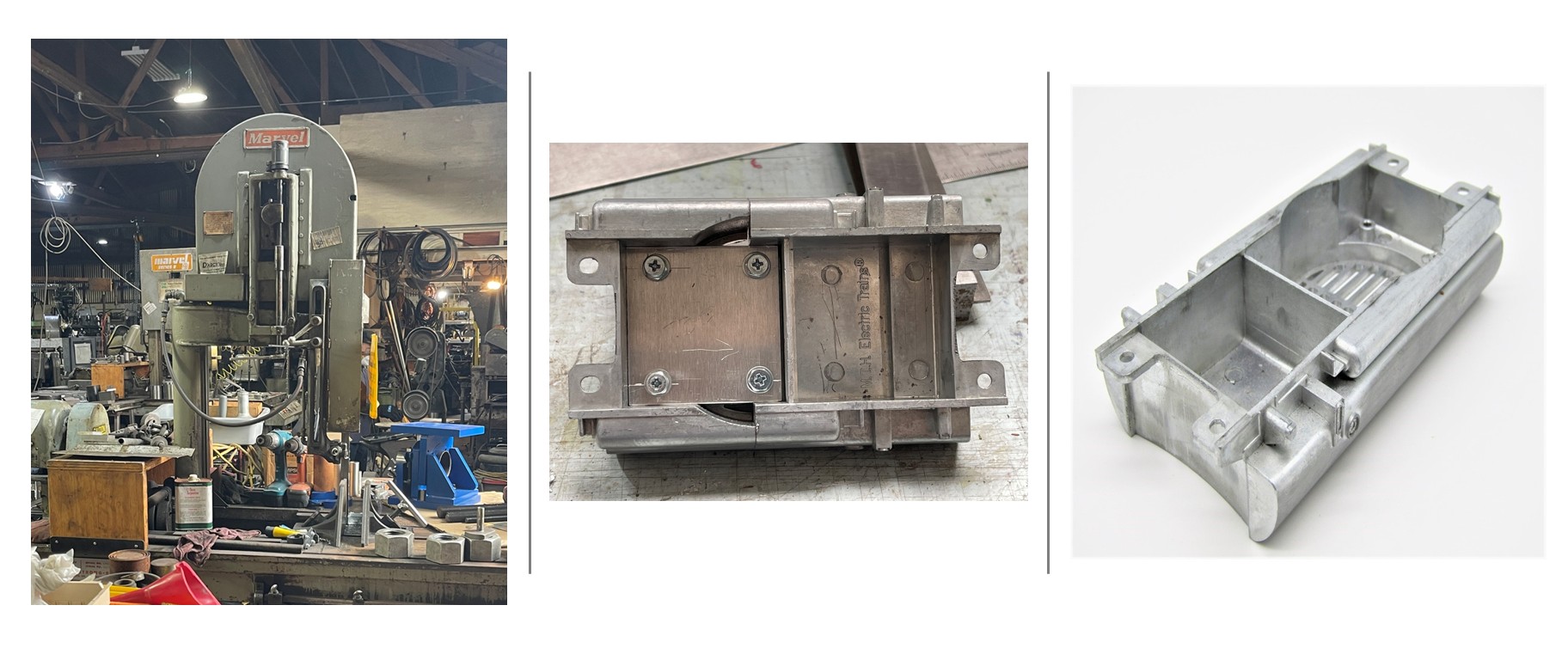
Finally, on to what I’ve been doing. The Lionel train came with an awful fuel and air tank - not that it doesn’t work, It just doesn’t look that great. As such I found this cast aluminum version (on the right) - oh what a treat! It looks pretty good, is hefty, and, was too long - a lot too long, maybe 7/8”!

So, rather than trying to cut it down myself, I ran by a local machine shop and asked (I mean, very timidly, asked - as this is a real, full size machine shop working on really big and complicated stuff) if they could/would do it. You can see the bandsaw on the left - wow - it is at least 7’ tall! They not only cut it down, but machined the opposing surfaces so that I could bring the two back together and have a flush joint. I did this using a piece of thick alu sheet, screwed in place. This was a really interesting task - and quite a challenge, but all went better than hoped.
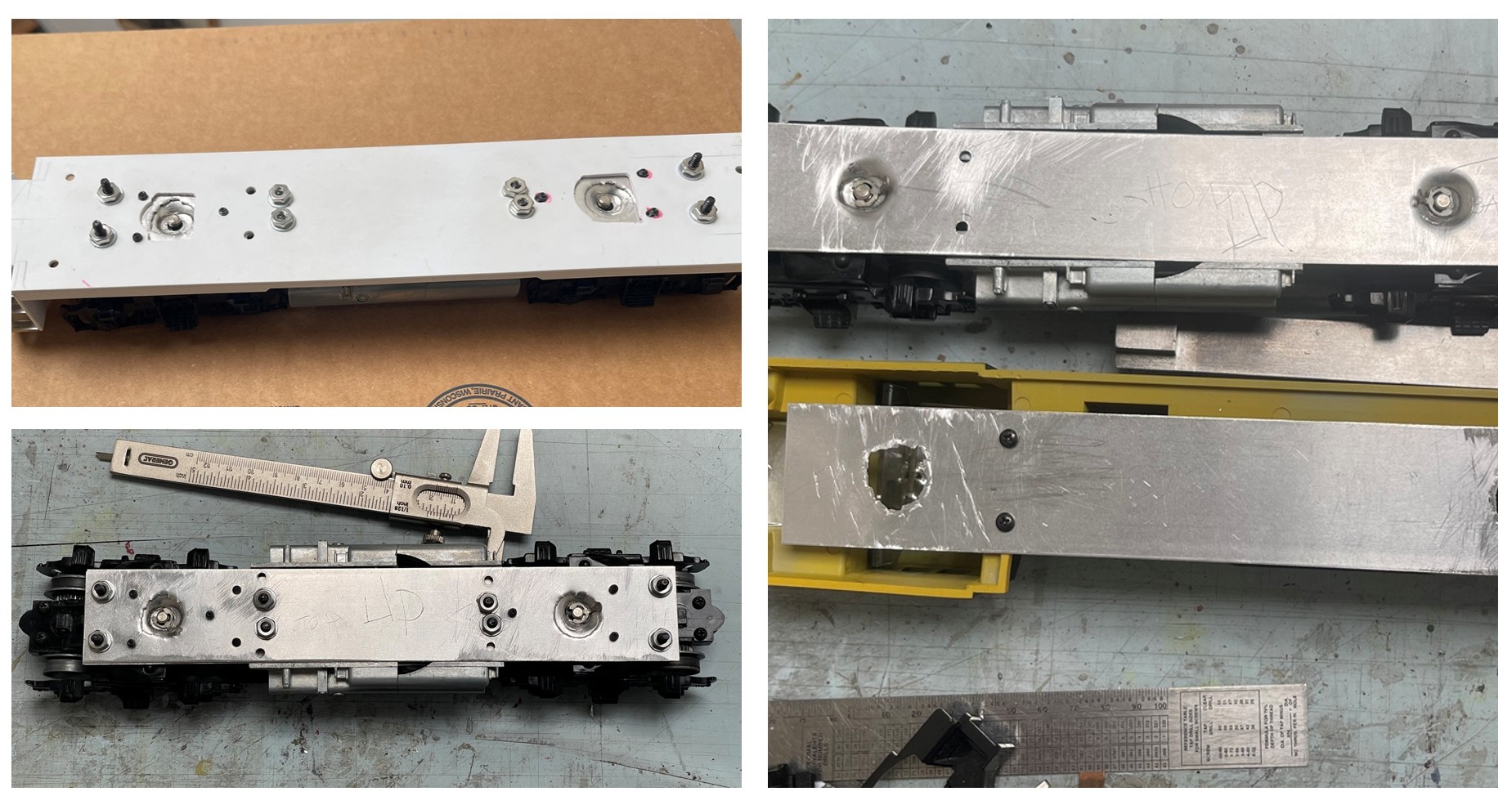
Next up was making a frame. The Lionel chassis is fine, but clunky and toy-like, and very strong. So, I tore the trucks off and apart, removing the engines, and went about rebuilding. An interesting attribute of this was discovering that the bolsters on these trucks are not centered - who knows why not? but, they also include holes that are indeed centered - which proved useful as I got into reworking the front draft gear.

Anyway for this, I made up two alu sheets for the lower layer of the frame. I punched dimples into the lower sheet for the bolster pins, then made an upper plate to help hold the weight of the mighty alu fuel tank. I bolted these two together using 6 set screws. Then, attached a sheet of .060” styrene to server as the deck and body mounted - the whole thing was then sandwiched together with 8 machine screws. As I only have hand tools and a cordless drill this was a bit nerve wracking!

Then, on to some more frame work and into body work:
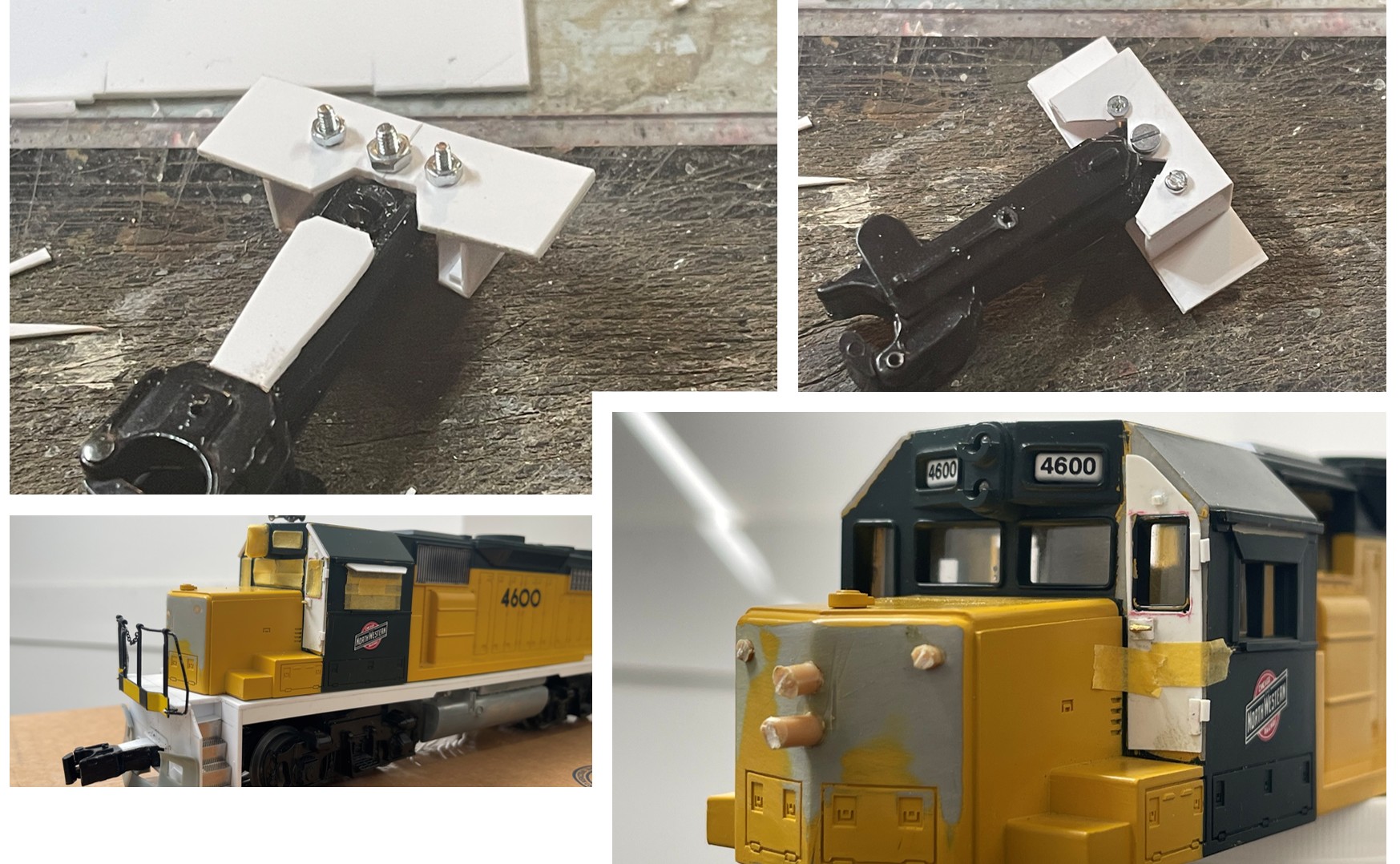
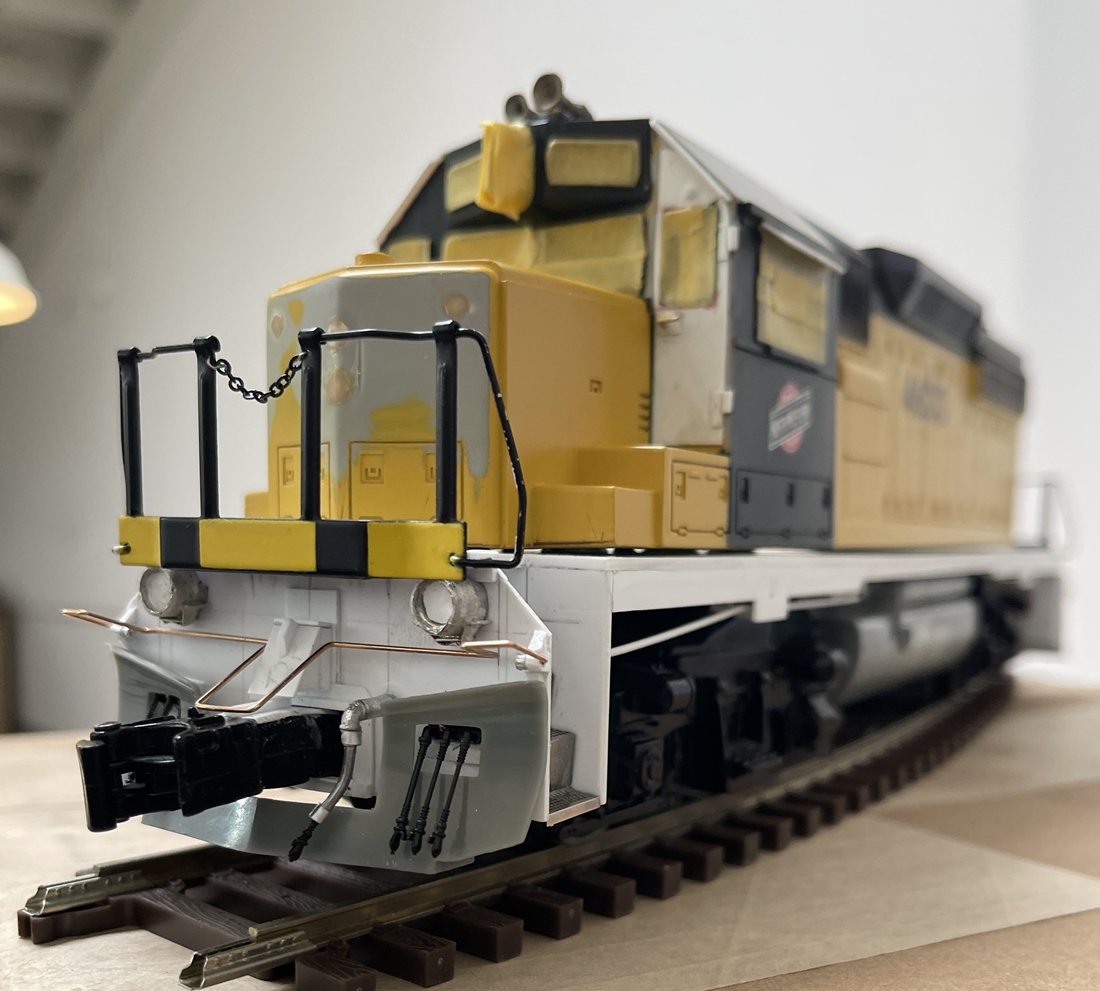
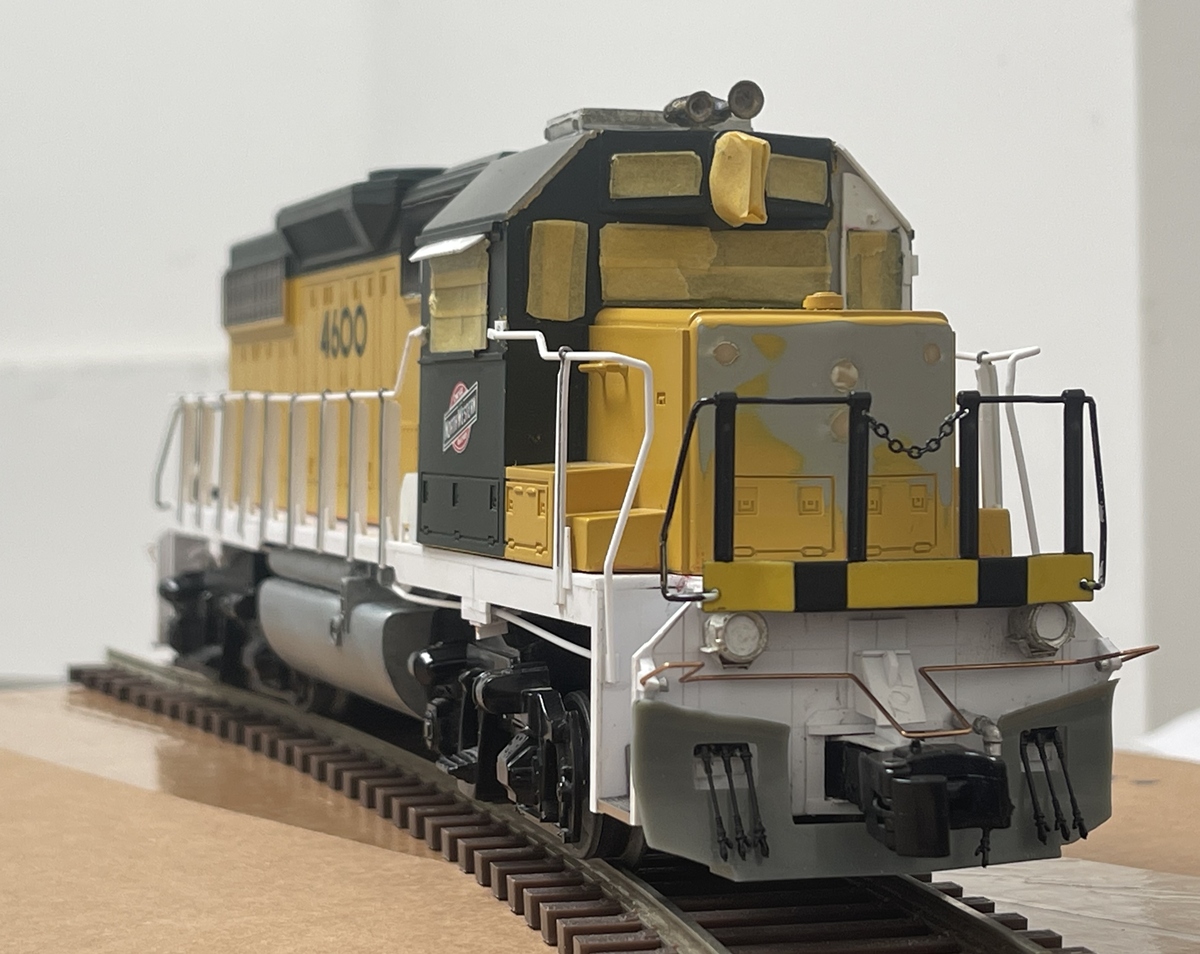
While I am not matching one specific GP38-2, I am using lots of reference photos - so obvious things are getting fixed - adding the front door, making new pilots and dealing with the draft gear. The latter has been a real challenge. Plan was to use a set of Kadee parts - perfect! but not, not perfect for too many reasons to list. As such, I reused the kit shanks and couplers - fine…except, these were initially attached to the trucks, which while fine for a modest/starter loco, just not good for what I want. Lots of head scratching later, the front pilot is on, and snow plow and handrail dry fit - so some good headway.

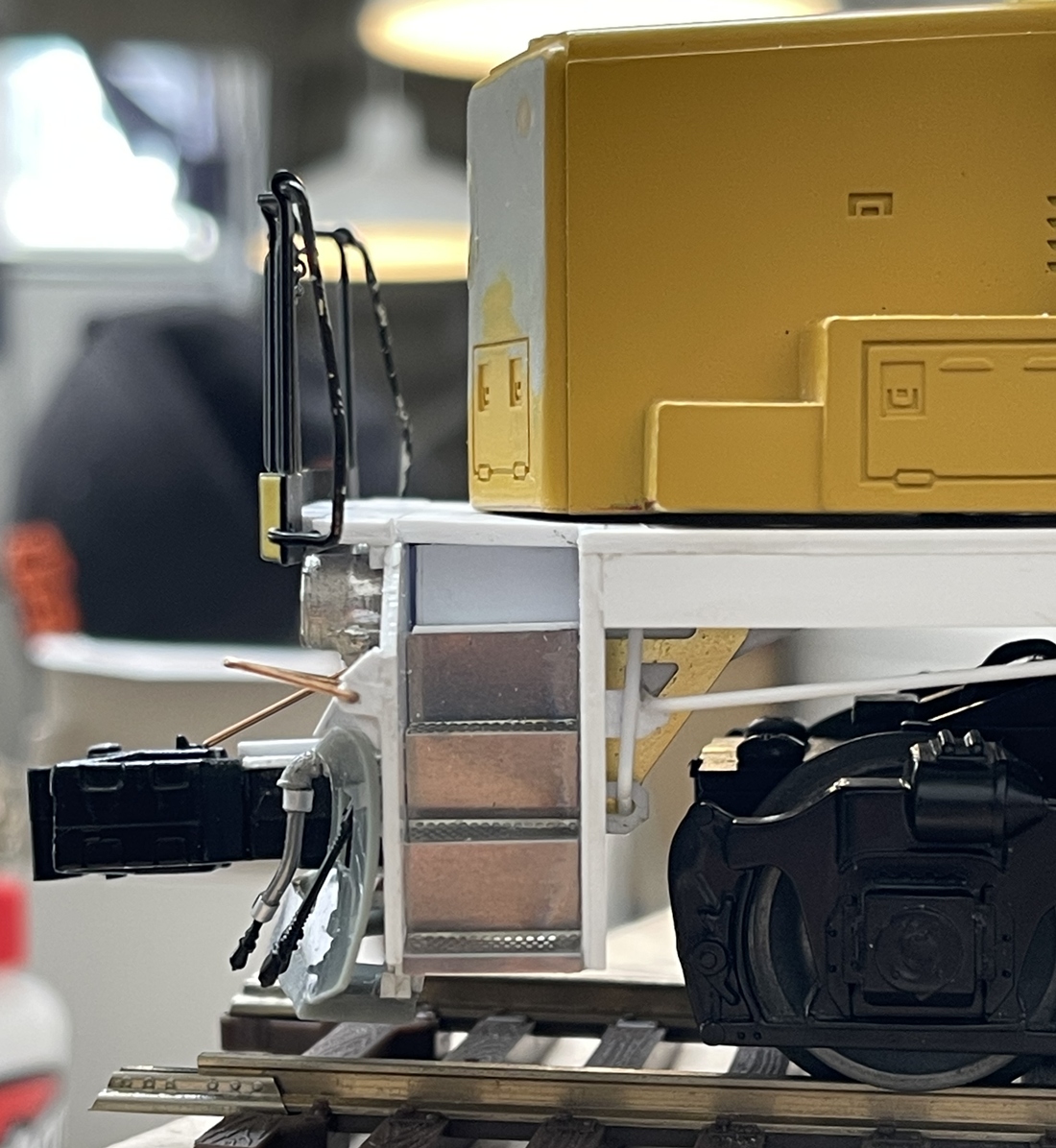
For full disclosure, the front draft gear was firmly attached before I realized it looked awful - way too long (as you can clearly see on the upper left). So, while firmly attached to the train, out came the saw and off went about 1/4” of the shank. As this is made of “engineered plastic” and not regular ‘ol styrene, I couldn’t glue it back together. So throwing caution to the wind, I drilled the small holes into the sidewalls of the shank (as it is naturally, U shaped and not, a solid piece of material!!) and pinned it back together.
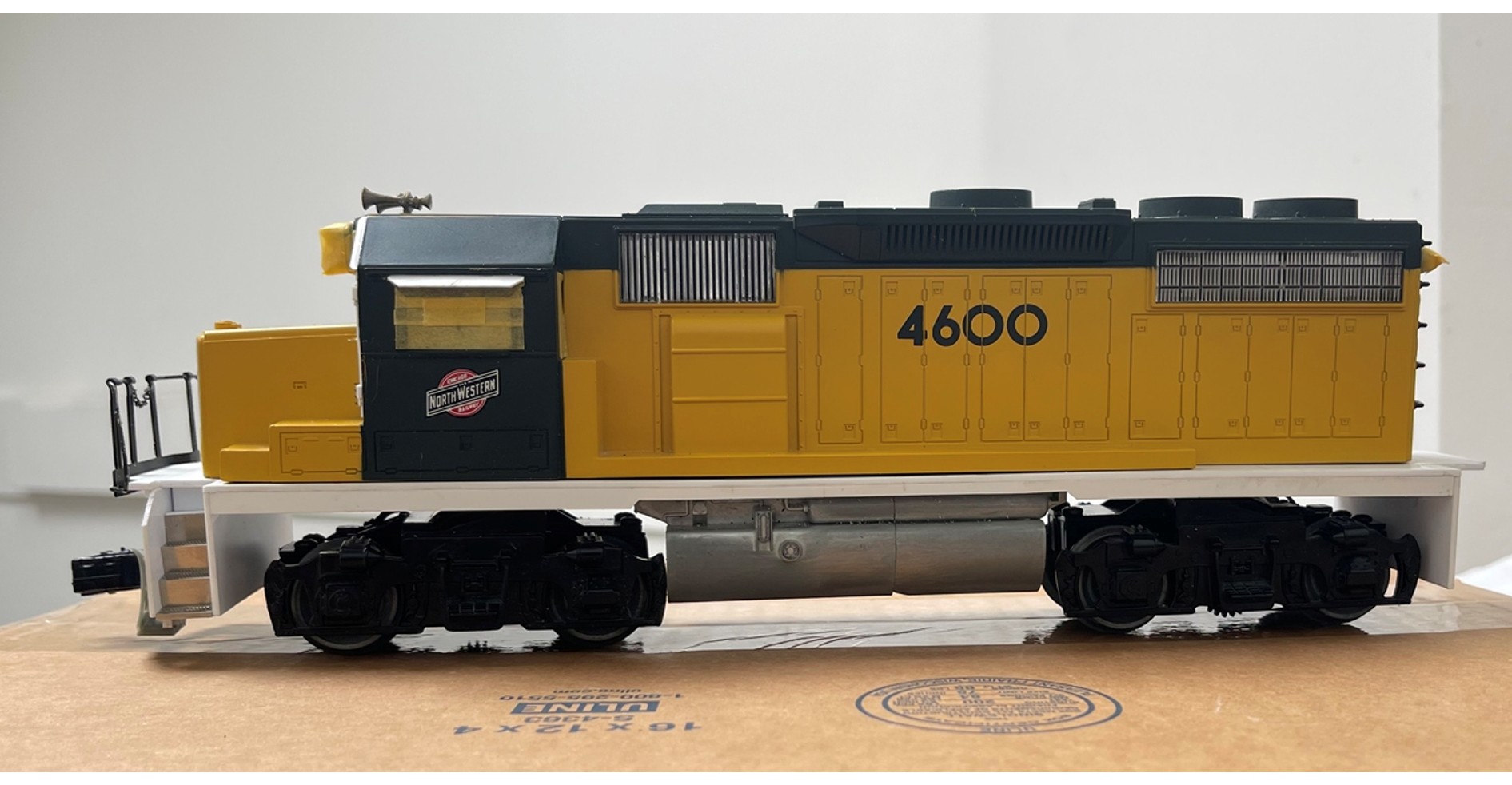
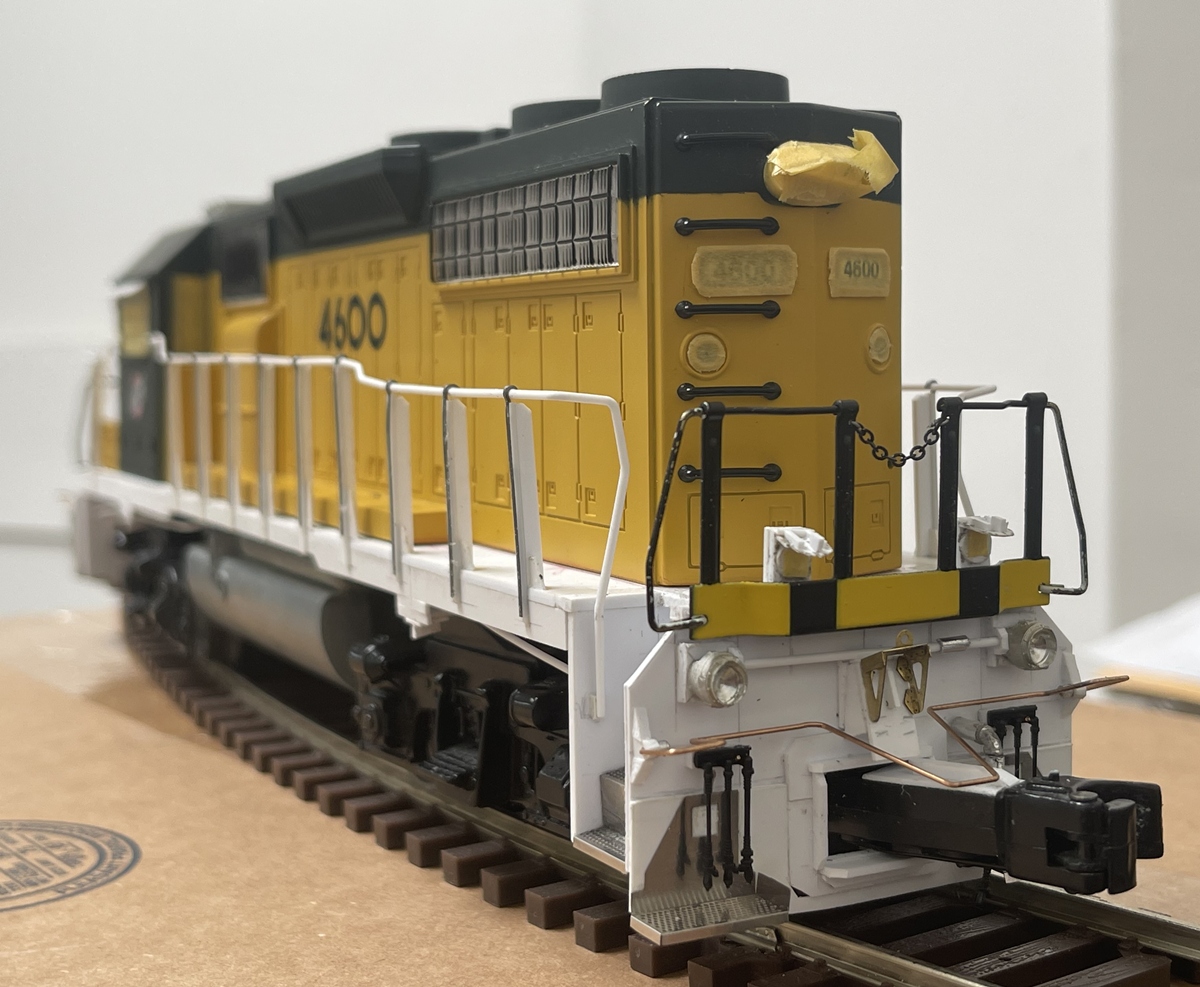
And here’s where it sits right now. You can see even after cutting the fuel tank down, lowering it from the frame, and moving the front bolster to a centered rather than off-set position, the fit is pretty tight. It also sits a bit higher than I’d like but come on man! :grinning_face_with_smiling_eyes: it’s close! :grinning_face_with_smiling_eyes:. You can also see the proportional question I mentioned, as this looks pretty similar to a GP 15 to me….but that’s fine! it’s good enough for who it’s for! :grinning_face_with_smiling_eyes:

For today I’ll get after the back pilot which has lots of problems of it’s own, and bear in mind, this will be pulling at least one car, so while it doesn’t need to be functional per se, it needs to be functional enough to couple with that car!

OK, thanks for having a look - this should be a fun project!

Cheers

Nick :man_biking:

9 Likes

When I saw Thomas I thought you’d run right off the rails there :upside_down_face: ! Looking forward to this one, maybe you can supply a soundtrack once it’s all done? :grin:

1 Like

Indeed …

Very hurtful words Tim, very hurtful! You know I try and keep on track with all of my projects! :grinning_face: And, @Uncle-Heavy, :man_shrugging: et tu Robin? et tu?:grinning_face_with_smiling_eyes:

Right, this project is a bit different for me - between seeing lots of trains near to where I live and the thread on graffiti and trains has kept me thinking about it and well, here we are!

I am sticking with a short local train because despite being 1/48 scale, these are huge! The loco alone is the size of a 1/24 scale diesel truck! And, it’s a challenge learning a new scale, as I really need to think twice before I “eyeball” a size - uhh - this is smaller than 1/35 and a lot smaller than 1/20! So, I’ve been forced to recalibrate the eyecrometer! :grinning_face_with_smiling_eyes:

I’m in the middle of work on the loco - which has been a good challenge, as in addition to needing to figure out what I’m looking at, adding details to a cobbled together frame on a proportional model has led to a few instances of one step forward and three back! :grinning_face_with_smiling_eyes: Happily I have big pile pile of evergreen and plenty of glue - and the knife is always at the ready to cut up new bits, and cut off mistakes!

I’ll hopefully have an update in a day or so. I’ve been working on the pilots, which in English means the front and back of the locomotive and the gear required to support the couplers.

OK, thanks for having a look, and on we go -

Cheers

Nick :man_biking:

4 Likes

Have absolutely no idea what’s happening here, as trains are as far out of my comfort / knowledge zone as you could get, but as it’s being brought to life by you mate, we all know it’s going to be a treat. … So once more, I will be jumping on board for the journey :+1:

3 Likes

Ah well sorry but what are friends for? :rofl: I’m sure you’ll get over it - at least I didn’t use the M word :grin:

(That’s M*n*a*u*e, if Nick sees that word he turns into a :goblin: )
2 Likes

@Johnnych01, well John, that sort of makes two of us! :grinning_face_with_smiling_eyes: While I get the basics of what happens on a locomotive, like they are big, have 2000 HP engines and so on, but beyond using them in HO scale, this has introduced a steep learning curve! But, that is good for model building!

And, @Dioramartin, I asked you to please not use, or even suggest using…the “M” word! :grinning_face_with_smiling_eyes: Can’t you see this is important stuff??? :grinning_face_with_smiling_eyes:

Speaking of important stuff, on to todays demonstration of what happens when a guy decides to do what is not supposed to be done to the incorrect base model for the task at hand! :grinning_face_with_smiling_eyes:

I can report that this has not been the hardest project to build per se, but, it has been hard trying to reconcile parts that were likely designed for family fun, and not serious model building! :grinning_face_with_smiling_eyes:

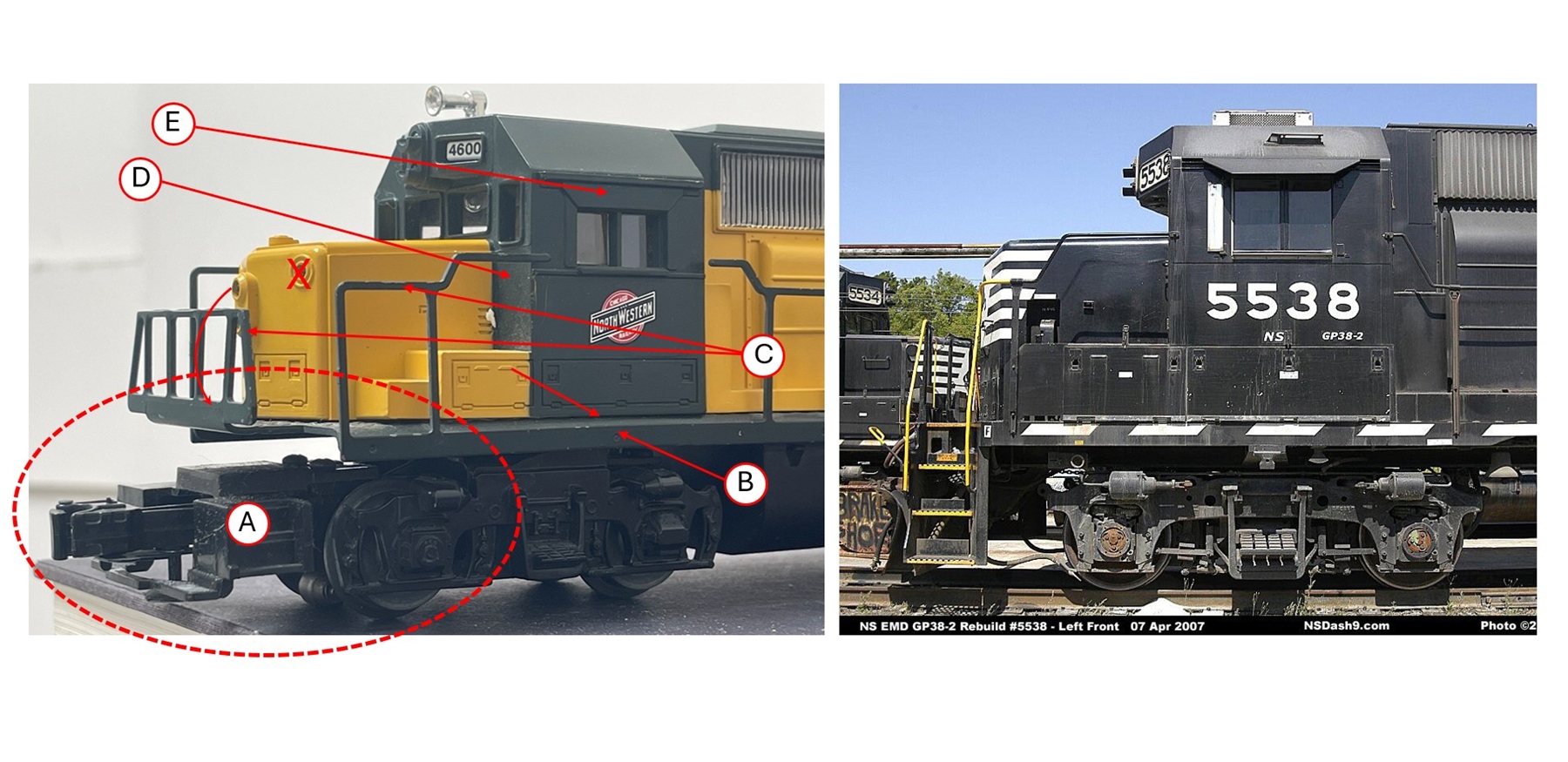
So, I’ll start with clarifying what I’m trying to do, comparting my toy engine to a real engine:

Before I get into a project, I suspect like many of you, I do some research, which in this was was required as I don’t know that much about the specifics of these - so, I made up this and several other comparison slides - and here’s what I noticed:

A: This area is apparently referred to as a “pilot”, for me, the front of the engine, where the coupler goes. In the two pictures you can see the obvious and less obvious challenges. Something that is obvious is that the model does not include stairs, so there’s a project. Actually, there are conceptual/visually evident stairs, but, they are attached to the coupler and not the deck. This results in the huge gap between the coupler and the deck, and not a very good look.

Less obvious, the way the coupler works. In the model, it is attached to the front (and rear) truck, and not the frame. I suppose this is for ease of use, and in order to make the relatively tight radii of “O” gauge track, which makes sense. Except, it looks awful. I eventually cut these off the trucks and have mounted them to the frame, revealing the problem here, which is that if not done carefully, the loco won’t couple with other cars.

B: This is a tricky problem, in that the model cab is narrower than the chassis, and in real life, it should be flush. I thought this would be easy enough to resolve because I’m making a new chassis anyway. Naturally, that was incorrect, as it turns out the new fuel tank and old trucks are pretty close to real-life proportions, and the cab is a bit narrower. Choice 1: widen the train body to match the chassis. Choice 2: ignore this and move on.

C: The (metal) handrails on the base kit are attached to the chassis and not very good looking, though very strong. As I’ve rebuilt the chassis, I’ll need to figure out how to make new rails and stanchions. This might be fine, as unlike the original, this won’t receive too much handling, other than during the build, so, I’m hoping for the best.

D: I already addressed the missing forward door in the previous post. I thought I would “just” cut a door into the cab. That idea was short lived as the cab material, including windows is about an 1/8” thick! So, a no go, and I instead applied a door over the face.

E: the model includes molded in visors, but, they are flush with the train body - so, I applied visors to the body, like the door.

X: I don’t know what model year the base model represents, but it is old, and as such, the front lights are no longer seen in common usage, which is why they were removed and filled.

Ok, to once again quote the great Marty DiBergi, “enough of my yappin”, and lets go:

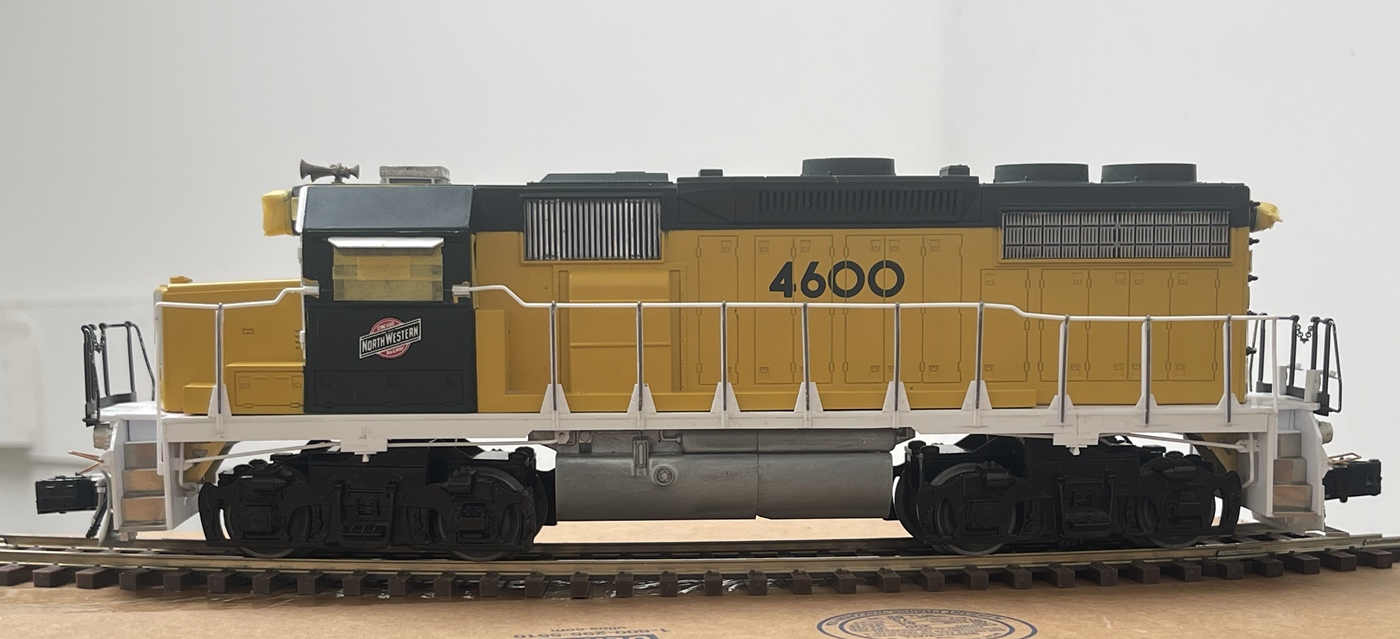
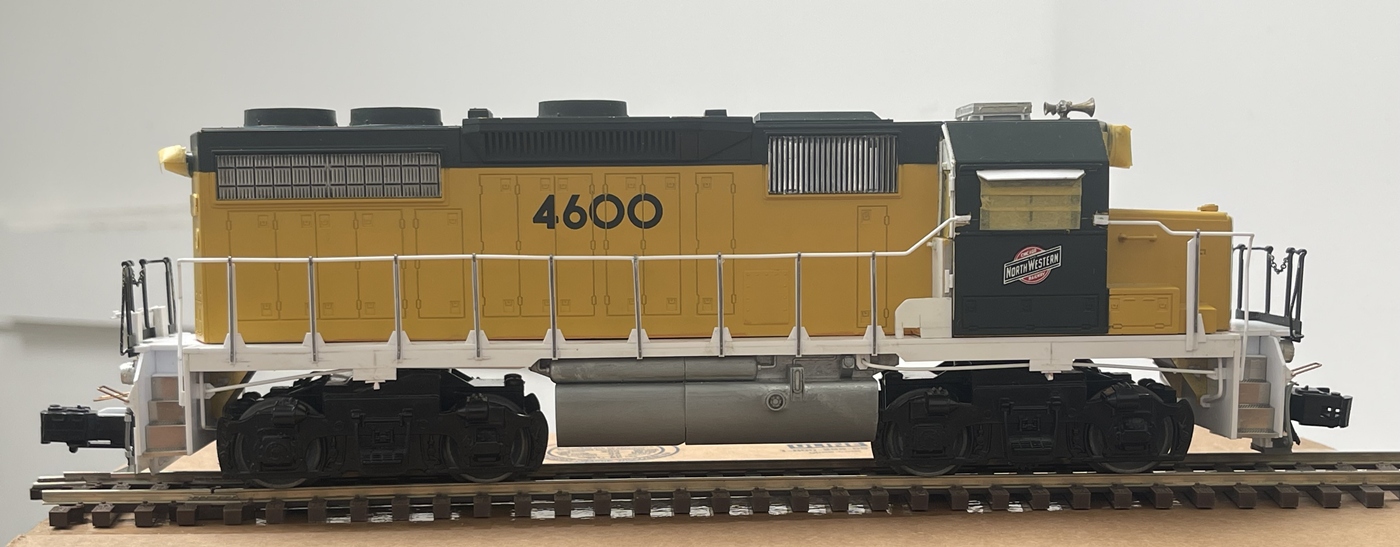
Funny, all of this looks easy enough :grinning_face_with_smiling_eyes: However, not easy for me! This took a lot of head scratching, patience, and a few build, tear off, and rebuilds!

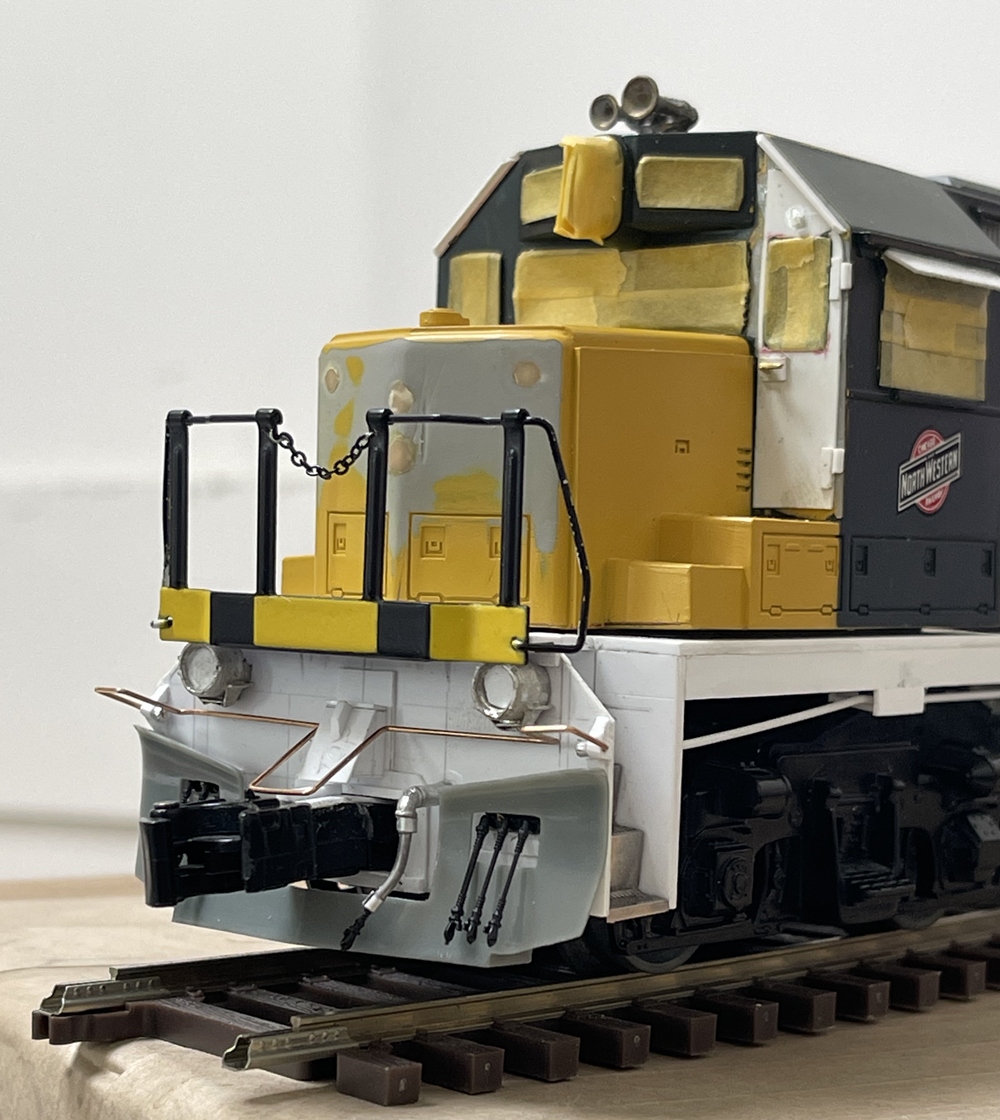
There’s a lot going on here, and I will spare the details. Despite being 1/48 scale this is huge, so in went a lot more .040” and .060” styrene than I’ve used before. This stuff is heavy! and like the real thing, while developed with years of engineering, there is nothing delicate about this - it’s big and chunky - all of it!

Above you can get a better understanding of the implications of this being designed with the coupler attached to the trucks and not the frame - yes, it still sticks out pretty far, even after I cut it down. But, mercifully I did a test coupling with a car. Guess what? In order for the two to connect on a curve (track section), they need to be long to connect - as the couplers on the car are also attached to the trucks. So, weird but true, and something I have to live with.

The handrails come from another model company than my base, but seem to fit.

On to the back:

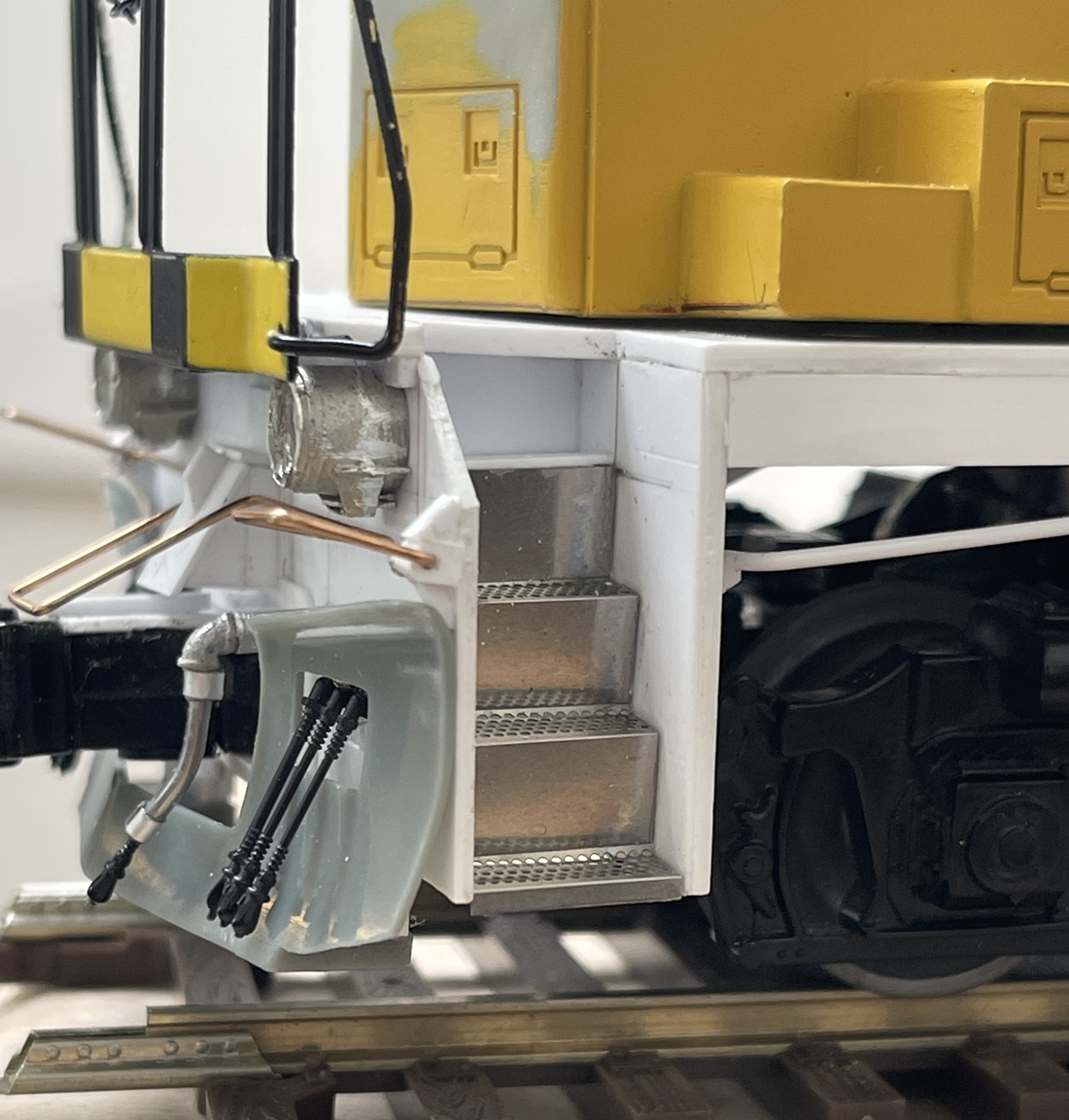
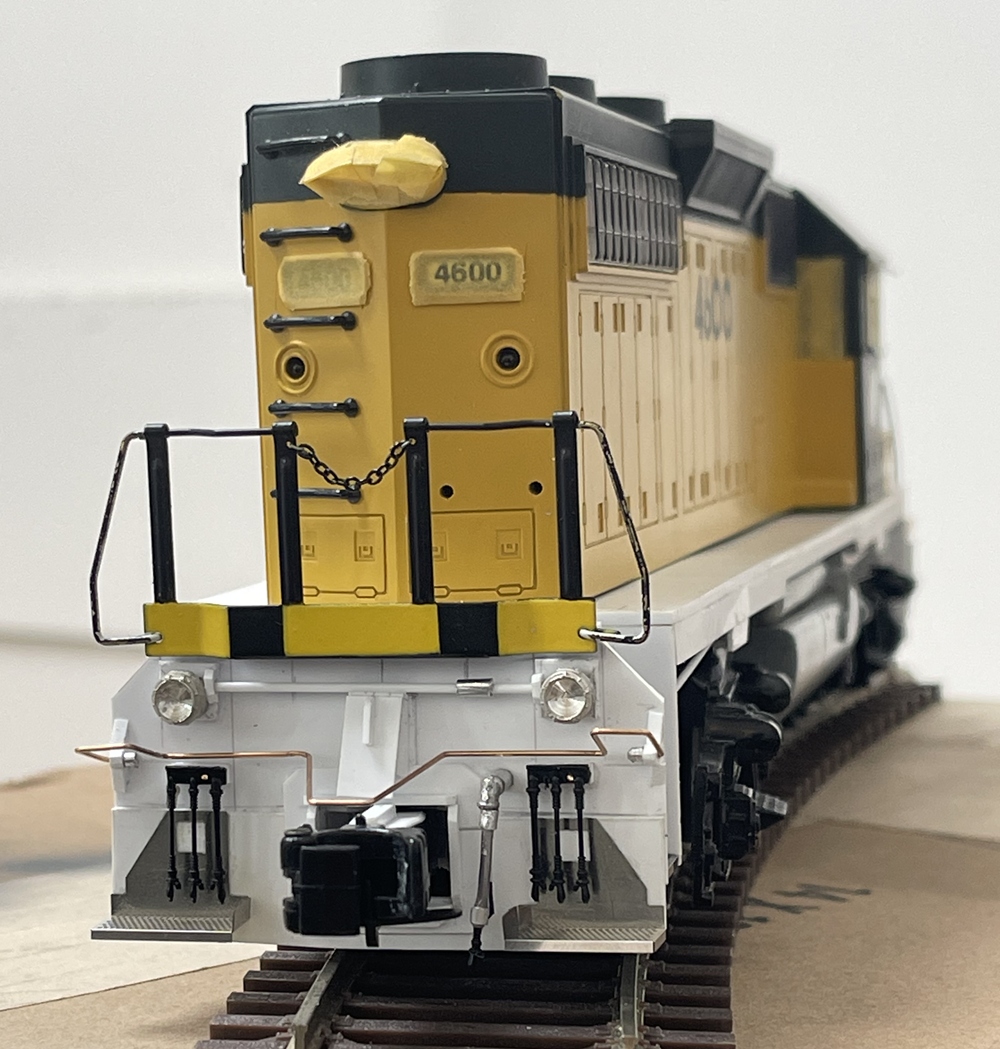
Naturally, similar, but not the same as the front - perfect. Different lights, and this gets some little running boards that I think look pretty cool. These and the front stairs are not supposed to be used on this, but, desperate times require some problem solving! It turns out that while you can find what seems to be every conceivable detail part in HO scale, the same is apparently not the case for O scale, so lots of scratch work and improvising required..

The piece of metal rod that’s been bent up and running from side to side, is something called a “cut bar”, which is a lever that is used to help to uncouple cars. In real life there is a piece of chain attached at the midpoint, which is connected to a pin that drops into the coupler.

When you lift the “bar” you pull the pin - hence, cutting off the cars following. These look different in real life, as in real life the coupler shank is much shorter, alas, in this case, we need the long shank - so this is what we get!

So, is it exactly right? No. But does it meet my overarching build criteria: Does it: demonstrate convincing realism? Well, I’m saying yes, it does!

Ok thanks for having a look and on we go.

Cheers

Nick :man_biking:

5 Likes

Mind-bending wire-bending, beautiful detailing. Positively exquisite. My only question is what’s the taped thingy between the front windows, I can only see 2 small projections on the 1:1?

1 Like

It has to be that way on a model locomotive that is supposed to go through turns that would fit on a decent lawn in 1:1 scale. Curves on standard track (not trams on streets) have a minimum radius of 288 feet, in 1:48 this would be 6 feet. The 1:1 curve will be a tight squeaky fit that can only be rolled on at very low speeds.

Couplers on models: They have to move with the “trucks”, otherwise the tension in tight model curves could yeet the wagons off the track. In 1:1 scale operation there is enough movement even with frame mounted couplers, actually mounted in pockets of some kind to allow for lateral movement, to allow for the minimum curves.
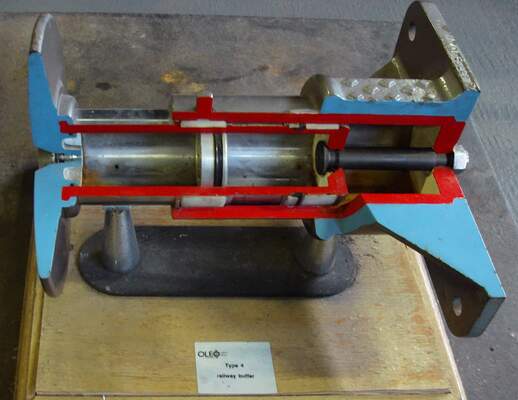
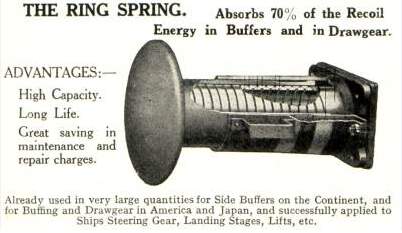
The European style with chains pulling two wagons together relies on the buffers being mounted on springs or oil pressure cylinders so that they can move forward/backward. The curves can’t be tighter than the buffers can adjust for.
Oil “sprung” buffer:


With a real spring

Pilot trucks: This is a carry over from the steam engines. Modern diesels have all axles powered and mounted on bogies that will track through curves. The old steam engines usually had one or two unpowered (pilot) axles to help guide the rest of the locomotive through the curve.
The steam powered axles on big locomotives could move a little bit sideways to let the 3, 4 or maybe even 5 axles form a curve when seen from above. This movement was controlled by the pilot truck “feeling” its way through the curve and by a set of levers and rocking arms the sideways movement of the pilot caused the powered axles to move sideways.
Lots of tricky and finicky bits in a steam locomotive chassis, too expensive to replicate in models and it would probably fail as well. Model locomotives have wider wheels to allow the straight and stiff axle group to pass a curve, the rails move sideways but the wheels are wide enough to stay on the rails. In some cases some of the wheels don’t have any flanges to avoid binding in tight curves. Mallet locomotives (such as the Union Pacific 4-8-8-4, Big Boy)


had two assemblies (trucks), at least the forward truck could turn underneath the engine, guided by the pilot truck. Some modern three axle trucks also adapt to curves.

2 Likes

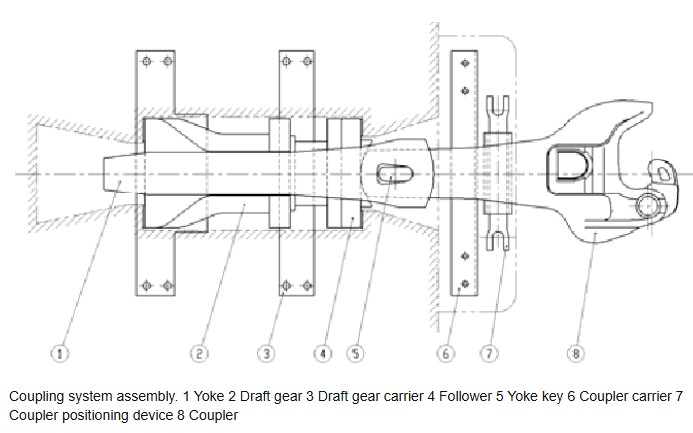
HI Robin, yes I eventually figured this out. In a sense the couplers on the base kit work more like drawbars than couplers per se. As your figure above shows, and in this image, which I used to rationalize the build:

Couplers and their boxes are not quite as straight forward as they may seem. And to your point, unless someone wanted to build a giant model railroad to accommodate 1:1 turning radii, the real life solution seems to result in some design problems. To address this, the base model uses something more like a draw bar which seems to be the answer, for the Lionel engine anyway. The draw bar solution allows for a much tighter turning radii, and is much more practical for novice model railroaders. I built up something of a hybrid, where the draw bar is connected to the frame, but it has to be longer than the real thing to negotiate curved track lengths.

I understand other O scale versions of these and other engines look closer to the real thing, and as it turns out I still have an HO scale model of a GP38-2 that looks closer. That said, even the HO engine was a lot more expensive than the version I’m using.

In the dio this will be pulling at least one car, and fortunately for me the Ebay special I bought at a modest price ($20) turned out to be a Lionel too, so the couplers work.

Like a dummy, I bought a set of better looking Kadee couplers, but, they don’t work with the couplers on the car. Happily they weren’t too expensive. To use the Kadee couplers, I would need to convert both the loco and car to use frame mounting points - and then, I couldn’t be sure they would work on a curve, which I want to use in the dio. As is, the rear coupler works fine with a car. In retrospect, I probably could have cut more out of the front shank but the whole process was getting too messy, and I couldn’t figure out how to detach the coupler and keep it’s basic function in tact -

And, Tim, that bent wire took a few tries - I just couldn’t get it the first time front or back. As for the tape in front of the cab, like the real engine, the model includes two headlamps that are separated, so the tape you see wraps around both and looks oblong -

OK, on we go -

Cheers

Nick :man_biking:

3 Likes

There is a lot more to railroading than the casual observer might think.
Model railroading is complicated enough but the real thing is just mind boggling …

1 Like

@Uncle-Heavy, hi Robin, yes, there are. And being only peripherally familiar with them, well, the more I notice, the more I’ve added.

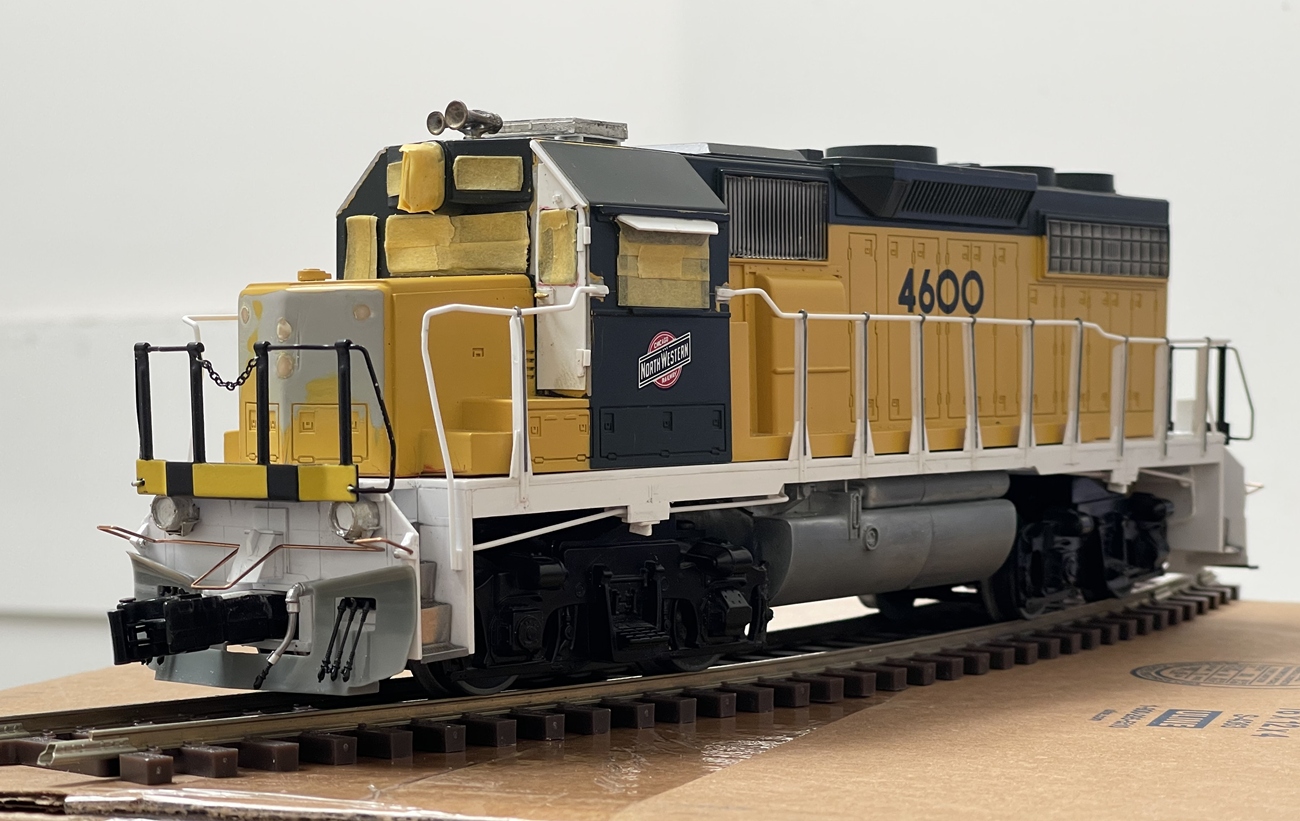
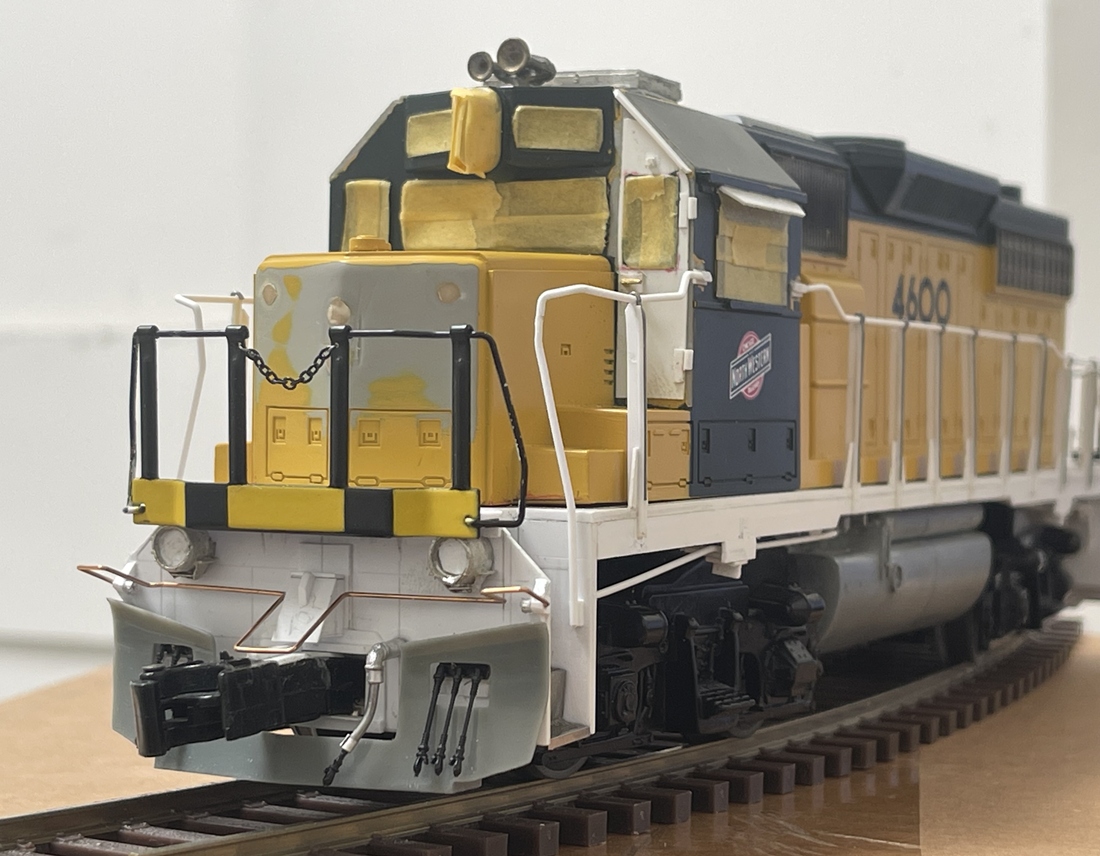
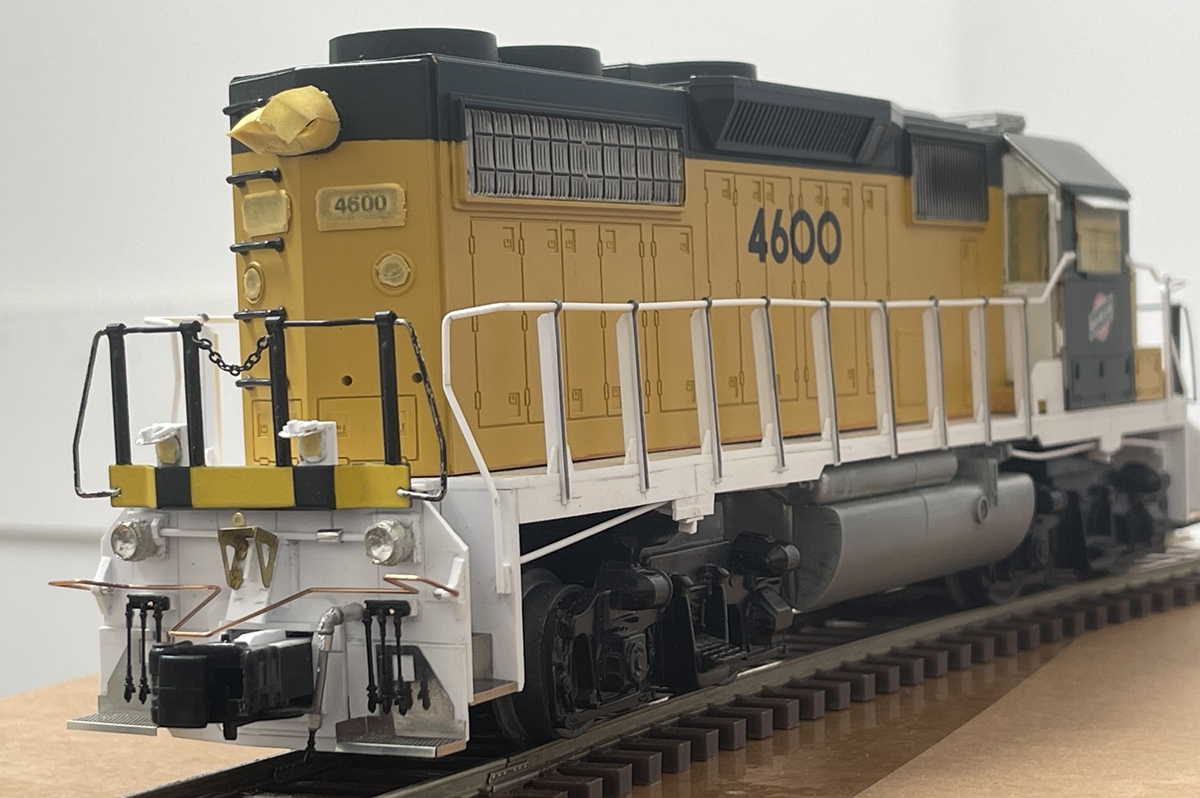
I spent some time working on stanchions and handrails. This was another in what is turning into a long list of awkward but not necessarily hard to do steps in this build. The size and weight of the misleadingly diminutive 1/48 scale has been a challenge - this is not a diminutive project. This is a big, heavy, clunky model! Nonetheless, on we go:

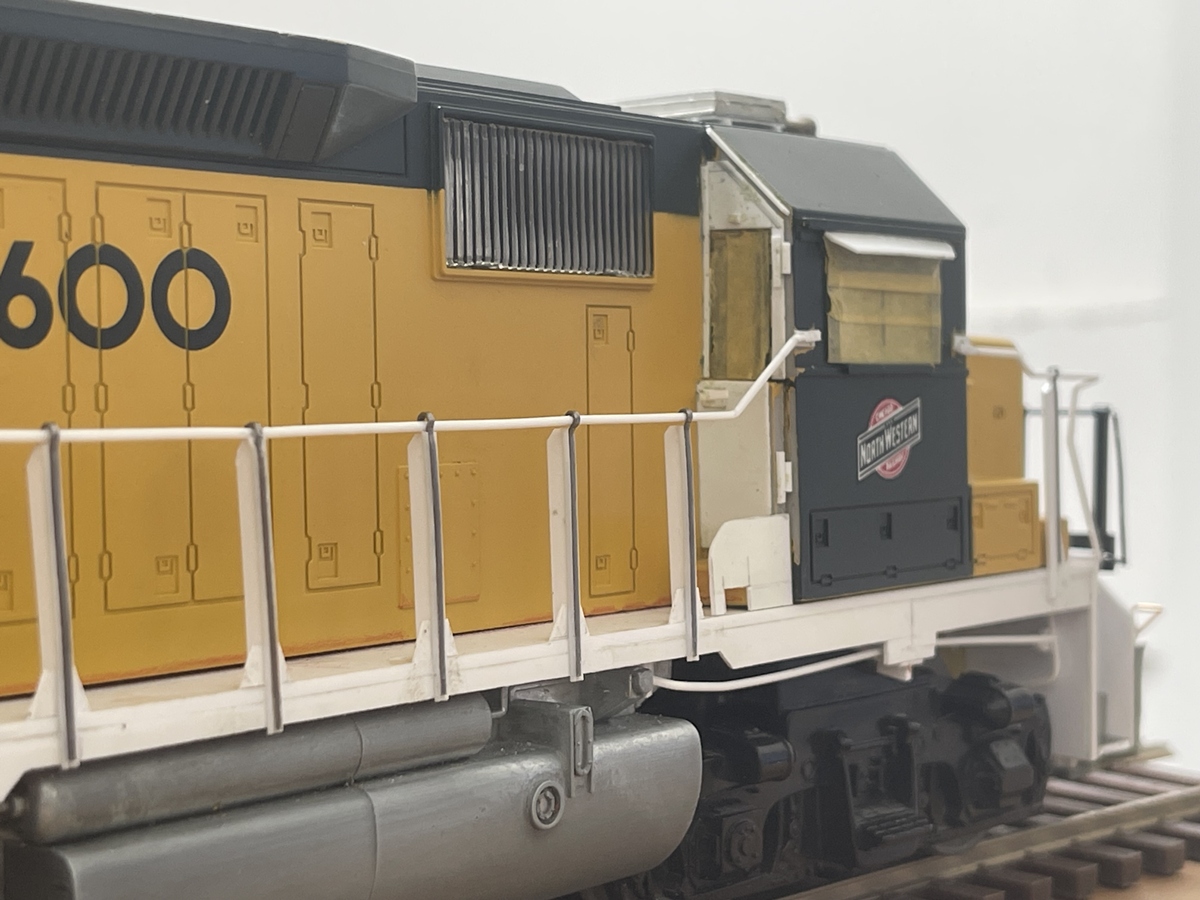
Each stanchion includes at least five pieces: a metal central section that is fairly strong, set into a piece of channel, with a strip for backing (keeping it from moving in and out) and two small plates are the base to keep if from moving back and forth. I went with a styrene rail instead of brass - it was easier to use, that is bend, and to eventually insert into the stanchions.

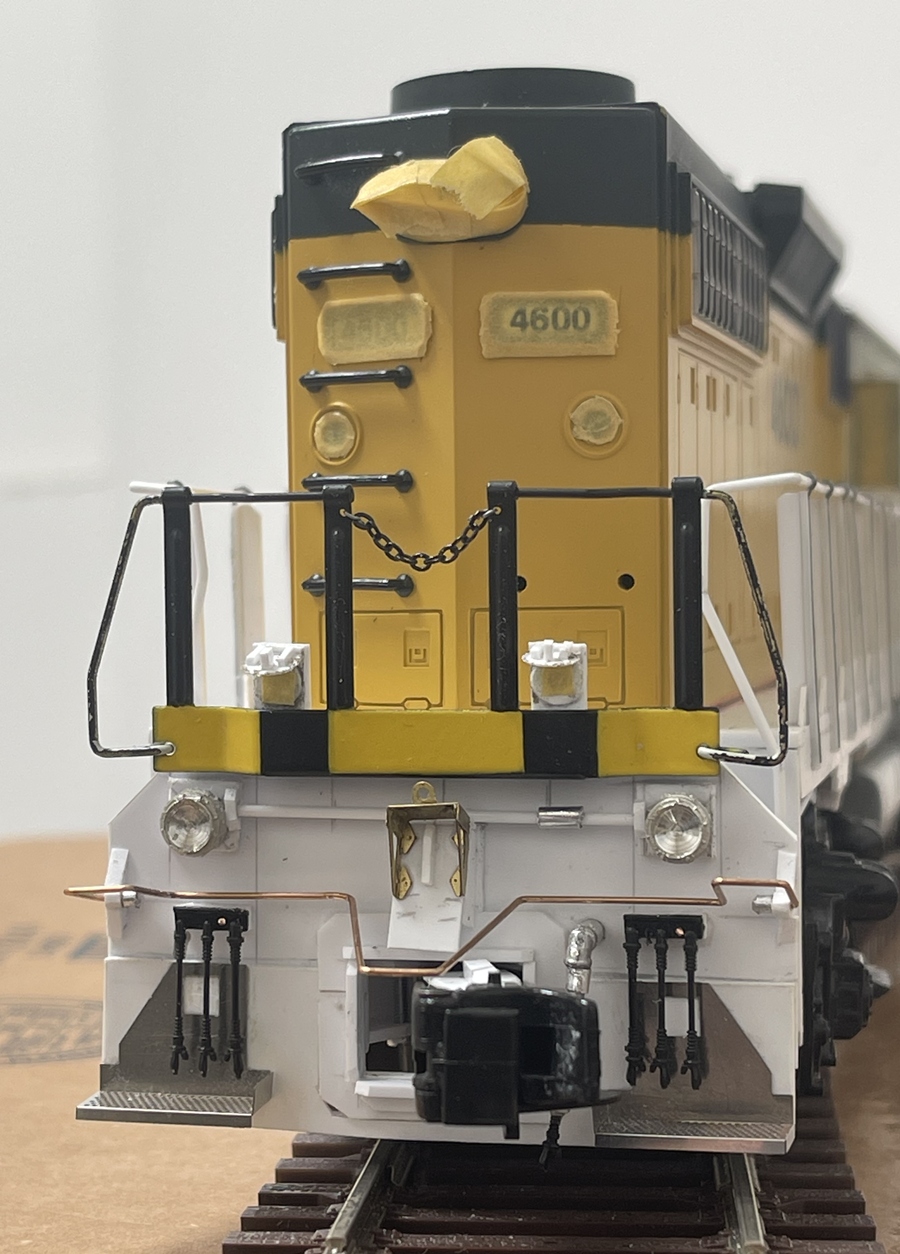
And from the back:

I added a door to the back side of the cab, and the little plate that abuts the steps.

Those two boxes on the deck are MU connectors - the places where multiple engines connect via a length of cable. I have that part made but will add it later. Using some remnant PE I made up the bracket over the coupler, where the central part of the MU cable will lay.

Considering how awkward the handrail was to make I’m pretty pleased with the result. The rail is glued to the stanchion, and the metal outer piece clamped tight over the top using pliers.

The body is temporarily attached to the frame, as it will be torn apart for paint, so the rails aren’t glued to the body yet.

I almost skipped out on the rear door, as the kit parts are not flush and a bit oddly shaped. However, it is so obvious, I did what I could to make it look ok.

I’m waiting for some material to arrive, so will start another vehicle for the dio

Thanks for having a look

Nick :man_biking:

6 Likes

You should be!
Excellent work on those handrails!

2 Likes

Yet more outstanding work Nick, the new improved detailing turns it into a whole ew engine :+1:

3 Likes

Well guys, @Uncle-Heavy and @Johnnych01 , thanks! The beast is moving along, but, I ran out of material, so on to another vehicle!

What you can barely read on the cartoon is “I am having fun” and, indeed I am! So, the plan is to convert a 1/35 scale excavator to a 1/48 scale Cat 317 excavator! As a guy would do!

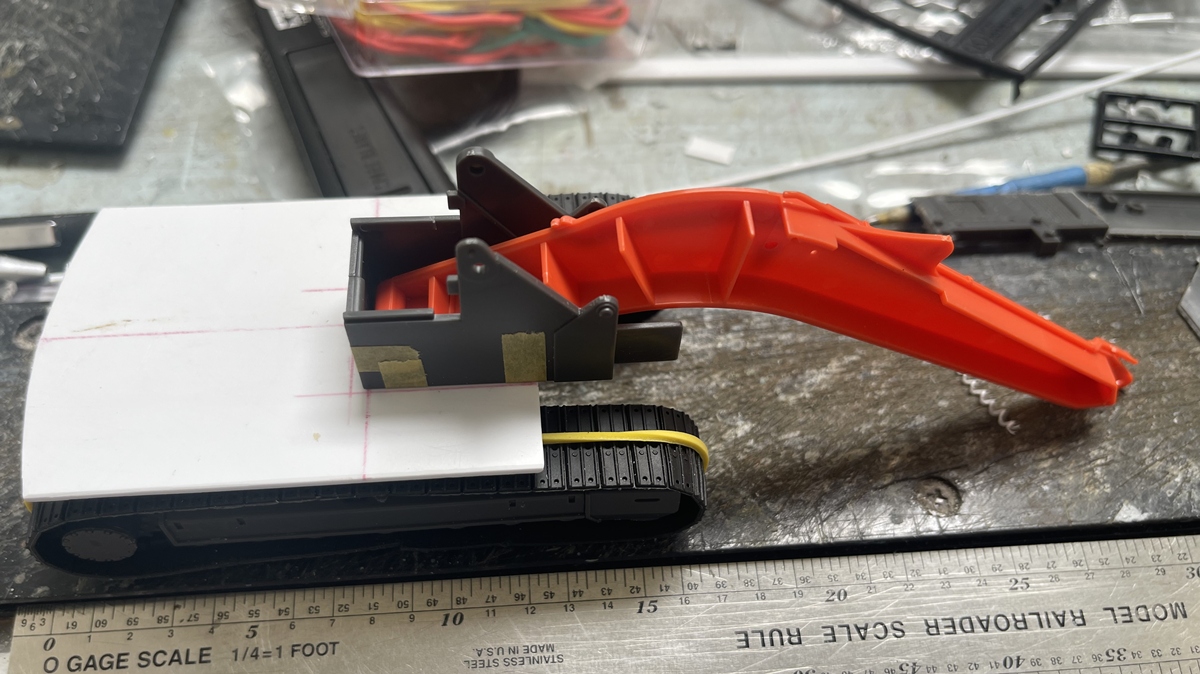
I picked the 317 because after measuring the scale length of the 1/48 track and rails, I figured out that it is very close to the scale length of the rail and track of the 317 - so, on to work:

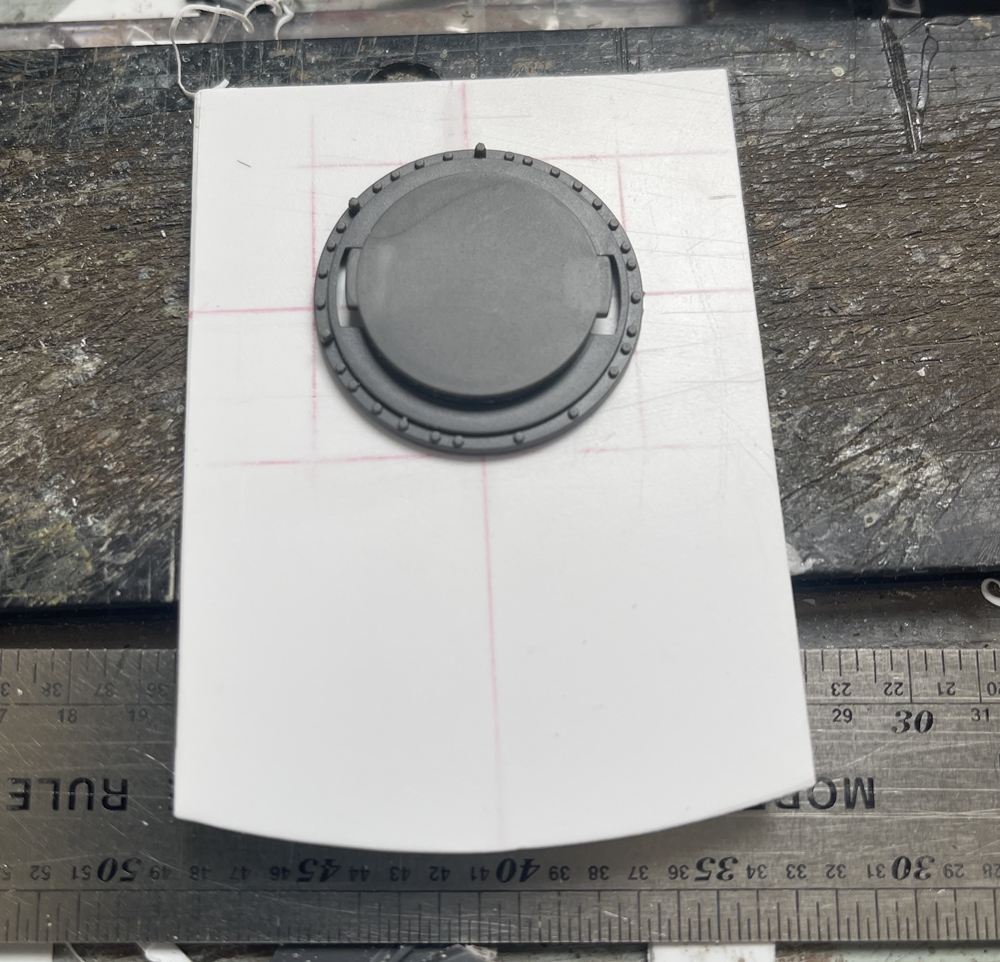
While the track and rails is the right length, the frame was way too wide - almost an inch. So, I glued the top and bottom together, then marked and cut the extra width out of the center in order to get the correct overall width in 1/48 scale. Yes, this was a measure a few times and cut once! I also cut off the upper and lower rings (like on a turret) so I can reuse them.

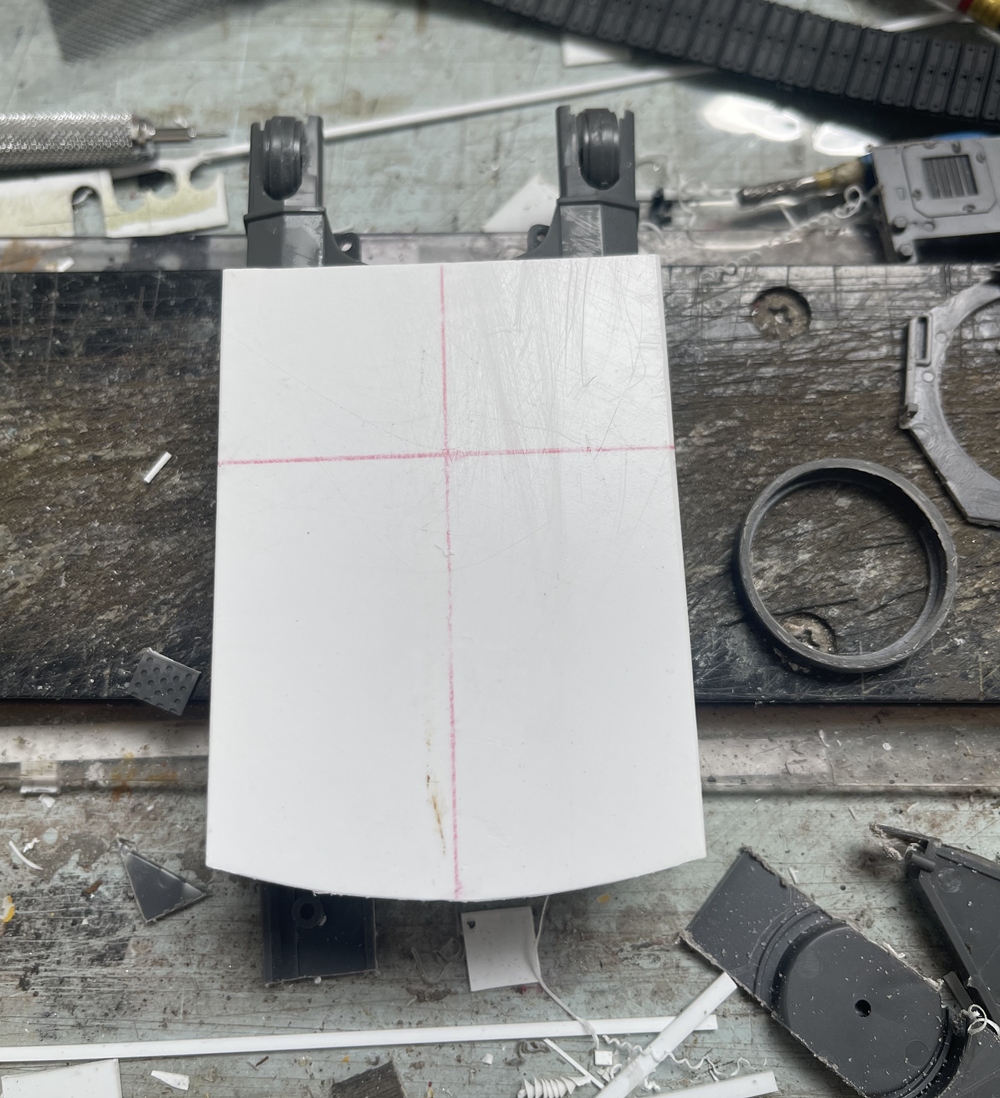
As I now have a big sheet of .060” sheet from the GP build, it was cut up more and used to make my deck.

A test alignment of the arm - I kept the scale in the pic, as this overall length works out remarkably well - very close to the 317 in 1/48.

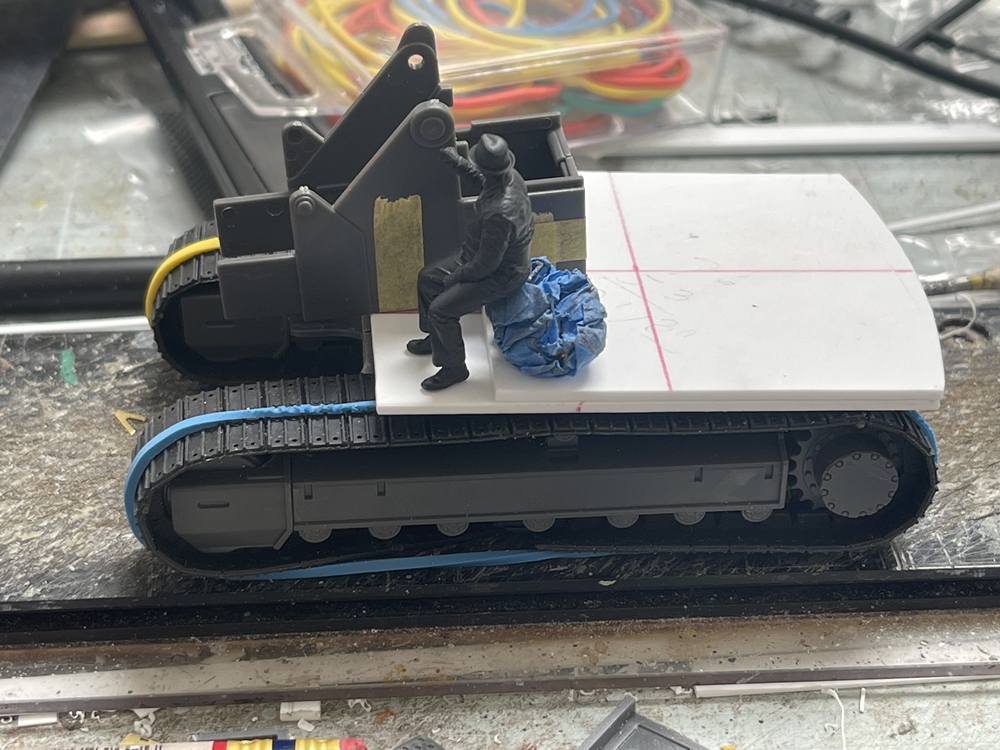
This isn’t glued together, but you can see how the underside of the deck will work.

And for some scale, you can see a 1/48 scale figure/operator in place. He was supposed to be the train engineer, but as he’ll be next to impossible to see in there, well, he now has a new job!

OK, on we go, thanks for having a look!

Cheers

Nick :man_biking:

8 Likes

Hello model builders,

On we go with the excavator conversion:

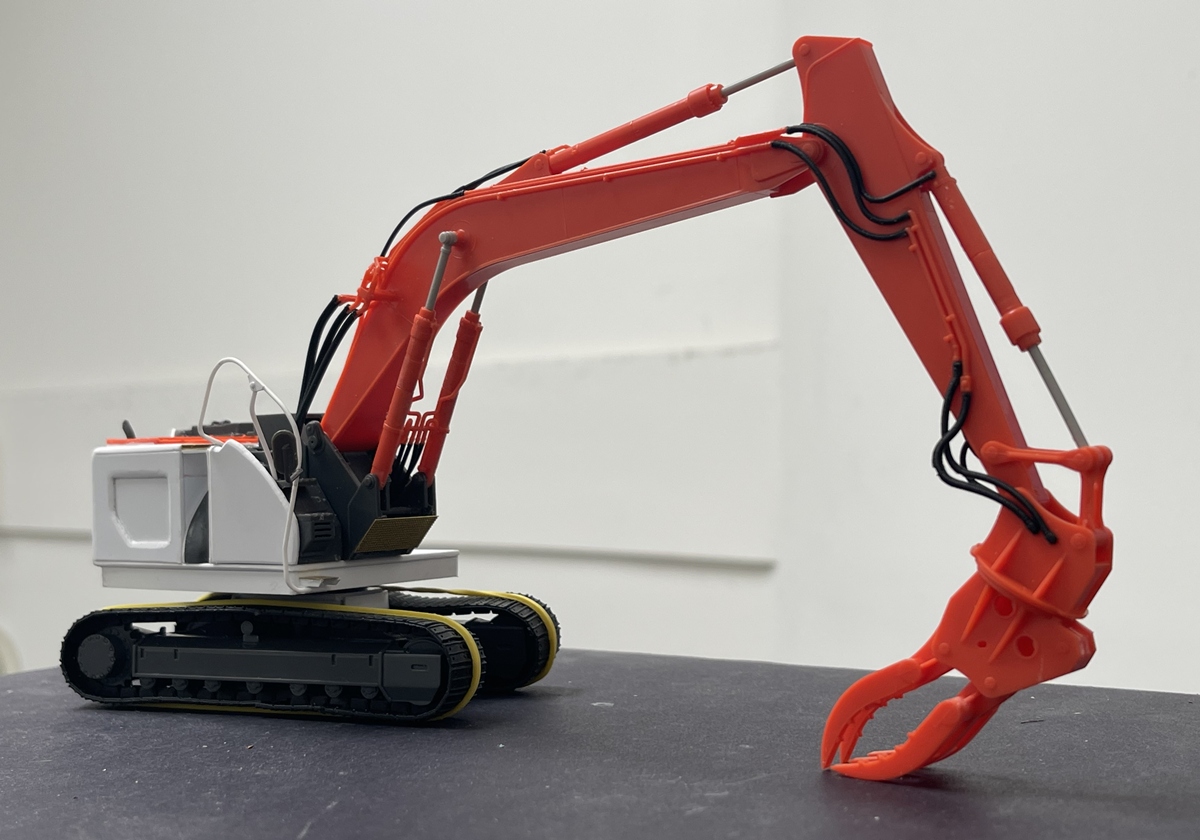
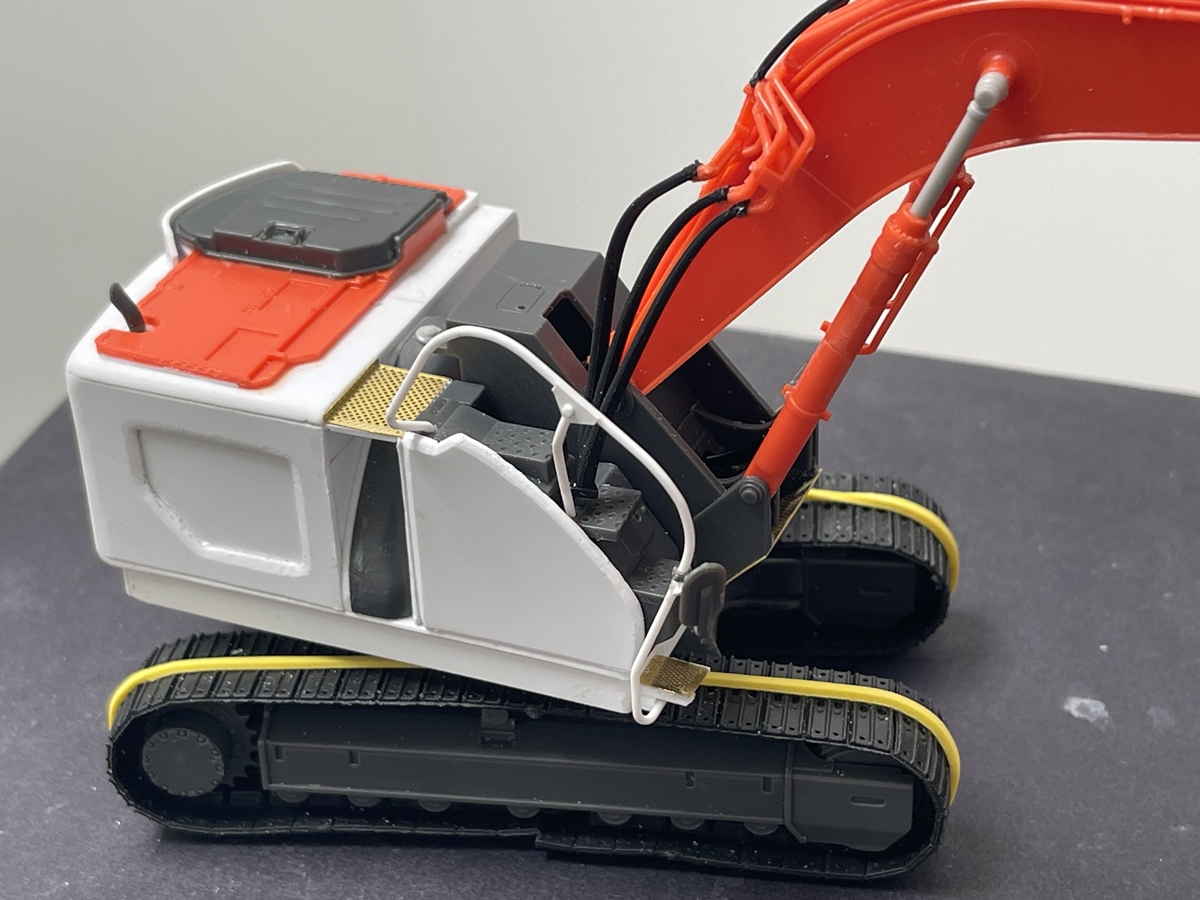
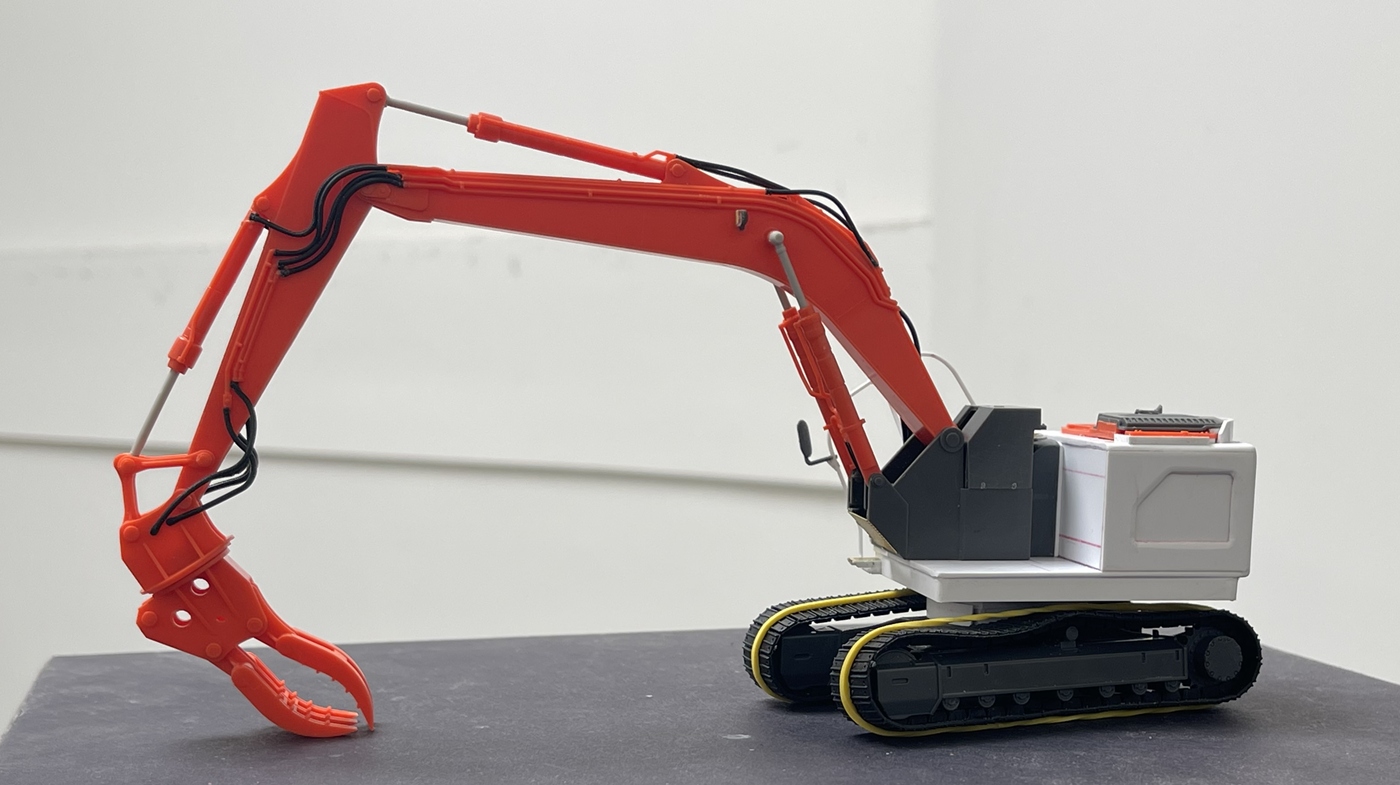
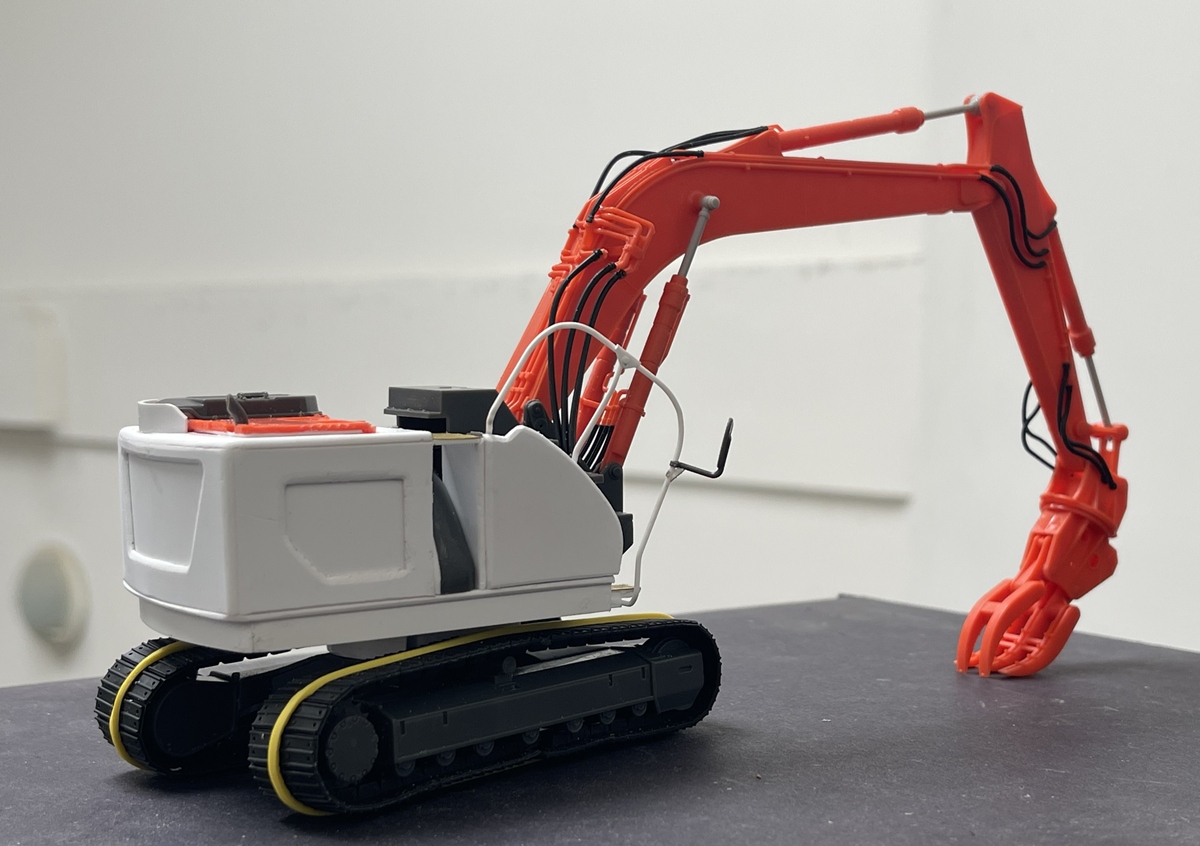
Hopefully the previously shared images make more sense now, as you can see, this now has the rear engine housing and an arm. I figured out that the base kit is close to what is often described as being a mini excavator, allowing it to nicely translate to a 1/48 scale medium excavator.

The conversion includes modified kit parts and scratch building. The Hasegawa kit is really nice as it is indeed a model and not a toy, even though the orange colored plastic has a toy-like look. It isn’t a toy, and the construction is a bit complicated and details are pretty nice.

The kit includes a nice handrail, but it is obviously 1/35 scale, so I used it as a template of sorts to make up a styrene stanchion and handrail assembly in 1/48. In real life, the Cat 317 has stairs too but, they access from the side and not the front. But, the parts fit really well as shown, requiring some cutting, but once together works fine.

The Cat 317 uses stamped metal to house the engine area, so to generally achieve this look I stacked .040” styrene sheet over .020” styrene sheet. I cut patterns out of the .040” sheet and filed the edges to achieve the look.

Now I’ll start on the cab. Unfortunately, it doesn’t look like I’ll be able to use too many of the kit parts as they clearly look 1/35 scale and not 1/48, but like the handrail, I am hopeful they will provide some general patterns for the scratch built parts.

OK, on we go

Cheers

Nick :man_biking:

5 Likes

While Hitachi developed it from an excavator, the Astaco Double Arm Working Machine is intended for roles in demolition and rescue operations, removing and breaking up debris to clear obstructions, not the digging that an excavator would do. What you’re doing is essentially taking the vehicle back to its ancestry, then reworking it to a different design. More work, but you come out with something unique.

3 Likes

I always wondered about the double arms on one of those Hasegava kits …

You can find videos on Youtube showing off the Astaco and get an idea of how it’s expected to be used.

2 Likes

So, yes, who’s not to say this excavator won’t be used for demolition?

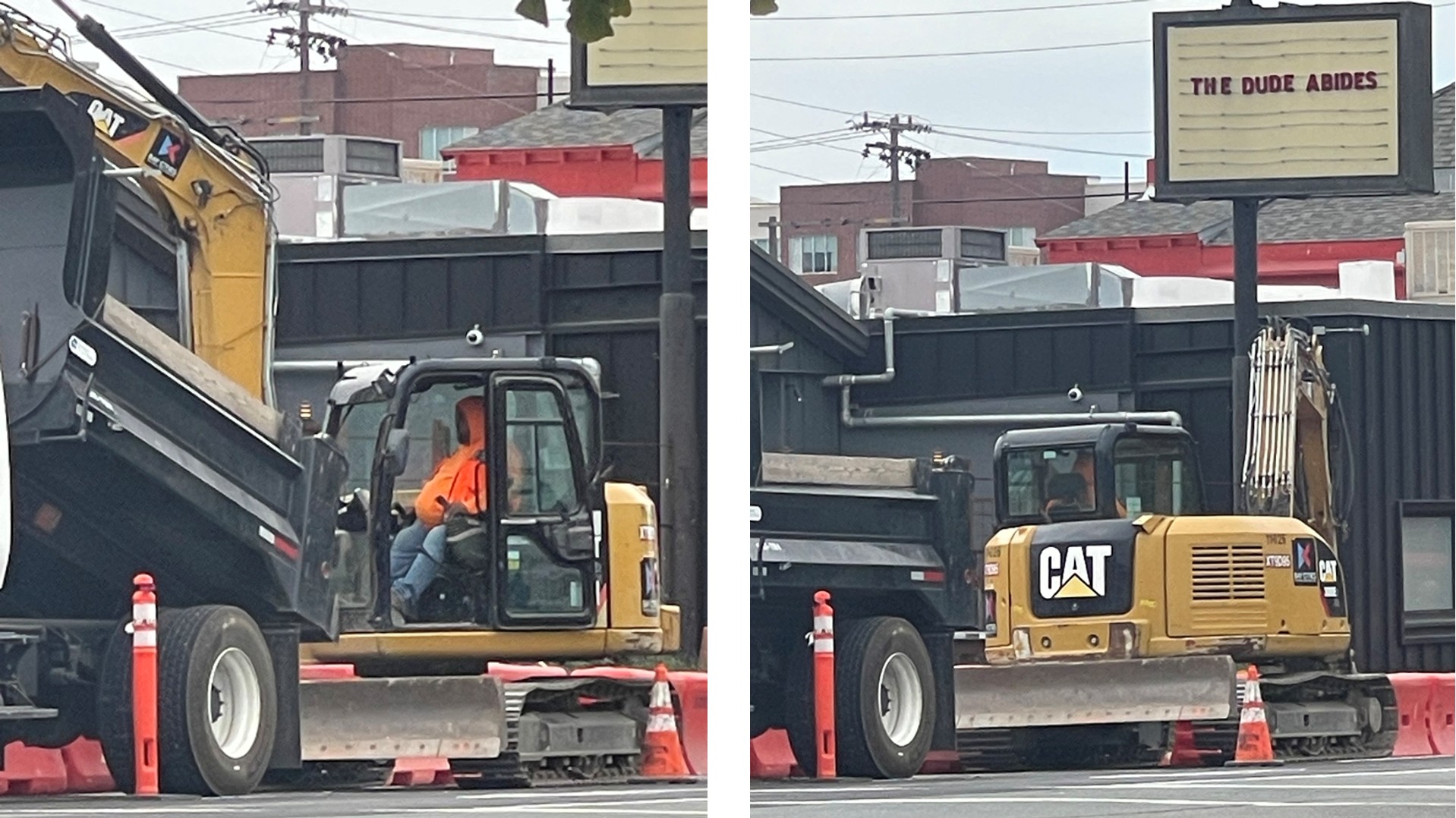
While I was out on my morning bike ride I came across these:

This is a Cat 326 with a bucket and thumb, and this, apparently a Dude approved mini:

And what I am making is this, a 317, which is between the two:

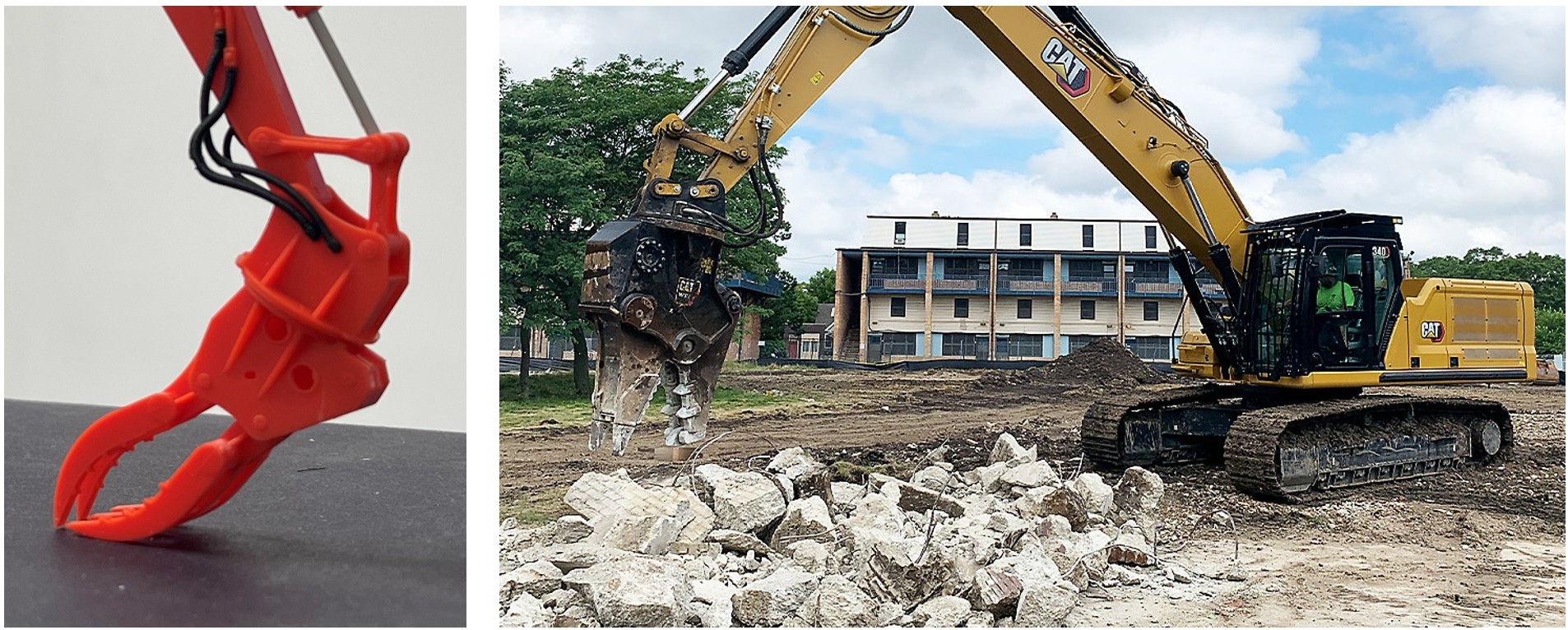
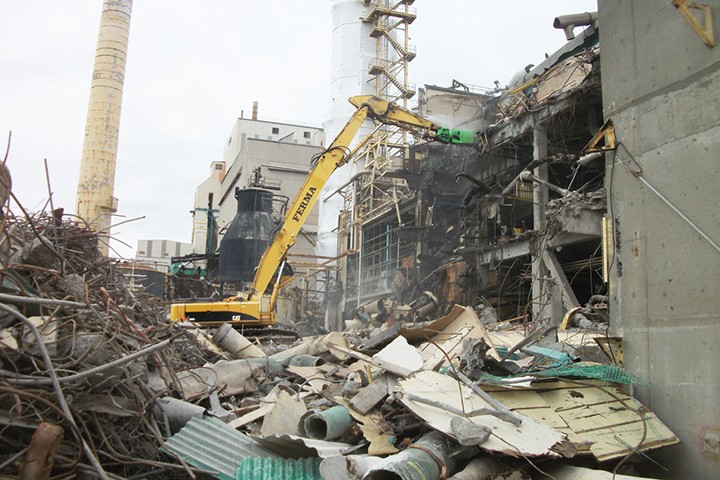
As you can see, the Cat has a crusher, but mine has a grapple, as of now. The kit includes a crusher, but it is small. This has made me wonder if I should convert the grapple to a bucket with a thumb, or make it look like a crusher? In any event, the dio might look something like this:

Uhhh, sort of like this. I will not be building a mid-rise and then tearing it down - or, at least not for now :grinning_face_with_smiling_eyes: That said, looking at this does make me wonder!

Cheers

Nick

4 Likes