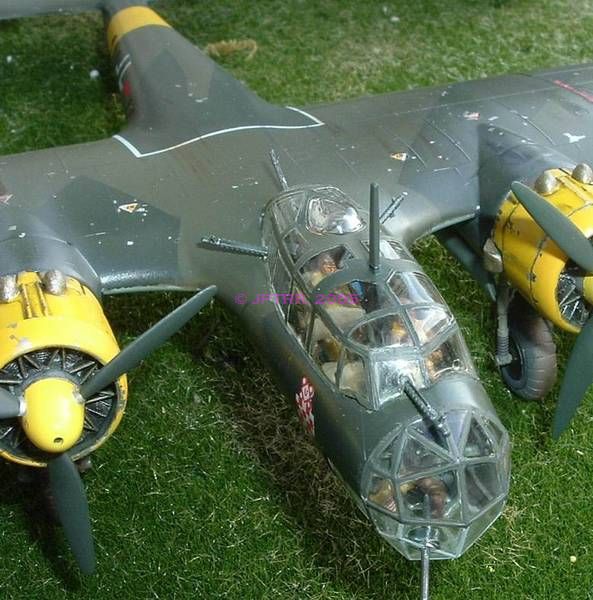
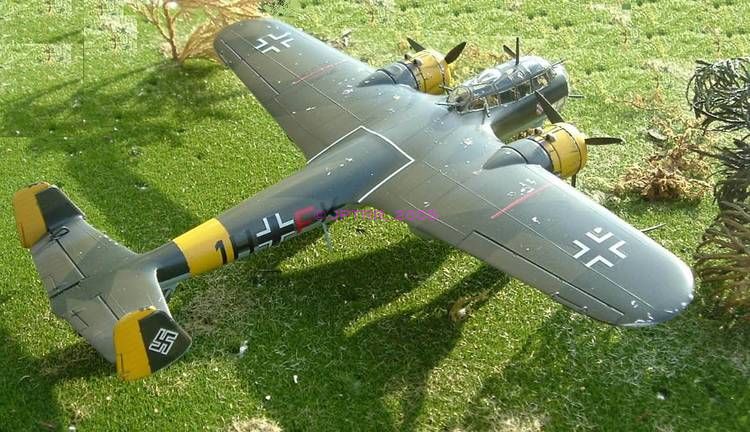
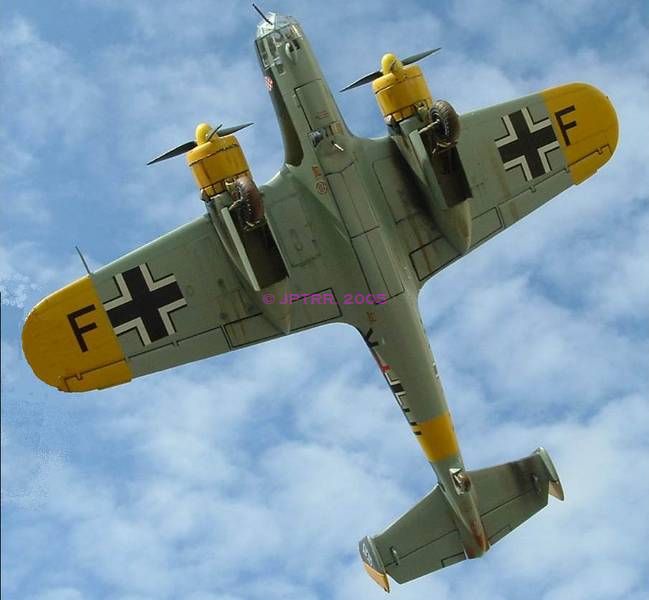
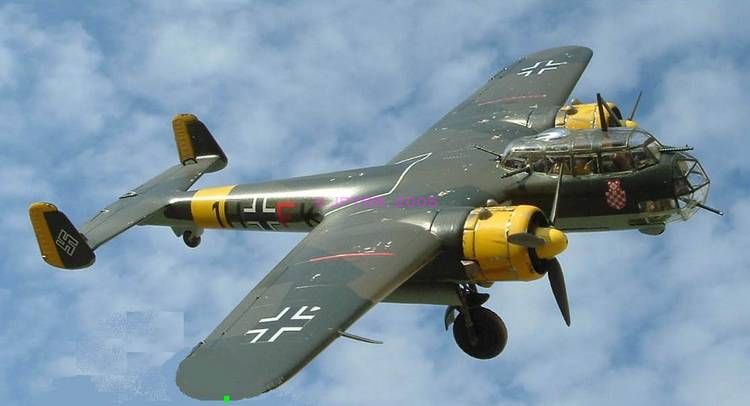
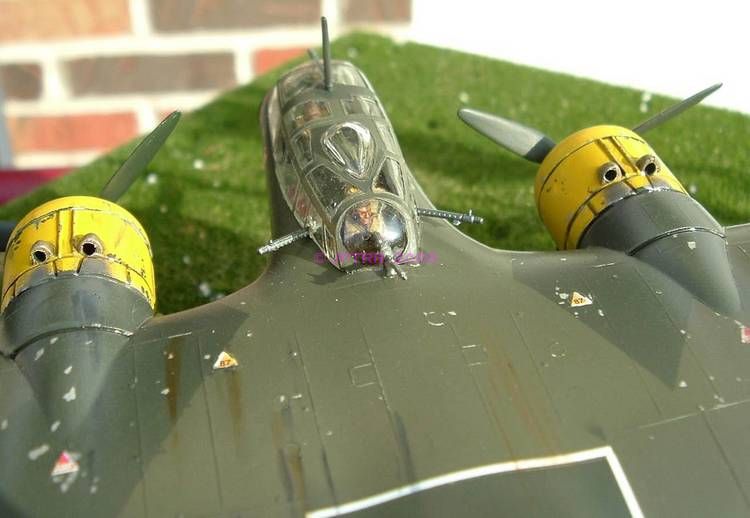
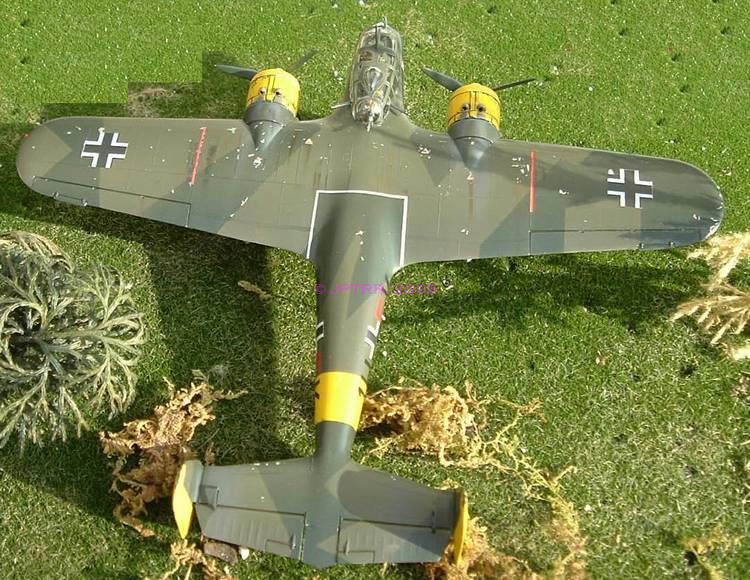
Another of my oldies but goooo - er, ah, not-baddies - Monogram’s 1968 Do-17Z. Not a recent build, it is revived from the archived Aeroscale, when I posted this c.2005.
I remember that I first bought this in '69 at Bill’s Pharmacy, one of my first 10 models. It has always been a favorite of mine. This is a retro-reissue and I put the wings together but, unable to just build a kit OOB, it was put it aside until I could figure out what to do with the cockpit. Finally, I revived it, added a cockpit floor, numerous resin panels and boxes and stringers, painted the crew, replaced the kit guns, and:
Carlos, thank you. Yep, lots of good memories. I plan to build Monogram’s A1E Skyraider ASAP, with and without the Cobra Company resin cockpit, and also the Monogram Bf 110. Fun time.
Friends, at the original post 20 years ago, I posted a photo of a Do 17 in North Africa, presumably in desert colors. The photo no longer opens. I recall KG 26 had a Gruppe supporting Afrika Korps, but didn’t find any photos today. Do any of you have any verification of Do 17Zs in desert colors?
Hi, I think the north African Do17Z operated with a heavy-fighter unit, ZG26. I have seen photos of an aircraft, coded 3U+FU, in a standard dark green/pale blue European-style colour scheme, but the Airfix Do17Z kit in 1/72 scale offers the same aircraft in a sand yellow/dark green mottle colour scheme. I’m sure there is a photo of the desert scheme online, but I can’t recall where I’ve seen it.
Hi… yes, this is the aircraft, but this is it still in its European camouflage. I’ve just noticed a slight coding anomaly… the aircraft I/D letter on the fuselage is ‘F’, but under the wing it’s more like an ‘E’. Perhaps the factory code ended in an ‘E’ and hasn’t been painted out? That was more of a common occurance than many might think. Thanks for providing a colour photo… much appreciated .
Yes, the changing of code letters makes sense when aircraft are transferred between different squadrons. Now the other question would be, did the aircraft ever wear a desert 78/79/80 scheme? At this point in time when the photo was taken, it’s captured and out of the war. Would it have been repainted from a tropical scheme to a continental scheme before capture?
Sadly, I have still to find such a photo of an aircraft with the desert scheme applied. Personally, I’d think it would have been unusual to repaint from a desert scheme back to a European scheme, although a lot of unusual things happened to Luftwaffe aircraft during the war. There are many model kits that offer the colour scheme, and although that is never a given, I would think it unusual if a model kit manufacturer didn’t do at least some research into their kits’ camouflage schemes.
There is a German/English language softback publication - “Dornier Do 17E-Z Do215” by Manfred Griehl (ISBN 3-935687-42-7) where, on the inside of the back cover, there is a colour profile of the aircraft in the sand yellow/dark green mottle.
Also, in another publication - “Luftwaffe Codes, Markings & Units 1939-1945” by Barry Rosch, p380, there is a photo at the top of the page which shows the aircraft slightly more clearly and still in European scheme, and it is evident that there is the ‘ghost’ of a coloured band around the forward fuselage carrying over to the opposite side, in front of the cockpit canopy. I only know of one unit equipped with the Do17Z that carried such nose band markings, and that was KG2. There is also a slight shadow in front of the ZG26 unit emblem, suggesting there was another overpainted emblem in that area previously. This strengthens my belief that the aircraft moved between units, and may explain the anomaly of the differing aircraft I/D letters on the fuselage and under the wing. Perhaps the underwing ‘E’ was the I/D letter when operational with KG2.
The image in the Barry Rosch publication also shows this Do17Z beside an Italian Fiat BR20 medium bomber, which has had its wings removed and potentially also some panelling from the fuselage. To me, this suggests either both aircraft have been moved to an aircraft ‘graveyard’, or they may be in a repair facility. There appear to be records of this unit, 10./ZG26, possessing around eight or nine Do17Zs during 1942 and their apparent movement to and from the unit, some as known losses and others for ‘overhaul’. I think these would have been used as utility aircraft, or perhaps transports for high-ranking personnel. There is always the possibility that this Dornier could have been repainted into the desert scheme after being at a repair facility. Unfortunately, the caption in Barry Rosch’s book does not provide a timeline.
Hi, one of the old fana de l’aviation has a build of the monogram skyraider, the old fana magazines had build articles , now it’s more avion de combat or wingmaster in france
Could that be the aircraft in the background of the photo that I posted? There is some sort of derelict aircraft in the background missing some fuselage components.
Sorry, been meaning to comment for several days. Like you said a lot of unusual things happened but the war. The Smithsonian’s Fw190 at Udvar-Hazy, they produced a detailed book about its restoration. I have that book so I can look up the following when I have the time. They detailed that while removing paint, there were several different costs of camouflage paint on the fuselage or empennage, including a desert scheme. They also noted that was obviously aircraft had been damaged and repaired several times.
Stikpusher: Yes, I think it may be the same Fiat BR20 hiding in the background of the image you posted. The removed fuselage panels appear to be consistent with those in the Barry Rosch publication. Also, you can just see on the BR20’s lower fuselage a thin area of light coloured paint under the area of shadow. I think that area is similar in shape to the rear-facing ventral gun position of the Fiat, which from memory, could be lowered and raised, so it wasn’t what I would call a fixed position.
JPTRR: Thanks for your input about the colour schemes on the ‘190’. Yes, there are many instances of multiple schemes being discovered during refurbishment and restoration projects. I don’t doubt you have a point there. I’ve been wondering how many ‘190’ airframes the Germans managed to get back from north Africa before their eventual defeat. I can well imagine that a ‘190’ would be much more valuable than an old war-weary Do17Z, and that was more where I was coming from. A pity this aircraft wasn’t set aside for posterity. It would’ve been interesting to see if it, too, had further paint schemes on it’s airframe… .

 .
. .
.