Keeping with my current para them I plan to show guys right after they were nabbed prolly by the 82nd Abn. Trying to show the “five S’s” acronym taught by the US Army for dealing with POWs. “Search, Silence, Segregate, Speed and Safeguard”.
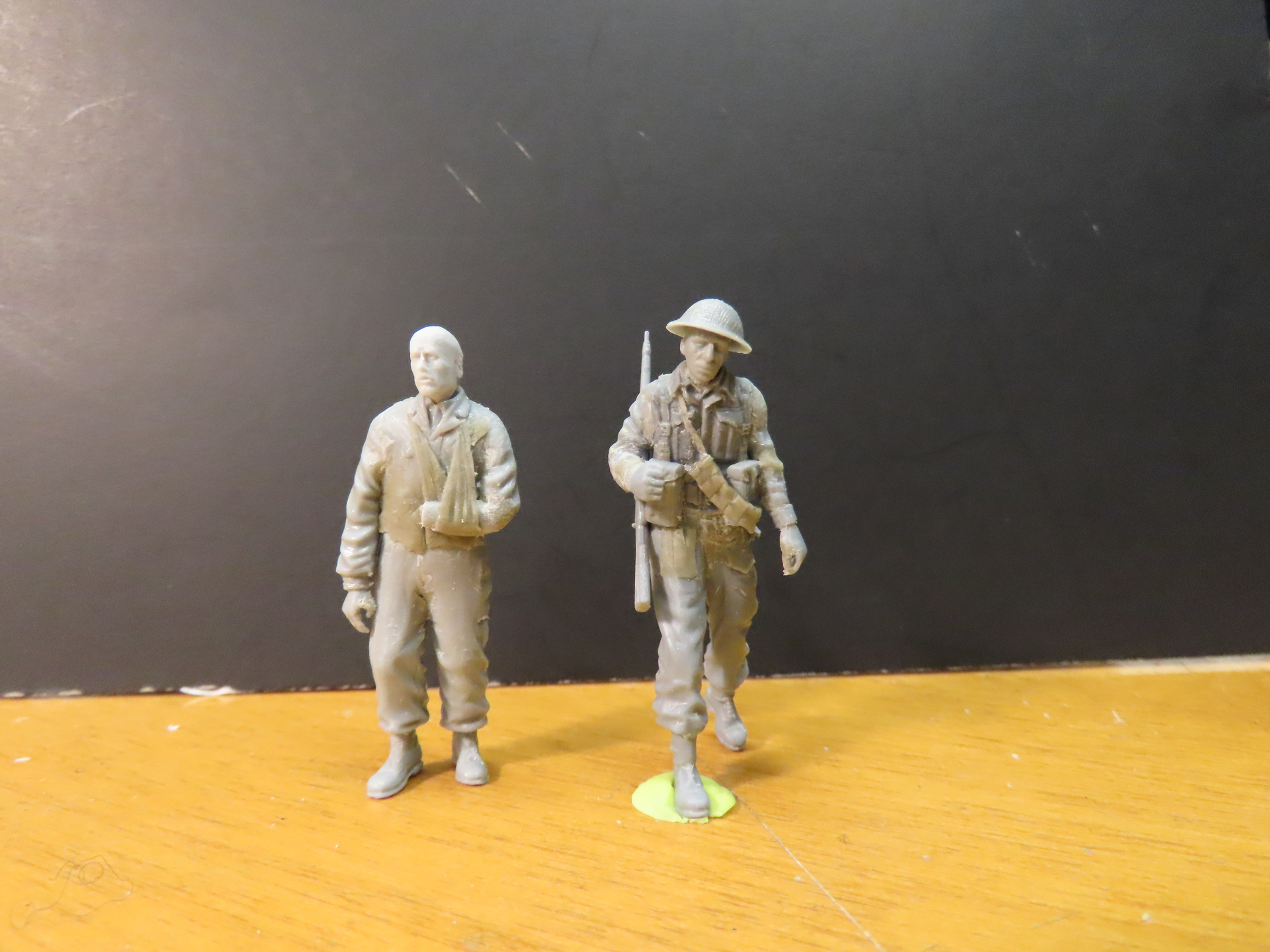
First chap has been searched. Yet another Jock has wormed his way into the lineup here. The para is a modified Dragon fig with an Alpine head with the helmet surgically removed. Various layers of putty applied.
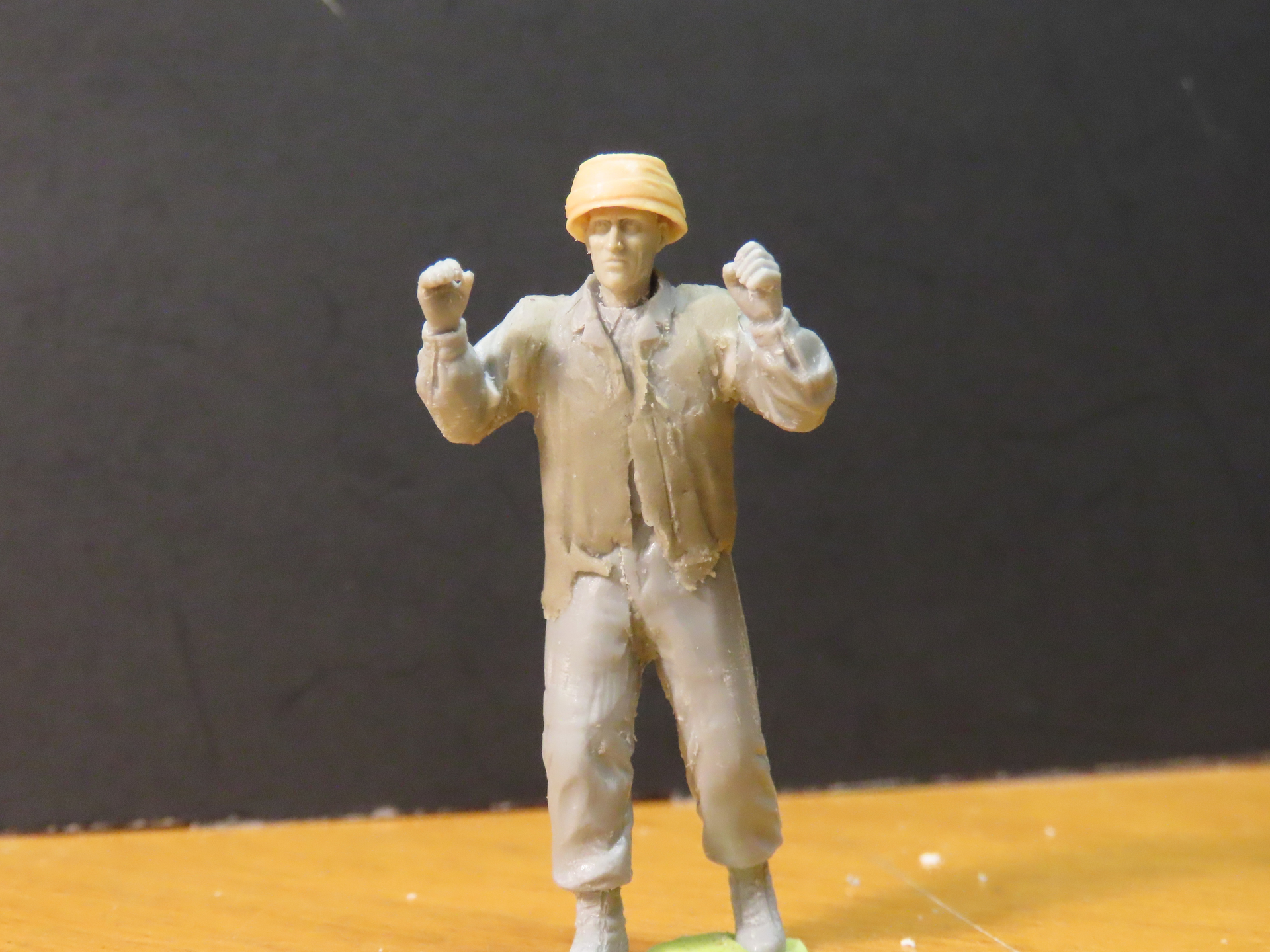
I think most scale para helmets look a bit small so I tried going for a smaller Hornet head and a larger Warriors helmet. Once again a modified Dragon guy with mods to have his arms and hands like this. Very initial stages so lots of bulk putty still in place.
I dunno, maybe some will find this mildly interesting. Heheheh
J
Is that a modern thing, or a Second World War one? It sounds modern, is why I ask, and modern attitudes towards captured opponents are rather different than back then.
I did learn this in 1977 for sure but it has a very sound practicality to it so I cannot see why something like that was used back then. It was not written policy for example to clip POWs. Only a few American commanders gave such orders. Speeding to the rear so maybe very valuable intel can be cleaned is very wise as well as segregating NCOs from other ranks plus. officers. My point is maybe the acronym was not taught but I fully believe the concepts were.
Those core modern principles were all derived from experience which have since been broken down into easily remembered phrases or acronyms (soooo many acronyms that still sneak into daily life! Who else sees license plates and can associate an acronym for most of them?). The principles of prisoner handling like speed, separation and search have been in place for a long time. Remember too that the KISS principle came out just before WW2.
Possibly, but I wouldn’t assume it to be. Also, you’ve got at least one British/Commonwealth figure (whose ammunition pouches sit too low, incidentally), and their procedures for dealing with POWs might be totally different from how the Americans did it.
I’m happy to be proven wrong on all of this, BTW — the main reason I bring it up is because you seem to be starting from principles that may or may not apply to the time your models are set.
@“clip” is a Mob slang for murder.
@ forget about the Scotsman he isn’t involved in the scene he was just in the old pic I took with the POW. @Pouches too low? I own a real pouch and the loop in the back corresponds to the belt on my fig as shown. I would say however that the buckles and attachment points on the Tamiya torso were molded a bit high.. @The 5 “S” acronym is an easy way of teaching what are very basic infantry methods for SOPs dealing with POWs. And yes I do assume most modern armies use the methods proscribed IE Search the POW while you segregate officers and NCOs from the enlisted men, keeping them silent so no plan to escape can be made. You then speed them to the rear while safeguarding them from injury by either hostile civilians, friendly troops or even artillery fire which is why POWs are usually allowed to keep their helmets initially.
As a qualifier I would add I served 17 years in the US Army Infantry and so am a bit familiar with this stuff. I am also wondering why this axle is getting wrapped.
Ah, OK. Because he’s in the photo, I thought he was going to be part of the diorama.
OK, it looks on the figure like the pouches are centred on the belt, while pictures of real ones (I don’t own any, at least not Pattern ’37 ones ) show the patch with attachment hooks to be a little below the centre.
The axle being referred to is an expression. Apologies but often we forget that many English language expressions are hard to understand, particularly when English is a second language but sometimes even for those of us with English as a first language!
In this instance, to get something wrapped around the axle means to be distracted by, or held up by, something that is not central to your task. Driving over loose wire and the wire wrapping around your vehicle axle will cause you to stop and focus on unwrapping it so you can continue your journey.
In the posts above, the discussion about whether such tactics would have been used in WW2 is considered a distraction to the central task of Jerry showing us his funky modelling skills. Unwrapping (meaning discussing or clarifying) that is delaying our seeing the next steps in this dio.
Question - The putty you’re applying is Magic Sculpt, correct?
Your feedback on using this would be helpful. Many years ago, trust me many, I tried Aves, Squadron, Tamiya, Miliput. Just curious how your comparisons lay out. Thanks
SamS has made a fairly close explanation here so I won’t repeat it. I enjoy a good discussion but it seemed like things were deviating from the main topic a bit ? Or maybe I am imagining that? Yes,we were getting “wrapped around the axle” by the discussion and also another nice American slang phrase" down in the weeds". Or in other words getting a little too over focused maybe ? I dunno. Anyway I shall soldier on.
J
Well Dave all I can say is I’ve been using it for years and have done dozens of figures and even airplane model master patterns using it and I will never change.
J

 ) show the patch with attachment hooks to be a little below the centre.
 , I tried Aves, Squadron, Tamiya, Miliput. Just curious how your comparisons lay out. Thanks

