First of all, the vast majority of what I will write in this thread is the result of about three years of looking into the subject, independent research of mine aside (talking to veterans, photographic evidence, archives and such), I have chatted with other notable historians on the topic and of course used a wide variety of books, of course you may ask for a source on anything or just recommendations for further reading.
I will not explain in great detail everything, and there is a lot of context missing for someone how has no idea about Israeli tanks, if something is unclear just ask away.
I will make other posts under this topic however I’d begin with Sherman gun tanks… Or at least Shermans Part 1.
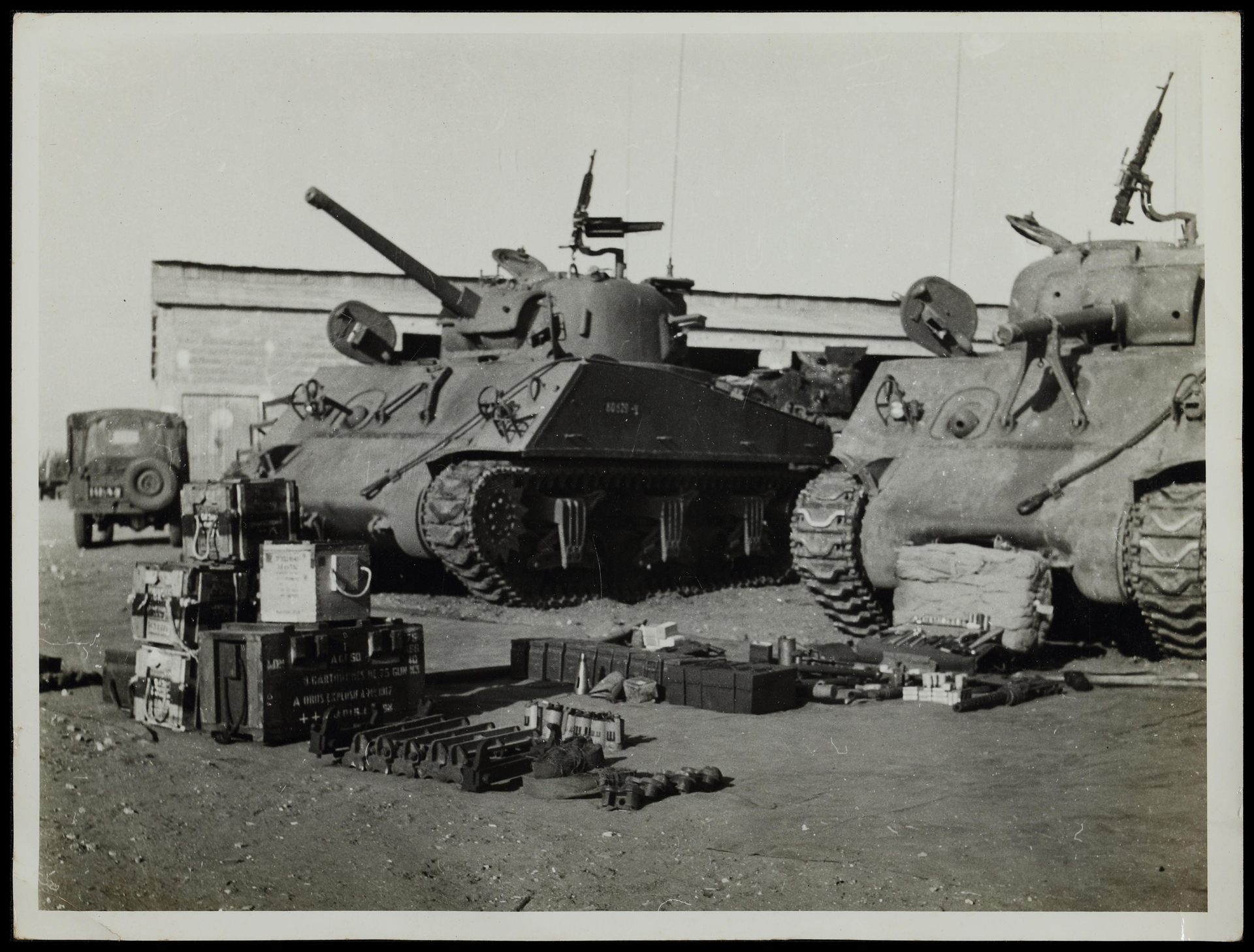
Israeli Sherman Degem Alef Keva. Note the ammunition box for the French HE Mle 1917 shells, hinting that they were used in early Israeli Sherman tanks.
In spite of what one might think, while yes some of the most popular post-war Sherman tanks were of Israeli origin, we have a lot more research before us, and a lot of which I will write on the post-1973 Sherman tanks in Israel stems from independent research which is very much ongoing.
In May 1948, a Jewish nation is birthed, while yes even since November 1947 the land had been in a state of a civil war, it will now turn into a full scale invasion.
On the 14th of May, using bribery the first Sherman, or perhaps the first tank, reached Israeli hands. It was an M4A2, I believe Federal Machine & Welder (FMW) production September 1943. It was busted up, but all was repaired or replaced except for the 75 mm M3 main gun. It was decided to replace it for the time being with an Hispano Suiza Model 804 L/80 20 mm Anti-Aircraft cannon, which was installed inplace of the original gun inside a cylinder made of either metal or wood to make it seem like the original, more menacing 75 mm. It was named “Meir” and given the serial number 3999.
David Ben-Gurion, the first Israeli prime minister and the de-facto ruler of the newborn nation during the war had kept a diary. Unlike personal diaries that people like you and I might keep, his was a war diary, a compilation of documents and reports and the bottom line of conversations he had with officers and his deputies. A diary entry from the 30th of May 1948, on the dispersion of 20 mm anti-air cannons in different places reads:
“20mm anti-air: […] 1 on Sherman tank (?)”
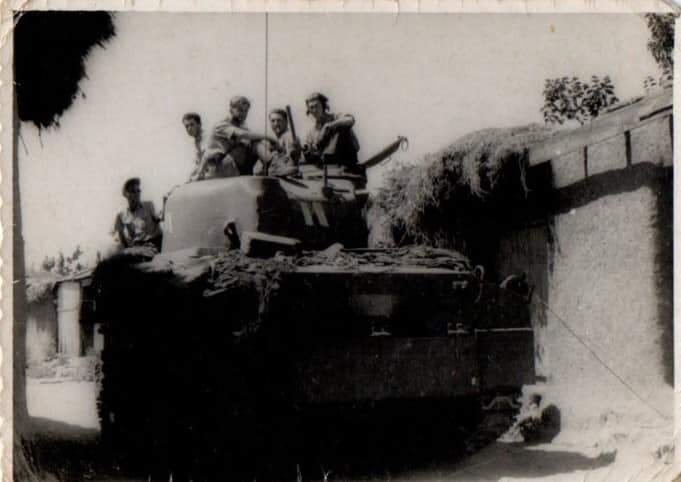
One of the few photos I have of the M4A2 “Meir”, no caption sadly. Note the turret is of the type with no pistol port whatsoever.
At the same time the M4A2 “Meir” was being fixed up Brigade 8 would be formed, and it shall be commanded by one Yitzchak Sadeh, perhaps one of the most interesting IDF commanders of all time. Under the brigade three battalions would form:
The tank Battalion, Bat. 82, which was commanded by Felix Beatus. It is impotant to note, that while on paper it was a tank battalion and eventually after the war it would become a fully functional tank battalion which exists to this day! (Battalion 82 “Ga’ash” is in Brigade 7 nowadays), during the war the IDF had never fielded even twenty tanks, and never all at once, at times not a single tank was operational.
The commando battalion, Bat. 89, commanded by legendary Moshe Dayan, who’d continue to rise the ranks of the IDF long after the war, eventually becoming Chief of Staff.
The support battalion, Bat. 88, commanded by Netanel Chitron, it was the last battalion to be formed and consisted of mortars.
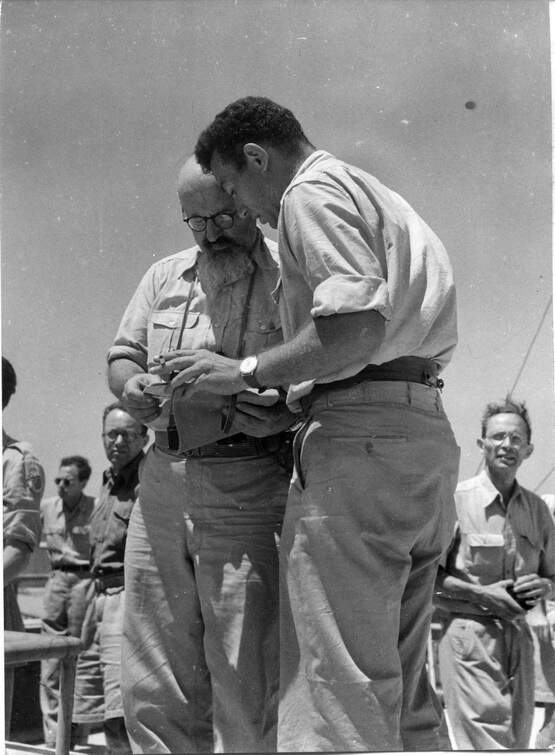
Yitzchak Sadeh (on the left), with the beard (which he hated) and glasses, chatting with Felix Beatus (on the right) during Operation Danny
Fun fact: Nowadays Brigade 8 exists as a reserve brigade in the IDF, it is also called “Chativat HaZaken”, meaning The Old Man Brigade, due to Yitzchak Sadehs iconic beard which gave him the look of an old man!
As the war progressed, the IDF had acquired additional Shermans from Italy, specifically from a scrapyard in the town of Forli. They were M4 (105) VVSS Shermans, perhaps ex-British, which had their M4 105 mm Howitzers de-militarized.
As they reached Israeli shores, the IDF began repairing them, but the de-militarization process which they had endured meant that the original howitzers could not all be replaced.
Swiftly the IDF had searched for 75 mm M3 cannons, and had purchased three from Italy, they arrived in September.
The M4A2 “Meir” would have the 20 mm Hispano-Suiza replaced with an M3 75 mm, it would be repainted and given a new name! “Mania”. The other two would be used for the first repaired Italian Shermans, the first would be the Tamar, and the second was Root II, a third Sherman would be repaired and pushed into service without a main gun, used as a tractor, called Eda.
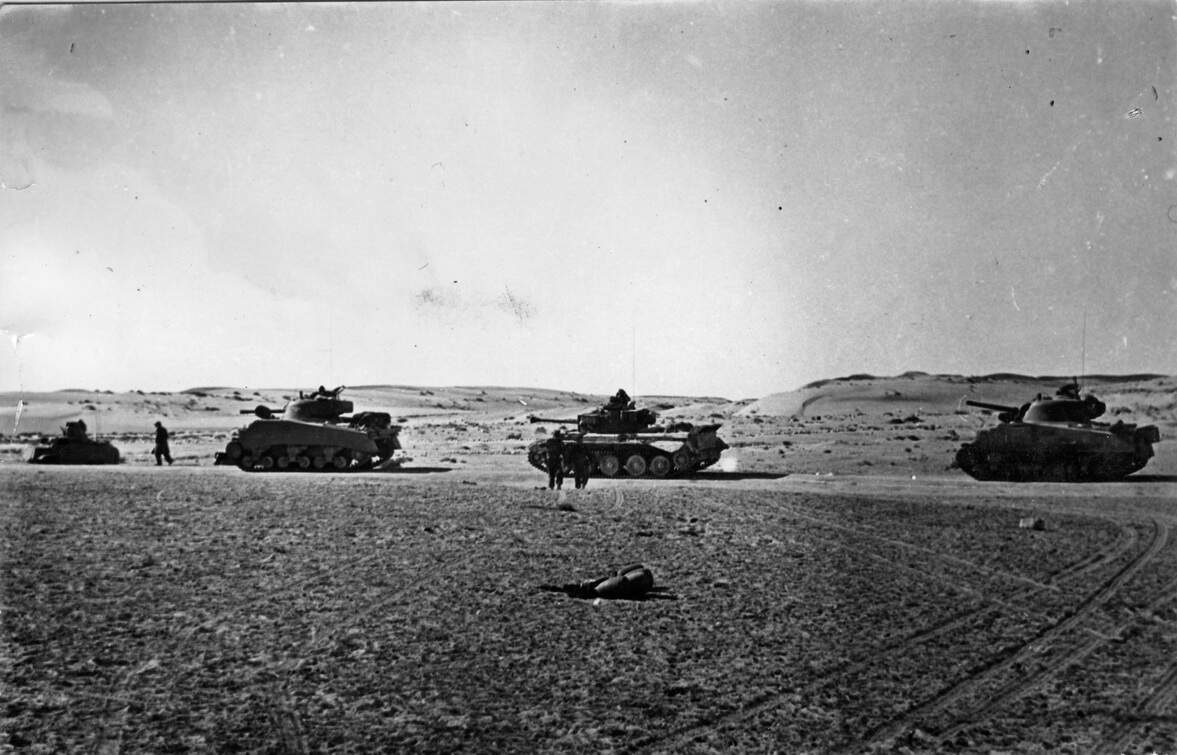
Left to right: Tamar, Cromwell 211, Mania.
Ironically, the first Israeli tank, would be the last one to be lost in the war, as during a battle on the 29th of December 1948, during the push northwards to El Arish in Sinai (Operation Horev), the M4A2 “Mania” got stuck, to not let it fall to enemy hands it was blown up the next day.
Perhaps I’ll expand on it in a future post if you’d like, but long story short, immediately after the war the only tanks which the IDF fielded were Shermans, specifically with the R975 engine.
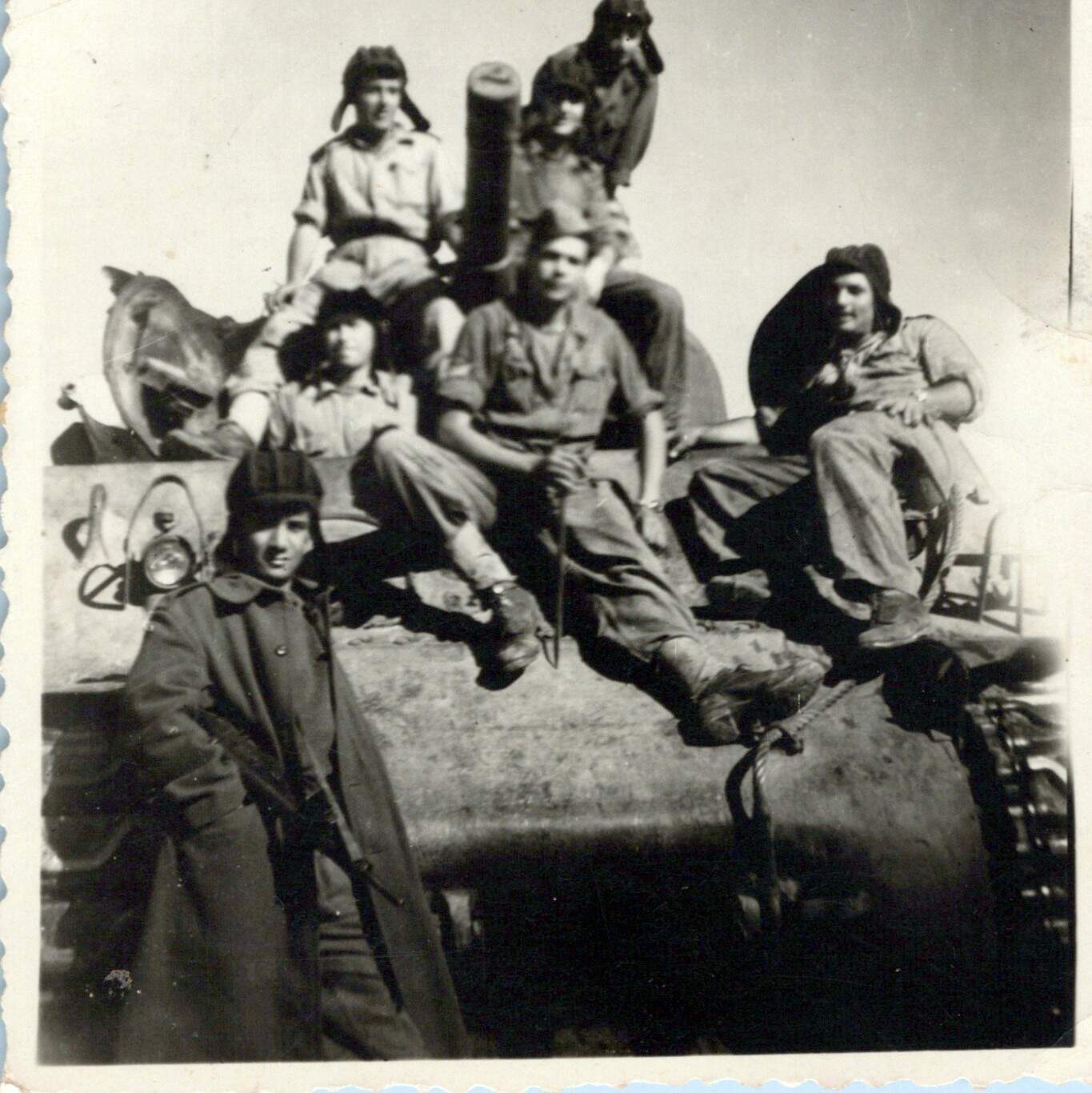
Krupp Sherman of Battalion 82, photo taken by my Great-Grandpa, 1950-52.
In April 1949, Brigade 8 would disband and Battalion 82 with it’s Shermans would be transferred to Brigade 12. Additionally, as a stopgap measure, M1903/22 7.5 cm Krupp Field Guns would be installed in six Sherman tanks until M4 105 mm Howitzers could be repaired to replace them.
The M52 Combination Mount was retained in the Krupp Shermans, and in just a couple years they would cease to exist.
As the fleet grew, designations were needed:
75 mm M3 cannon - Sherman Degem Alef (Sherman Model A)
105 mm M4 howitzer - Sherman Degem Bet (Sherman Model B)
Ara’ee - meaning “temporary”, vehicles which had yet to be upgraded to the new IDF standard, just pushed into service.
Keva - meaning “permanent” , vehicles which were upgraded to the new IDF standard, for example BESA roof machine-gun for anti-air.
Sherman Degem Alef footage, 1951
Importation of tanks and main guns continued, France, Italy and the Philippines. From France the IDF had mainly imported M4A4Ts, the T stands for Transforme, M4A4s re-engined to use the R975. Some Shermans were imported with other engines but they would always be re-engined to R975 before entering service, and the engine deck was changed accordingly to that found on M4/A1.
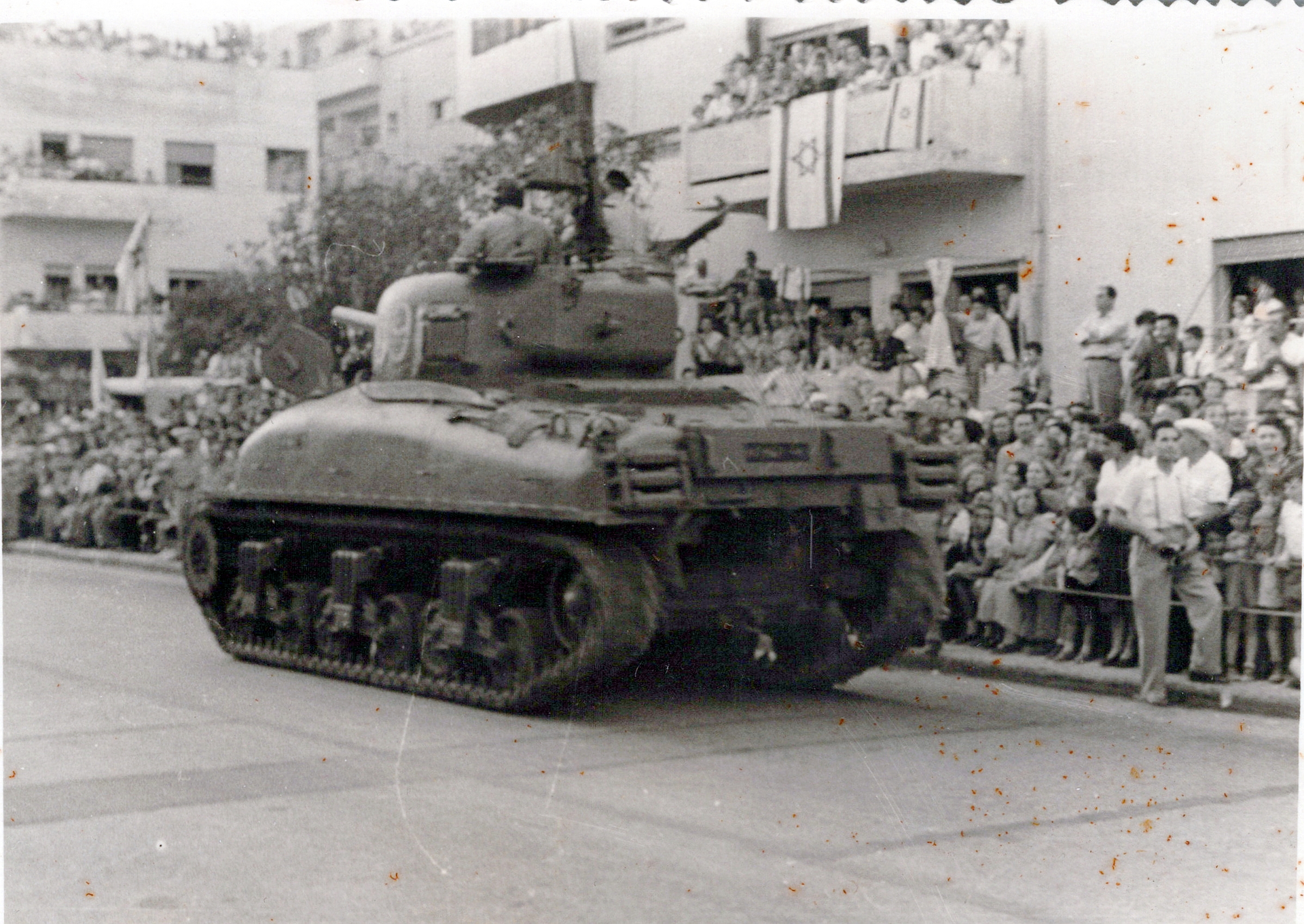
Rare! M4A1 tank on parade, I believe 1953, I have only ever seen three separate M4A1s with the original 75 mm M3 gun in IDF service, two imported from the Philippines like this one, and one from France. Photo from my private collection.
As time passed, Battalion 82 would again transfer, from Brigade 12 to 7, and as the tank fleet expanded so did the IDF. Reserve brigades 27 and, later, 37 would form. And modern AMX-13 light tanks would be imported from France alongside new 76.2 mm armed Shermans.
As these were purchased in 1955 a new designation system arose.
Sherman M-3 - 75 mm M3 gun
Sherman M-4 - 105 mm M4 howitzer
Sherman M-1 - 76.2 mm M1 cannon, technically… M1A1/A1C/A2.
Super-Sherman - 76.2 mm M1A1/A1C/A2 cannon, with HVSS. Yes! Contrary to popular belief, this was not some Israeli upgraded variant!
M-50 Sherman - Sherman with the SA50 75 mm gun.
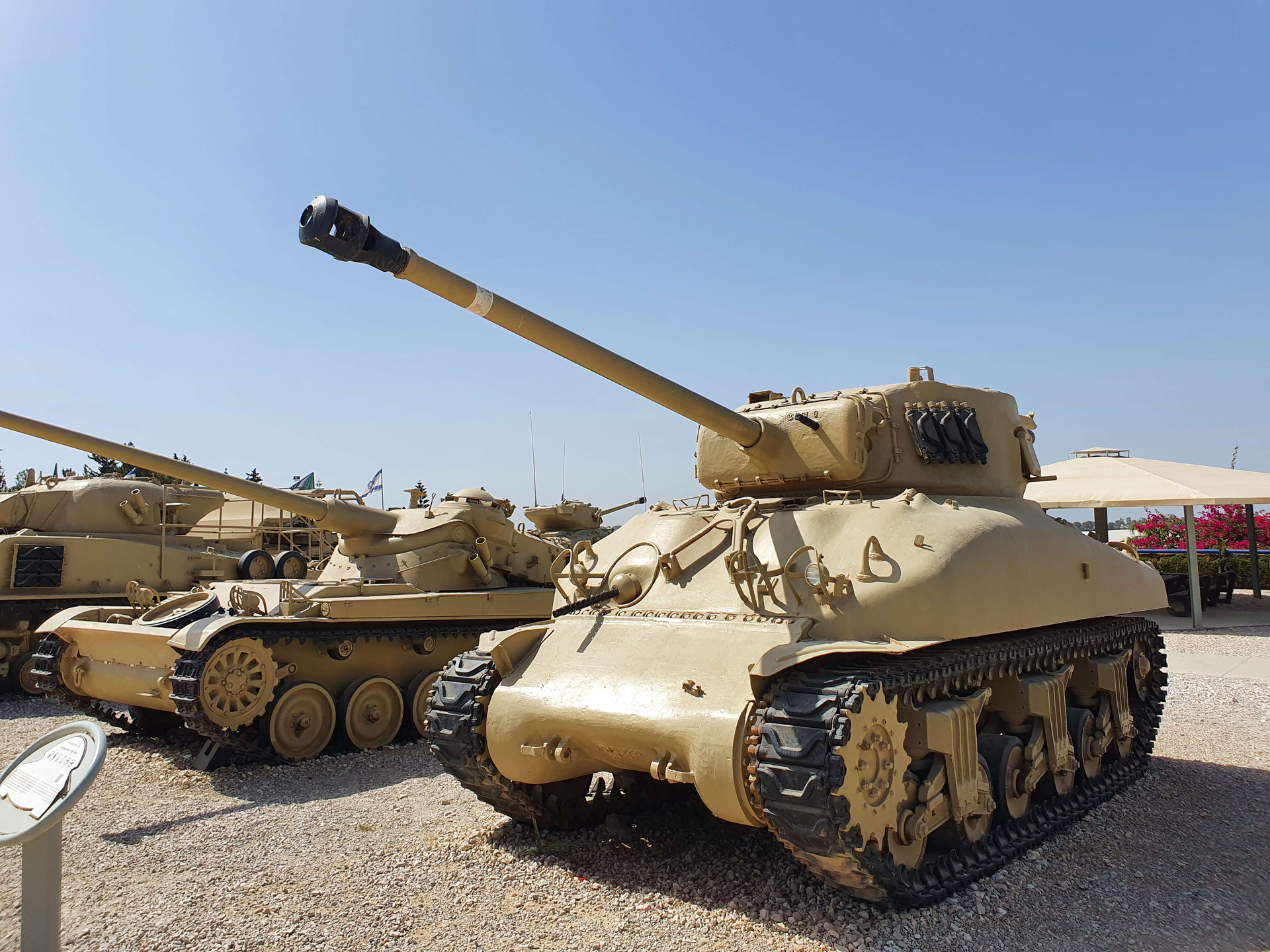
M-1 Sherman tank in Yad La-Shiryon memorial site in Latrun, Israel. Photo taken by myself a couple of years ago.
Ah, the M-50 Sherman, Egypt, which was seen as the main threat at the time, had a rapidly advancing armored force, initially purchasing armored fighting vehicles from Britain and in a limited manner from France, and later from Czechoslovakia. The IDF had to update, upgrade, and improve its aging fleet of M-3 Shermans.
Additionally, in an effort to avoid restrictions and costs of armament acquisition, the IDF preferred to purchase unarmed Shermans, in the hopes of arming them once they reach Israel. At the same time, the IDF began to build interest in the French AMX-13, a light, modern tank, one notable feature of which was the powerful SA50 75 mm L/62 cannon, powerful enough to deal with the threats found in the Middle East of the era. In order to solve the aforementioned issues, arming unarmed Shermans in Israel and upgrading the M-3 Sherman fleet, the IDF began a project to mount the SA50 gun in the Sherman turret. The M-50 Sherman was born.
I also have paragraphs comparing the M-50 and 76.2 mm armed Shermans but I’ll keep that for a future article…
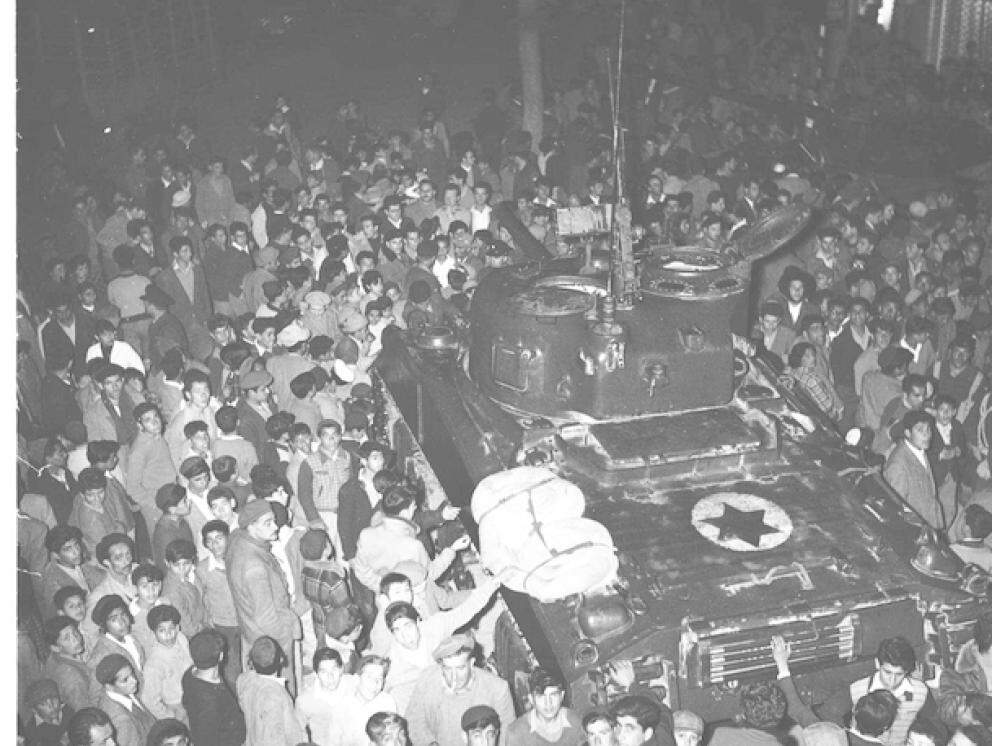
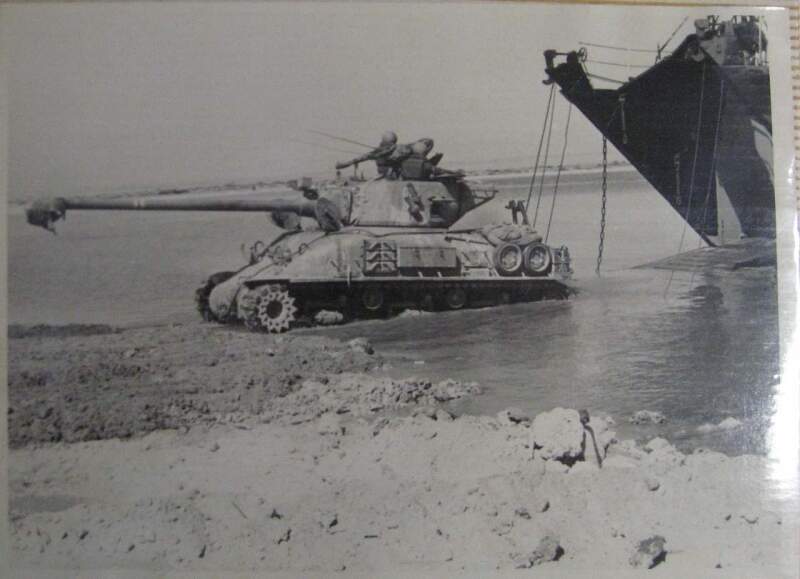
M4A4T, note the Star of David on the engine deck used for Friendly Identification until the 1956 Operation Kadesh. Also note the M2 .50 Cal machine gun. 1956.
In October 1956 the IDF invaded Sinai yet again! As a part of Operation Kadesh, Shermans served in all three brigades and faced Egyptian Shermans as well, Egypt had imported M4A2 and M4A4 Shermans from Britain, and re-engined their M4A4s to use the GM6046 engine of the M4A2. Additionally, with the help of France some M4A4s were upgraded with the AMX-13’s FL-10 turret, not too dissimilar in idea to the M-50 Sherman.
While the IDF wanted 50 M-50 Shermans ready in time for the Operation, and while IDF M-50 unit structure called for 14 M-50s in a company, only twenty-five M-50s were ready, thirteen in Company A of Battalion 82 Brigade 7, and twelve in Company C of Battalion 277 of Brigade 27.
On the 31st of October 1956, Company Alef of Battalion 82, the company equipped with the M-50 Shermans, was engaged by Egyptian M4A4 FL-10s at a range of two kilometers. The engagement ended with Egyptian tanks retreating. During the engagement, four Egyptian M4A4 FL-10s were knocked out, while zero Israeli M-50 Shermans were damaged. Had the Israeli tanks present in the engagement been armed with any other kind of armament found on IDF tanks, the Egyptians would simply outrange them; however, thanks to the M-50s SA-50 75 mm cannon, the IDF tanks managed to return effective fire, avoid casualties, and force the enemy into retreat following losses!
The fact that both sides of the conflict utilized Sherman tanks, resulted in a terrible friendly fire incident in the IDF, following the war, the IDF would begin heavily utilizing tactical markings, in an effort to avoid such incidents in the future.
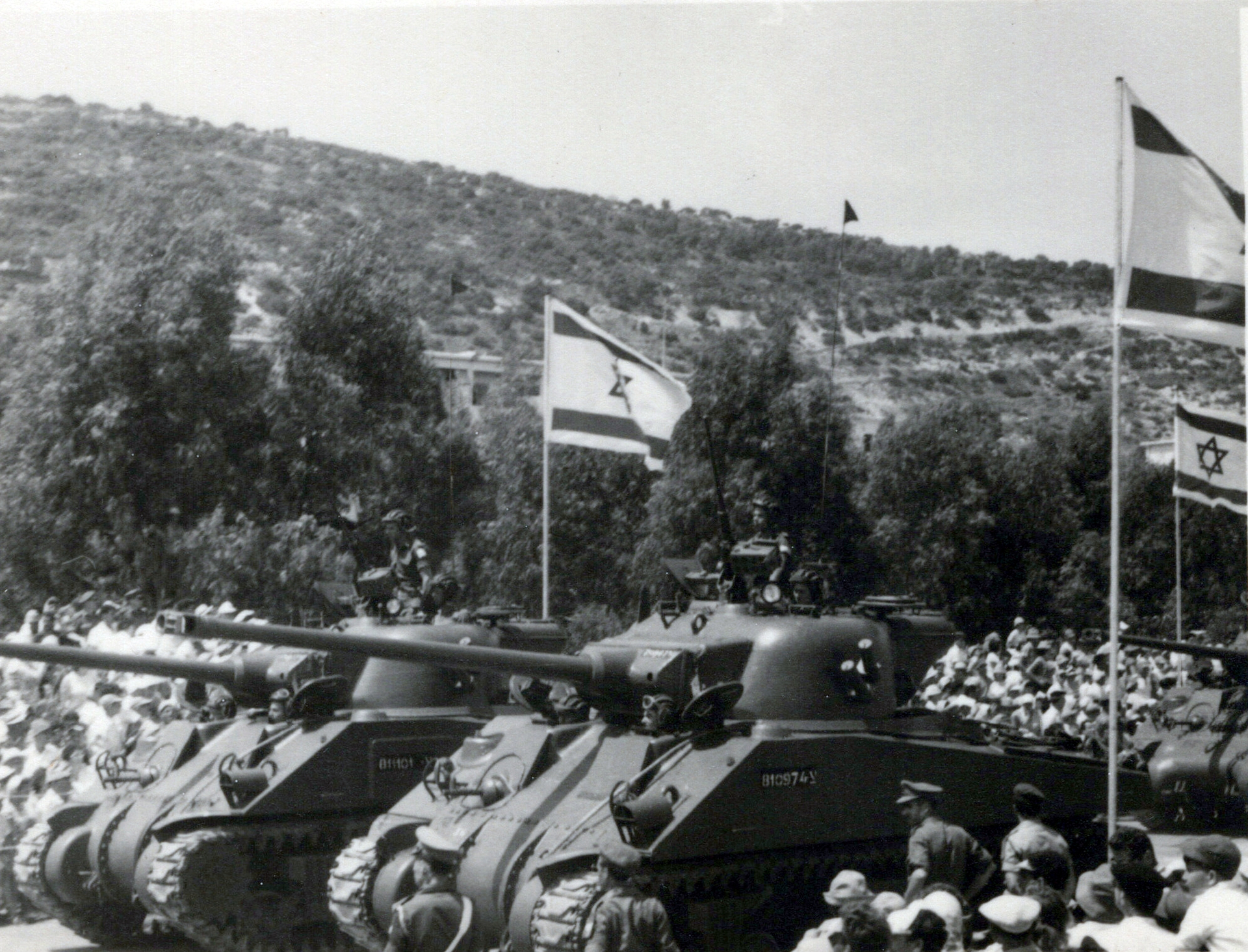
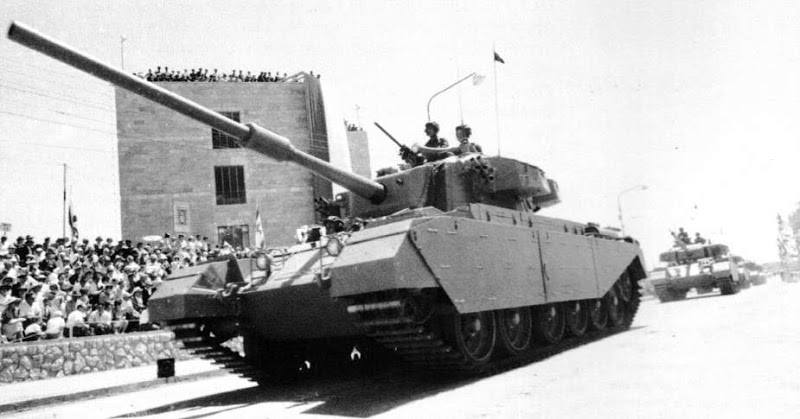
M-50 Shermans on parade, I believe 1963 Independence Day Parade, photo from my private collection.
Additionally in 1957 the “Optimal Sherman” programme would begin, eventually birthing the M-51 Sherman in 1962. The M-51, unlike the M-50 which was converted from 75 mm and 105 mm Shermans, the M-51 was converted from 76.2 mm armed Shermans. At the same time, the first batches of Cummings VT-8-460B1 engines arrived in Israel, while yes the first batch of M-51s was produced with R975 engines, since then all new conversions, M-50 and M-51 alike would use the Cummings engine, and R975 engine Shermans would be converted to Cummings. By the way, with the Cummings engine came HVSS to the M-50, which until now used VVSS.
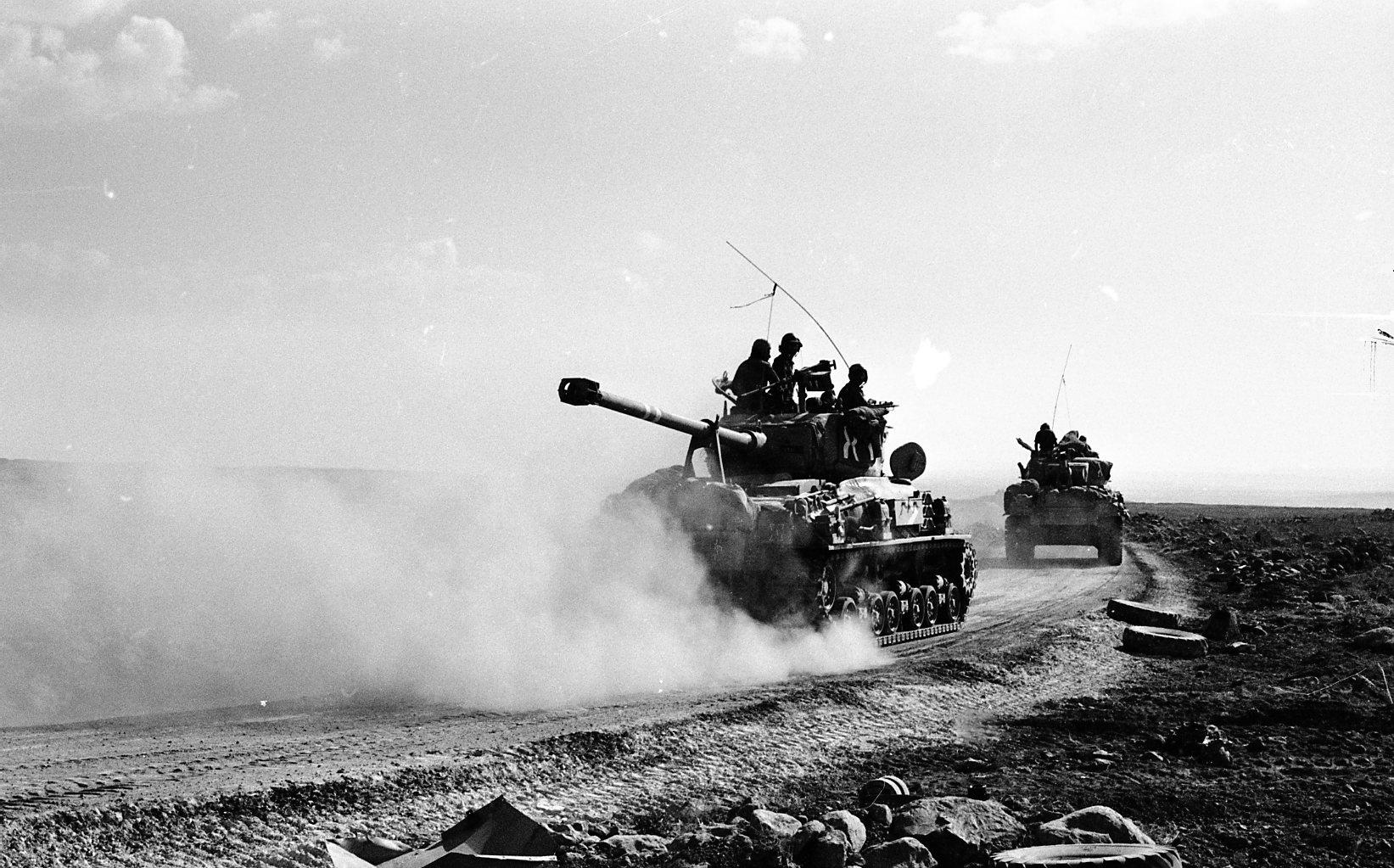
M-51 and behind it an M-50 of Battalion 377 Brigade 9, during the 1973 Yom Kippur War.
I did neglect to mention M-10 tank destroyers, technically Sherman family, and they did serve in Israel however did not see combat, and while I do have information I’d like to wait for another batch of documents from the IDF archives. But they did retain the GM6046 engines, logistically it was supplemented by using the engines from captured Egyptian Shermans!
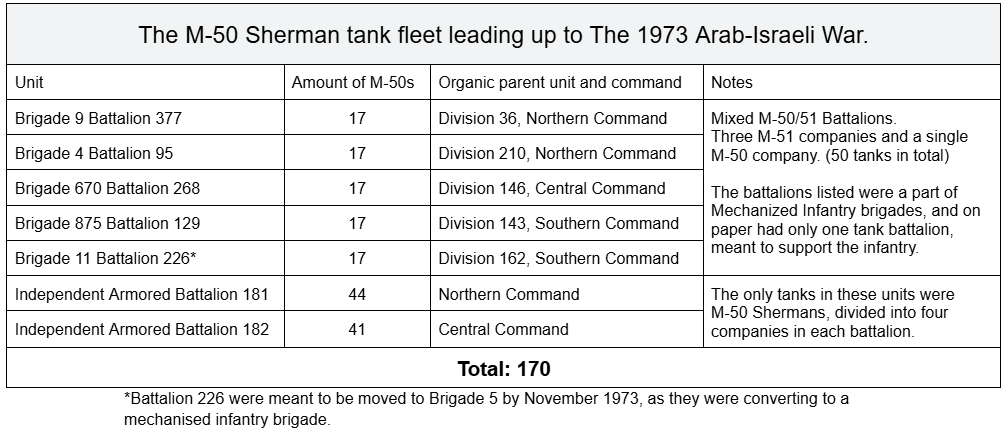
Alongside the brigades Independent Armored Battalions formed, such as IAB 181 of the Northern Command and IAB 182 of the Central Command.





 )
)
 )
)