Varanusk (Carlos) asked much the same question a few years back; my reply is below in Italics, just to help one keep track of this convoluted reply.
Essentially, and this is pretty basic, Rhodesia had been fighting a bush war against insurgents for several years. Needless to say various factions within a succession of British governments railed against such colonial “oppression” and blatant “white supremacy” despite the black population having a much better standard of living than in any other country in Africa. During the 60s Rhodesia broke away from the Home Country ie the UK, and declared independence. Much wrangling followed over the years and eventually Rhodesia was brow-beaten into accepting a cease-fire. A Commonwealth force was set up to monitor it all, and this is where my reply to Carlos comes in; I hasten to add I wasn’t deployed as part of the monitoring force but did deploy to Zimbabwe as it subsequently became known and I also refer to this; anyway, my reply to Carlos:
Not really Carlos, I wasn’t part of the Monitoring Force however, you may recall there’d been a deadly bush war type insurrection against white rule in Rhodesia for some years; sanctions were imposed by a lot of countries (against the white Rhodesian government) including those imposed by Britain, Perfidious Albion living well up to its name. A cease fire was eventually brokered - there being 3 main protagonists, ZIPRA, ZANLA, both African factions against the Rhodesians. I think, as per usual for Africa, the division between ZIPRA and ZANLA was tribal, ie Shona and Ndebele but there is far more political impact than that gross oversimplification.
It was agreed that elections would be held in 1980 - in fact - I think it may well have been a Conservative government who managed to field all that - I can’t remember - and I too can’t be bothered to look it up; I am sure there are some far more objective and informative sites dealing with this on the www somewhere. All factions were meant to be disarmed and held in cantonment areas pending the elections - apart from the Rhodesian military: many units, sensing which way the wind was blowing, “gapped” it, as it was known, in their entirety to South Africa. What has been described as the finest light infantry force in the world was therefore effectively disbanded.
Mugabe, and I really can’t remember which faction he was from, won the election and thus Zimbabwe was born. And surprise, surprise, it all turned to rat sh*t shortly after – but that is a far from objective view, save I was there in the early days and it was pretty clear how it was going to end, even back in 1981.
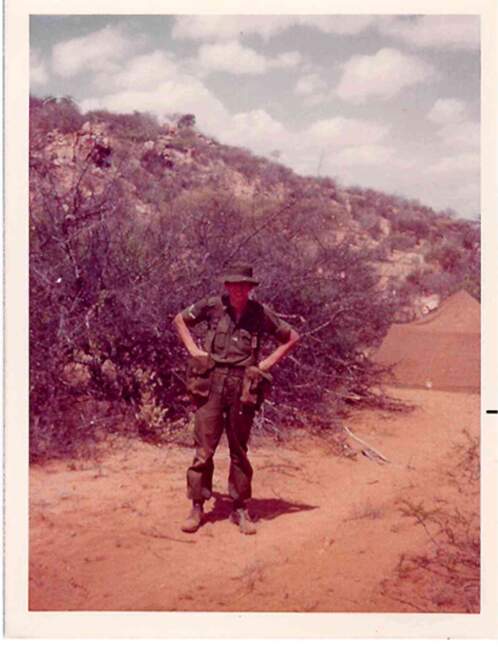
Part of the deal in running the elections was that the Brits would supply a training team to nurture the new Zimbabwean Army, which now would be composed mainly of Africans (some whites would in fact, stay on); in fact, despite my jaundiced view on all this, the British Army does/used to have a good record in providing “BMATTs” – British Military and Advisory Training Teams all over the world, so it was a sot of logical deal really. Two BMATTS were formed, strangely enough numbered 1 and 2; BMATT 1 was the combat arms training piece, and BMATT 2 was the establishment of a junior (officer) Staff Course for the emerging new leaders of the Army. It was the latter I volunteered for when a trawling signal came around the BAOR HQ I was working in at the time. As a young (26-year-old) newly promoted Sergeant, I was struggling a bit within the constraints of a large, soul-less administrative Staff branch (even though the subject matter – Intelligence – was interesting); I’d also been in the same garrison for nearly 5 years or so and was getting a bit jaded. My application was accepted and in February 1981, I arrived at the King George VI barracks just outside what had been Salisbury, the capital, and was now Harare, with 6 officers, to begin what became a 7-month tour.
I won’t bore you with the rest as I’m more than aware that you only requested a take on the background. However, needless to say, assimilating the differing warring factions, in other words terrorists, into the new Army, was a challenge; as was accepting that one could be spat upon by white Rhodesians, but that’s another story!
Afternote: having re-read all this, I do realise it’s far from accurate and not in the least objective, but really reflects what I knew at the time – which clearly wasn’t much(!) Forgive me if my sweeping statements ruffle any feathers, but that was how I saw it all back then.
Now, as I say I’ve simplified somewhat, and my take on things may offend some of the more sensitive souls around (not many on here I must admit!), but this was clearly a case of “careful what you wish for”, and the betrayal of a white population and their country; granted it may please those who dwell on such colonial actions but look at Zimbabwe now eh? That worked out well didn’t it? Practically a failed state.
Anyway, this isn’t meant to be a political view/answered. If you want to know in detail how my Zimbabwean tour on a training team panned out, I’m happy to send it you by PM - it runs to some 7 pages - and may not be that exciting a read(!) i don’t think it would win me many friends if I posted it on here.