Hi all I am completely new to kit models. I have built a tiny 1/1700 HMS Duke of york, painted it and loved it so much that I immediately went out and spent hundreds on paints, airbrush stuff and a 1/700 USS Indianapolis. I want to make the ship as accurate as possible and have found a nice picture I can use which I think is accurate. The front of the ship has a wooden deck and I love the look. But the model has a smooth surface with no wooden deck lines. I am not sure how to get that effect. I was thinking the best way was to use a razor and cut small straight lines but if you guys have any experience or tips I would love to hear it,
What about this instead of painting?
Is the question regarding wooden deck technique for the Duke of York or the Indianapolis ?
It is for the Indianapolis.
You are talking about 1/700 scale. A scratch of 0.1mm in the deck on this scale would be similar to a 7 centimeter gap on the deck of the real thing 
you can only do somthing realistic with paint or with the balsa wood based “planks” that are availabel in some model shops.
Welcome to the forum.
I believe it was on the old Revell tall ships - the deck had a wood grained effect. Yes - it was overscale. They told you to paint it first with a darker color, then a lighter one over the top of it, and lightly sand. I seem to remember it looking pretty good, but then, I was a 10 year old kid.
In 1/700? If you really want to give it a go use a medium grit sand paper and give it a few swipes. It won’t give you individual planks (not should it) but it using the above technique it might good you a nice effect.
Yes, I also think it would work, just make sure to sand only in the length of the deck direction, not sideways across the deck.
Regarding the Indianapolis, sanding the deck to indicate planking could accidentally erase molded-on detail, and the slightest amount of wavering during sanding will make the planking all wiggly - not good! If you want to scribe lines I would suggest a straight edge and sharp blade. Even better is scribed wooden decks such as from Artwox. Also keep in mind that, depending on era, the deck (wood) could be unpainted, or painted dark blue:



Wood decks, whether painted or plain, can look quite nice:

Trumpeter 1/700 Warspite with Artwox deck


1 Like
Many decades ago I bought a book about building model ships written by someone who worked as model ship builder for a museum.
One of the lessons that stuck in my mind was to avoid details that are too small for the scale.
Example: External “doors” on ships have handles, many, to close them watertight. These handles can be close to a foot long (to get the needed leverage). In 1/700 scale the handles would be 0.4 mm long (1/700th of a foot) and less than 1/700th of an inch thick. Barely visible but a skilled model builder could maybe do it. Most viewers of that model would never see those handles.
Wood grain is even smaller, at 1/700 it is barely possible to distinguish the caulking lines between the planks. Those planks are scrubbed to keep them clean (avoid slimey and slippery surface).
In wartime they could/would even be painted. The surface would be smooth, at least in scales smaller than 1/96.
This photo of the USS Wisconsin (I hope the publisher got it right, an Iowa class battleship at least) zoomed in (plus / minus sign)
shows the ship on my 24 inch screen at almost the same length as a 1/700 model.
IMHO the wood grain is not visible, the caulking lines might just possibly be visible (assuming good intentions and positive thinking by the viewer).
Up close and personal (photographer standing on deck).
Caulking lines are very visible, wood pattern is visible, wood grain (surface structure) not so much.
If I were to build a 1/700 model of a wooden deck I would not worry about the wood structure or the colour variations, they get blurred at that scale.
What I would worry about is the deck camber which is mostly completely missing on plastic ship models.
That camber adds strength to the ships deck, it is easy to bend a flat sheet of paper and less easy to bend a curved sheet. The camber also makes it easier for water to run off the decks.
The camber is independent of scale since it is usually a fraction of the deck width.
On a 2 inch wide hull the camber would be around 1/25th of an inch (1 mm) and this is visible for most viewers.
Text below copied from the link further down.
"Camber is essentially the transverse curvature of the deck and is usually parabolic. Camber has several advantages, including drainage of water accumulated on the deck, accounting for weld distortions, and increasing strength against deflection and other flexural loads. The camber may vary from ship to ship, but it usually remains within 1/50 of the vessel’s breadth for all practical purposes. "
Hi Caz,
There are any number of ways to create good looking wood decks on ship models;
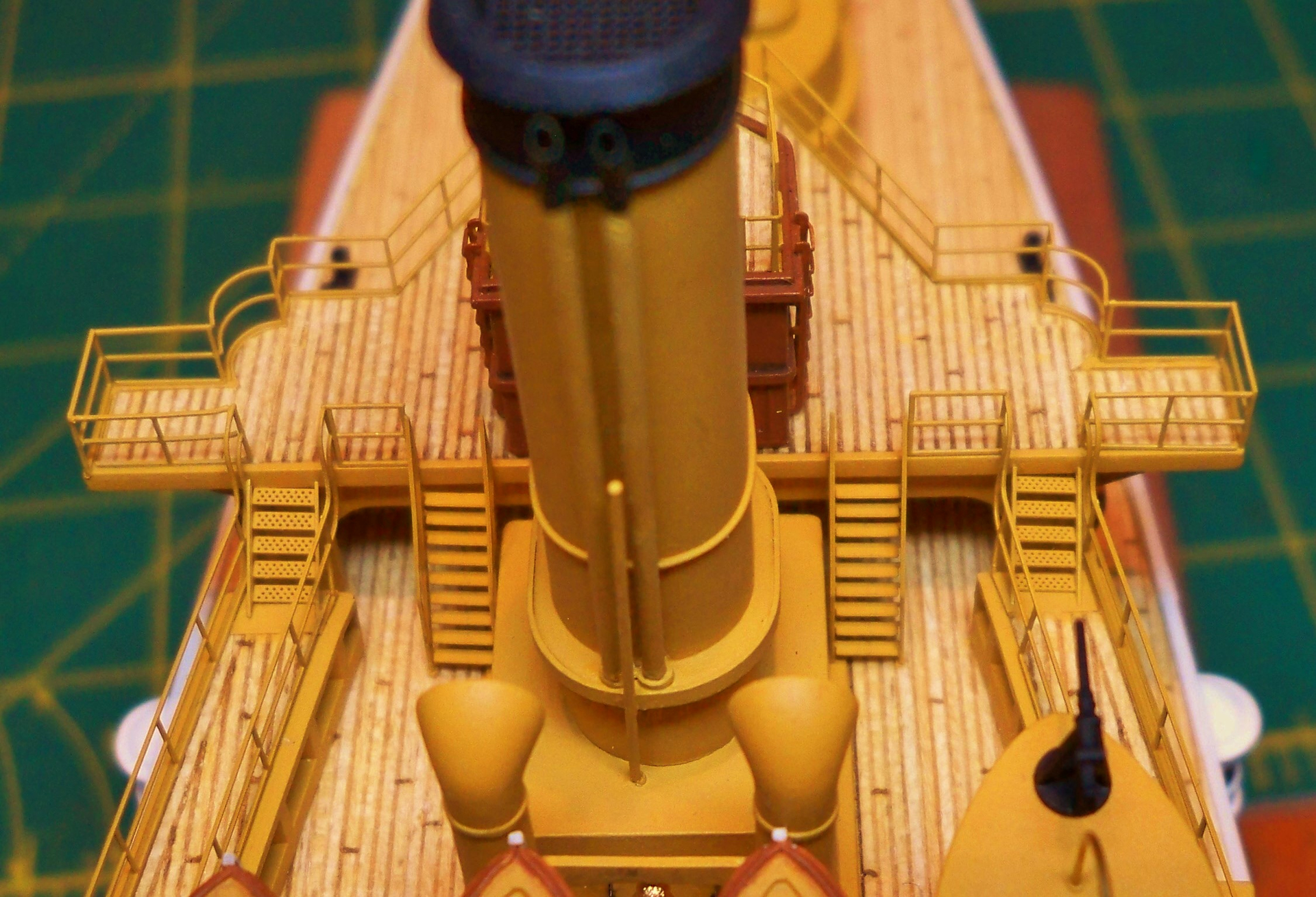
One of the fancier ways is to use real wood like on this 1/232 scale Olympia, but even in this relatively larger scale the planks are oversized and exaggerated…
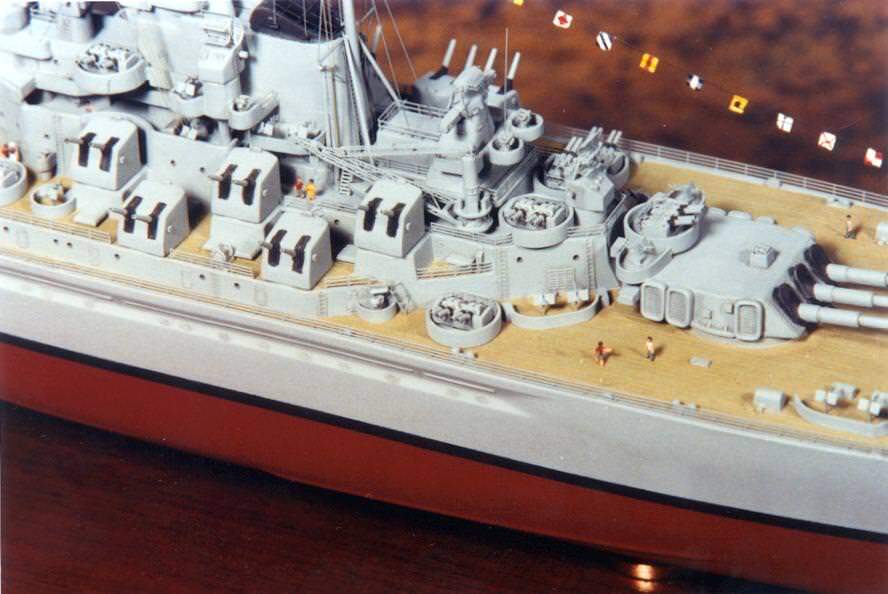

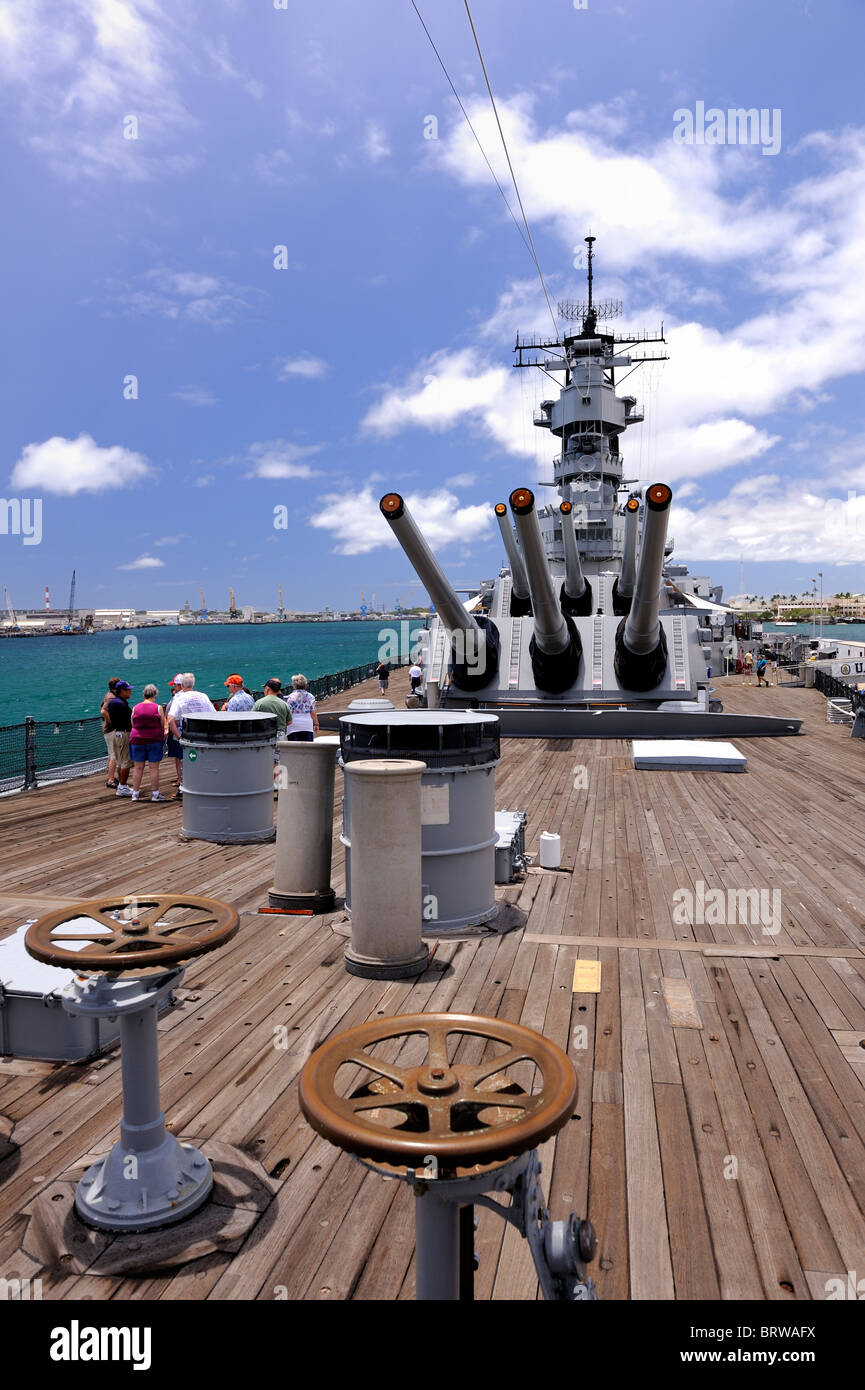
This 1/700 scale battleship’s planks were simply painted and, while not as striking as real wood aftermarket decks, look more like what an observer would actually see looking at the original ship at normal viewing distances.
Good luck with your Indianapolis!
2 Likes
Yes, with a very fine brush you could make random longitudinal streaks with tonal differences to indicate individual planks. Takes a very steady hand and a sharp eye - both of which are leaving me! 