The box art looks rather more accurate than the model …
2 Likes
Not worse than some 1:1 ones used in movies… 


H.P.
6 Likes
Tony Greenland’s Panzer Modelling Masterclass
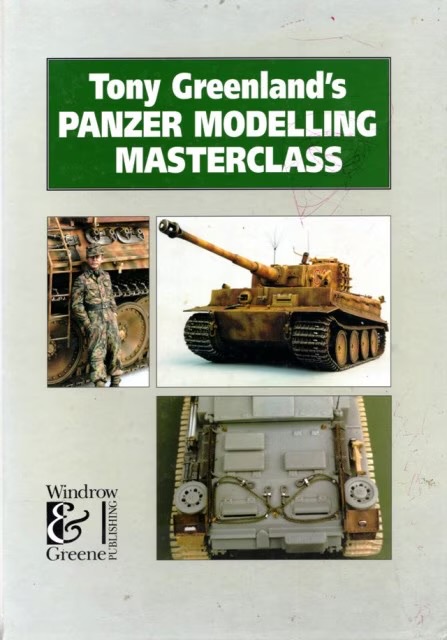

Written by: Tony Greenland (with a contribution by Stefan Müller-Herdemertens)
Publishers:
Originally: Windrow & Greene, 1996
Re-release: Osprey, 1999
It’s already been mentioned above more than once, but I only recently came across a reasonably priced copy so now I could actually read it for myself. I had seen plenty of Tony Greenland’s articles in Military Modelling magazine in the late ’80s, early ’90s, so what’s in here was not really new to me. Unfortunately, Tony died recently, but that kind of makes it feel like a good time to read his book.
This book is not one intended for novice modellers wanting to learn the basics, but rather, aimed at those who already know how to build a model and want to improve their skill and learn more advanced techniques. About the first half of the book describes Tony’s preferred tools, his ways of building and of painting models — only of German vehicles, as the title indicates — plus a chapter on painting figures by Stefan Müller-Herdemertens. The references to specific brands etc. are a little outdated, but not overly so. The second half is a kind of showcase of Tony’s models (and a few of Stefan’s), mostly fully finished ones though there are also some unpainted ones.
The chapters on construction are very much still worth reading. Tony was an excellent modeller and most of his techniques and tools still apply with little change today. It’s his method of painting that I disagree with — though he was unquestionably a very good painter, his style is far too artistic for me. It’s as if he thought that every German tank crew painter had been to art school and given free reign (and time) with a spray gun.
But this is a relatively minor criticism. On the whole, it’s a book I would recommend if you want to read about modelling — just don’t pay more than a moderate price for the book 
Edit, two days later: Added the Osprey edition, whose existence had slipped my mind when I wrote the above.
5 Likes
Model Military
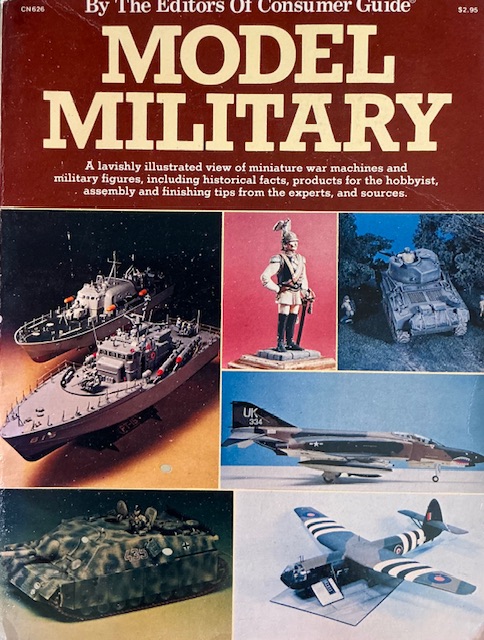
Writer(s): not mentioned
Publisher: Harper Colophon Books (Publications International Ltd.), 1978
(There are companion volumes titled Model Planes, Model Cars and Model Trains. I’m assuming they’re along the same lines as this one.)
At very first sight, this seems a reasonable introduction to military modelling (which here includes military aircraft and military watercraft, as the cover shows). Once you actually read it, though, it quickly turns out that it’s little more than an overview of what military modelling is, and what kind of kits were available for it in the late 1970s, all filtered through the lens of people who write this kind of stuff about a wide range of subjects rather than being modellers themselves. Only the last eight pages of the book are semi-useful, with short illustrated overviews of common modelling techniques — but you probably don’t need those anyway if you’ve gotten beyond the absolute beginner stage of this hobby.
If I had paid more for this book than to reimburse postage to the person who messaged me to ask if I wanted it instead of him throwing it in the waste paper bin, I would feel cheated
2 Likes
Scale Colour for Modellers
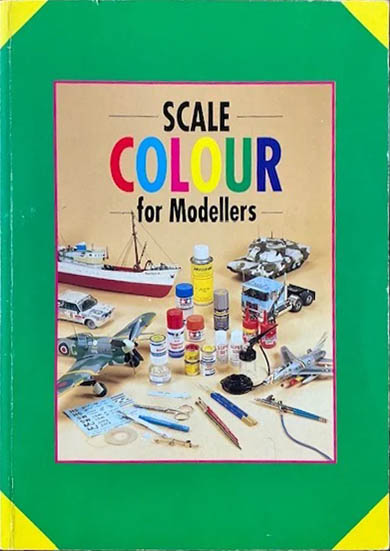
Editor: Ian Peacock
Publisher: Argus Books, 1991
This is another of those “could have been good” books. In essence, it’s about how to paint model kits, but I get the impression that the editor wasn’t up to the task of making the disjointed chapters by a multitude of authors (almost as many as there are chapters) into a coherent whole. For example, although it’s supposed to be about scale colour,[1] a lot of the chapters don’t even mention this at all when they talk about painting different kinds of models, like planes, warships, AFVs, cars with custom paint jobs, and so on. At the same time, several chapters repeat exactly the same advice because apparently, the author wasn’t aware somebody else had also written about the same techniques. Some authors also appear to have confused a book about painting models, with one about general modelling advice and so talk to some extent about research, filling gaps, markings (not how to apply them but what markings would have been on the real thing) and more. What’s more, even though photos in the book and on the cover show various brands and types of paint, the only thing used by most of the authors is Humbrol enamels.
The last part of the book is a set of tables with suggested model paints for various real-world colours. This is still kind of useful, because it was compiled using the Methuen colour system[2] presumably with reference to real colours to work out the model paint equivalent. However, it’s once again Humbrol-only and doesn’t covers anything but aircraft colours — except for three entries that it says apply to Israeli tanks.
There is definitely some good advice in this book that still applies today, 35 years later. However, much of it’s buried in stuff that isn’t anymore, or is even not relevant to the supposed subject of the book at all. The main useful chapters are probably the two about painting and airbrushing techniques in general rather than painting specific types of model, though even these contain much superfluous information and get sidetracked at times. All of it’s not helped by this being a book about painting that was published entirely in black-and-white, except for the front cover. Captions regularly refer to effects that are supposedly to be seen in the photos, but because they’re black-and-white, are hardly apparent at all.
The theory that a model should be painted in lighter tones than the real thing it replicates, else it will look too dark ↩︎
This was a book with colour chips and a card template to allow comparisons of a sample with the chips. It’s long out of print, and when I looked into obtaining one, the price immediately made me think I can do without
There are apparently PDFs, but those would be entirely useless for comparing colours. ↩︎
4 Likes
Nice review, thanks. Sounds like somewhere buried in the publisher’s info there’s a connection with Humbrol, although to be fair back in ’91 they were the main game in town, at least in the UK.
Yeah that’s kinda a mild handicap being printed entirely in black & white 
2 Likes
The publisher, Argus, also published Scale Models International magazine and the chapters about general painting tips and applying markings are credited to “Scale Models Staff”. I’d say the preference for Humbrol is simply because it’s a book written by 1970s–’80s British modellers.
i don’t know how I missed this thread, but anyway, I digress here slightly…. the lower left magazine cover, the guy reminds me of a young Cozy Powell.
1 Like
I had to look up who that is, but his Wikipedia photo doesn’t make me see much resemblance. I do keep thinking the chap on the book cover looks like someone moderately famous, but I can’t put my finger on who I think he resembles.
Famous rock/ metal drummer.
1 Like
Mostly of groups I have no particular interest in, as wasn’t a teenager in the 1970s but in the 1990s 
1 Like
Understood- I was a teenager in the 80s so I grew up listening to that stuff from the 70s on actually. To each his own 
1 Like
Actually, late ’80s/early ’90s for me, which means I had exactly the right age at the time to greatly appreciate grunge
2 Likes
Me too- a breath of fresh air! I liked some 80s stuff but not all. I was very selective lol.
1 Like
(Now totally off original topic) It always fascinates me how we individually identify with peak music depending on our age/circumstance. I was born in ’56 so do the math – for me the ‘70’s, particularly the early ‘70’s in the UK was a wasteland of good “popular” music, so much crap compared to the generally excellent ‘60’s. Notable exceptions being the so-called super-groups like Pink Floyd et al. So I surprised my Dad by “discovering” and liking Glenn Miller, Benny Goodman etc., to him the peak of his youth, utterly out of fashion in the mid/late ‘70’s.
Punk in the mid/late ‘70’s was mostly crap with a few diamonds like the Clash & the Jam (not forgetting the Stranglers). Then the ‘80s came along and suddenly it was paradise – Eurythmics, Blondie & a host of others - right through to the early ‘90’s when (for me) things ran off the rails again although Nirvana & Red Hot Chillis were diamonds, Rap mostly crap.
Into the noughties & teens there have been more diamonds amongst a sea of mediocre stuff. Today it’s the same, every now & then I hear something new and I’m as impressed as in the ‘80’s. My point is that compared to my Dad, who thought all good music ended around 1945, I’m far more open to whatever’s going on. I’m not sure how that happened but I don’t think I’m alone.
3 Likes
No, you are not.
There has been plenty of crap produced during all decades (even centuries),
the good stuff gets remembered, the rest is usually (mercifully) forgotten.
3 Likes
Saw him with the Michael Schenker Group. Still had his bass drums with the Rainbow resonant heads.
1 Like
My son is 15 and a Jazz and Big Bands fan. He even has a Glenn Miller T-shirt.
I will enthusiastically tell him about what I heard on XM’s Real Jazz and he will acknowledge his familiarity.
Kids these days with their Jazz and Big Bands music… 
1 Like
Have to mention that Cheetah Chrome (real name Eugene O’Connor) of Dead Boys passed on this past Sunday. He was 71.
I have his “Solo” CD which is fantastic. Very mature songwriting with an outstanding country-rock instrumental that kicks things off. He was based here in the Nashville area.
Rest In Peace, Eugene.
1 Like
2 Likes