Thanks sergeant major!
That had to be the fastest response ever.
J
1 Like
Hi Jerry,
I think Michael sums it up…your builds are like stills from a war office film crew embedded with the troops…great story telling,  .
.
Cheers,  ,
,
G
1 Like
Crackle crackle—white noise–crackle-this is the BBC. …Stalwart Commonwealth forces have today begun a new and greater Offensive against Jerry in Normandy–white noise,crackle.
1 Like
Could the infantry talk directly with tanks? The US Army had this problem.
As shown in one of pics here, they had the telephone mounted on the back of each tank. Other than that,I do not know if the radios were compatible between Infantry and Tanks. Good question for G and some others on here.
Great to see the whole narrative Jerry. Really like that long view of the mortar carrier, the Bren team and the rifleman beyond them- a great sense of scope and scale in just one picture.
Thanks a bunch man. I need to learn how to use a camera though probably.
J
This combination of narrative and pictures creates such a tight sense of atmosphere! Thank you so much for the time you have taken to share this with us…
1 Like
Next episode I will wait until I have the energy to post correctly the first time. Thanks for the excellent comments!
J
2 Likes
OK,I deleted the first set of pics posted without captions. The new set appears in proper order and captioned.
J
1 Like

Epic work, epic result! Tough choice but I think I like the sniper images most of all. Hopefully this might inspire others to try narrative dios too 
1 Like
Thanks. It is much easier to light and frame a single fig so there is that . I think it may be beyond my expertise to get the bigger pics done as well. Plus,I can’t be recreating the entire landscape of Normandy every time I do get around to the photo phase.
Ah well, that’s my story and I’m sticking to it.
J
Exact same problem as the US Army had, with pretty much the exact same field expedient solutions employed.
The British generally started off experimenting with buzzers that could be used by the infantry to get the attention of the tank crew. The commander would then have to pup out of his hatch and try to hear the infantryman shouting up from the ground to him.
This was mostly because of technical issues with inter-tank interphone technology. The early radio sets didn’t have it, and the later sets (WS No. 19, in particular) integrated the interphone switching and control into the radio system, so simply sticking an interphone control box on the rear of the tank could lead to the infantryman accidentally switching the tank’s radio to some mode that rendered it useless to the crew.
(The US radio and interphone systems were separate and relatively independent of each other - not totally, just not quite so integrated as the British systems.)
Phones on the backs of the tanks were (until nearly the end of the war) expedient wiring projects using tank inter-phone components extended to the rear of the tank and protected in a suitable metal ammo can. The British problem was also compounded by the general need to use both separate headsets and microphones since a suitable “telephone type” of handset wasn’t usually available. And again, the British radio and interphone systems were interconnected, so wiring up a field expedient infantry phone that couldn’t inadvertently be left switched in the “radio” mode was necessary.
Towards the end of the war, both armies started to field design-purpose and manufactured infantry phone kits to could be installed on the tanks in field or at depots. These were late coming and never in quantities sufficient for all tanks.
(BTW, both the US and the British tankers had problems with infantrymen using the expedient phones and then not restoring the handsets and headsets along with all their wiring back into the storage box, so after a few meters of travel with the kit dragging behind the tank, it was often lost or rendered inoperable.)
The British WS No. 19 tank radio was not compatible with the infantry nor was the Infantry common tactical WS No. 38 set compatible with the tanks.
(Nor were the US infantry and tank tactical radios.)
The initial expedient was the same one used by the US Army which was for the tank unit to borrow a radio set from the supported infantry unit and simply stick the antenna right out of one of the hatches. Of course, the crewman whose job it was to monitor this infantry set couldn’t use his own tank’s radio-interphone at the same time.
Later, both armies developed kits to install the infantry radios in SOME tanks. This solution was never universal or widespread. There were never enough spare infantry radios or installation kits fielded. It was, however, more and more common towards the end of the war. Of course, such tanks will have an extra radio aerial installed and visible. The aerial bases and antennas are also different models from the standard tank radios, so these “infantry radio tanks” can be identified as separate from command type tanks that might have additional aerials for the regular tank radios.
Finally, both armies believed (especially at the start of the war) that basic HQ liaison practices would mean that individual tanks and infantry units would not need direct tactical communications. The infantry lagged behind the armor in fielding tactical, small unit radios, so this was not even really possible on the technical level anyway.
Both armies generally attached an infantry officer to the supporting tank HQ unit (or vice-versa), and this liaison officer would be equipped to communicate to his own HQ which was expected to relay messages from either the tanks to the infantry or from the infantry to the tanks. The potential for problems in this system are obvious now, but not so obvious then when the speed and pace of combat was not nearly so fast as it evolved to become. The liaison officer / relay system worked well enough in the interwar years, and, as we all know the old saying, “armies always plan and prepare to fight the last war.”
3 Likes
And now we know…the REST of the story. Thanks Mikey!
J
1 Like
Looks like someone has noticed your work - “Imitation is the sincerest form of flattery”…
Regards,
M
1 Like
Yes,I noticed that.
Whatever the motivation, I am happy to see another release of Commonwealth figures.
Now, if just one of them would get the kit to look right!
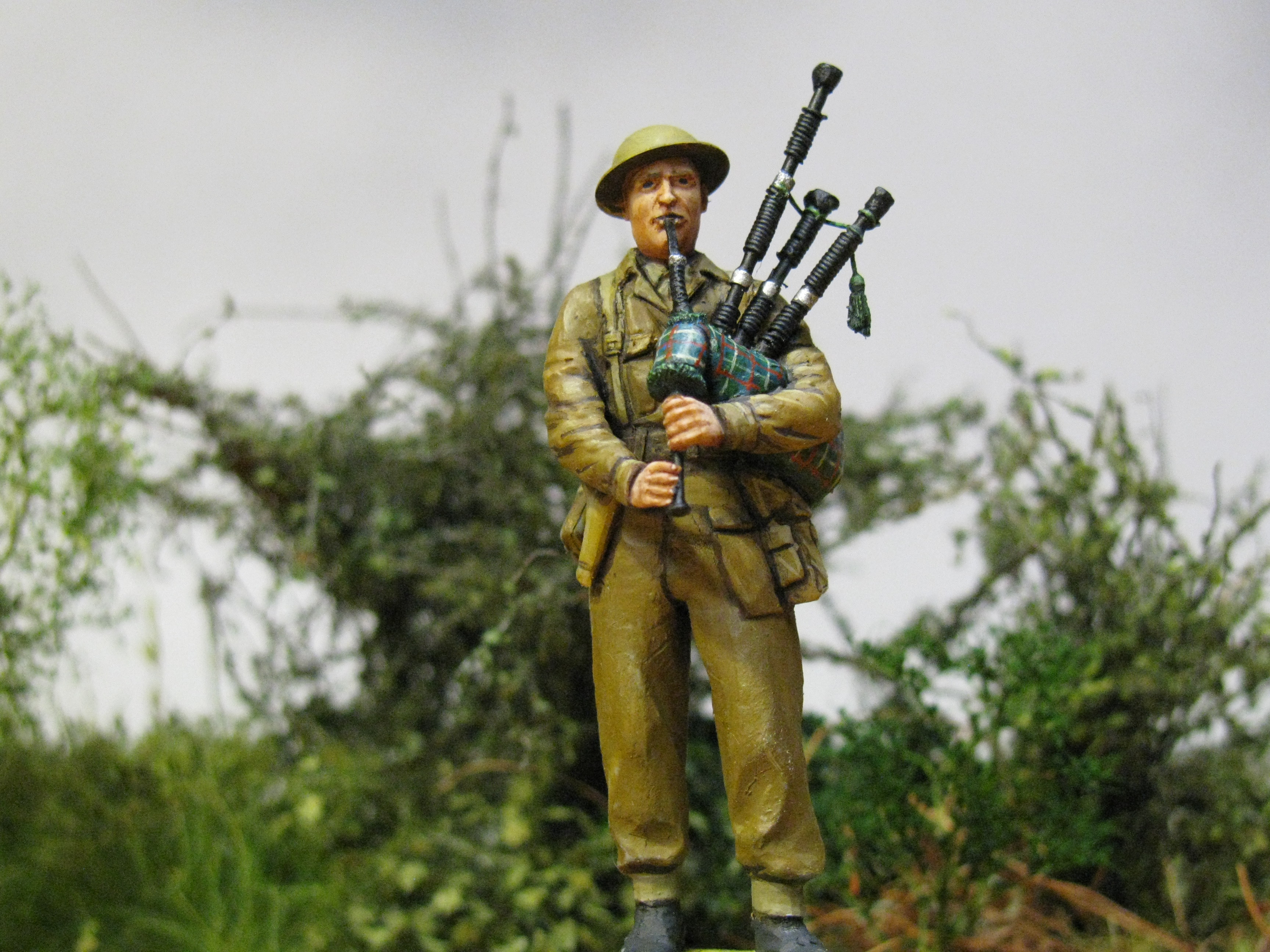
9 Likes
Hi Jerry,
Great looking piper, , did you scratch build the pipes?
Cheers, ,
G
Thanks G !
Yes,I built everything on the pipes except the tiny downward pointing horn bit in his right hand.
The figure began as the piper from the MB set. I think you can see the changes there.
J
Incredible as usual Jerry