no mate what company did the casting? 
My personal weapon was an SMG but.i would have ditched it for a SLR if the brown stuff had hit the fan pretty damn quick!
1 Like
Hah! Oh my God what a “Duh” moment! It’s the fairly ancient Italeri job, from this set, often reviled though I don’t quite know why; sure the SLR is more FN than SLR but that’s not really a problem.
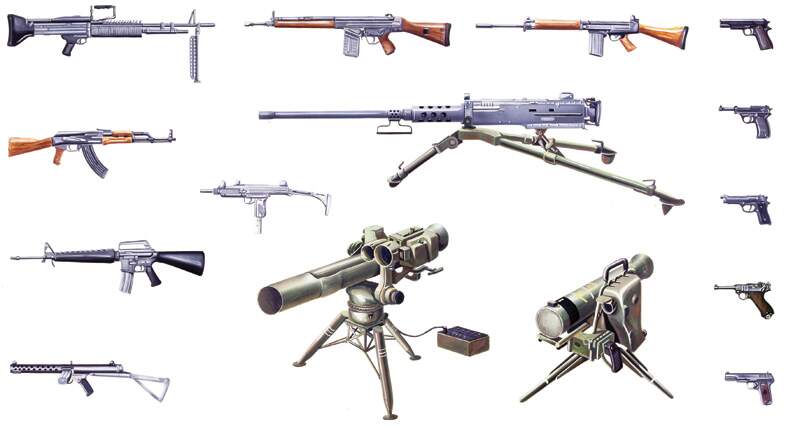
Probably eclipsed by enterprising 3D manufacturers, but it still does alright by me, plus I’ve several in the stash.
I find it quite useful; Uzis for my Dutch and Bundeswehr efforts, M16 for the US models - if I make figures, and of course the rifle and SMG for Brits. Oh, and AKs for my Sovs. I really must find a use for the MILAN and the TOW some day.
God, ignore my earlier post, I don’t quite know who I thought I was talking to; complete lack of situational awareness(!)
5 Likes
Here we go then; the denouement: as usual, you can cut out the historical blurb – there is a fair bit of it - if you feel like it, and scroll down to the pics. However, as there’s a danger of the casual viewer thinking this is a vignette of POWs studying their mail, a read might have some merit. That said, a large amount of historical guff just to try and justify a small model with a mere 3 figures; you are all probably becoming sorely tried; forgive me.
And “Yes”, this is another model with me in it.
From March 1974 to September 1977, I was stationed at a Divisional HQ in the southwest of the UK. I worked in the General Staff Branch of the HQ, known simply as “G Branch”. Back then the British Army staff system was based on hard-won historical precedent, and an HQ staff was organised into G Branch, A & Q Branches, and then all those branches representing the various Arms and Services eg Artillery Branch, Engineer Branch and so on and so forth.
For the record in case you wonder what I’m blathering on about, “A” stood for Adjutant General “Q” for Quartermaster General; A and Q Branches were always combined as “AQ Branch”. As I say, all based on our military’s history and I won’t dwell on further aspects of the organisation of the then Divisional HQ; feel free to Google these illustrious appointments if you so wish, (now all long gone due to the modernising effects of some over-zealous crusading Generals – who also seemed to think beards were a good thing - but what the hell do I know?)
The clerical component in my branch consisted of around half a dozen junior ranks, headed up by a SNCO - a Staff Sergeant - who was the Chief Clerk. We all ranged from Private to Full Screw (that is Full Corporal). We were mostly single, and lived in a pretty crappy wooden- hutted barracks on the edge of the Salisbury Plain Training Area, around a mile or so from the Div HQ building. This was the domain of the supporting Signals Regiment, who, in addition to their main role in providing communications to the HQ, also administered the whole, including those attached personal, such as cooks, clerks, drivers, pioneers and so on. As an aside, they also went out of their way to make life as unpleasant as they could for us attached personnel.
We had the role of the United Kingdom Mobile Force which meant we were a NATO reinforcement division assigned to either Denmark or Schleswig Holstein, the latter being the bit of the then West German real-estate leading up to the Danish border, just in case you’re geographically-challenged. Do keep up.
To make sure we were up to the job of commanding the three fighting brigades which composed the Division, (5, 19 and 24 – all designated “Airportable” since you ask) the HQ was often deployed on domestic exercises - known as Command Post Exercises (CPX) in the UK - just to hone our skills, and roughly twice yearly, we actually practised in our deployment areas on larger overseas exercises.
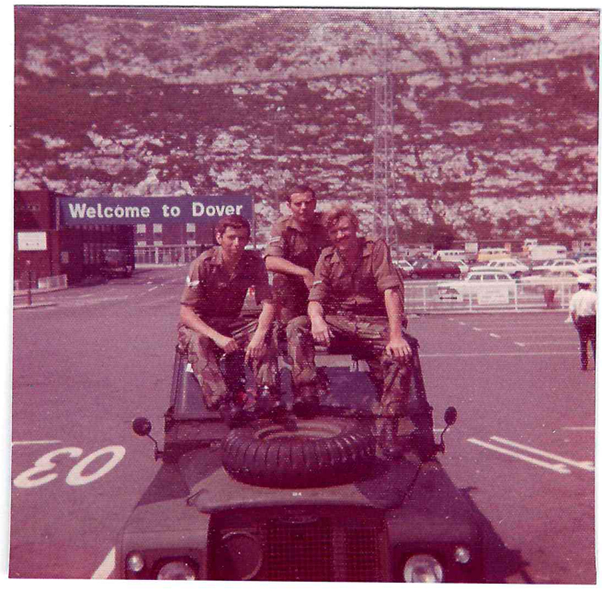
Off on our way to yet another exercise abroad; yours truly on the left.
Now, the skills required of clerks on the Staff – reflected in the more accurate trade name of “Staff Clerks” were varied, as you would expect in the days of hard-copy paper: filing, the preparation of documents, despatch, classified registration and typing were all within our remit. Correspondence was drafted in longhand by the respective staff officers; we must have had around a dozen or so Captains and Majors covering the disciplines of Operations, Plans, Training, Exercise Planning, Intelligence, Security and even an RAF Squadron Leader attached to deal with Air. The Branch was headed up by a full Colonel, identified as the Colonel GS (General Staff) and a very no-nonsense officer he was too! Apart from being head of our Branch, he was really the de facto second in command of the Divisional HQ; technically, the Commander Royal Artillery, (CRA) a Brigadier, would fill the role, but the staff expertise resided with the Colonel GS. Next up the chain was the General Officer Commanding (GOC) the Division, and one didn’t mess with him either. That said, all the officers I have mentioned were highly professional – they simply had to be if selected from the Staff Colleges for employment in G Branch – the salient branch in the HQ - yet also approachable; there existed a sort of professional symbiosis between Staff Officer and Staff Clerk, which of course had to be, and I would say generally, we were a happy Branch.
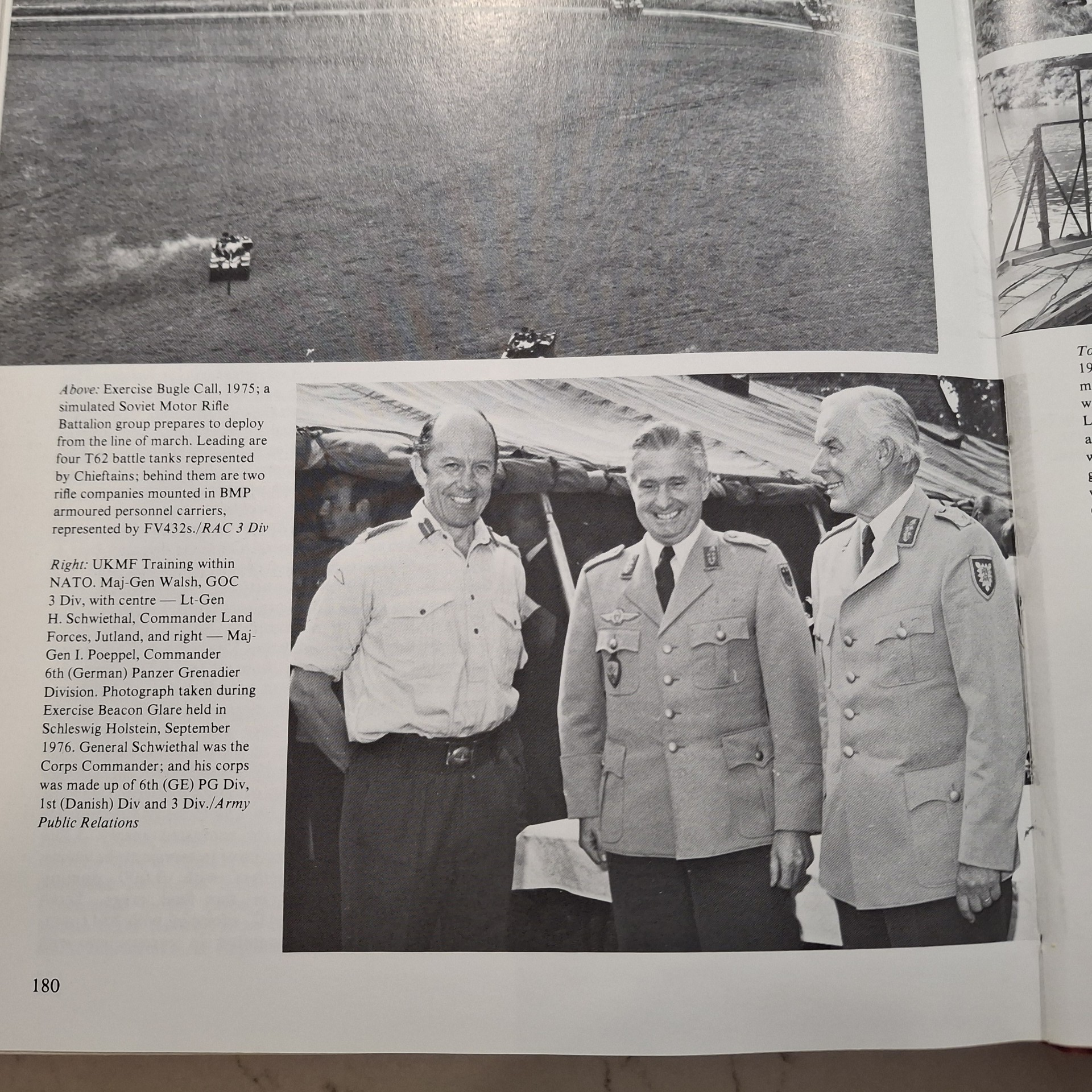
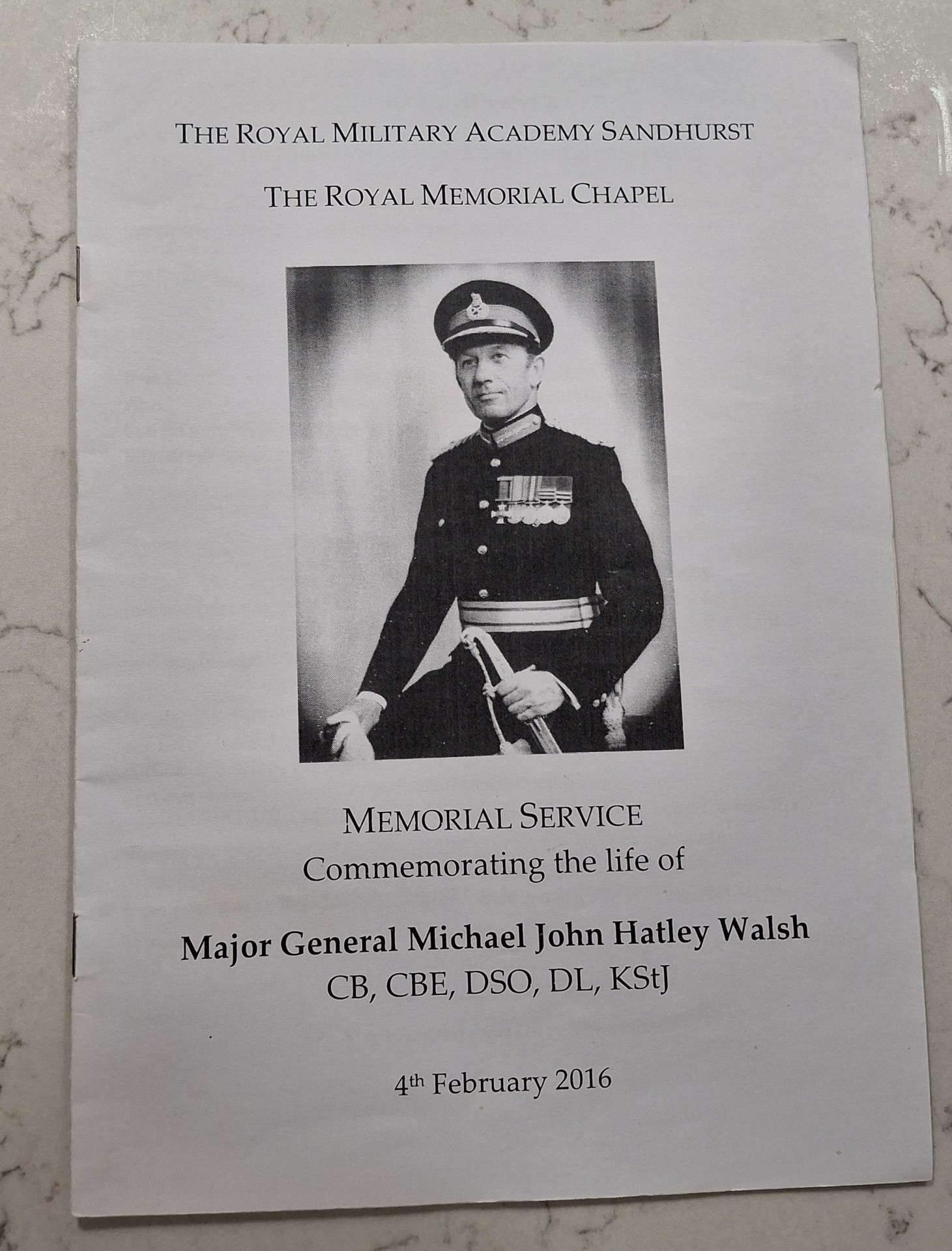
Our General was hugely experienced, having begun his career in the Second World War, to combat in Malaya, to Commanding a Parachute Battalion, and a Brigade in Singapore.
Fist pic shows him with his opposite number in 6 (GE) Pz Gren Div, and his Corps Commander. The second pic, an inevitably more sombre event; I did attend in case you were wondering.
The General relied upon us lesser mortals whenever he was presenting briefings to those further up the greasy pole, as we manned the overhead projectors and slide machines, and became Ninjas dealing with slides and vufoils; in fact, I believe I was his favoured clerk for that task (based on the simple premise that it was always me who was chosen!) as I could (just about) keep up with the constant interruptions and meanderings as these high-level briefings were underway, and it took no small effort to keep track of the script as discussion waxed and waned; I, being fairly bright (or so I was told – a first in my life) also managed to understand what was under discussion, so I think that was a string to my bow as well. It also meant I got to travel with him in his staff car as he presented wherever, which meant I had a day out, and conceivably, this all did my emergent career no end of good.
Anyway, back to the correspondence bit: so, letters and orders were drafted in longhand by the officers, us clerks typed it all up, it was signed, reproduced and then despatched, all part and parcel of the staff routine.
On exercise, correspondence was reduced primarily to signals message traffic, ie those orders etc transmitted by the Royal Signals regiment, via teleprinter and whatever technical links back then existed. Signals were permitted to be handwritten but some still had to be typed. More involved instructions to our subordinate and flanking units/formations involved the production of operation orders (OpOs) and these were much more complex, conforming to a deliberate structured format, and often accompanied by traces and map overlays. They could consist of up to 20 pages or so; this was all important stuff. Accuracy was paramount – men were being committed to battle here, even if only notional on exercise, but the process had to be got right; this was serious stuff!
Again, these would be drafted by hand, either by the Grade 2 Staff Officers (Majors) or even Grade 3 Staff Officers (Captains) or sometimes both from within the disciplines of Ops and Plans, but initiated of course by the General and the Colonel GS, who would give verbal or their own handwritten orders. The more junior officers earned their pay researching the details and the fine tuning, including Task Org, ORBATs and the very composition of the order; and woe betide them if any inaccuracies were detected (sometimes, refreshingly perhaps, by the clerks). Their efforts then came to the clerks for typing, and these were hammered out on stencils as they were known, to ultimately be rolled off on ink duplicators and despatched as necessary; the whole being highly classified as one would expect.
A blast from the past: a typical typewriter of the time and a Gestetner rotary duplicator:
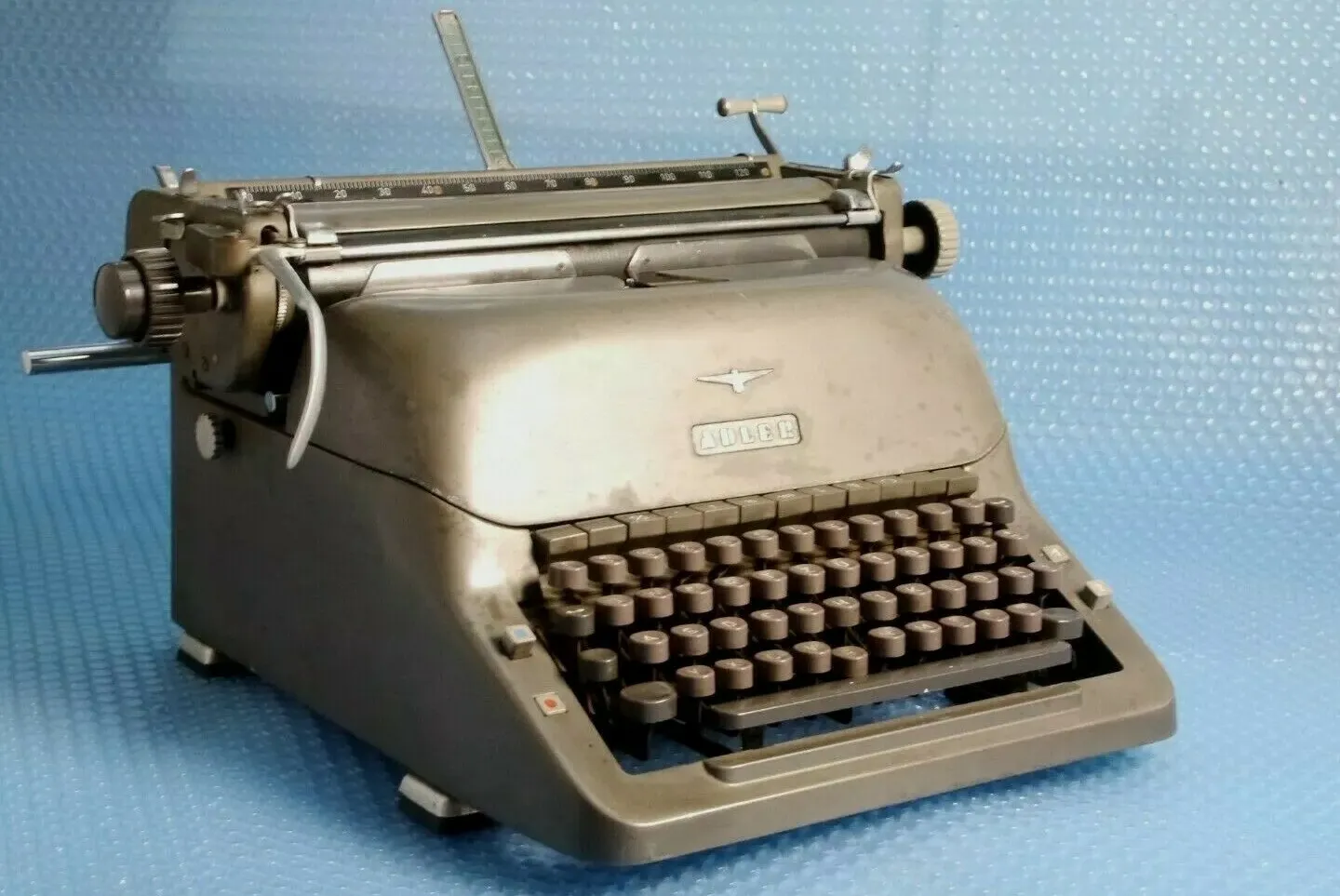
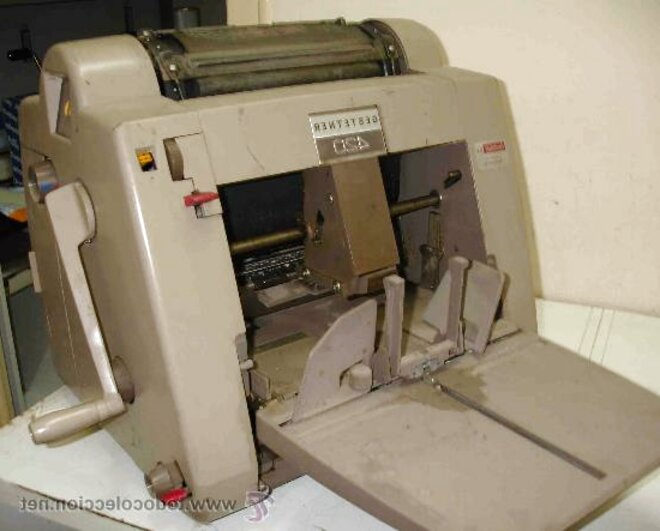
So, all this is to explain that we were busy - and then some! Such a process involved a fair amount of checking; the OpO simply had to be accurate and perfect in every way. The layout and format had to be scrupulously followed. If this sounds pedantic, remember that such documents would be read and actioned upon by tired men; a specific format ensured that nothing was left out and that the reader would be in no doubt as to what was coming next within the document, and the impact that it may have on his command. As I said, men were being committed to battle here.
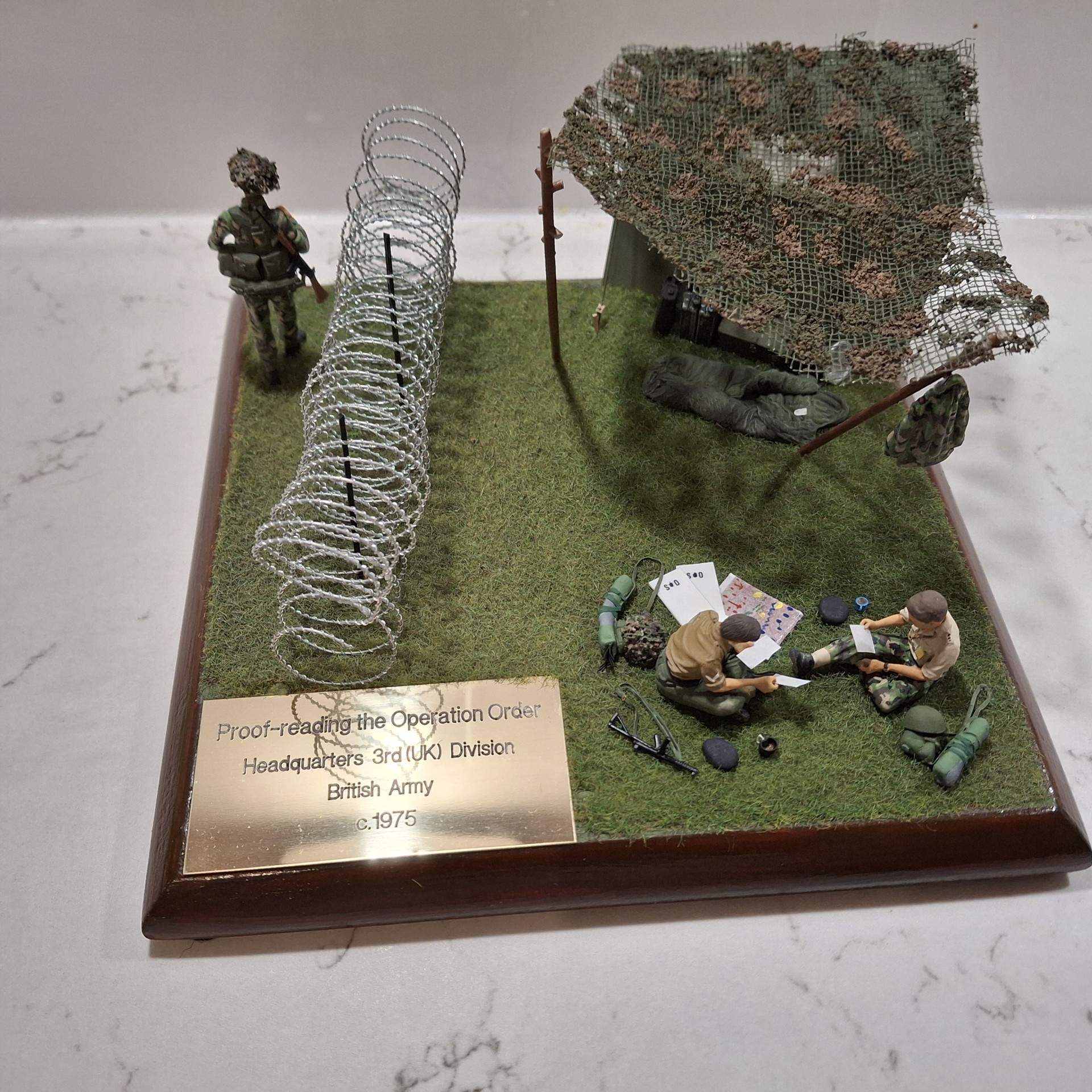
The only foolproof way to ensure such accuracy was to read it all out, aloud, to one another, known as “proof-reading” and this is what my small model depicts. I’m aware of course that the term is well known generally, this is just how we went about it back then.
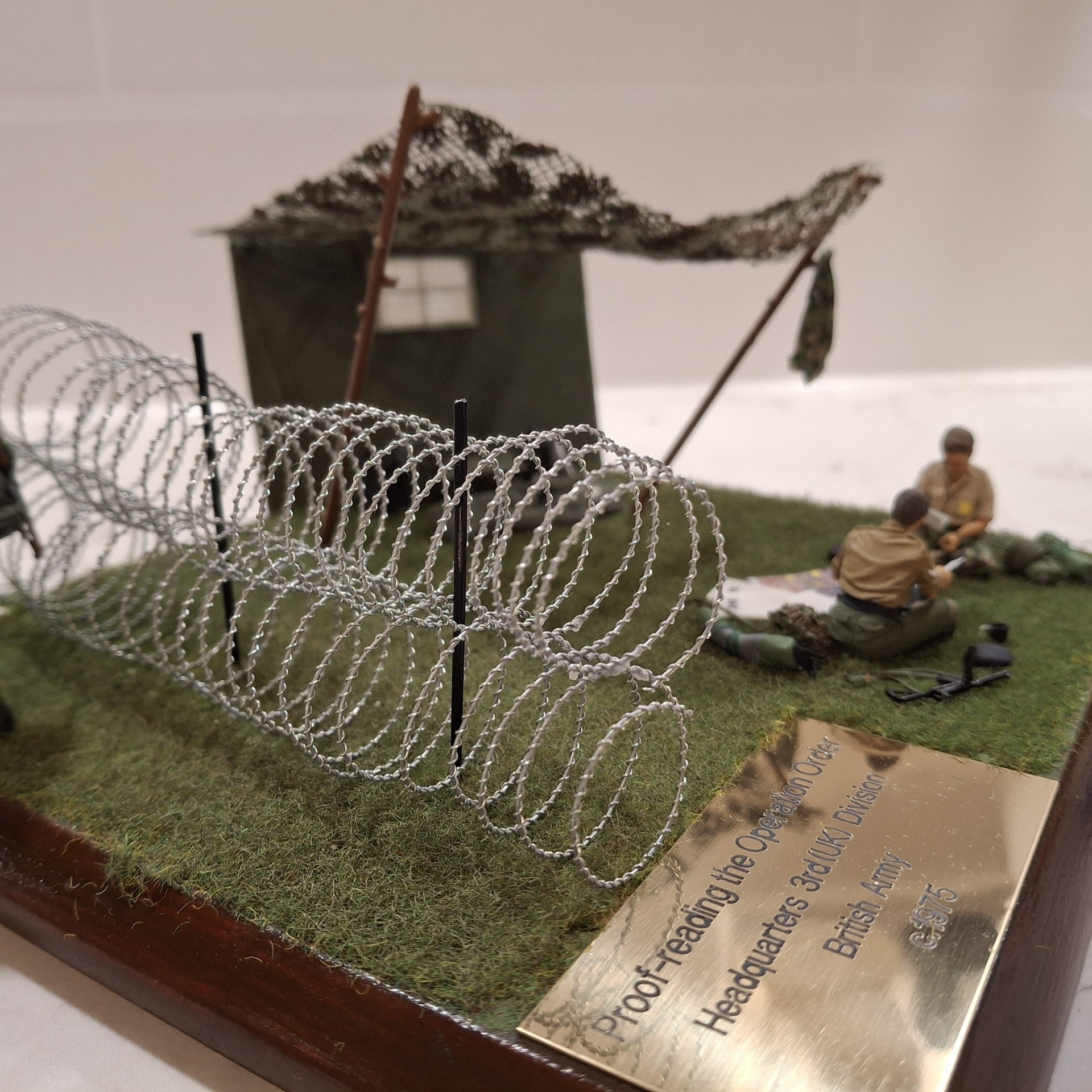
On this occasion, I think we were in Schleswig-Holstein, the town of Itzehoe rings a vague bell; as usual, we were set up in a wood or forest somewhere, the HQ consisting of a Land Rover and tentage complex; this was because we were deemed to be air-portable (light-scales) so no office trucks or armour. The complex probably consisted of around 10 or so Land Rovers with associated tentage and extra canvas for the plans and briefing tents, all camouflaged by Hessian, poles and nets, and surrounded by barbed wire, patrolled by the Pioneer Corps Defence Platoon. All other supporting vehicles including the Signals trucks, and admin set-ups such as the cookhouse were beyond the wire, dispersed throughout the location, all similarly concealed by nets and Hessian.
Anyway, to escape the noise of radio traffic, chatter and the fug of tobacco smoke, and to concentrate our minds, the GSO3 Ops, Captain Clendon Daukes, from the 4/7 Dragoon Guards, suggested we take the freshly typed OpO outside – it was a pleasant sunny day, and proof-read it there. And this is what we did. The stencils I’d typed-up, also known as “skins” were all in a cardboard box – the same type they came in, and a carbon copy, inserted by the clerk as he typed on the skin, was available for ease of reading. The draft, ie the handwritten original, was held by the GSO 3. We took a copy of an up-to-date battle map to enable us to check typed grid references; one doesn’t want to get those wrong if say, the nuclear or chemical boys are active. As the skins were checked, I put those in an empty box so we didn’t get muddled. We simply plonked ourselves down on the ground, within the wire of course, and read out loud to one another (we swapped around to give our voices a break) amending if necessary, as we went. If this sounds a bit quaint, well, I suppose it was in a way; but as I said earlier, there was that symbiosis, almost a professional intimacy.
Now Captain Daukes, even by his own admission, had a very distinctive voice, which was “plummy” in the extreme; some of the other clerks didn’t particularly warm to him, often through some nihilistic class-based chip on their shoulder, but I actually quite liked him; he always had time for my many queries as I wrestled in improving my military knowledge (I was young and oh! So keen!) What I was unaware of at the time, was that he’d seen the elephant as it were, having had his Saladin blown up under him whilst on active service in Aden. Interestingly enough, he’d also begun his military career as a Private soldier. He must have been as hard as nails to survive in an average infantry barrack room with that accent.
I discovered by chance the base figures - two sitting soldiers, reading mail, on eBay; I think they hail from Firestorm. Anyway, I noted they were in shirt sleeve order and immediately thought of the above scenario, which just goes to show that I really need to get out more.
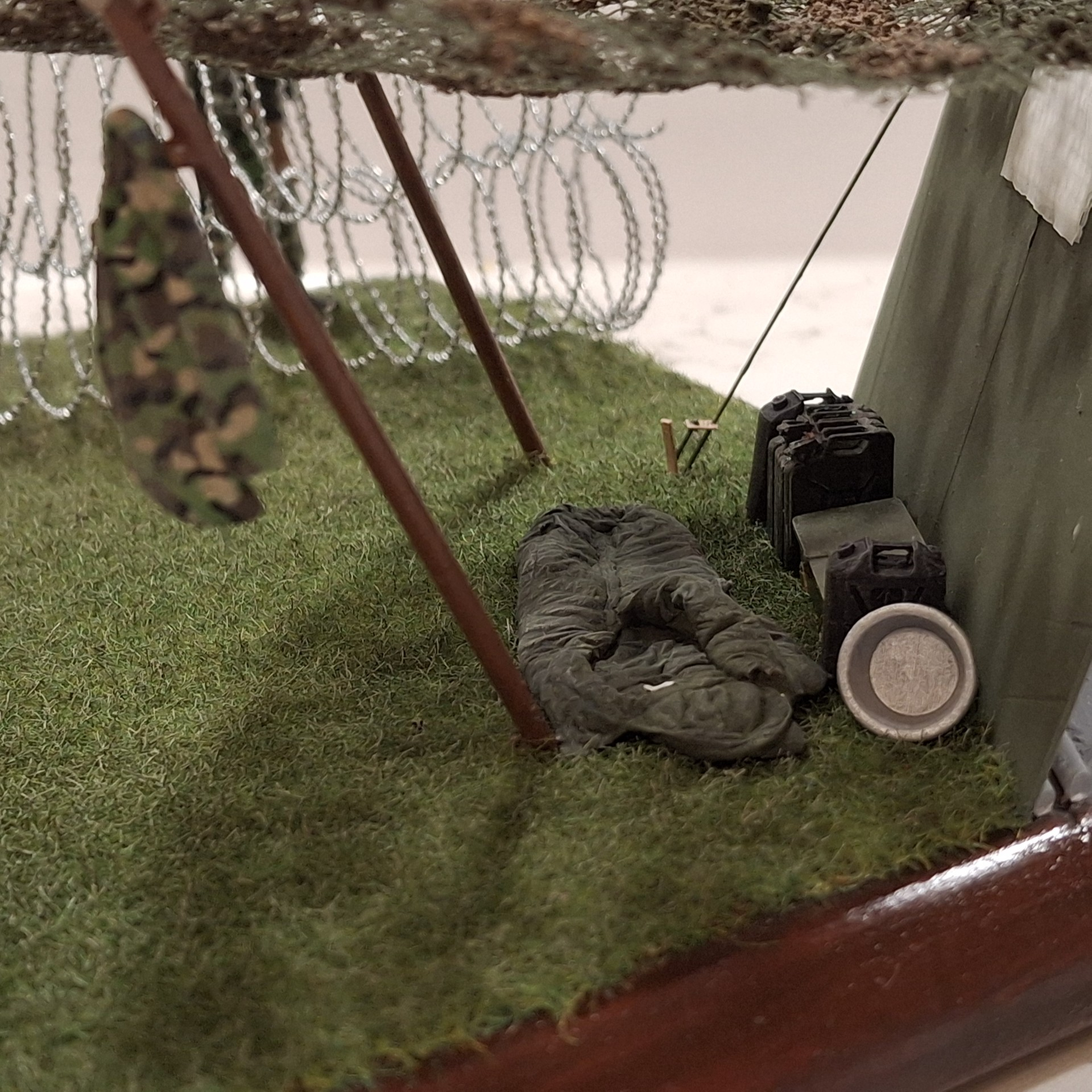
With only two figures I needed a smaller base than usual, so identified a 7" square as suitable. I devised a side of one of the tents of the complex and fashioned that from plastic card, incorporated a roll of barbed wire, and pickets, and added some of the usual junk that seemed to accumulate outside the HQ, such as water and fuel jerricans, a washing bowl, and even a sleeping bag that some hygienic soul has decided needs an airing, as well it might after a week or so on exercise. And that really was that.
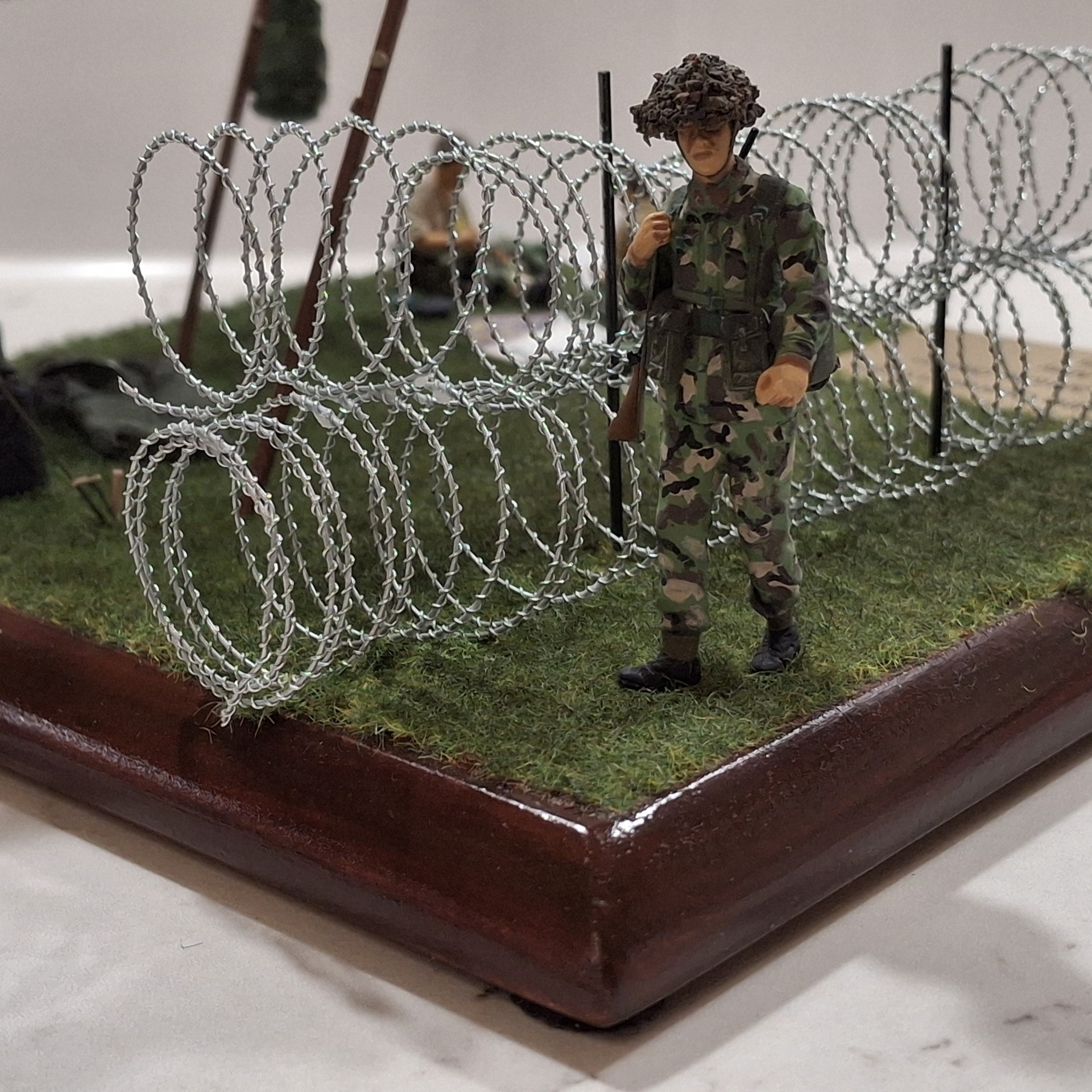
A note on the barbed wire: I had amassed several sets of etched wire, from Aber I think, but try as I might, I could not get it to conform to what I wanted it to do (basically just coil up tightly) even after heating. In the end I went with a proprietary product which I think was destined for wargamers or farming modellers. It gets an effect, but I’m not really happy with it. I may change it in the future. I was so busy getting to look right and sit where I wanted it to, that I overlooked paining it. As it happens, on occasion, the Pioneers, whose job it was to provide HQ security, did receive shiny new wire, but it really needs that rusty, much-used look. That said I have a suspicion that any such colouring may accentuate the over-scale thickness. More work/investigation needed(!)
I modified the figures to reflect the differing uniforms, I for instance am shown wearing OG (Overall Green) trousers - yet the officer is in combats. For some lax, yet welcome reason we were permitted to wear green lightweight trousers, (combat trousers being quite heavy and double-lined) and I further pushed the envelope by wearing overall green (OG) trousers, normally reserved for tropical theatres, just because they were an excellent piece of kit; what made them great kit in my view, was that they came with fastening buckles at the side, and were very comfortable with no belt buckles digging in when one bent; despite that I had to wear my RAOC stable belt in the interests of some conformity; I also modified what was to be the officer figure accordingly.
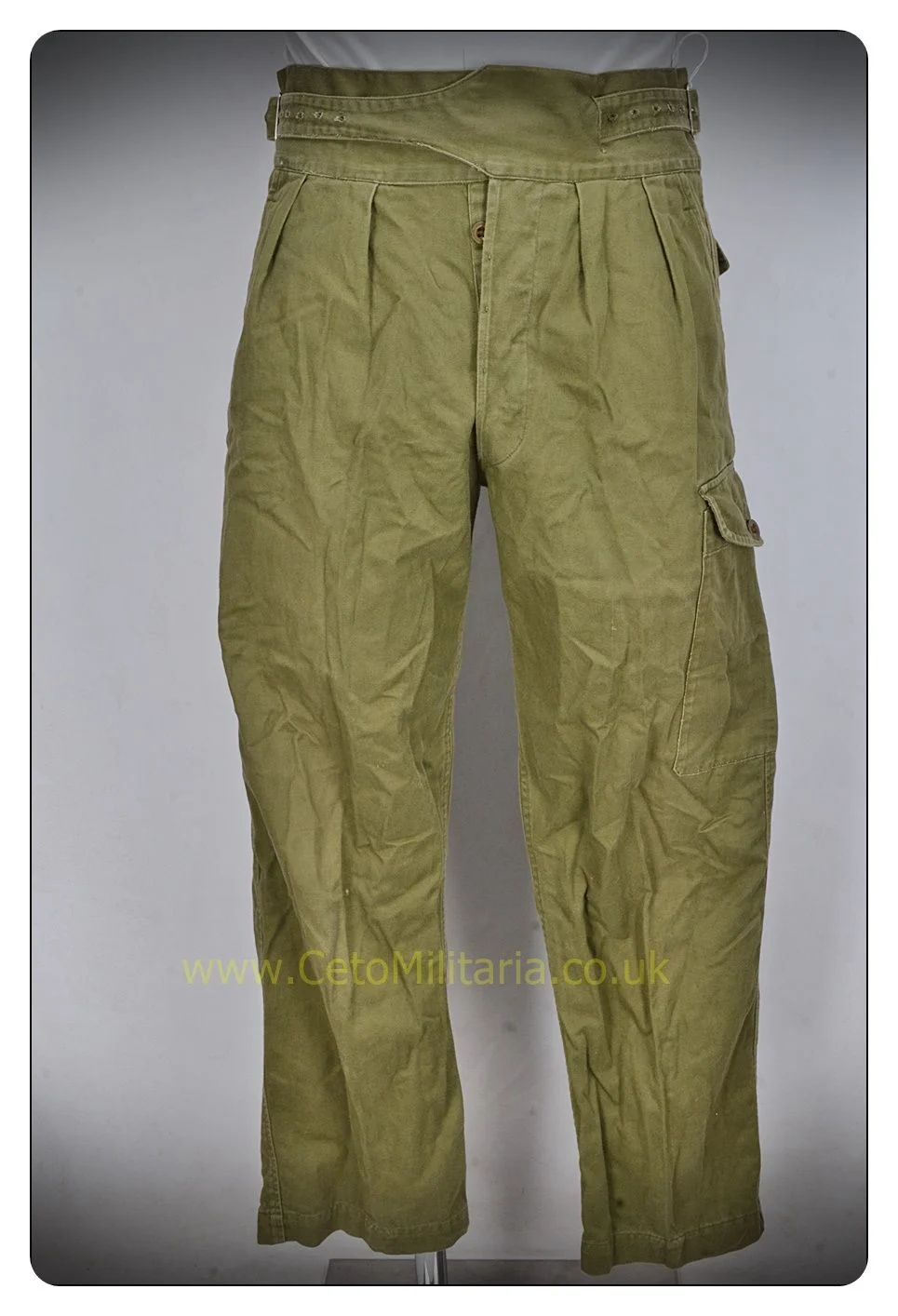
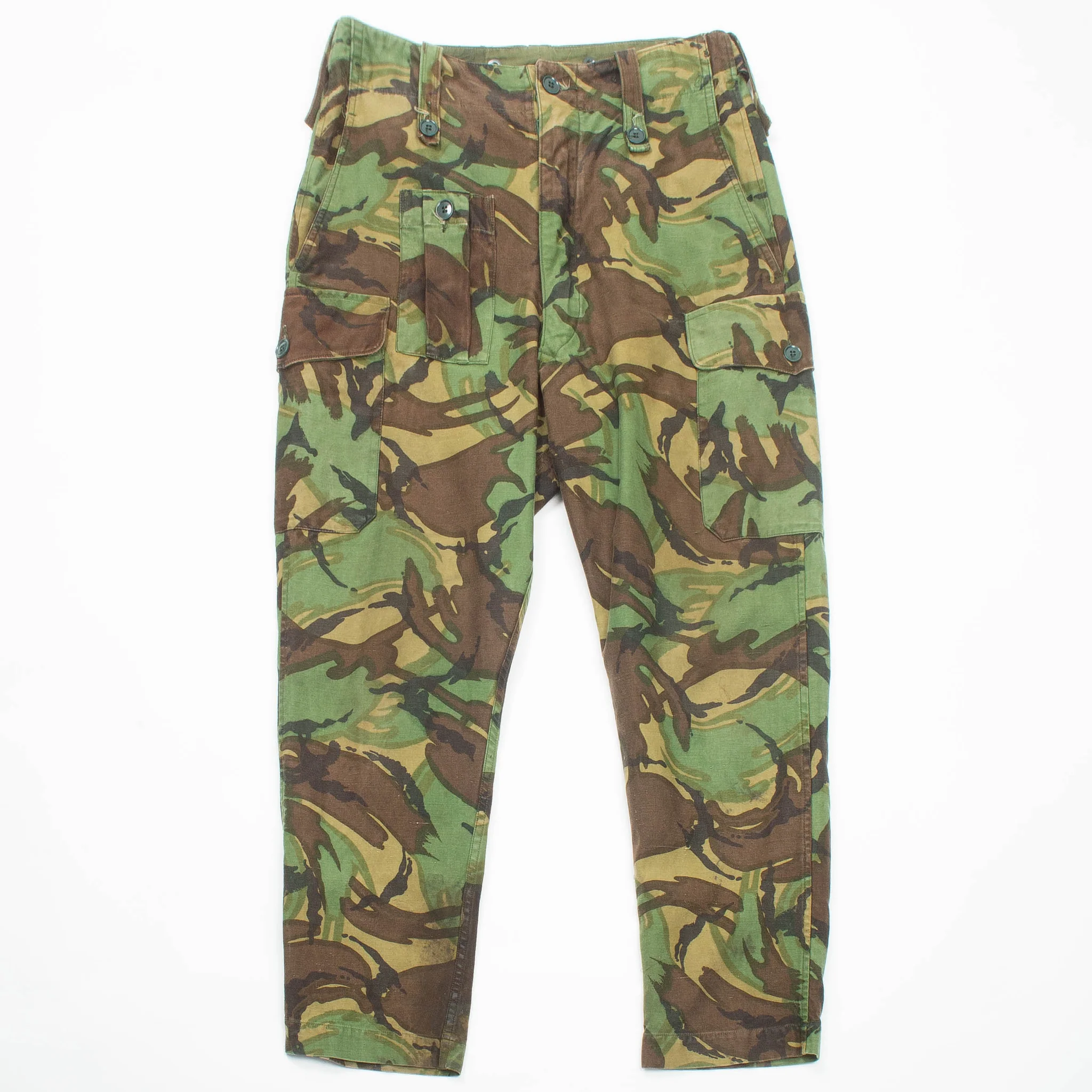
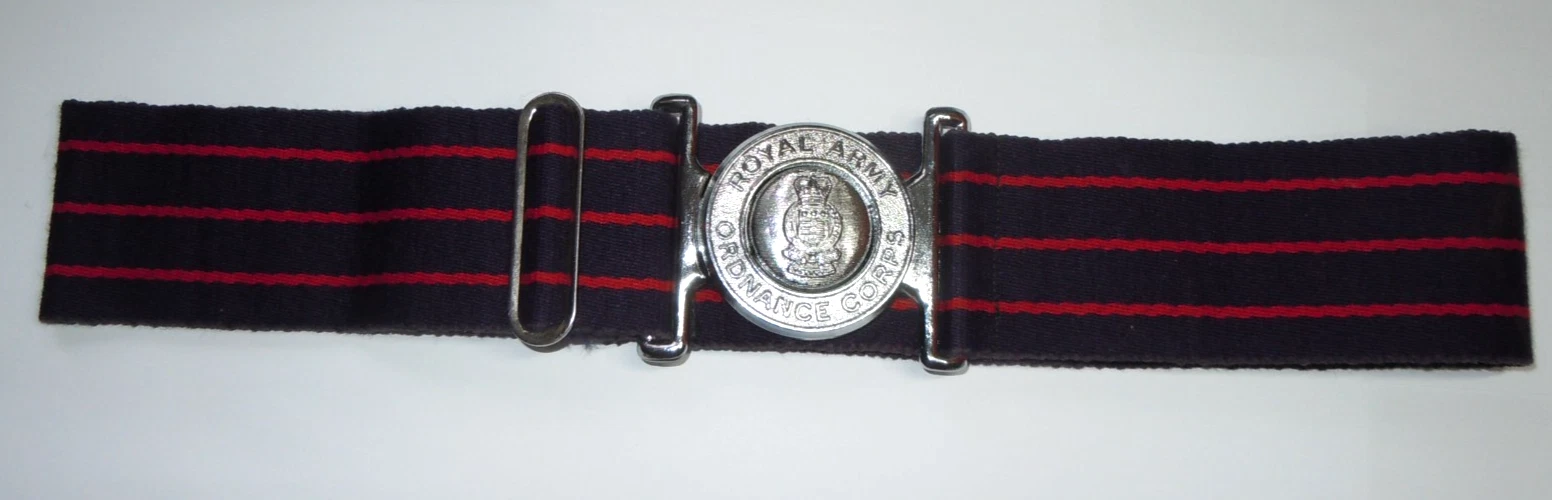
Painting the 3 scarlet stripes in 1/35 defeated me, so I didn’t.
I added a pistol, holster and lanyard to the figure, using a base pistol from an Italeri weapons set, plastic card, Magic Sculp and fuse wire for the lanyard, and also manufactured some respirator haversacks and NBC suits and depicted them in the vicinity of myself, and the Captain Daukes figure, and also my personal weapon, the 9mm SMG – courtesy of Italeri – with a sling from lead foil with an etch buckle. Obviously, we had to have our weapons, steel helmet and NBC kit to hand at all times. Back then, we tied our NBC suits to the haversack strap with string, or utilised the integral tapes of the suit itself; (hardly professional, but there was never any dedicated carrying method back then – or since come to that - for transporting the NBC suits; much later, the '58 pattern poncho holder was utilised – at the expense of carrying one’s poncho of course (pre Goretex, the only waterproof kit we had) – but back in the 70s – string! Not exactly living the military dream, and it vexed me for decades to come. Steel helmets were looped over the respirator case using the chin strap. You will note the rubber over-gloves protruding from the bundle on my respirator strap – not a severed arm in case you’re wondering.
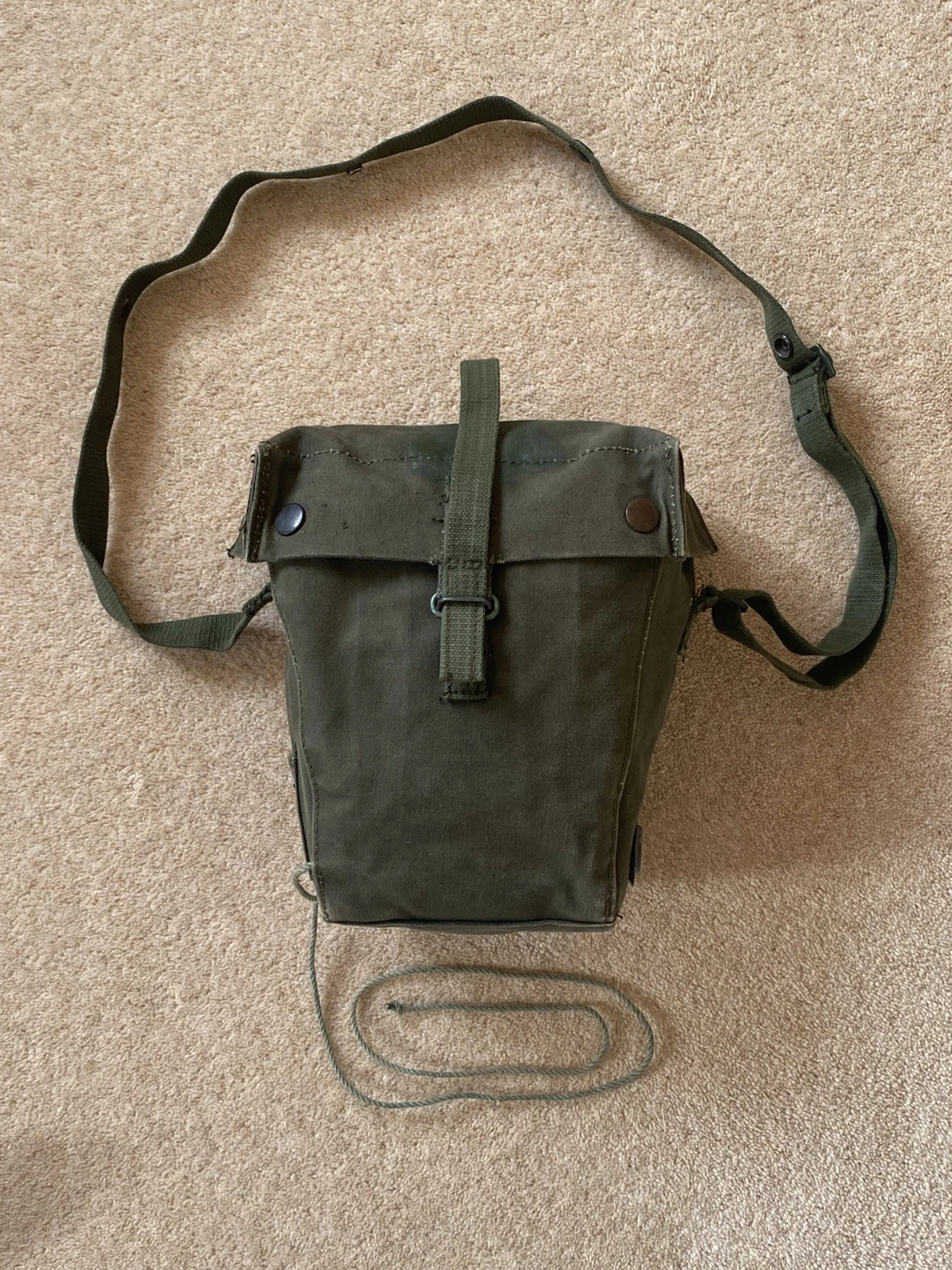
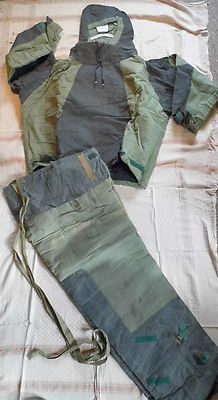
(Overboots and gloves not shown)
Berets are shown on the ground; it was a sunny day after all; for some reason I’ve brought my combat smock along and hung it up on one of the scrim poles. The 3 Div badge is on the LH sleeve, and my rank on the right – Lance Corporal folks – the first step to world domination! The small yellow rectangles affixed to the shirt breast pockets were exercise security passes. As an aside, you can see me in this pic in a German farmyard still wearing such a pass:
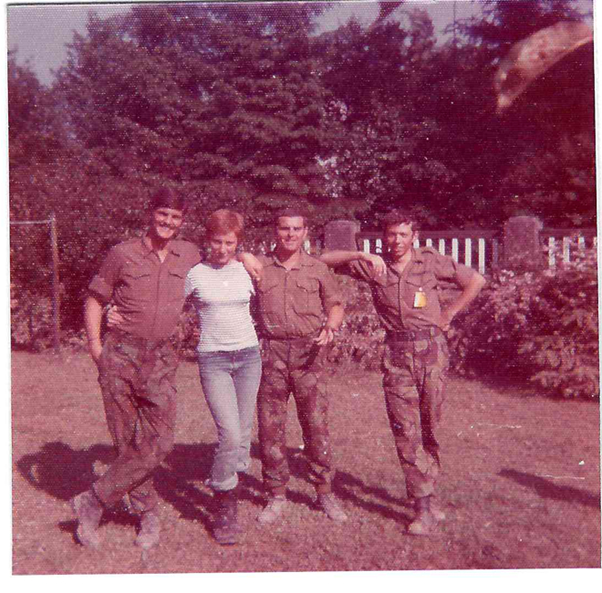
I have made myself a brew, using my '58 pattern mug, and for the good Captain, using one of the pool mugs.
I added a sentry pounding his beat just outside the wire; he was from the Defence Platoon and they were from the Royal Pioneer Corps. I utilised a Tamiya Brit WW2 Infantry figure as he had his rifle slung which is what I needed. Lots of sanding to prepare the figure, then the inevitable manufacturing of the skirts of the combat smock, the yoke for the webbing equipment, then the pouches, water bottle, respirator etc all from Magic Sculp; I used lead foil for the various straps and tabs. His Self Loading Rifle (SLR) came from the Italeri Modern Weapons set, slightly modified to represent the Brit version of the FN. I also used a Hornet Head and added scrim to the helmet. Oh, and his anklets web, were sanded down to represent puttees. All described in detail previously.
The deployed cam net overhead was made from gauze bandage, stiffened with PVA glue, then bedecked with used tea-leaves in the same fashion as I use on my AFVs. The supporting poles are from plastic rod and represent the fir saplings we used back then for supporting poles; just so you’re aware, camouflage nets just draped over something do not break up the outline sufficiently, be it vehicle or HQ tented complex; it will just look like something with a net over it, and then, once relatively easily identified, attract the fury of the enemy, and no one wished to endure a BM 21 salvo or two; so poles are used to break up the outline. On an exercise of this scale, real-life recce sorties were flown by NATO air forces so our camouflage and concealment measures had to be pretty good. Much, much later, properly designed poles and net-spreaders would be devised, but back then, this is how it was.
The paperwork shown came from, well, paper, (I actually used the thin stuff you get in boxes of paracetamol explaining why one shouldn’t take the drug at all, in around a zillion languages – as it was very thin) and the boxes of skins were just represented by thick card as they were quite shallow.
And that folks, was me on exercise, back in the day!
PS: For the record, Captain Daukes went on to a fairly distinguished career, ending up as a Brigadier. He is widely known as the initiator of the Berlin Brigade urban camouflage scheme when he was Officer Commanding the British armour squadron in said capital. So now you know.


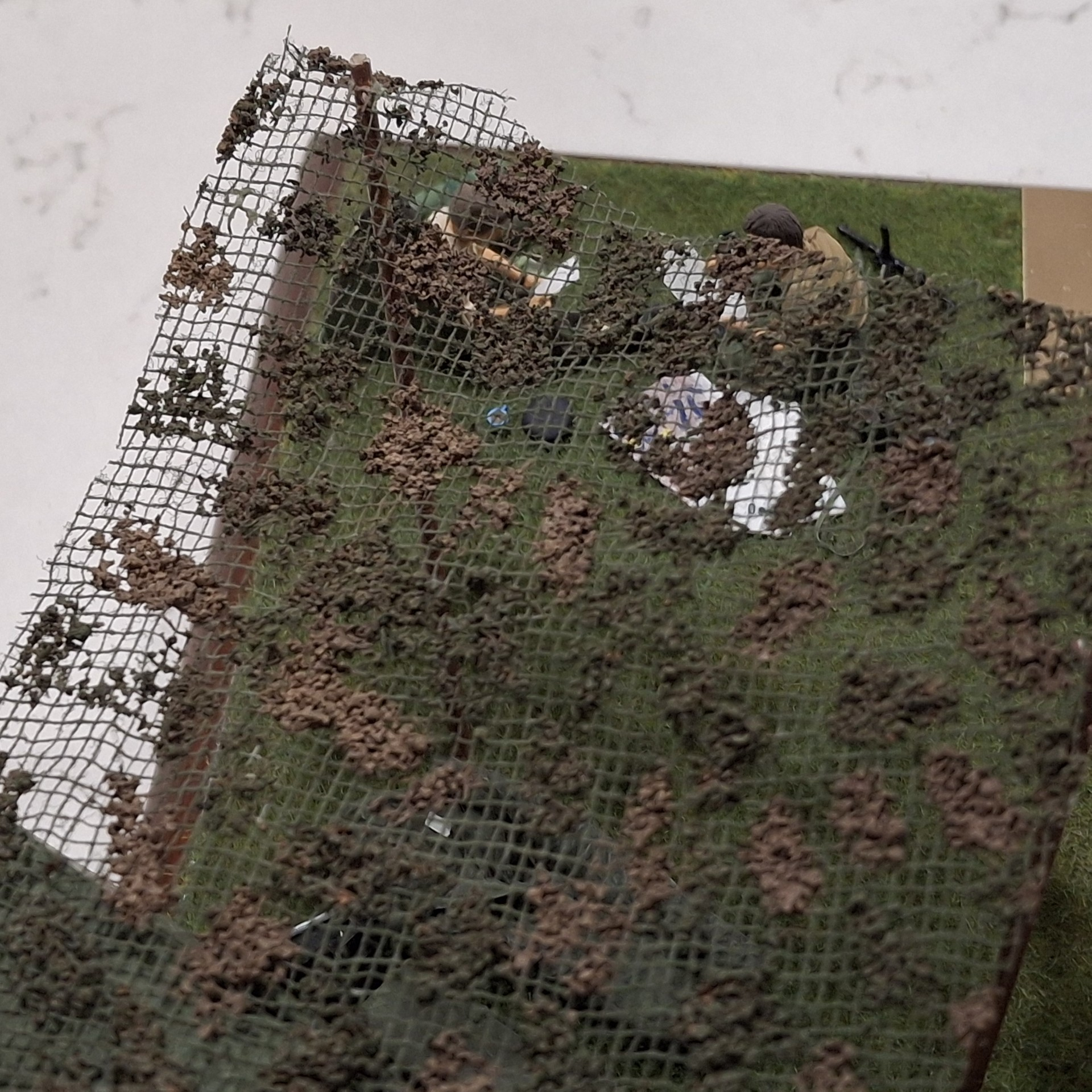
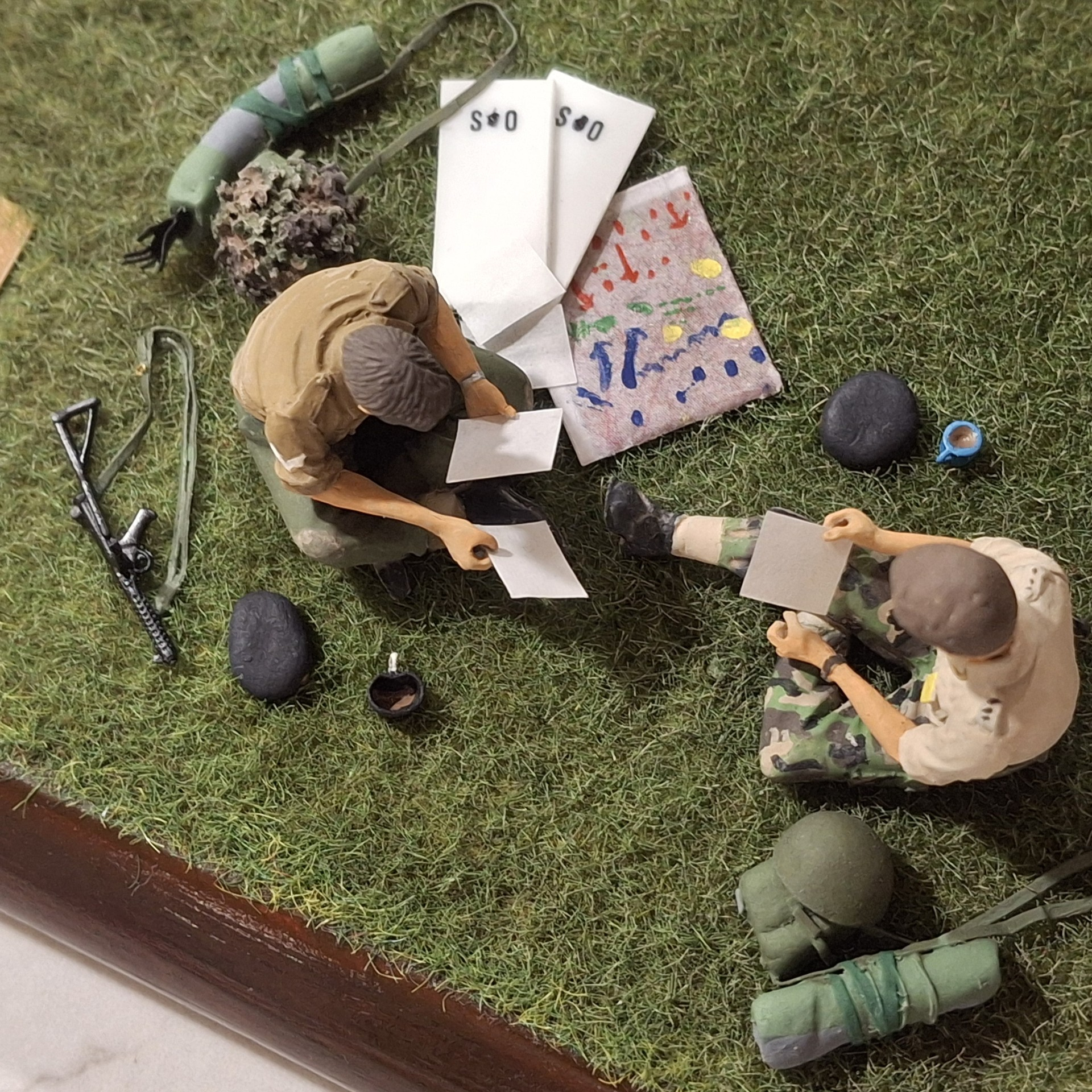

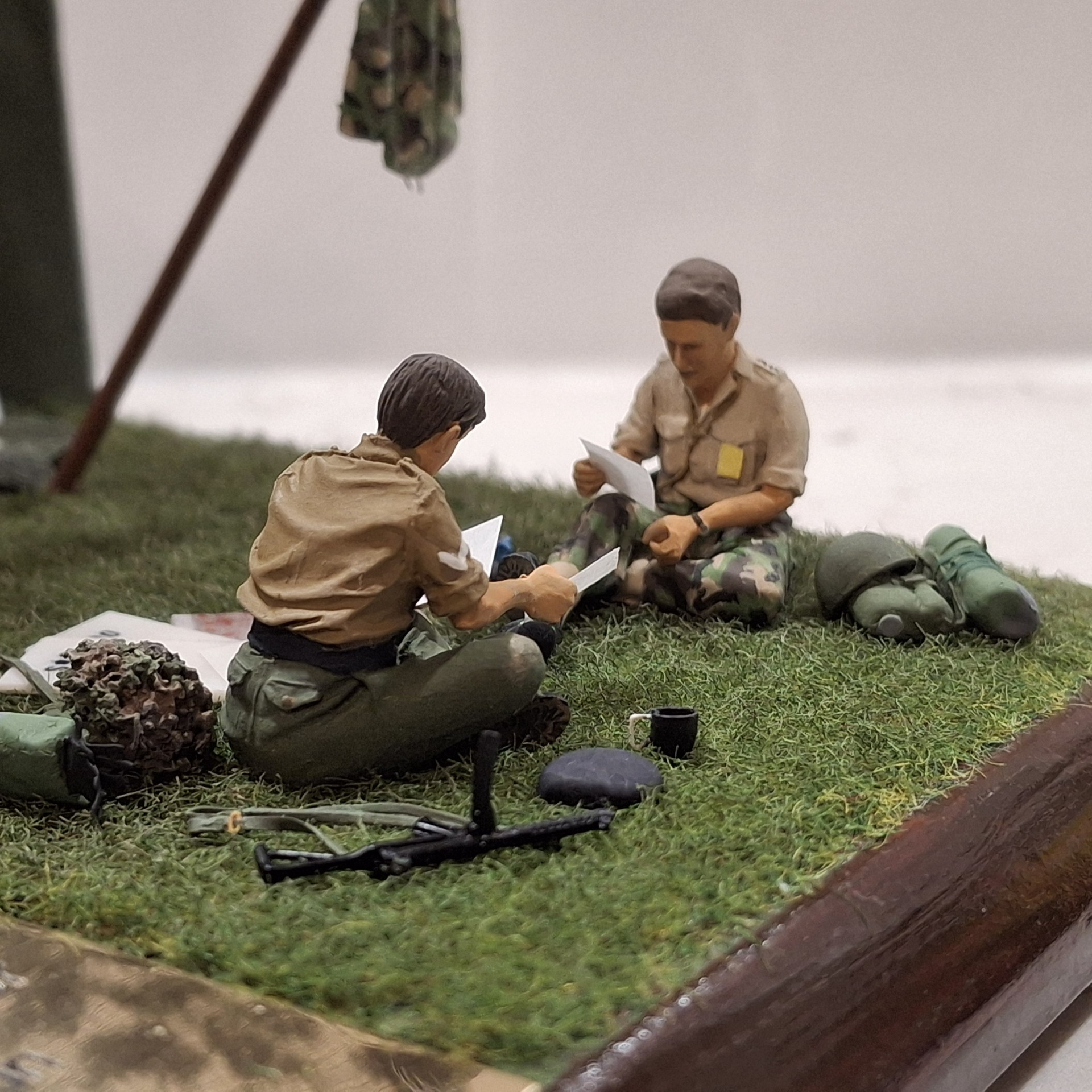
13 Likes
Brian, that’s come up really nicely! I do enjoy your slices of history that really illustrate the ‘day to day’ of military life. The comprehensive back story is also excellent and interesting context. Much appreciated!
3 Likes
Well, that’s a) a relief as I did go on a fair bit, and b) very gratifying - thank you very much Sam! I fear that’s 15 minutes or so you won’t get back.
As several have observed (on the site) an awful lot of military life is deemed mundane, depending how one views it. Certainly life as a clerk could be repetitive - so are most military jobs when one thinks about it - but on the Staff it also facilitated a much wider appreciation of how an Army worked, its most intricate organisations and roles laid bare, plus, in a way, one was part of the intellectual process of committing men to battle, hence my emphasis on that professional symbiosis we had with our officers. However, I am aware I proselytise far too much(!)
5 Likes
A sort of autobiographical vignette- that is how I would describe this! A seldom seen portion of military life served up with a bit of a history lesson on the how and why. It was nice to read along with this and see it come to life- in particular to see the various bits of kit that went into the business of running an army- I’d never seen a rotary duplicator before- interesting to see the military style typewriter too- looks like a heavy piece of kit!
I like the way you have set out the scene- each element has a decent amount of space in quite a small area- easy to see all the angles and the various bits of equipment here and there. The DPM kit is nice contrast to the drab, plain greens. The tea and the colored maps are neat touches too.
3 Likes
Thank you very much Karl for your, as usual, insightful comments. It must seem like ancient history to some given the predominance of the electronic medium and it’s impact on the world today. Back then, that was about as efficient as it could be with the then, available technology.
One interesting aspect of this was, in lacking any electronics, it was relatively foolproof when it came to technical eavesdropping; if there’s no signal, there’s no information being transmitted that can be harvested by the hostile. Even electric typewriters which were around back then (but we didn’t deploy with them) gave off a signal, which could be captured.
The bulky looking typewriter is in fact a German product, and not one we had in our HQ in the UK. They would abound though in the HQs in BAOR.
I’m glad you found it interesting - I wasn’t too sure how people would take it(!)
5 Likes
Great story to clearify the scene, thanks very much, was again a pleasure to follow 
2 Likes
Thanks Bert; probably not too good a point if one has to describe in such detail, if one works to the theory that a diorama should tell its own, but some things, the arcane nature of the British Army staff system perhaps, do indeed, need to be set in context, and that I felt, was the case here.
'Glad you found it enjoyable.
2 Likes
Don’t forget, I’ve not been in the Army, so the extra background info was very good for me
2 Likes
A very good point Bert, and all too easily forgotten; I do try, when I add a background, to bear that in mind though, which whilst it may add to the length of the thing, does hopefully help, and it would seem by your comments that it does, so thank you for that.
It’s all too easy to use military slang, and especially abbreviations that confound most. If I can make the organisation of the British General Staff a little more digestible, than I might be going in the right direction(!)
6 Likes
Nice addition mate and perfectly executed. Well done.
1 Like
Thanks John; old hat to a war horse such as your self, but I do try(!)
2 Likes
It was interesting. I used to drive/command a gestetner back in 79-82 time frame, producing Panui (Notice) for Maori Land Court sittings here in NZ, typically a couple of hundred copies of 5-10 page document.
Yes the proof reading had to be done, mistakes given back to the typist to correct with nail polish (I think that’s what it was - memory).
After the pages were printed, the notice had to be collated, stapled, enveloped, addressed (we had special stick on labels for regular recipients, one offs had to be written) then bundled up & taken to the Post Office with a docket for the number of envelopes being sent (bulk mail, though not much bulk).
The fun part of the job was doing the collating, stapling & enveloping - we’d split into teams & race to see who finished first.
Haven’t thought about that for years
Mal
1 Like
Well, glad it brought back some memories Mal. The stuff we sued to correct typing errors on the waxed paper skins, was known to us, rather unimaginatively as “Correctine” and was very like nail varnish; it came in small red bottles and was deemed vital kit:
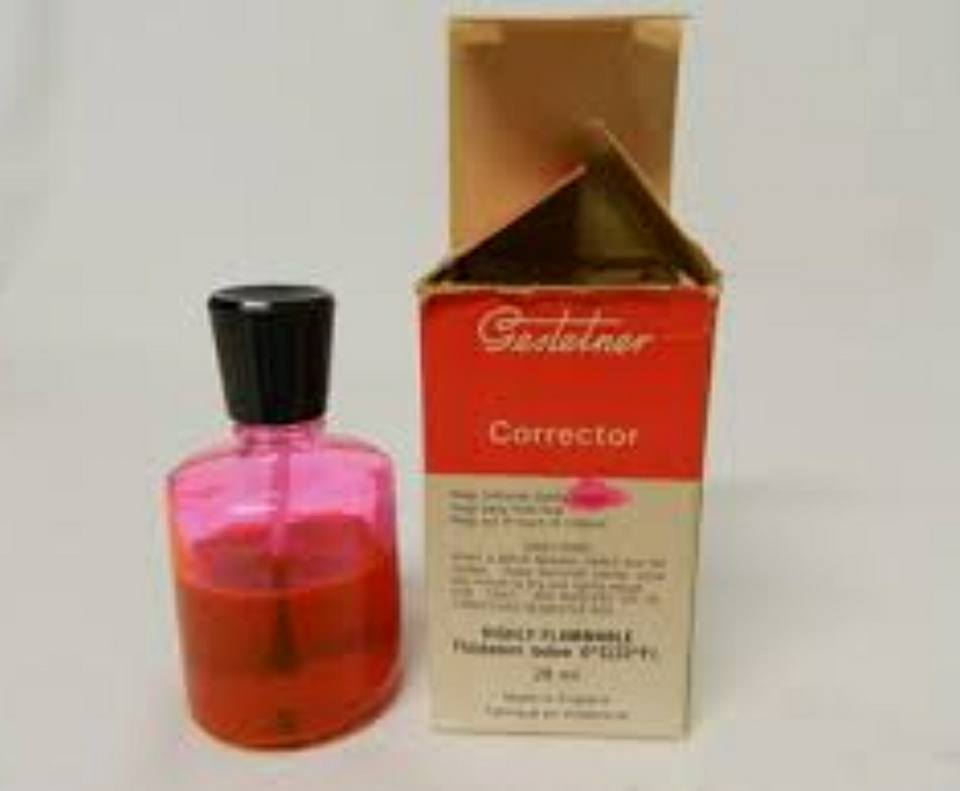
We also used it to colour the light bulbs of our torches, turning the light beam glow red, which was the only acceptable emission at night time. Funnily enough, there was a viscous green fluid known again, with great simplicity as “developine”, and this was applied to the stencils when they were on the duplicator to bring out any faint impression where the typewriter key hadn’t been struck sufficiently hard enough to develop the character; I suppose, thinking back, it must have been a very light acid, and given the inherent fragility of using skins in any case, had to be applied with care.
Even operating the duplicators in any HQ - let alone in the field was a fraught, busy undertaking, (some of the larger machines in the bigger HQs were electrically powered) Running off hundreds of copies of the larger documents was indeed a black art; the ink for these machines was a black, viscous stuff and came in lead tubes and got everywhere.
Of course, collation followed, and that was achieved manually by laying out the document in its entirety, often with maps and/or traces as components, and with clerks walking round and round the tables compiling and stapling the individual pages together; this was the same methodology we used in the field, and had to be precise; often such documents were classified, and there then followed that arcane process of recording them in registers, processing manual receipts let alone applying the rigorously packaging and despatch procedures; all had to flawlessly carried out. Truly a paper war(!)
Ah, those were my soldiering days, and one had to be up to snuff! Combat Arms? You’ve never had it so easy!
2 Likes
I do recall the ink & having to run a few copies manually - multiple rotations of a crank to get the ink flowing through the stencil sufficiently, then engaging power for the required number of prints. You had to be present in case something went wrong. I don’t recall Correctine - but that was typist territory.
Funnily enough that job led to my only range time with the SLR. The local TF (Territorial Force) unit used to challenge the local Govt Departments to a shoot at the local range behind Mt Parihaka in Whangarei. That was one of the many ranges that were closed later in the decade when they found out richochets travelled further than previously thought. 10 rounds rapid from standing is the part I recall most, trying to bring the rifle back on target, prior to the next shot.
I think Army won that year
Mal
1 Like
God Mal, Who’d ever have thought we’d have this discussion on Armorama eh?
2 Likes
Hi Bryan
Ok, I agree about the gestetner et all, but isn’t reaping the memories this sites secondary purpose - sure seems like it
Mal
And I forgot to congratulate you on the build…
1 Like
Yes, or course, and who knows what other models will result from such stimulation?
Thanks re the build; not something you’ll see that much on the display tables, I’m sure!
Then again, I did the one about “unloading a Land Rover” and “Painting Hessian” - mundanity my byword(!)
2 Likes
The path less travelled modelwise, over represented in real life…the latter of ‘Hurry up & wait’
Mal
1 Like