Er, well, thanks! I should have it wound up today sometime.
2 Likes
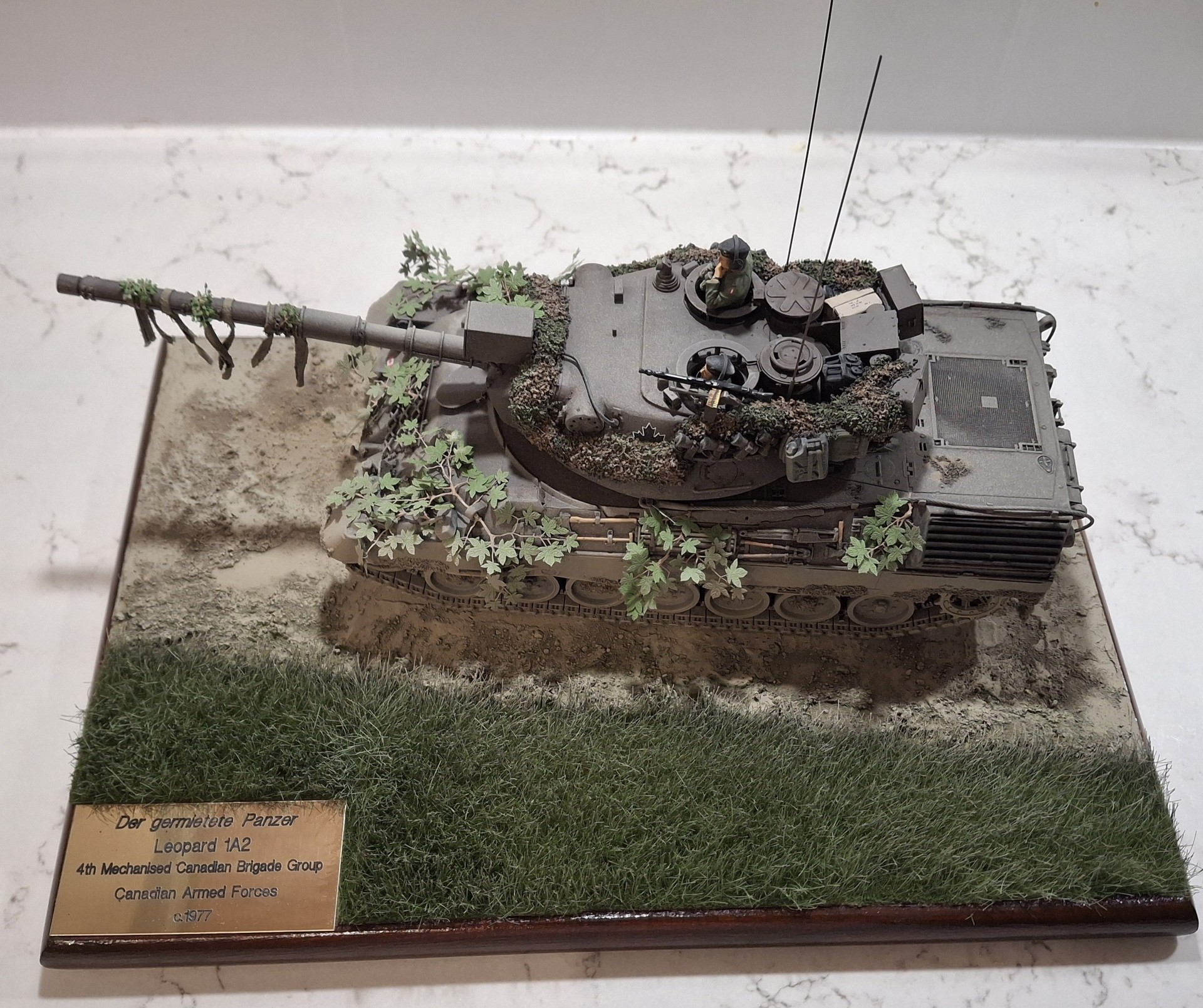
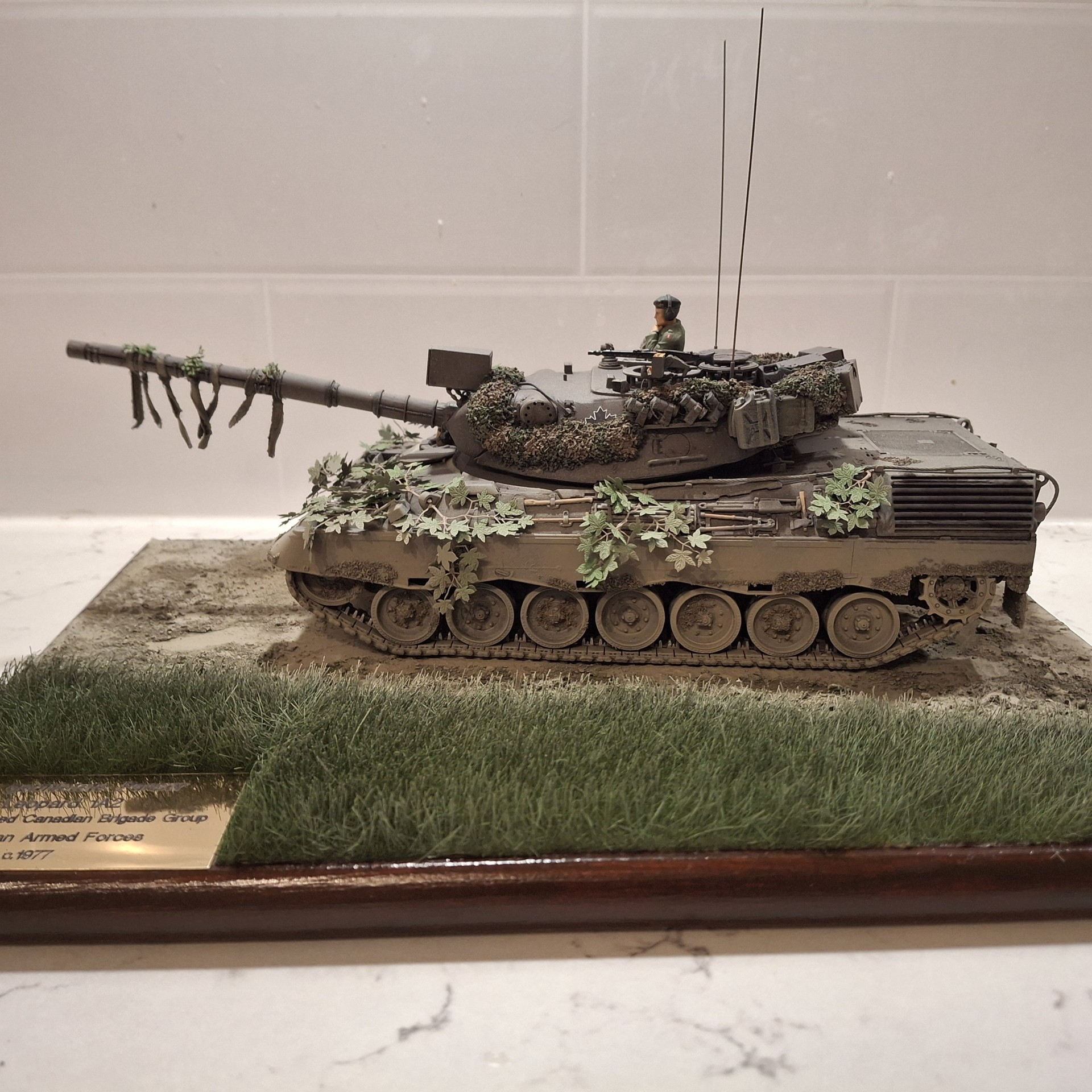
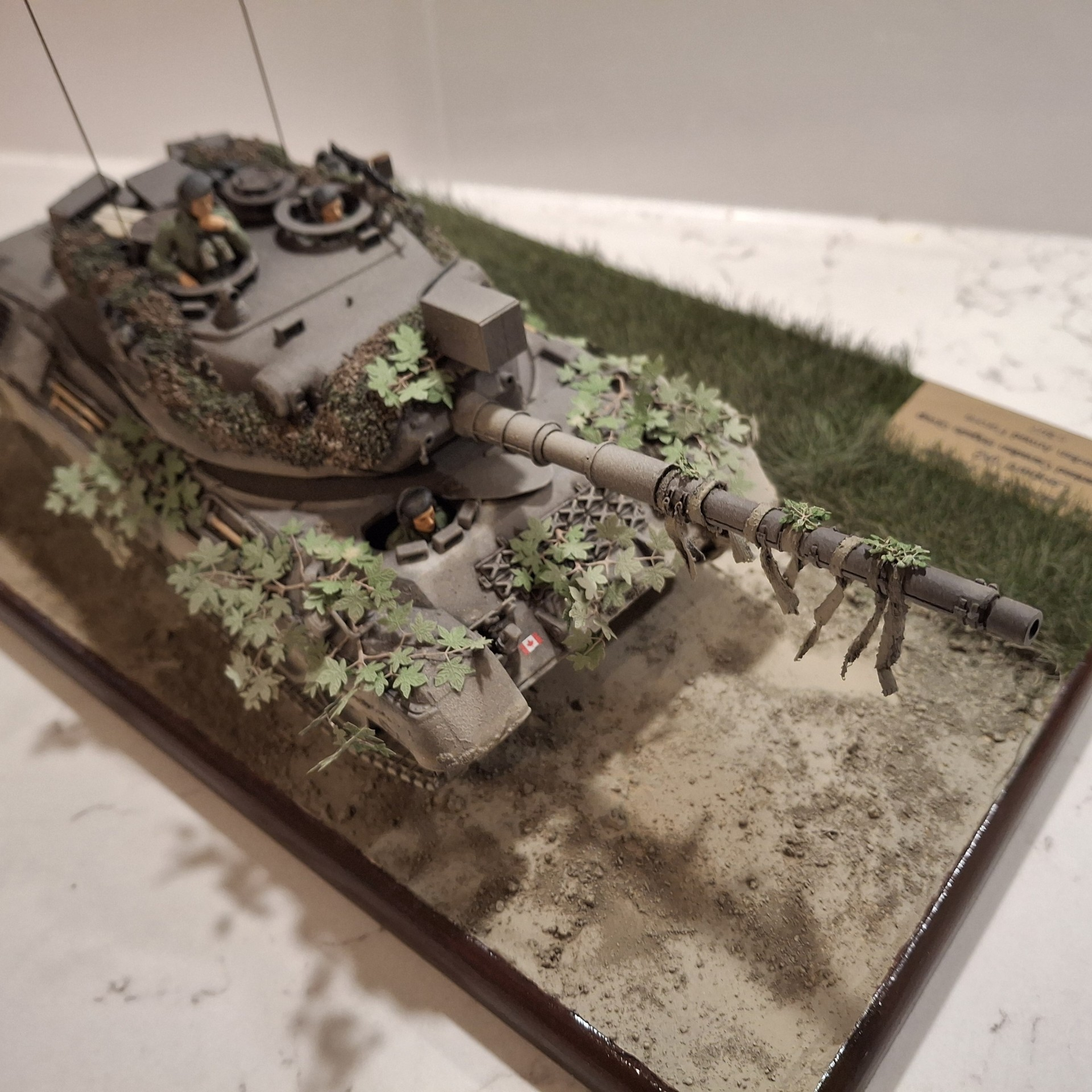
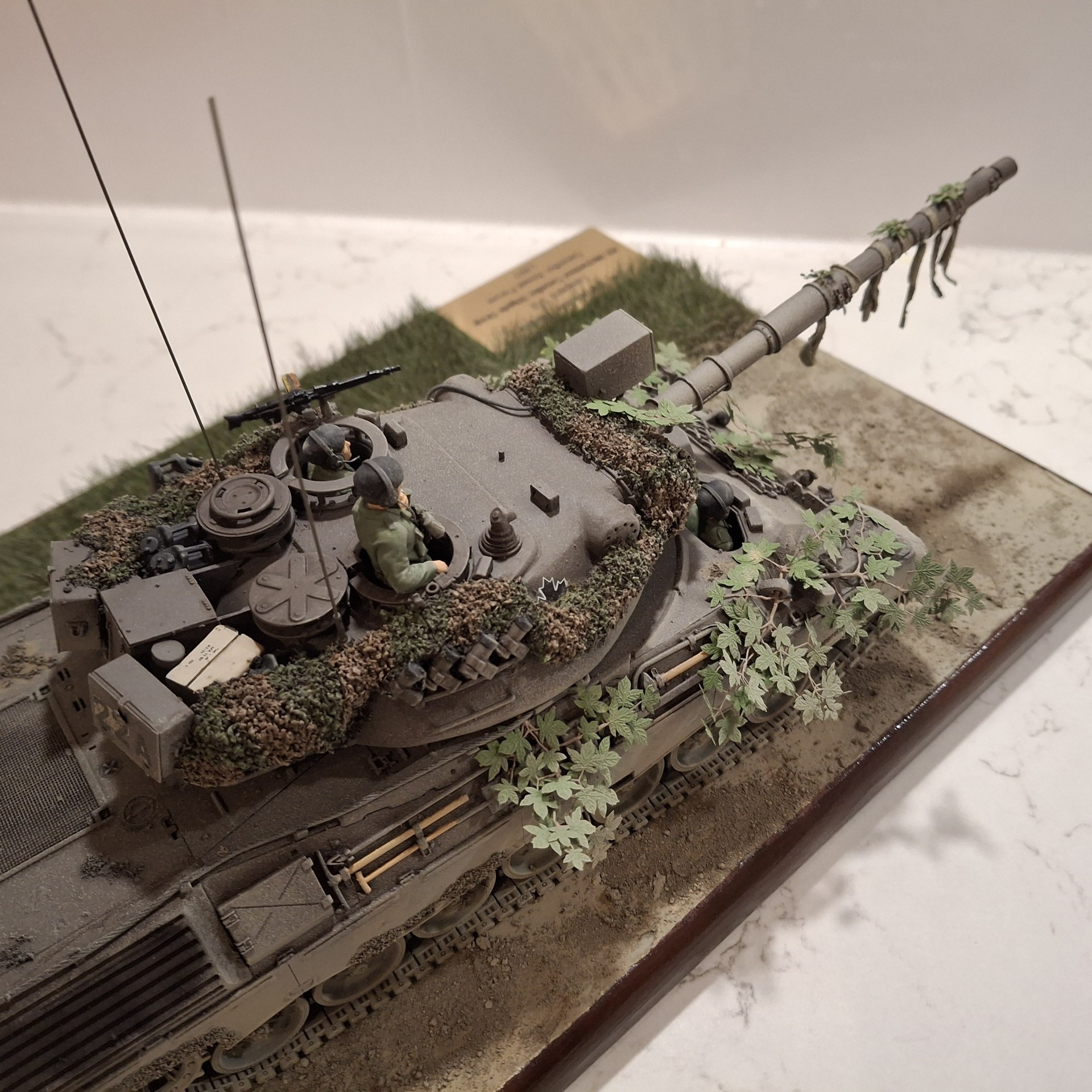
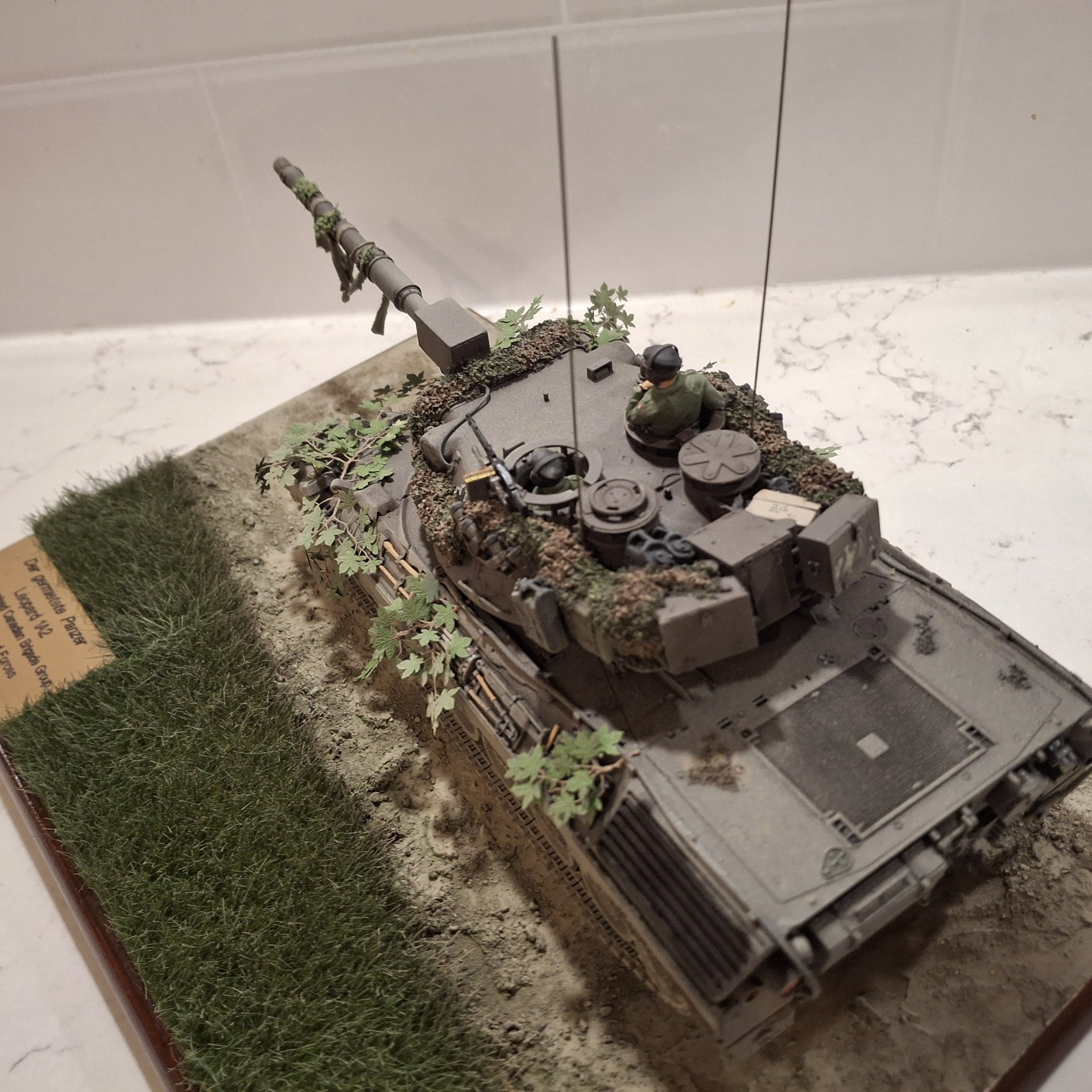
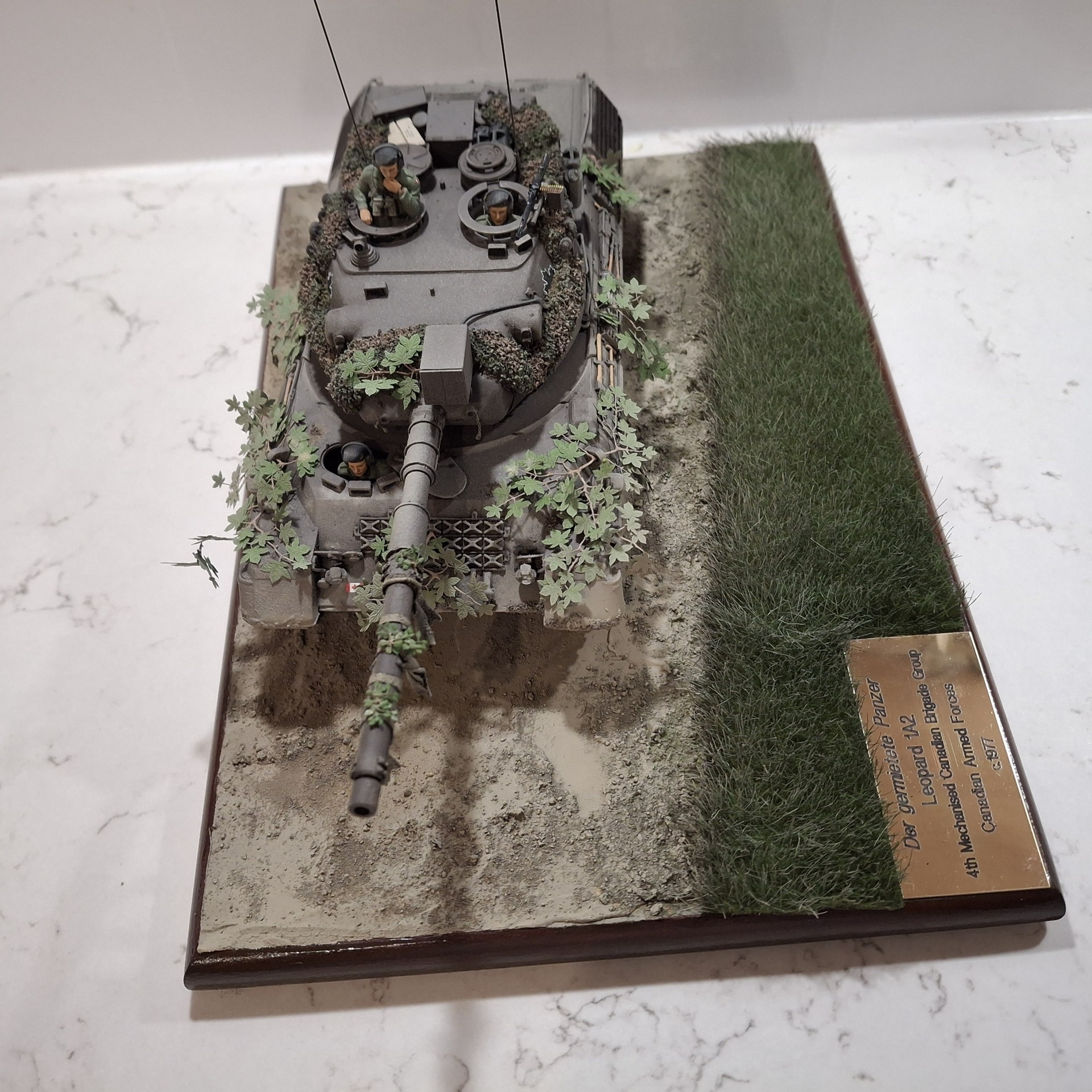
Well, here it is, my rendition of a Canadian Leopard 1A2, “Rent a Panzer” (in German: Der gemietete Panzer) as they were humorously known, reflecting the lease of some 32 tanks to the Canadian Army in West Germany, while the C1 version of the Leopard was developed. Only 32 tanks were loaned, which is only really enough for a couple of squadrons’ (companies) worth. One does wonder how much worthwhile training was undertaken other than familiarisation with the type, due to such a relatively small number. I mean, it’s not as though the CO can hone his skills on any exercise and practice running a complete regiment with such a small number of tanks, is it?
I sometimes feel sorry for the Canadian forces; I mean, if you’re a keen young lad with martial proclivities, yearning for a military life, you might just end up disappointed; you’d be part of a dwindling Army with a government that clearly doesn’t see much worth in you – or that’s how it seems to me. Decent equipment would not seem to be a priority at all. Not, I hasten to add, that I wish to start one of these nugatory arguments that populate the site from time to time.
So, back to the model: I used a Revell 1A5 as the donor kit and purchased a 1A2 turret from Perfect Scale Modellbau. This sort of worked out, but fit wasn’t very good and I messed up the stowage rack installation and found installing the smoke dischargers very difficult. This seemed to pave the way for further foul-ups when I located the towing cable brackets too high on the exhaust (despite having excellent references in front of me as I did it!) However, I thought I might be able to obfuscate the shortcomings of the rack, with, wait for it, lots of stowage, and may have gotten away with it. The brackets, well, not so, but I’ll have to live with that.
Colour was Gelboliv; the colour scheme, secondary armament, and even comms fit were all as the Germans issued.
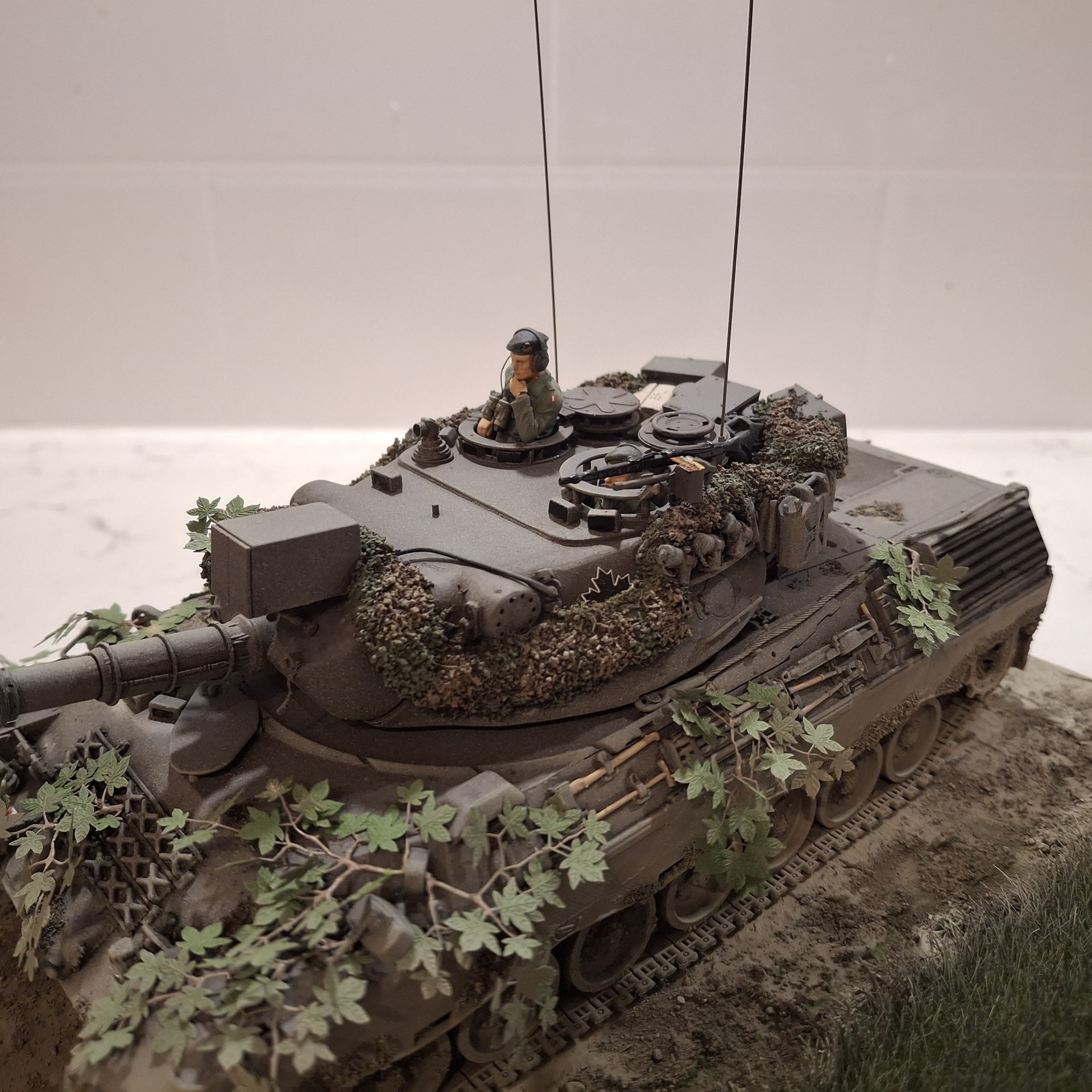
Markings were limited to a black and white maple leaf emblem either side of the turret, and national flags front and rear. Not even a bridge plate to help add a bit more colour. There was however, a rudimentary callsign on one of the rear stowage boxes; following on from the other mistakes, the decals didn’t settle down at all and one can see the silvering. This was turning out to be a very frustrating build. Most notable of the stowage is the furled camouflage net, which I made from Magic Sculp and then added dried, used tea leaves – my normal method of doing so when it comes to replicating those nets from the late 60s onwards.
I mentioned the Karaya tow cables during the construct phase; I also added 2 x stowage boxes from plastic card and converted Academy ammo boxes, to the rear of the stowage rack. These seem to be of a common design so I assume a unit workshop initiative. They were fitted with hinges, a hasp and padlocks. Actual stowage consisted of water jerricans, even more cam net, a cardboard box – rations perhaps though I have no idea if it reflects reality, and a folded tarp.
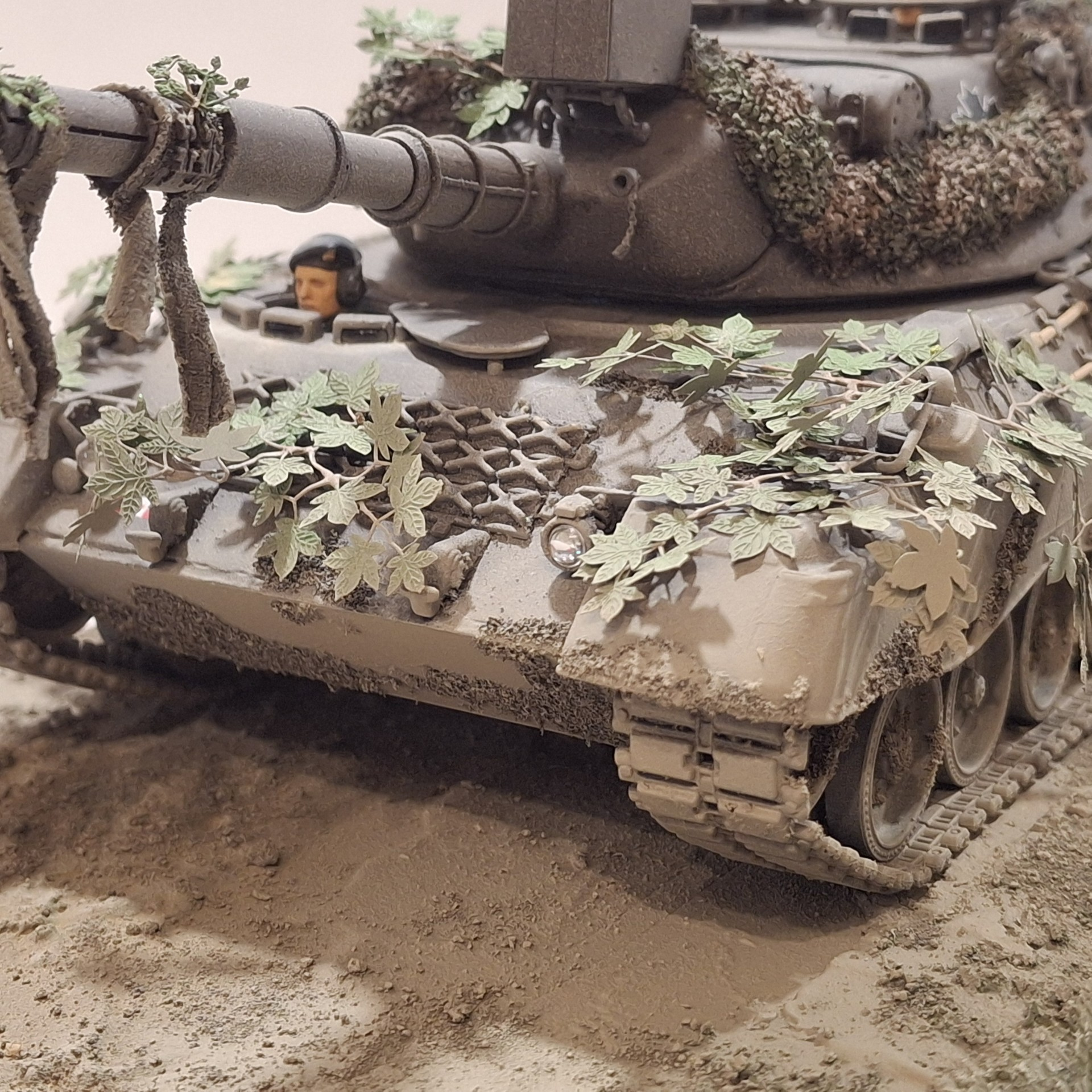
Scrutiny of these tanks on a Reforger exercise in 1977 showed that some used a mud camouflage scheme on the skirts; others tied Hessian to the gun barrel, so this is really a bit of an amalgam of images I discovered, mainly from the Tankograd books. Jason Bobrovich assisted by confirming that Canadian forces used natural foliage to camouflage their vehicles on exercise, hence the use of etched brass greenery. From the limited references I had, I noted that the hull seemed to be the focus of the foliage, not the turret, the complete opposite of German units for instance. Sadly, the mud-based stripes on the hull sides disappeared as I was somewhat over-enthusiastic with my application of Tamiya Buff which I use to finish off my models and tie them to the base, representing dust etc after a hard day’s exercising.
Crew figures came from Sylly’s Models; the Driver and Loader are identical but will have to do; the faces are a little bland, and I didn’t really alter the headsets enough to change the Canadian version into the German one; a bit more sanding was really needed on the earphones. I did manage to install cabling for both throat mikes and earphones though. The figures are wearing combat jackets but I left them as it was; a combination of such a jacket over a tanker’s coverall would be highly likely in a German Autumn.
The base, constructed from my usual A4 paper-sized 12mm MDF, stained and varnished, reflects a simple track alongside a grass strip, which was made by tiling grout and a proprietary grass mat from the model railway scenic side of house.
And that folks is about it; at long last I’ve broken the mould in not having any Canadian models reflecting the composition of units within NATO’s Central Region; overall though, frustratingly, not one of my more successful builds, however, the way ahead may now include a Lynx recce vehicle, an M113 and possibly this tank’s successor, the C1 version of the Leopard. Not just yet though (!)
As always, over to you.


14 Likes
Stunning! 
And you’re way too hard on yourself!
2 Likes
Well, thank you very much (and I suspect you’re right re the hard on myself bit).
1 Like
Another excellent build there Brian! I like the etched-brass maple leaves as a nice “national” touch. Now of course you are forcing me to buy a 1A2 resin turret!
1 Like
Hah! I didn’t actually notice that the leaves were maple until late in the day; etched foliage is now becoming hard to find. Eduard have stopped production of theirs. I am making headway with 3D printed stuff, not cheap, so that will probably turn out to be the way ahead. I must admit, etched brass is laborious stuff when if comes to using it on an AFVs.
Thanks too for the plaudit. If you do get a 1A2 turret give it a bit of attention before you start working on it; sort out the grooves for the stowage bin and the locations for the rack, and smoke dischargers. That’s what I should have done.
1 Like
Fine work Brian- I think the lack of much in the way of insignia and markings lets the wonderful hessian and foliage shine. And as always an interesting history lesson to go alongside the model!
2 Likes
Thanks Karl; much obliged.
2 Likes
Well, even though you are not to satisfied with how things went, it was fun following your show again, and for someone like me, not bothered by knowledge of towing brackets being placed a mm or so to high or low, the result looks great again 
On to the next !
2 Likes
Thanks Bert!
1 Like
It’s not my area but this really looks the business, suitably mean – I particularly like image Final 6. And sheer genius to deck it in maple leaves (mate never admit happy accidents), I’d only suggest some of them need browning at the edges – yep an easy fun job but you’ve got the chops. Then go win a Show competition with it 
1 Like
That looks really nice.
1 Like
Thanks Tim; not too sure about a competition though.
I won’t be browning the leaves though I applaud your suggestion; when I was with a TA Infantry Battalion (God, they were bloody keen) we used Land Rovers in HQ Company to get around in and besides, they were fitted for radio (FFR), so in addition to providing the battalion’s comms, we camouflaged them with chicken-wire, scrim and foliage. The drill was that after Stand To - always at dawn and last light, the first thing we did was to check the cam and anything wilting was immediately replaced; I have assumed that the Canadians were equally on the ball(!).
4 Likes
Thanks a lot Ralph!
1 Like
An excellent push to the finish line, Brian! Great to see another Canadian Leopard rolling on! Don’t fret about the Canadian Army then or now. Back in the 70’s the tank crews transitioned from the Centurion to the Leopard…a huge leap with relaibilty, mobility, and interoperability. The 105mm gun was already familiar to the crews and they maximized their skills on the rental tanks and later C1s. The Canadian Brigade in Germany had the right size for what it could maintain overseas with an Armoured Regiment with three operational tank Squadrons given the available resources and budget. Canadian Leopard 2s are now holding their own very well along side other NATO Leopards in Latvia.
1 Like
Thank you very much Jason; you have to be the arbiter regarding Canadian models - glad I made the cut! My comments about soldiers were never to disparage, merely that, well, in a way I felt sort of sorry and frustrated for them, but that is not to patronise either I assure you.
I’m glad I have at least one 1/35 representative model of the Canadian Brigade Group now completed; I have recently received a Lynx from Sylly’s Models - and look froward to that interesting colour scheme. But I also hanker to make a Centurion, and have been recently inspired by several of the Tankograd booklets - priceless for Cold War modellers in my opinion - and again, the colour scheme options are very interesting, from options with sand, green and OD in the 60s, to the later similar to Lynx versions, of the Cent Mk 11.
I have often worked with Canadian staff, in Bosnia and later in Iraq (where I’m sure we had a Canadian Staff Officer on the Div HQ staff) and whilst easy-going on the surface, were consummate professionals when one drilled down(!)
Thanks again.
1 Like
Top job
1 Like
Thanks mate. Very much.
1 Like
I’d never considered gardening was part of the camo drill but it makes sense – also makes me wonder why they didn’t just spray the leaves mid-green when installing…um…
2 Likes
Because then they’d have to paint the whole forest to match! 
2 Likes