They already do - the key system is the East-West Pipeline, or Petroline, which runs from the oil fields in eastern Saudi Arabia to terminals on the Red Sea coast. It was built specifically to reduce dependence on the Strait of Hormuz.
The UAE built the Habshan–Fujairah (ADCOP) pipeline, which carries Abu Dhabi crude directly to the port of Fujairah on the Gulf of Oman. The question is, like the one above, is a matter of capacity.
Oman? Oman’s main oil export terminals are already on the Arabian Sea/Gulf of Oman side of the peninsula, so Omani exports don’t need to transit Hormuz.
Build new infrastructure? Not just time and money are involved. You have to get different governments to agree - something the US and Canada have difficulty doing.
I saw plenty of stuff like that when I worked at the Hobby Distributor. It’s what happens when inventory comes in faster than it can be processed and properly put away. I’m sure it’s still happening there now.
To be fair, this was a huge project. You can see the one pallet is numbered “74.” It was way more than that. They were stacking up because delivery trucks, which I escorted, weren’t being loaded fast enough. Because they only had one forklift driver, who was also trying to load the pallets onto a huge shrink wrap machine, waiting for them to be wrapped, moving them to the staging area, and then loading another pallet onto the machine, which could actually accomodate another much sooner then he was loading it. (They were on rollers.) I timed how long it took to wrap each pallet (something like 1.25 minutes, but it varied depending on the height and length of the pallet. I talked to the driver, who then began shuffling pallets, loading the truck, and adding new ones to the shrink wrap machine as soon as possible rather than just waiting. It increased their output considerably. Not because I was any smarter, but because they had never encountered the situation, and because I could also look at every aspect of the operation rather that one facet, which is what each employee was doing. what most employees do in any endeavor actually.
But because of that, we also eliminated the safety violations, which I documented by the fire exits as well.
Yes there are already some pipelines to the west and south to avoid the SOH. The issue is they don’t move enough oil and natural gas to offset what other gulf countries produce and ships have to go through the SOH to get out. Many more pipelines are needed to totally avoid the SOH.
It is also not all about oil. There are 100s of cargo ships that transit the SOH daily as well.
That’s rich.
That said, you can’t even handle a little ribbing. I merely pointed out that you missed what I said, only in a much more abbreviated fashion. Relax. Light a J. Or just lighten up.
This article hightlights my earlier comments about the East West Pipeline, as well as those made about the UAE’s poet at Fujsirah. Using the southern route only weakens Iran controls even more.
I do not know what kind of weapons, drones or system that Iran possess
or what range these may have. Even If I had had perfect knowledge about
what they did have half a year ago I would presume that things have changed
since then.
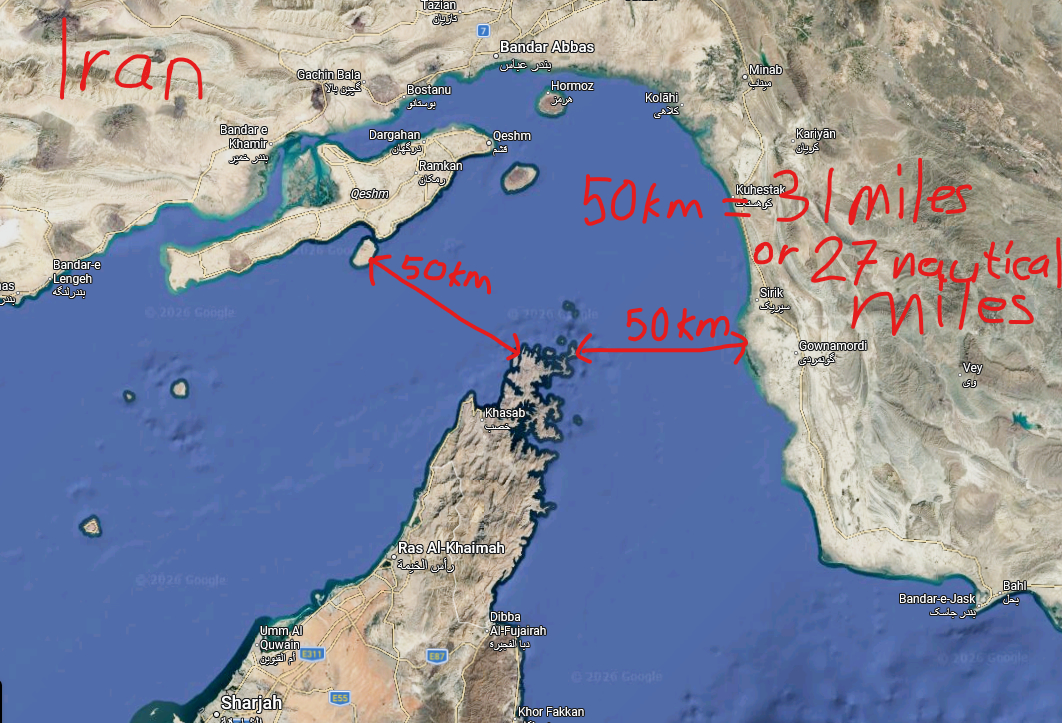
I would not consider 50 km (shore to shore, a big ship needs to be further out
to sea) to be a safe distance.
Yes, drones can be shot down, lots of drones could probably be shot down
but eventually the wave will overwhelm the defenses, it’s just mathematics …
 Oman’s main oil export terminals are already on the Arabian Sea/Gulf of Oman side of the peninsula, so Omani exports don’t need to transit Hormuz.