Anti-AI BS on another modeling site

An example of the unintended and unimagined consequences of something that was, I’m sure, intended to be benign, entertaining, useful and efficient. The detrimental effect on reading ability is also largely one that is indirect. TikTok itself doesn’t cause someone to forget how to read, it influences culture and society in ways that devalue and disincentivize learning to read. It also doesn’t work alone. It has to be combined with other technologies to do what it does.

Cameras evolve from glass plates, to film, to digital. They are also miniaturized from wooden boxes on tripods to an accessory included with every cellphone (which has its own story of evolution). Cellphones are integrated into the internet and worldwide, nearly instantaneous wireless communication, which is itself, supported and enabled by constellations of satellites. Those satellites are launched into orbit on rockets that were developed from ancient Chinese fireworks, which were themselves likely first conceived as weapons of war.

So, a chain of consequences, some intended and some not, create a social or cultural condition that disincentivizes young children from learning and developing skill at reading. Some clever guy in China develops gunpowder, and centuries later, children in Sweden don’t want to learn to read.

Now imagine what sorts of unintended, unfortunate consequences could manifest themselves in the future from the use of AI today. The problem is not, however, with gunpowder or AI, but with a lack of willingness to imagine those possible, unfortunate consequences and take some rational steps to prevent or mitigate them (steps which would no doubt have their own possible unintended consequences).

Sticking your finger in the candle flame is one way to learn that fire will burn you. Your natural reflexes will likely make the experience one you will survive with just a small blister that will heal in a few days. Sticking your finger on the red launch button and pushing it just see what will happen is an experience that might kill us all. Somewhere in between lies the technology of AI.

We should learn from all the times before that we burned our fingers in the flame before we just push the red AI button and launch the entire world on a path that we haven’t taken the time to envision or the imagination to see where it might end.

2 Likes

Raw meat gets tiresome after a while though
:wink: :grin:

Here we are having a nice exchange of ideas while on
another forum the moderator has put a lid on it.

2 Likes

Indeed. Just be careful grilling your meat, and all is good. However, don’t asphyxiate yourself in your cave from the smoke.

2 Likes

It’s context that they don’t understand, and fail to pick the correct pronunciation of homographs (words that are spelled the same, but pronounced differently), multiplied by the fact that YouTube channels chase the almighty meta and pump AI-generated videos out without review. If they reviewed the narration, they could change the script to force a specific pronunciation (i.e., changing “I have read this book” to “I have red this book” — people watching the video won’t see the script text, they would just hear the correct word). But they worship the other GIGO — ‘Garbage In, Gospel Out’ — and can’t be arsed to check anything. The silliest one I’ve heard was a failure to parse a number — the script (and captioning) said “45,000 years ago”, which was read as “forty-five [pause] zero years ago”. The AI-generated artwork can be worse, though; there was a “The Germans Couldn’t Figure Out…” video about the M4 Sherman, and the thumbnail showed a bunch of Germans standing around the bow of a Sherman with the (nonexistent) cover plate on the glacis armor removed, with a V-8 engine visible just behind the removed cover plate, right where the driver and bow machine gunner sit.

1 Like

AI voices on police bodycam videos: “He called nine hundred eleven.” :grinning_face_with_smiling_eyes:

2 Likes

Yes, the irony is thick here. In the veery thread, an attempt was made to curb speech.

2 Likes

Scientists first started becoming aware of bacterial resistance in 1928, when Fleming noted penicillin had no effect on certain bacteria. It was formally identified in the early 40’s when antibiotics went into mass production. Sorry the news took so long to get to your country.

1 Like

It took so long to get to ME, I’ve only been around since 1964,
the language skills were limited the first few years and once I
started reading I did not dive into medical journals.

In the 1960’ies - 1970’ies the concept “hospitaldisease” went viral,
hospitals infested by resistant bacteria …

Medical professionals and researchers in Sweden were aware
in the 1940’ies - early 1950’ies.

1 Like

About the touted “infallibility” of AI systems:

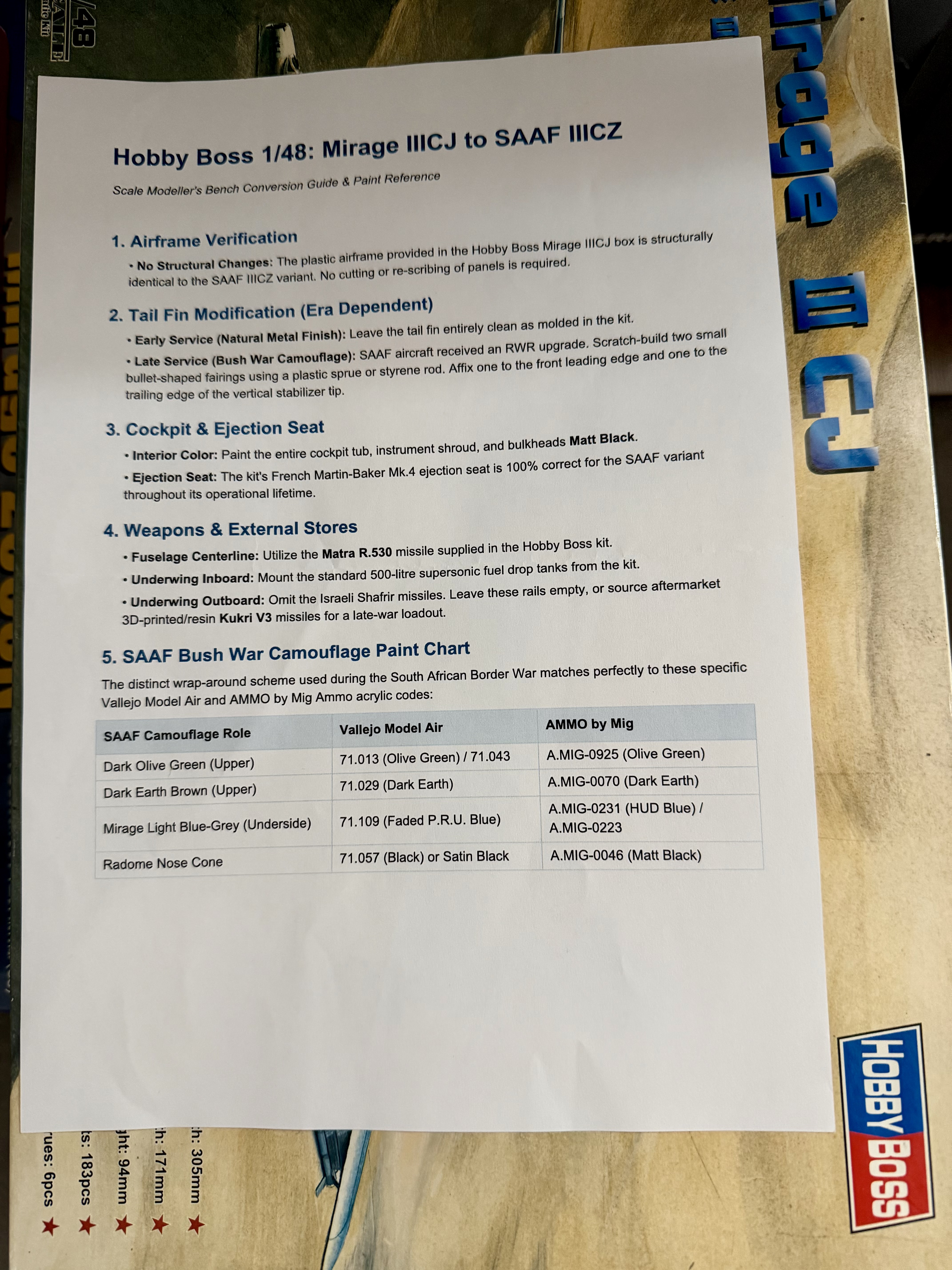
Just my good unexpected experience with AI, recently got a kit of a Mirage IIICJ but don’t want to build an Israeli example so went on Google and asked for the difference if any between a CJ and a CZ (South African). The AI asked what I wanted the information for, I replied to build a model, it asked what scale and which kit. I gave the make and scale, AI then proceeded to tell me the difference between the aircraft and early/late modifications then asked what paint range I use before listing the paints in two ranges I stated. I asked for a printable version of the information, it put it all into a pdf format so I could save it and print, then listed websites I could visit to purchase the SA indigenous AAM used after the arms embargoes.

However on the flip side who has seen the AI ‘photos’ of people with three arms or five fingers and a thumb. Even a leg of someone kneeling that ends in a hand with the foot connected to the fingers.

4 Likes

Be gone You foul Heretic
:wink: :rofl:

:slightly_smiling_face:

Just for info here’s the print out it gave me.

3 Likes

It’s only as smart as the people who use it. :slight_smile:

3 Likes

Nürnberg-Fürth 1835? Brauerei Tucher oder Patrizier?

I am not sure which other first German Train there could be. Maybe ask AI?

Lederer Beer , as the saga goes…

In the old days there were dozens of Brewers

Rabbits

1 Like

Da bleib ich doch lieber bei der guten alten NI (Natürliche Intelligenz). :grin:
NI und ein gutes Archiv funktionieren auch ohne Strom. :rofl:

1 Like

The point is, that for most of the time since the discovery of antibiotics, they have been (almost without exception) universally considered positive. Doctors have prescribed them even in cases when their use was not precisely called for but out of (certainly well intentioned) over caution. “Well, it might not do any good, but it can’t hurt.”

It’s taken nearly a century for medicine (and biology, in general) to begin to recognize that the widespread use of antibiotics has likely created problematic medical conditions that are much more ubiquitous than the occasional readily identified resistant pathogen. That, indeed, antibiotic use probably causes harm to the human microbiome resulting in greater frequency of a large number of what were previously rare conditions.

The broader point was that this is an example of widely accepting a technology without cautious skepticism and imagination to consider what kinds of unintended, detrimental consequences might manifest themselves in the long term. Antibiotics have saved countless lives, but after a century of their widespread use, the developed world is probably paying an unforeseen and unexpected (and to many, a surprising) cost. What was once considered universally good, might not be so perfect after all.

2 Likes

I am actually more than aware of all you just said, as I teach those themes every year to classes of high school students.

Also, I was just being facetious when I made that reply to Uncle-Heavy; wasn’t worrying about any “points” being made.

1 Like

Fair enough. I just didn’t want Uncle-Heavy to take any implied flack (facetious or otherwise) for a response to a point that I was trying to make since I was the first to raise it. For all I know, he’s also totally aware of history of penicillin.