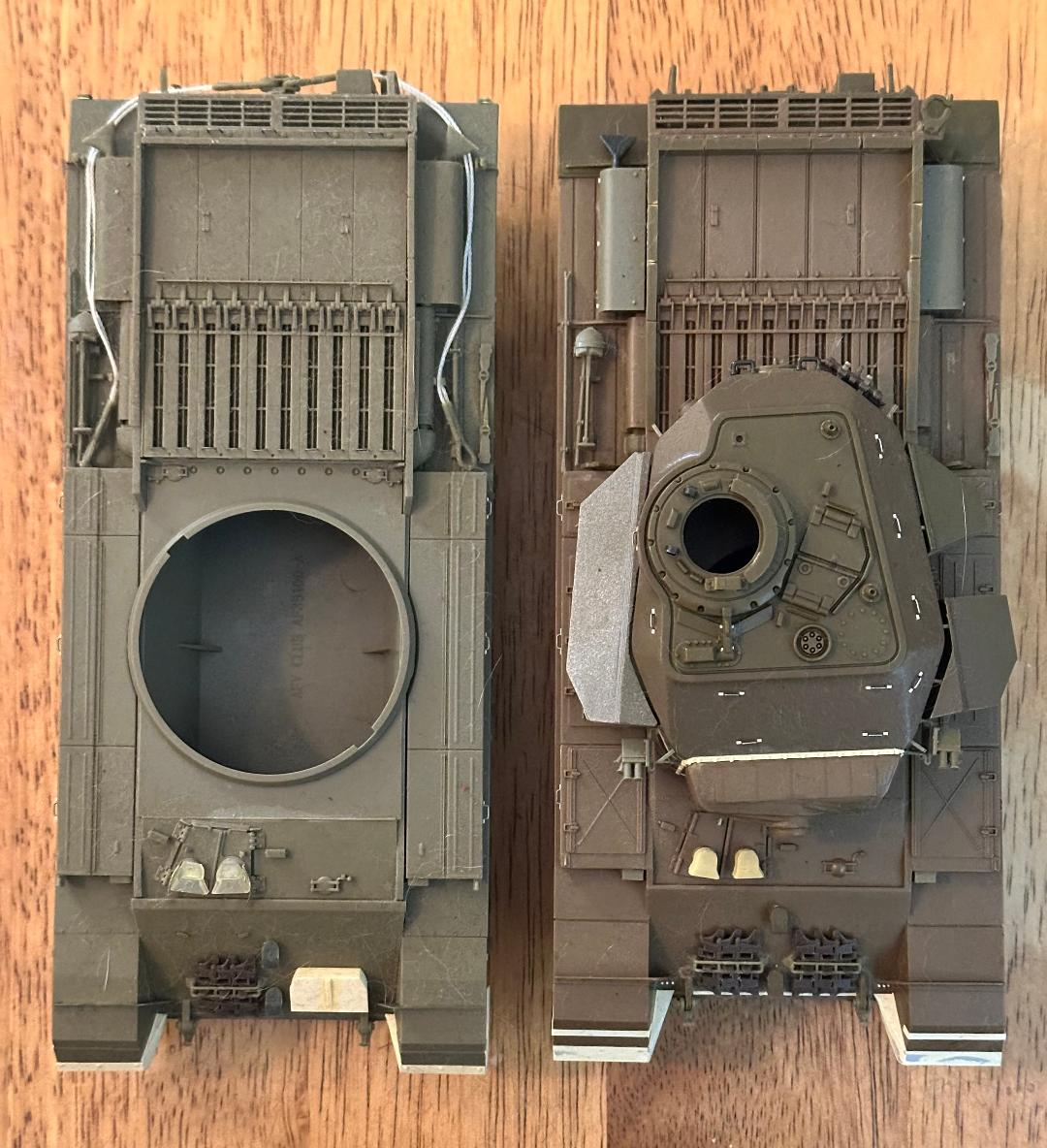
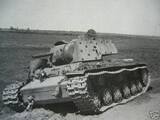
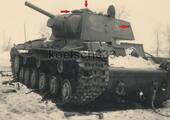
I recently acquired the Tamiya KV 1 and was comparing it to my Trumpeter Kits. I noticed the Trumpeter idler was larger than Tamiya’s and the engine access hatches on the Tamiya kit were larger than the Trumpeter ones. Does anyone here know which one is more accurate? Any help would be appreciated.
Which Tamiya KV are you referring to? Because most Tamiya KVs go back to their original kit from 1972, but in 2020 they released a completely new kit. I would expect the Trumpeter kit to be better than the old Tamiya ones, but (based on the manufacturers’ relative strengths and weaknesses) the new Tamiya kits to be better than Trumpeter’s.
Thanks for your help, the kit I have is 35372 1941 production. The engine covers are only about an inch different, which is nothing to worry about. However Neil does indicate the idler is undersize on the Tamiya kit. He says it is ‘slight’ but it equates to about five inches difference! Probably a good idea to replace it with a Trumpeter one. Thanks again for your help.
The original KV idler has a diameter of 680 mm.
Neither model is perfect in terms of equipment, but the Tamiya model (the new one) is worse in terms of historical accuracy of various parts.
Probably a good idea to replace it with a Trumpeter one.
Trumpeter made the wrong shape and size idler lid.
It’s better to use the lid from the Tamiya kit.
Tamiya showed incorrect torsion bar suspension arms (on which the road wheels are mounted) - they are not suitable for Chelyabinsk tanks of this production period.
At the same time, Tamiya’s turret is definitely more correct.
Hmm, so then, is there a consensus on what is the “best” KV-1 Model 1941 kit?
I know the '“what is the objectively best kit?!??!!?” questions are annoying, but as someone interested in getting an early KV-1 and was counting on Tamiya, hearing it’s got some pressing inaccuracies is… A serious bummer
Keep this in mind. No kit is perfectly accurate. Newer kits tend to be more accurate, do to better quality tooling and have more information available to research. Museums tend to provide the examples they use to create the models from. However, museums have prototypes and modifications to vehicles that were not part of normal production runs. These inaccuracies get photo’d and measured and become part of the kit. This is what happens when there is few if any surviving production vehicles left. Sometimes, things are mismeasured. Sometimes things are intentionally changed to make kit production easier. Models are “toys” so making compromises for productions sake makes sense to many manufacturers.
Don’t lose any sleep. 99.99 % of the people who see your finished kit will never know it is not an exact, perfect replica of the real vehicle. You yourself will probably not know all the inaccuracies the kit has. Just know that whatever kit you settle on will be a compromise. People mix and match parts and scratch parts trying to make a personally satisfying, more accurate kit. However they are the only person who will know the degree of accuracy achieved in the build.
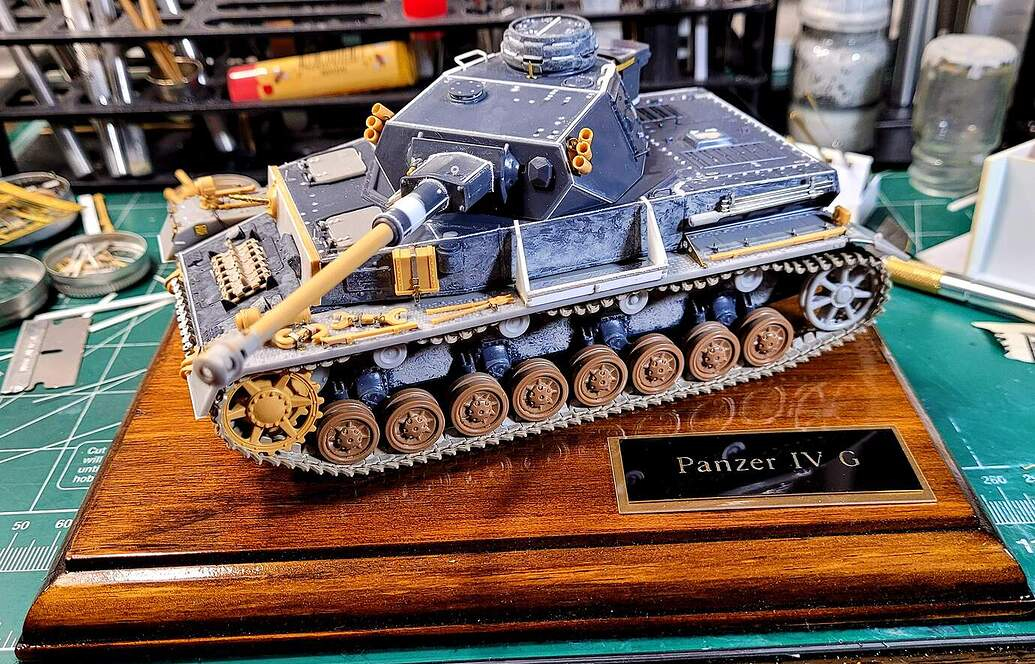
Moral of the story is, no kit is perfect. It is OK to modify the kit for you own enjoyment, or just build straight out of the box. You will be the only one to know. Wade, one of the forum members has a kit of a panzer 4 that everyone will know the changes he made and the amount of work he did because he did not paint the kit and you can see every change he made and item he scratch built. But, if he had painted it, you would never have known anything was done beyond building straight out of the box.
Me, I have the Tamiya 1941 model. If I see something egregiously wrong, then I will fix it. Otherwise it will be built mostly out of box and placed proudly in my display cabinet.
'“what is the objectively best kit?!??!!?” questions are annoying,
I don’t think so.
1941 was a big year.
That year, the KV-1 tank was produced in three or four variants, and at two factories. The year began with a KV-1 tank with an F-32 gun, manufactured at the Leningrad Kirov Plant. Then, in April, the turret was slightly modified (but these changes are clearly visible on the model and are very impressive). In June, applique armour was added. In August, two new turrets appeared, manufactured at the Izhora plant and the Stalin Plant in Leningrad. Both were made with 90 mm of armor—visually very different from the previous ones.
At the same time, KV production was launched in Chelyabinsk.
Until October 1941, production was sluggish (25 tanks had been scrapped by the beginning of the year), and in October, tanks began to be mass-produced with the ZIS-5 gun.
Half of the Leningrad KV-1s mentioned were made by Trumpeter. The Chelyabinsk tank, produced in November 1941, was made by Tamiya.
Both manufacturers’ models aren’t perfect.
Although the tank looks pretty good there. If you tell me which model you’re interested in, I can tell you the good and bad things about it.
Then you can decide for yourself whether it’s worth the money and effort.)))
When I’m interested in a kit and want to know which kit is most accurate, I do a number of things. Asking on this site is one, but I also put the kits in question into the search bar and go from there. Yes there are many entries sometimes but it’s worth the time it takes to read them. I also look up build reviews and build comparisons online. That usually gives me enough information to make a decision.
I suspect the Tamiya kit will be easier to build than the Trumpeter one. I’ve built two of those kits and they have some tricky fit issues and require a lot of clean up in some areas. I especially dislike the way they did the driver’s hatch opening. It’s difficult to sand the area around the opening after you insert the piece to make it the correct size. Tamiya doesn’t have that problem. Yes, the original 4bogreen site appears to be gone.
Thank you very much for the offer!
Well, I’d say I’m most interested in the infamous early KV-1 that both surprised and scared the Germans at the start of Barbarosa, when they found out they’re having a very hard time penetrating it
If I’m not mistaken, that one’d be the one without applique armor, and before the longer 76.2mm gun upgrade
But beyond that, I don’t know for sure, other than saying it’s the 1940/1941 model!
Anyway, I think that for this early KV-1 the options are just Tamiya, Trumpeter, and Zvezda?
RFM offers a later KV-1
I can savage a kit in a review with the best of them - even kits that others have proclaimed “should look pretty good.” However, that is not my main goal. I can live with slight dimensional errors within limits. Cookie Sewell once famously proclaimed that Tamiya’s Centurion was ruined because the proportions were so off:
So you noticed some slight size discrepancies when comparing the two kits side by side.
Would you have known either of them was off by looking at them individually?
And looking at the two together, would you know which is “more correct” without an expert telling you? All due respect to Holger (he sounds like he knows what he’s talking about) but some experts are, shall we say, less than knowledgeable. But because of their reputations, people still drink their flavor of Kool Aid. One such person was demonstrably wrong at least 100 times last year, and I did n’t even read all of his posts.
My favorite method for judging accuracy is to look at the thing myself if possible, and take my own measurements. When it’s not feasible, I look at walk arounds by others and determine what’s important to me and what isn’t.
Generally speaking, slight variances in size don’t bother me. From the article:
The screens are also 0.5mm too narrow
Good on the guy for knowing that. I’m probably not bothered by it. That’s 17.5 millimeters on the real thing.
Now if you’re talking about the thickness of a part, like fender supports, that’s something else entirely. I don’t need to know what their actual thickness is - I can see for myself when something is overscale, which is often necessary due to the limitations of injection molding. You then have the option of replacing with thinner styrene of brass shim, which I often do.
Thickness of a part is obvious. So is the omission of certain details. Or fabricated ones because the model company had to guess at them. Those are far more obvious than the width of a vehicle being off by 2 millimeters, and far easier to correct.
Number of track links per side? Please. We often see where the “correct” number doesn’t produce the look as want, especially on Soviet vehicle. I use the number of links that it takes to produce the tension (or sag) I want.
And finally, for the rivet counters: It matters. Sometimes. If it’s a long row of rivets, with not much to show how many there should be, then it’s not so important to me. But if the spacing is way off, or there are rivets where there shouldn’t be any (my recent post on the Mig-21) or no rivets where there should be, well, that might be a problem. Or single rows where they should be doubled. That’s kinda noticeable whether the number of rivets is correct or not. So is the number of lug nuts on a wheel. Especially when the kit has five (an odd number) and the real item has six, an even number.
Ultimately you have to figure out which of these shortcomings is egregious enough to fix or replace, and which are never going to be noticed.
To be fair, I think Cookie originally wrote about the Tamiya kit about 10 years before AFV Club released theirs, that is, before there was anything to compare it to besides the Centurion in the APG yard a few miles from Cookie’s house. In the mid to late 1990s he wrote up short evaluations of the Tamiya kits up to that point. I can’t find my copy but I reduced his article down to a table of the ratings (from Poor to Excellent) and it stops at 35215. That was the Panzer IIIL from 1997, so it was no later than that.
The Germans encountered five variants of the KV-1.
1 - A tank with an L-11 gun (there are some differences in detail between early and late versions, but that’s for connoisseurs)
2 - A tank with an F-32 gun (two types of turrets, differing in the welding method of the turret sides to the front and rear plates, as well as the rivets on the turret roof).
3 - A tank with spaced armour (both full and partial)
4 - A tank with a turret made of 90mm of armour (manufactured by the Izhora plant); it differs in nuances from a turret made of 75mm of armour.
5 - A tank with a simplified turret made of 90mm of armour (manufactured by the Stalin Metal Plant in Leningrad).
Of what’s available on the market, I would choose two models: Trumpeter 00356 and 00357.
Both models share a common drawback: they have symmetrical turret sides (in reality, the turret is asymmetrical) and a hull that’s 2 mm shorter in the engine compartment area.
I know this based on in-kind measurements of surviving tanks and original drawings from TsAMO.
Otherwise, they fairly accurately convey the overall appearance of the tank as stated on their box. The turret can be adjusted, but the engine compartment length is practically nonexistent.
It’s a shame the RFM didn’t make it into the early KV field.
I saw a youtube video and the maker said the new Tamiya KV1 is littered with errors and is a mishmash of parts that dont portray what it is supposed to be on box
You make interesting points, and I’m quite certain any model company would benefit from your expertise. Let’s look at a possibility - we know that the IS-III that used to be at Aberdeen had an engine deck from another model of tank. It fit, and even though it was a museum piece I suppose it could have been made to work.
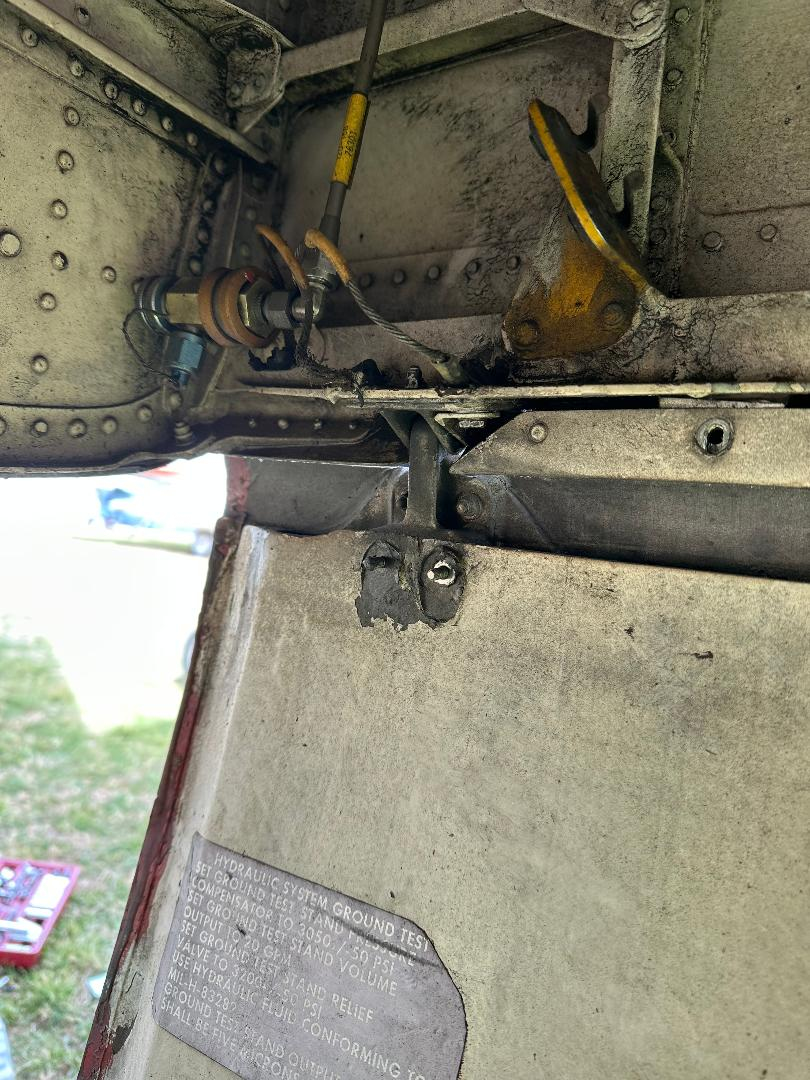
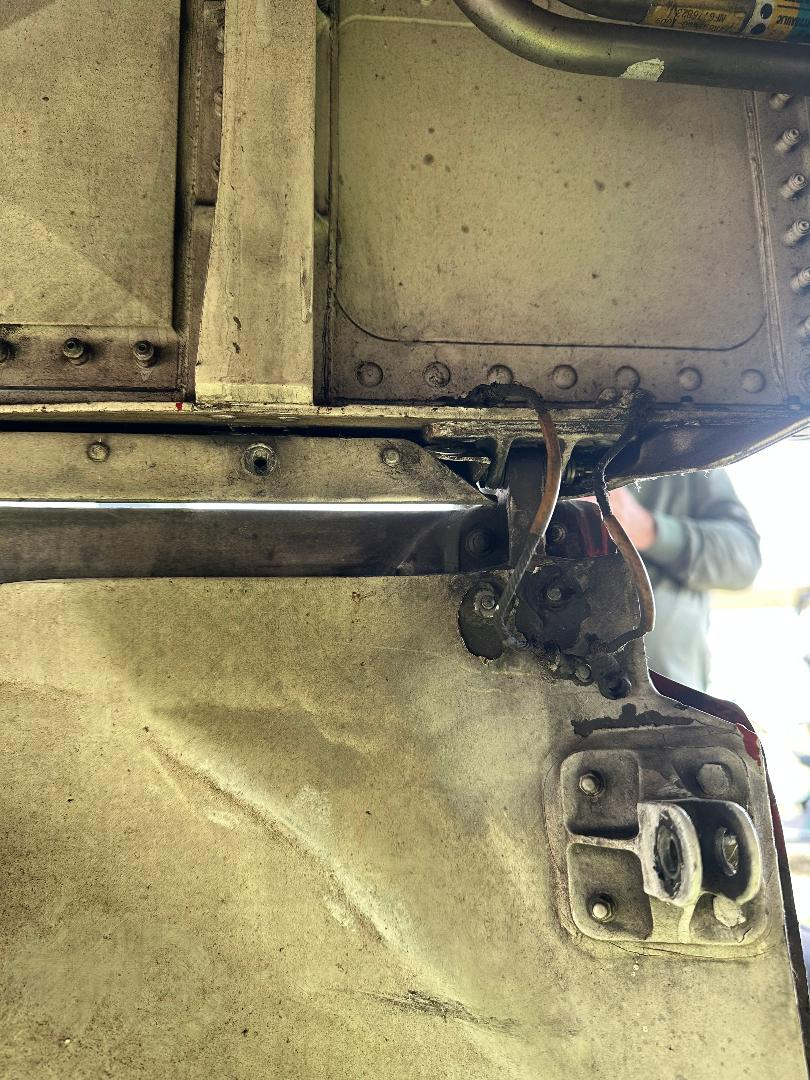
Let’s look at another example - this F-18D:
It’s got landing gear doors from at least two other planes, one of which is an A model. I know this to be true because I’m the one who removed one of the doors.
So - if something like this, that must remain airworthy, can have parts from different models swapped out, I’ll posit that the same can be done on armor. Perhaps Tamiya copied a museum piece. Or - perhaps the museum piece was simply a tank that used cannibalized parts on the battlefield, like the suspension arms. In that case, the model could be more correct. It’s an interesting possibility, See this thread - it shows that a museum actually got a “mistake” right on the ISU-152: