M151 1/4-ton ID Features and Differences

History:

In 1951 the Ford Motor Company was awarded a contract to develop a new vehicle to replace the WWII-era Willys MB Jeep and its descendants the M606 and M38/M38A1. The result was the M151 series of ¼ ton utility trucks, designed by Ford and later built by Kaiser, AM General Corporation, and General Motors Corporation (GM). A production contract was awarded in 1960 for over 10,000 units that would be used by all US and many foreign military forces. They were more commonly referred to as simply a “jeep” or “quarter ton”. The M151 was produced from 1960 through 1982 and served from the Vietnam War throughout the Cold War and beyond.

The M151 had a monocoque body design making it roomier than previous jeep designs and incorporated front and rear independent suspension with coil springs. Production of the M151 continued for just a short time.

The M151A1 was introduced in 1964 with modifications to carry heavier loads and added small turn signals to the front fenders. Serious problems existed with the suspension that made the M151 and M151A1 unstable and susceptible to roll-over in tight cornering situations due to the central articulation of the suspension arms, the lowering of one wheel relative to the frame would make the wheel move inward, effectively over-steering the vehicle and causing it to abruptly overturn.

The M151A2, fielded in 1972, brought a significantly revised rear suspension with semi-trailing A-arms that greatly improved safety in fast cornering. Many smaller upgrades including improved turn signals and a one-piece front windshield with an electric wiper motor were also included.

With some M151A2 still in US military service well into the 1990’s, the M151 series achieved a longer run of service than that of the WW2 MB/GPW, M38 and M38A1 series jeeps combined. It has since been replaced by the larger AM General HMMWV.

Identifying different types:

M151
Has all the same features of an M151A1 (below) minus the turn signals.
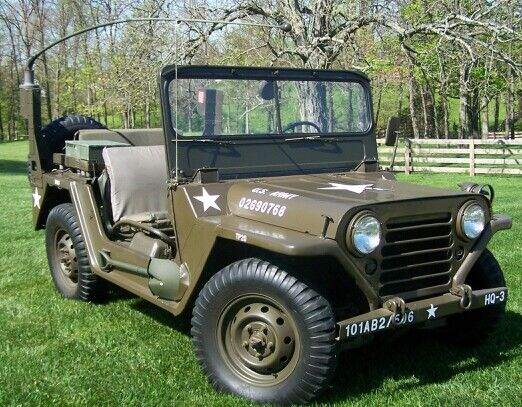
M151A1
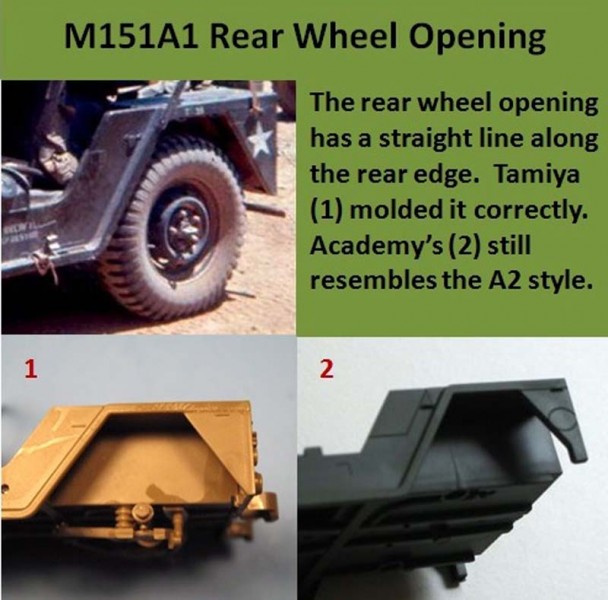
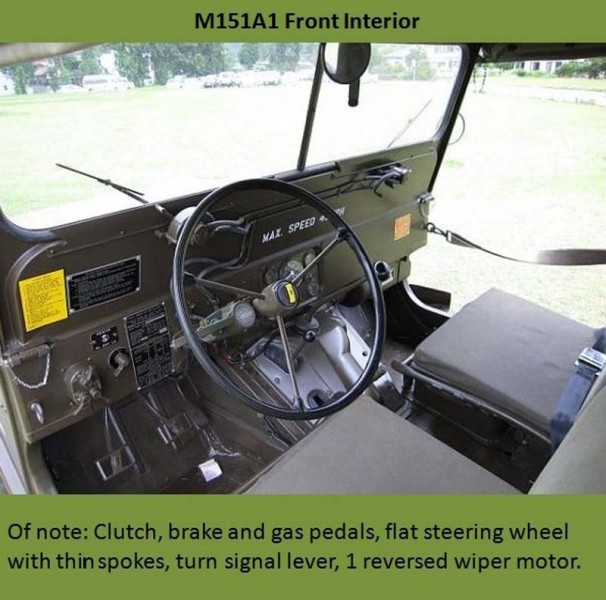
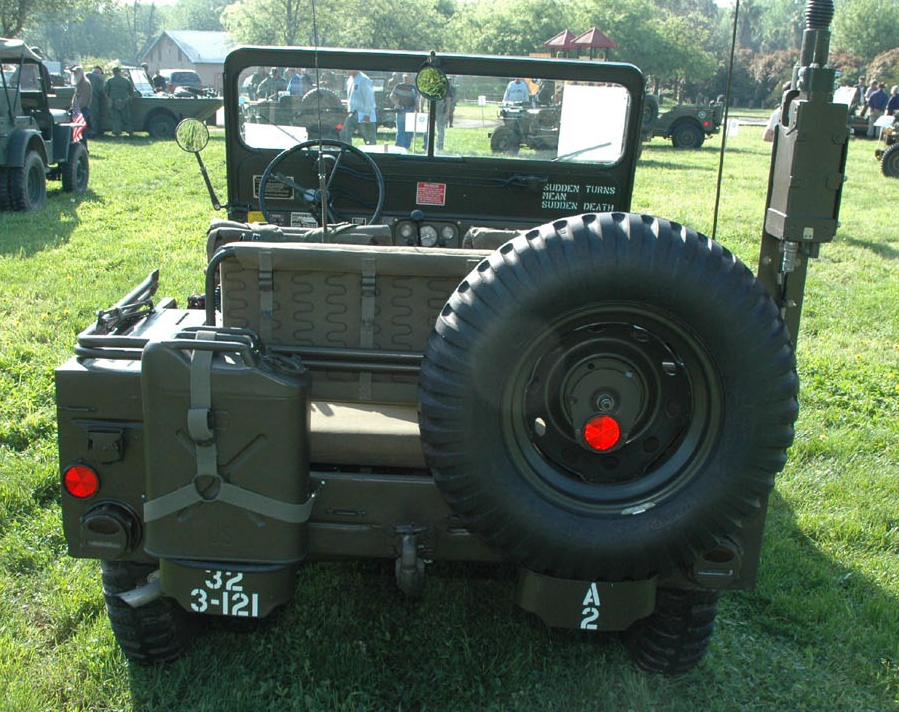
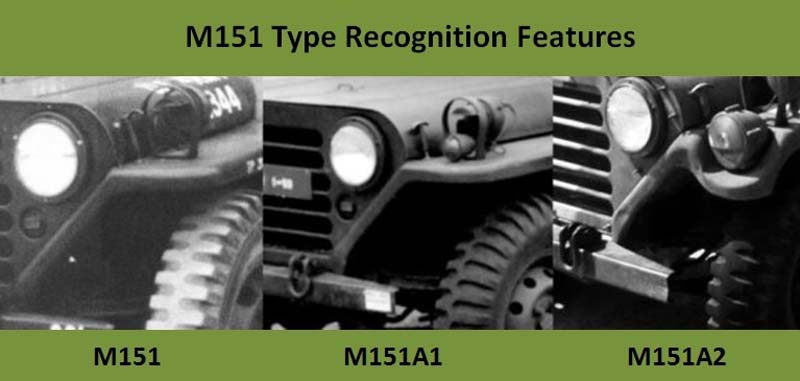
Split front windshield, small turn signal lights on top of front fenders, rear lights are older WWII style blackout lights, flatter steering wheel, straight rear wheel opening. It also had a trailing arm independent suspension with drum brakes all around. The wiper motors were independent for each side with one being turned 180 degrees from the other. The soft top for it had two differently sized rear window openings as well.
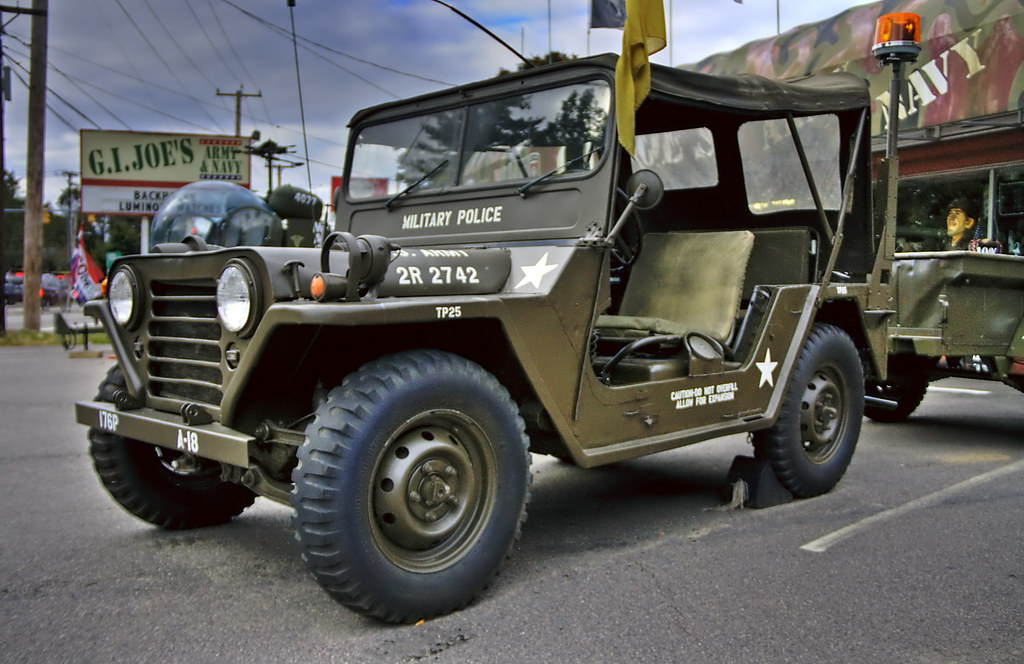
M151A2
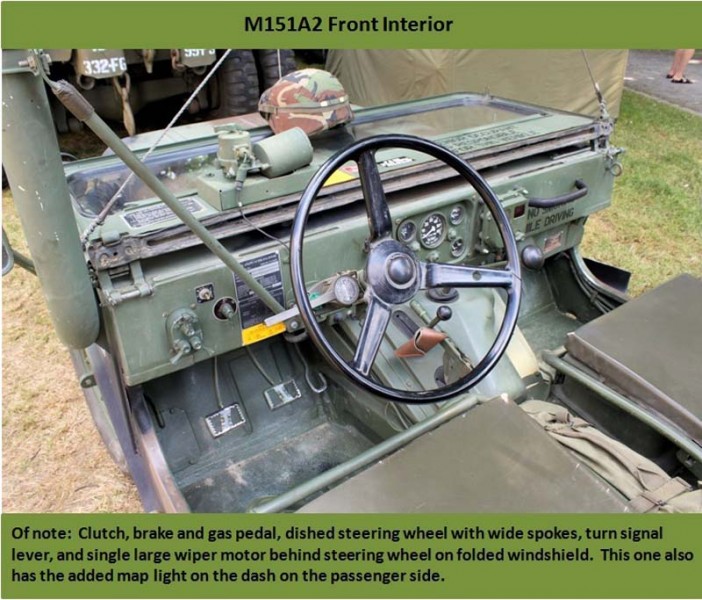
One-piece front windshield, large NATO turn signal lights integrated into front fenders, rear NATO taillights, dished steering wheel, squared-off rear wheel opening. The biggest update was on the rear suspension. The original trailing arm suspension tended to tuck under the vehicle and caused it to roll if cornered too fast. The A2 suspension corrected this by using an A-Arm suspension which moved the hinge point to the front so the wheel would travel straight up and down in the wheel well from front to back, as opposed to tucking in toward the centerline of the vehicle. A NATO slave cable adapter was added to the right-side front cowling on jeeps fitted with gas heaters (not all), and a single windshield wiper motor was used in front of the driver. The soft top for it had one large rear window opening.
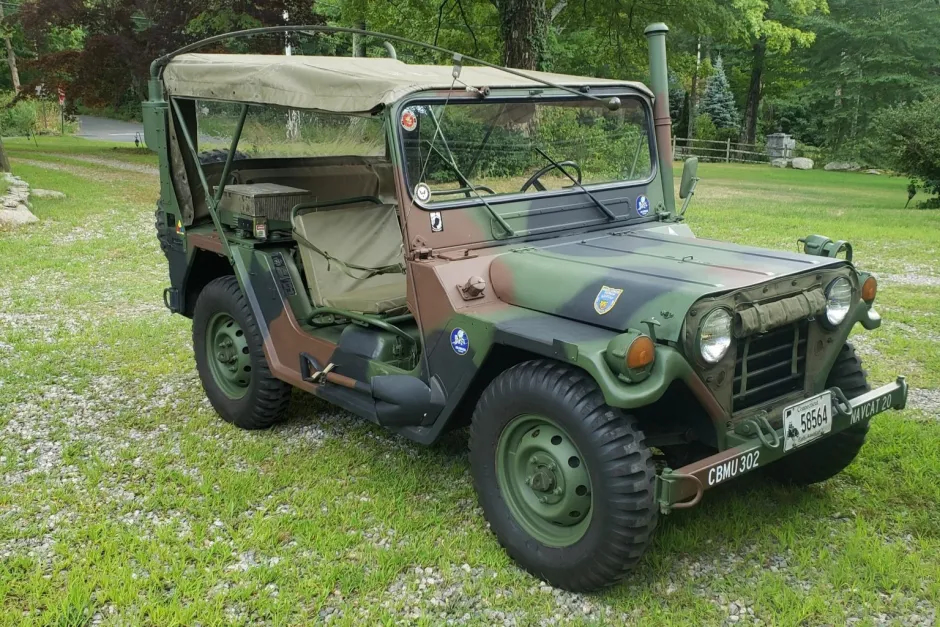
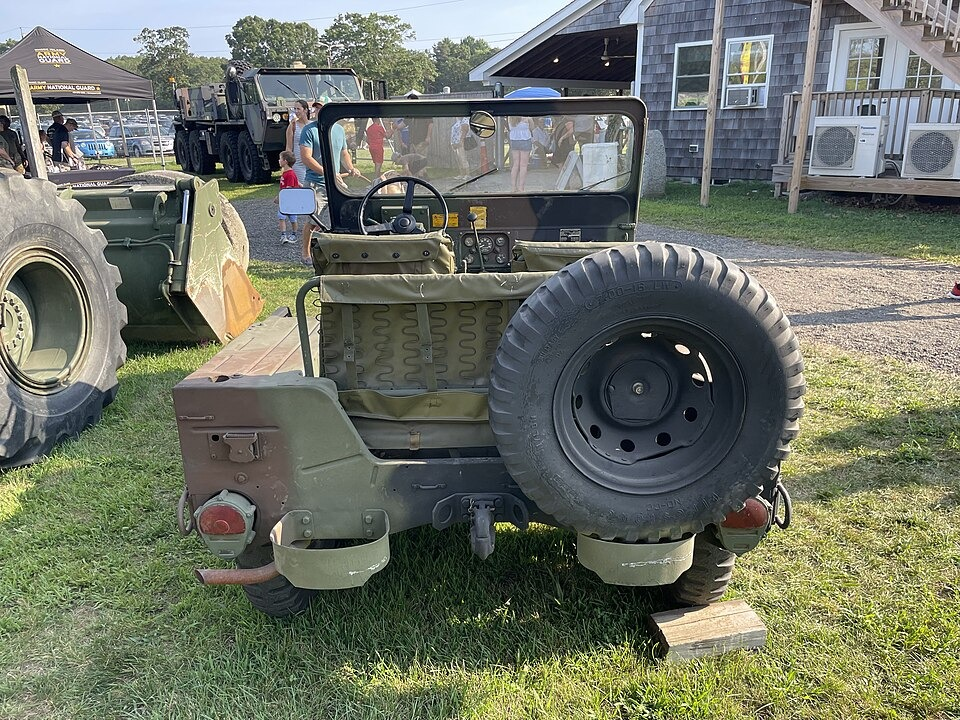
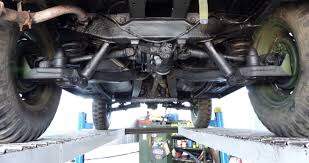
You can tell the difference in the rear suspensions between an M151A1 and an M151A2. From underneath, they look very different.
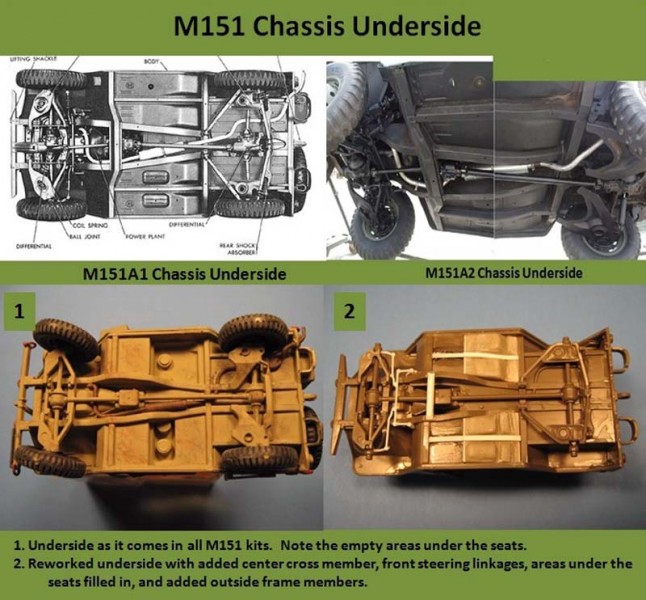

(#2 is an M151A1 model, while #1 is an M151A2 model.)

From the rear as well. You can see the different shape of the support arms (straight on A1, curved on A2) and the different position of the shocks (farther outboard on the A1).

A1 suspension
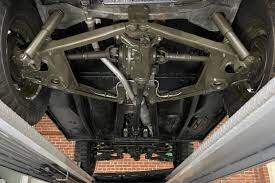
A2 suspension
Some other pictures of the above ID features.


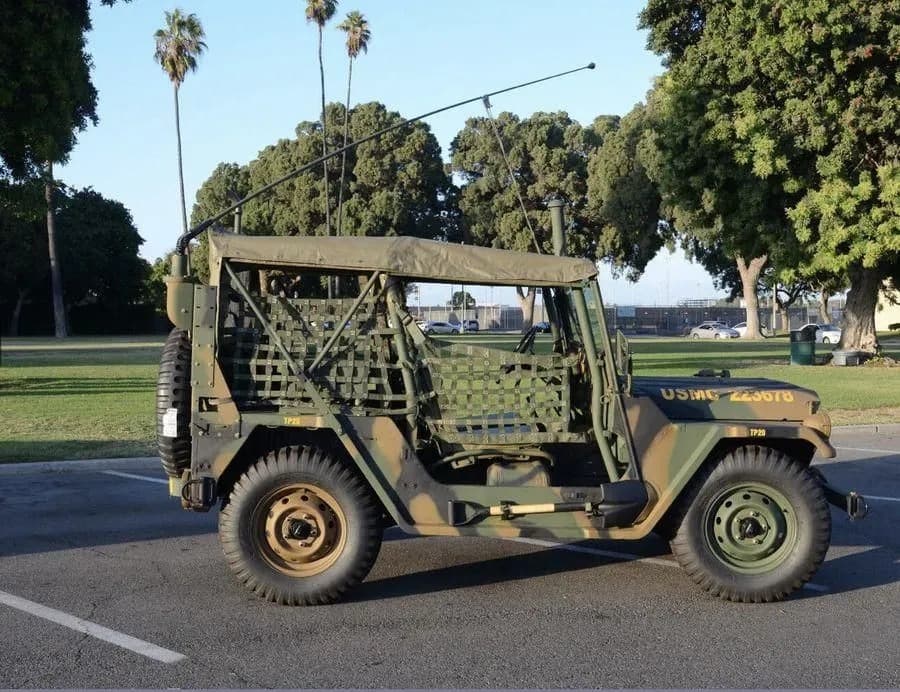
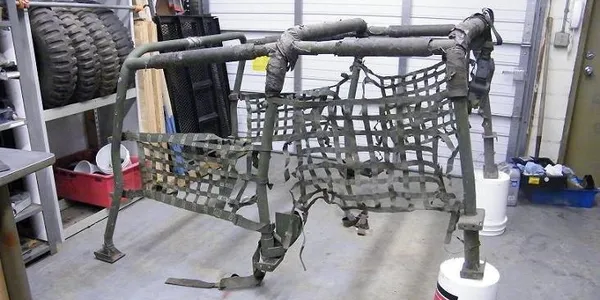
There was also the ROPS, Rollover Protection System (roll cage and side nets) added to very late model M151A2s to protect the crew in the event of a roll over.
5 Likes

For modeling M151s, there are lots of options, with some better than others.

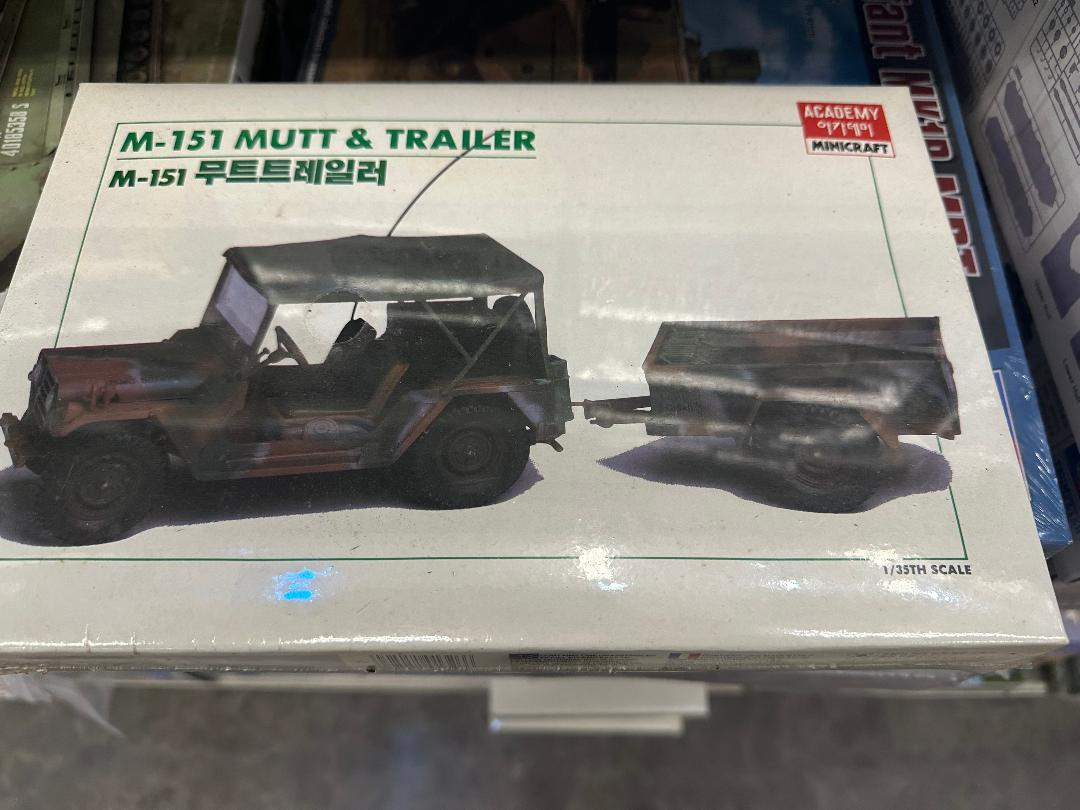
The M151 has been represented for quite a few years in model kit form. The first kit of one came out in the early 1980s from Tamiya in the form of the M151A2 (35123). This initial kit was what all the other Tamiya and the early Academy kits were all based upon. It was a pretty good kit with a simplified front suspension and differentials and cut corners on details with items such as a solid front bumper and some soft details. Tamiya continued to bring forth more M151 kits in the following years with an M151A2 (M825) TOW carrier (35125) and an M151A2 with M416 trailer with stowage for the trailer and a soft top (35130). Academy quickly jumped on the bandwagon by copying and reboxing these Tamiya kits, a common practice in their early days. Academy offered copies of all three Tamiya kits. Tamiya ’s kits were the standard for the M151A2 for 20 years.

Tamiya originals.


Academy copies.


In 2005 Academy massively reworked their M151s and introduced what were basically totally new kits. These had great improvements in details such as full engines and battery boxes, foot pedals represented for the brake and clutch, and the gas pedal in later releases. They also have separate front bumpers with the proper “C” profile, wheels with lightening holes that go all the way through, separate clear lenses for headlights, taillights and the reflectors. Soft rubber tires, new weapons and mounts, and detailed hood underside are also present. However, they still had some of the earlier problems of simplified front suspension and lack of underside details.

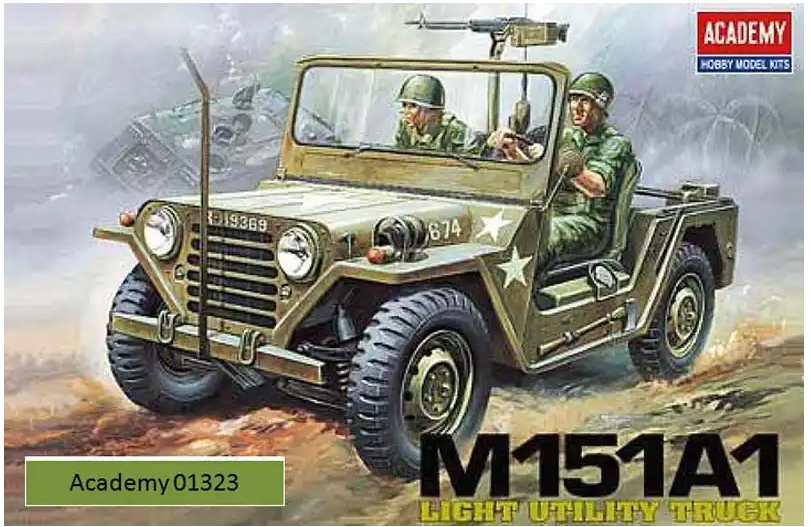
Academy also offered the first M151A1 kit (1323). This kit was nice but was not a true A1 version since it still had the M151A2 rear suspension and A2 features such as the square tab on the rear wheel opening, dished steering wheel, and NATO adapter plug on the right engine cowl. Academy followed this release with an M151A1C 106mm Recoilless Rifle Carrier (13003) and an IDF M151A1 Shmira Patrol Vehicle (13004), which is incorrect as all IDF M151s were M151A2s. Their next vehicle was a revamped M151A2 Hardtop with an M416 trailer (13012). This kit was updated with all three pedals for the driver, seat backs, and various other details throughout. The hard top is also a unique piece that is well executed, and it has very nice, colorful decals. Their last rework is an M151A2 (M825) TOW Carrier (13406) which updated the older TOW parts with all new ones which are well detailed and include the night sight and other parts not seen in earlier kits.

New-tool Academy kits.


In Oct ‘13, Tamiya released, another M151A2 kit (35332) and a reworked M151A1 (35334). These are nicely done with the M151A2 being the same as its earlier release with three new sprues to provide the parts to build an M151A2 as seen in the US invasion of Grenada in 1983. These include gear, weapons, and a couple more crewmen. The M151A1 is totally reworked with a corrected rear suspension, new front grill and fenders, a reworked windshield, rear lights and a new sprue with a new canvas top and a few other detail pieces to build a vehicle from the Vietnam War. These still have some of the earlier problems exhibited in both the Tamiya and Academy kits of incorrect steering wheel on their A1s, simplified front suspensions, and lack of underside detailing.

Newer Tamiya kits.


Thankfully, both Tamiya and Academy dropped the incorrect, unofficial “MUTT” moniker on their newer kits too.

More details on the model differences and details can be found at my feature I did on them.

7 Likes

My gosh. If this two day old post keeps magically reappearing at the top of the threads, let’s at least give it the attention it deserves and post all of the possible boxings. :smiley:

3 Likes

Thanks Gino, very informative. I didn’t realize the many differences between the various models of M151s.

There was another post about this vehicle if I remember correctly which spoke about the color schemes of the jeeps on Grenada. There’s the sand colored one that some of the 82nd AB guys used, a Ranger one in black (?) and some in MERDC camo? Is that correct? Did the Marines use them on Grenada too, and if so what color scheme? I’d be interested in modeling all the different camo schemes.

1 Like

Yes, they were used by USMC and US Army on Grenada. They were a combo of MERDC and NATO camo as it was a transition period. The sand 82d ABN one(s) had just returned from a Bright Star exercise in Egypt and they didn’t have enough time to repaint them.

2 Likes

Hello!

There are also two smaller features that I would like to point out as differences between A1 and A2.

The bracket 3 from the above picture - included in some PE sets wouldn’t be there on an A1 but is very common on an A2.

Another thing - the starting cable connector:

This connector is not there on the photos of A1s I’ve seen. Also, not all A2s have them.

I still have 2 Vietnam M151s to build - maybe even 3… Started in 2002 so it’s a looong way to go…

Have a nice day!

Paweł

3 Likes

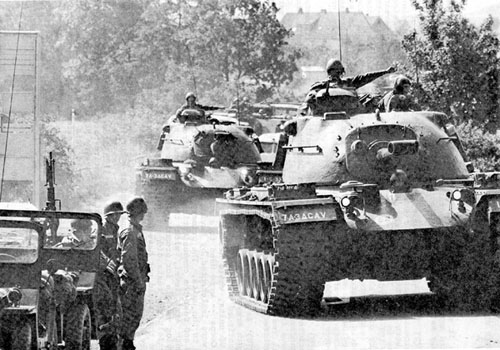
Sooo, I am planning to portray an M48A2 c.1962 as per this picture (which may not be of course, 1962 at all) in accordance with the Revell kit markings which depicts a tank from 14th Armoured Cavalry Regiment, “Fulda 1962”. If I wish to include a secondary vehicle - as per the photo - which then is the most appropriate model to use alongside?

As an aside, I am aware of the rather horrible surface finish on the Revell kits (M48 series that is) which is overdone; however, I am keen to see if it survives primer and paint; hopefully, it will diminish, but we’ll see.

I do feel that M48A2s are a little under-represented on the Cold War display tables; bags of coverage of M48s in Vietnam but precious little it seems in NATO’s Central Region; that said, I am aware of Elvis’ steed being around (M48A1 of course).

2 Likes

I’d go with Tamiya “new” M151A1 kit. One of the two pictured vehicles is fitted with a M60 on a pedestal mount, which is not included in the kit.

H.P.

1 Like

Thanks; would that be the “Grenada” version?

Assuming I wish to go with the open-topped scenario that is(!) - it always amazed me that rain or shine, the US forces I encountered always seemed to like the top down.

2 Likes

No, the “Vietnam War” one (with flat front fenders as pictured)

Here’s a caption I found for the picture you posted
M48 medium tanks of the 3rd Armored Cavalry Regiment responding to an alert in Germany, 1962” (from https://www.armyheritage.org/soldier-stories/cpt-wilbur-wolf-jr-eye-in-the-sky/)

H.P.

1 Like

Good catch on the tow chain connector plate.

I mentioned the NATO slave cable connector in the above write up. It was only installed on A2s with a gas heater.

2 Likes

Thanks for that - should be relatively straightforward (how many times have I said that during my projects?)

Thanks too for the caption - I’d forgotten where I found it; nice tie-in with Revell’s decals.

Suitable figures of course, will, as depressingly usual, confound me, but I’m used to that(!)

2 Likes

And just to throw a curve ball into the mix there is the odd ball M151 that was supplied to the British. It’s engine was replaced with the unit used in the Ford UK Transit van which required the ‘hump’ on the bonnet (hood).

3 Likes

Wow did not know that. How many were sent to the British? I’ve never seen any pics of one besides the one in your post.

1 Like

Unfortunately that’s about as much as I know, I think they were just trailed but the British never went ahead with them.

The owner did open the bonnet but I was so busy listening to him that I forgot to take any photos except this one.

2 Likes

Funnily enough, I encountered a couple when I was on Loan Service in Oman; they were left over by the Iranian contingent (a Brigade Group) whom it is not, I suspect, widely known, were allied to the Sultan’s campaign in fighting the Adoo in Dhofar (and elsewhere). I even managed a drive in one which belonged to a British Colonel; sadly he sold it - and “Yes” - I would have been interested(!)

As an aside - yours truly on Loan Service:

3 Likes

I think DEF models and one other make resin replacement tires for these kits. Anyone know if they are any better than the originals and worth getting??

2 Likes

Def Model has around 5 different boxings of tires for the jeep. Tanks Workshop and FC Modeltrend also have sets. I think I have one or two of the Def sets but haven’t checked them vs the kit tires.

2 Likes

The Def and others are good replacements for the crappy Academy rubber tires/wheels in their newer kits. I find the Tamiya (and Academy copies) plastic tires/wheels are fine and the resin ones are not really any better than them.

2 Likes

Thanks Gino, I actually have a set of resin tires in the box with the kit which means I must have bought it at some point and forgot!

2 Likes