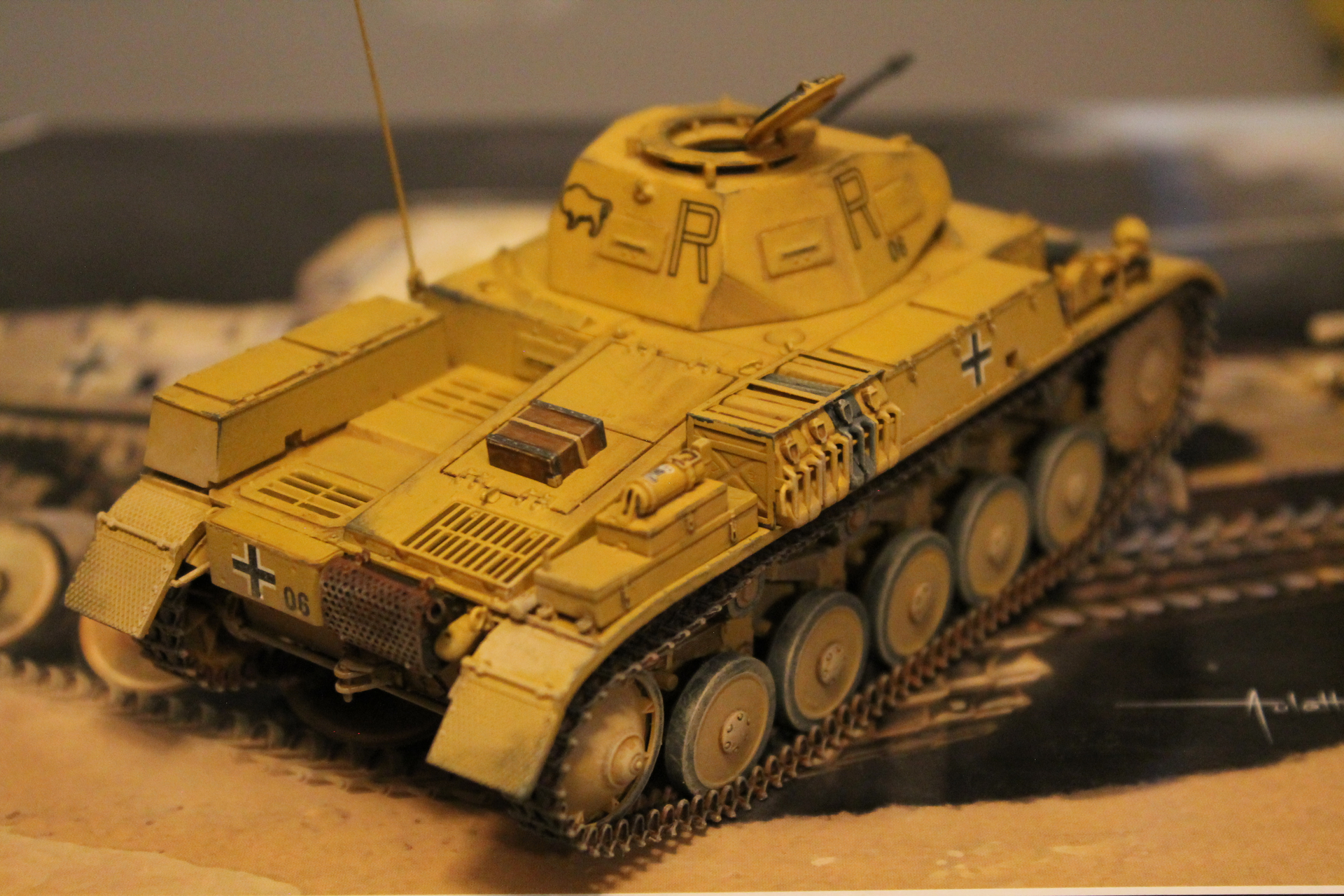
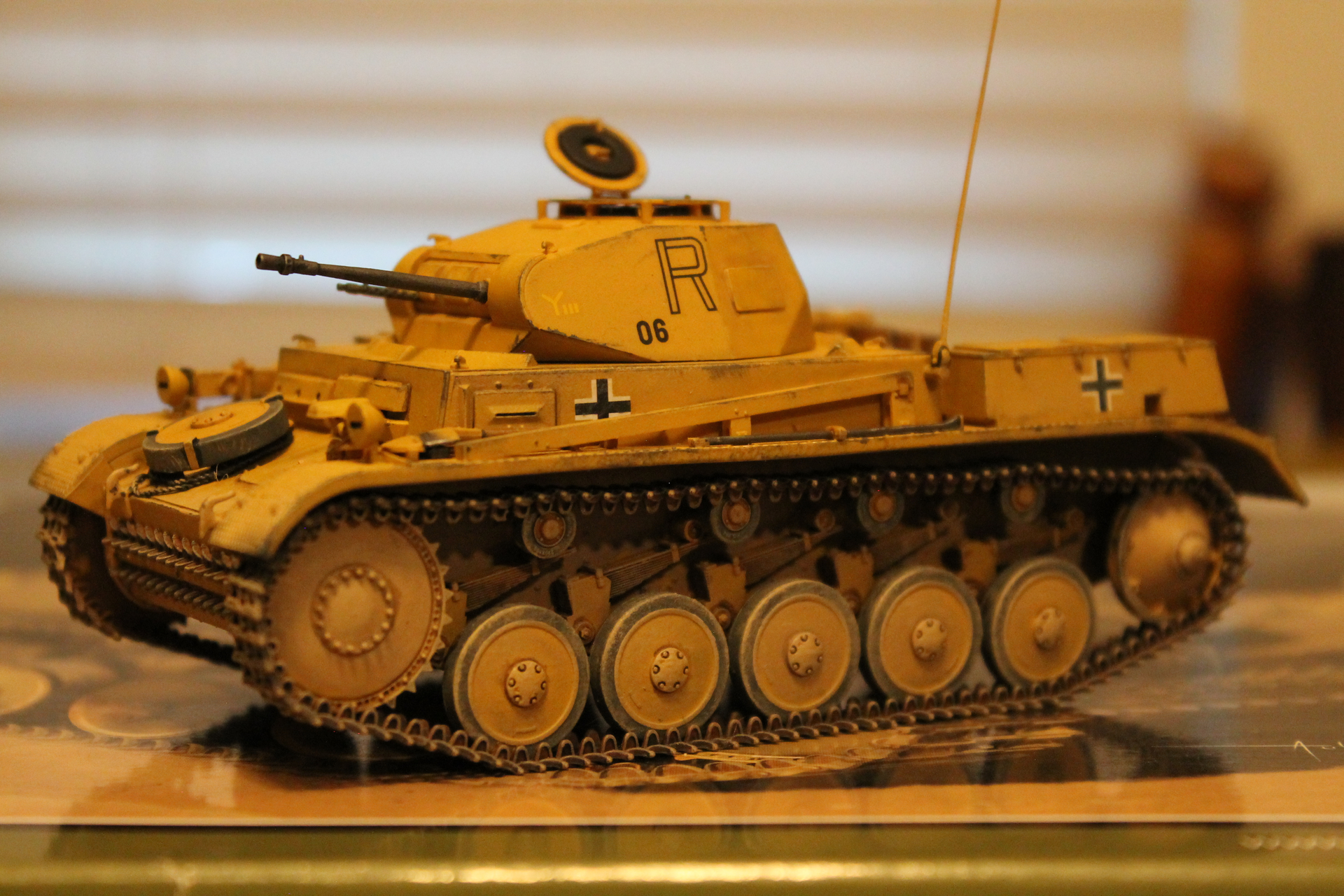
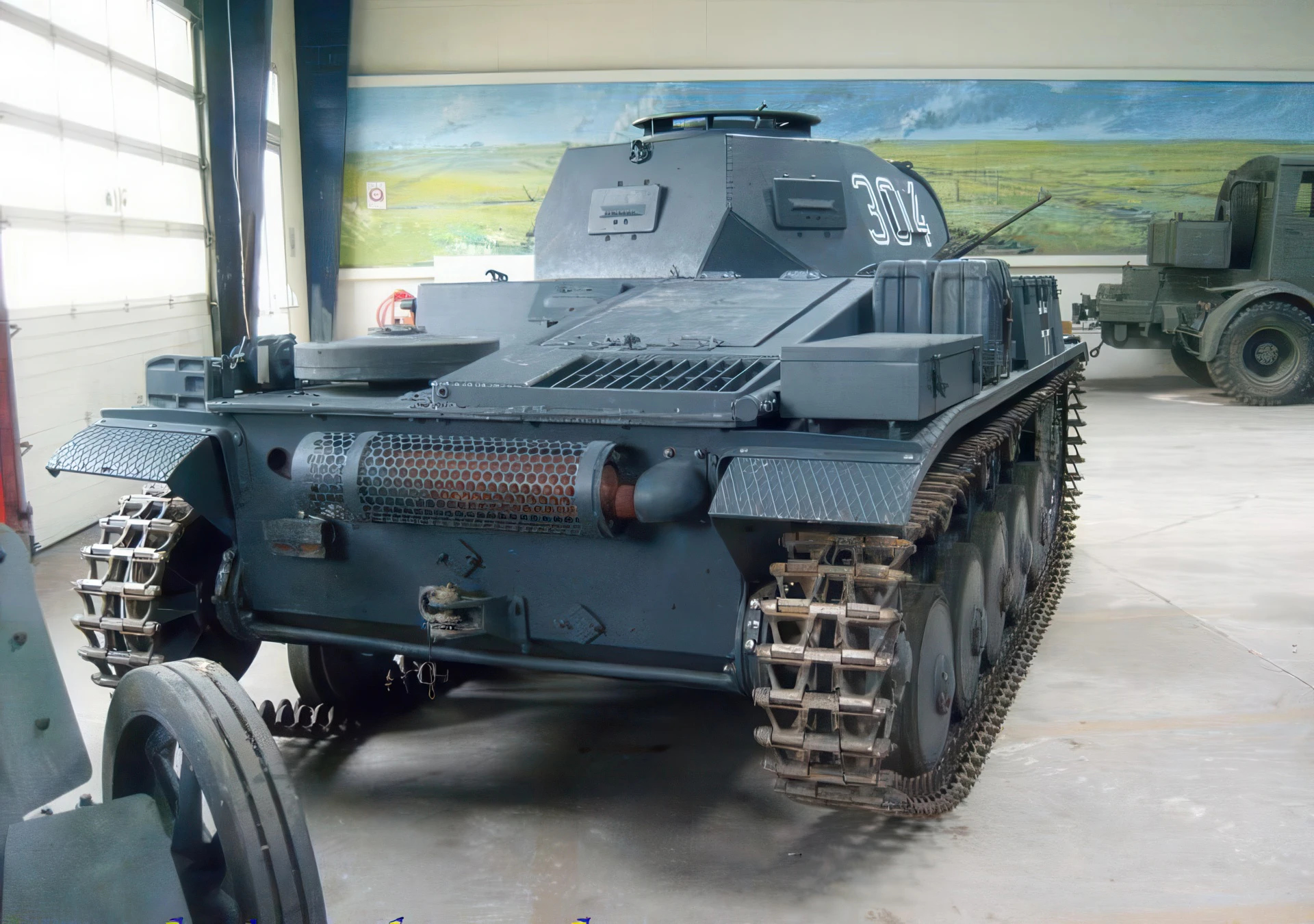
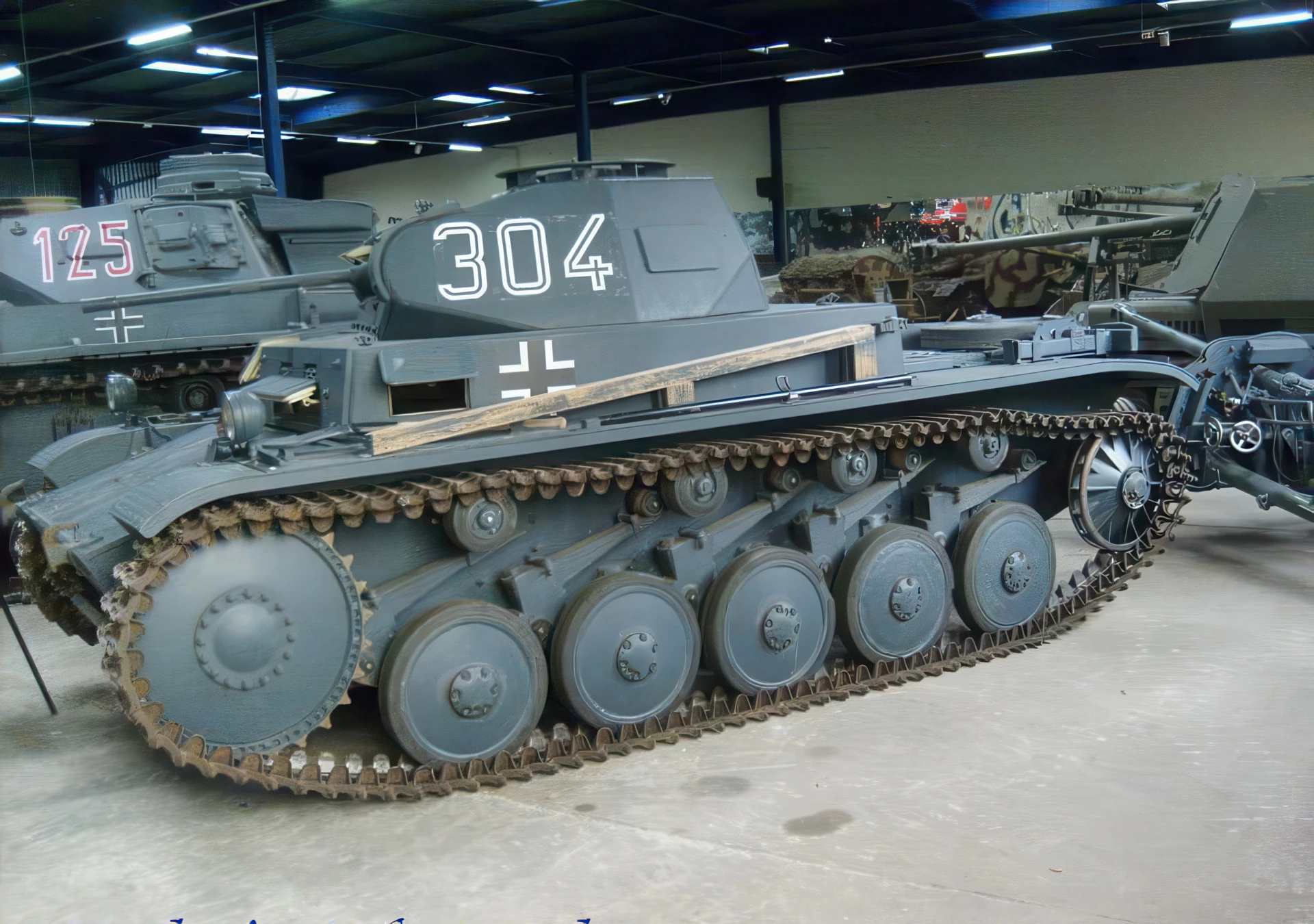
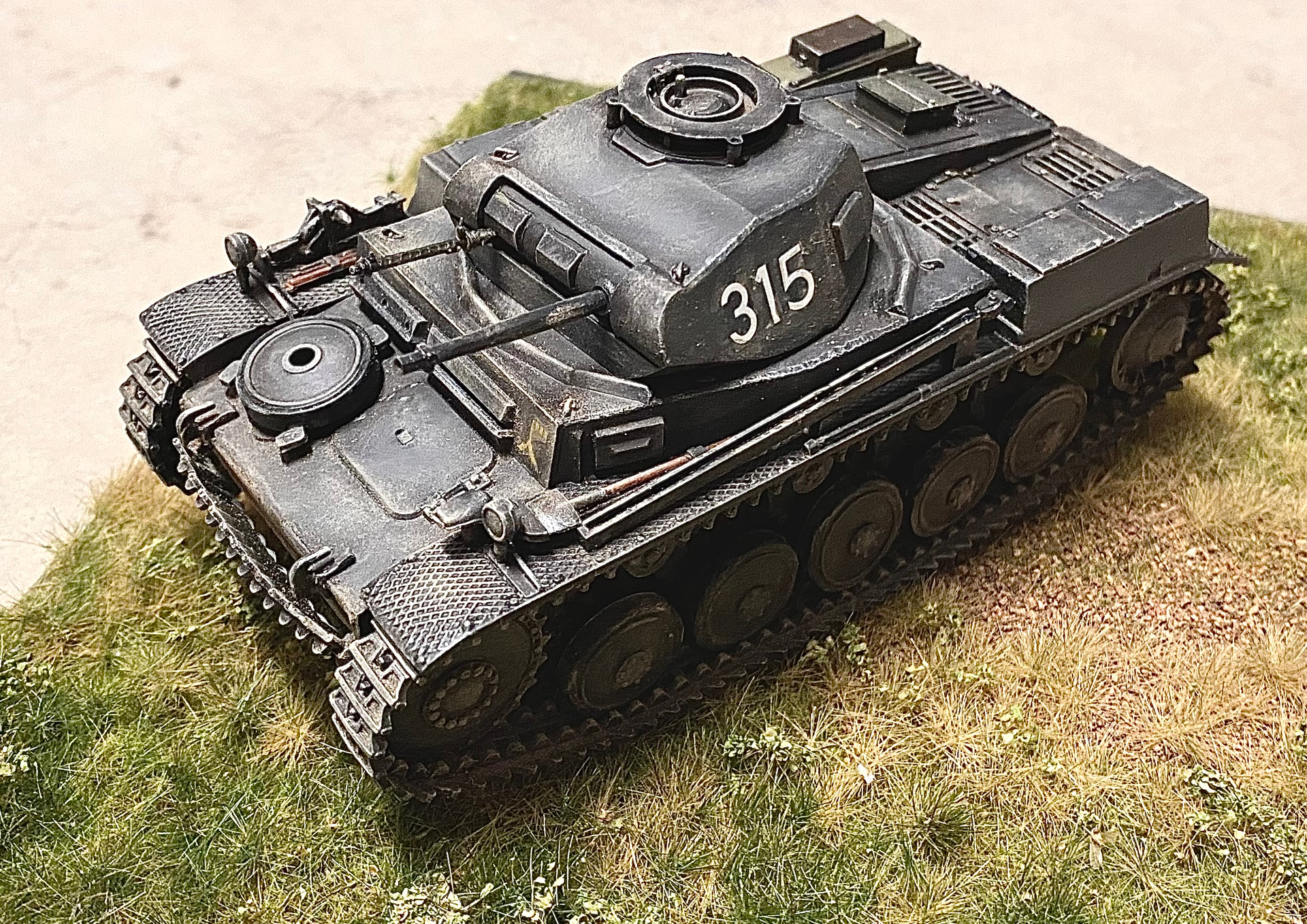
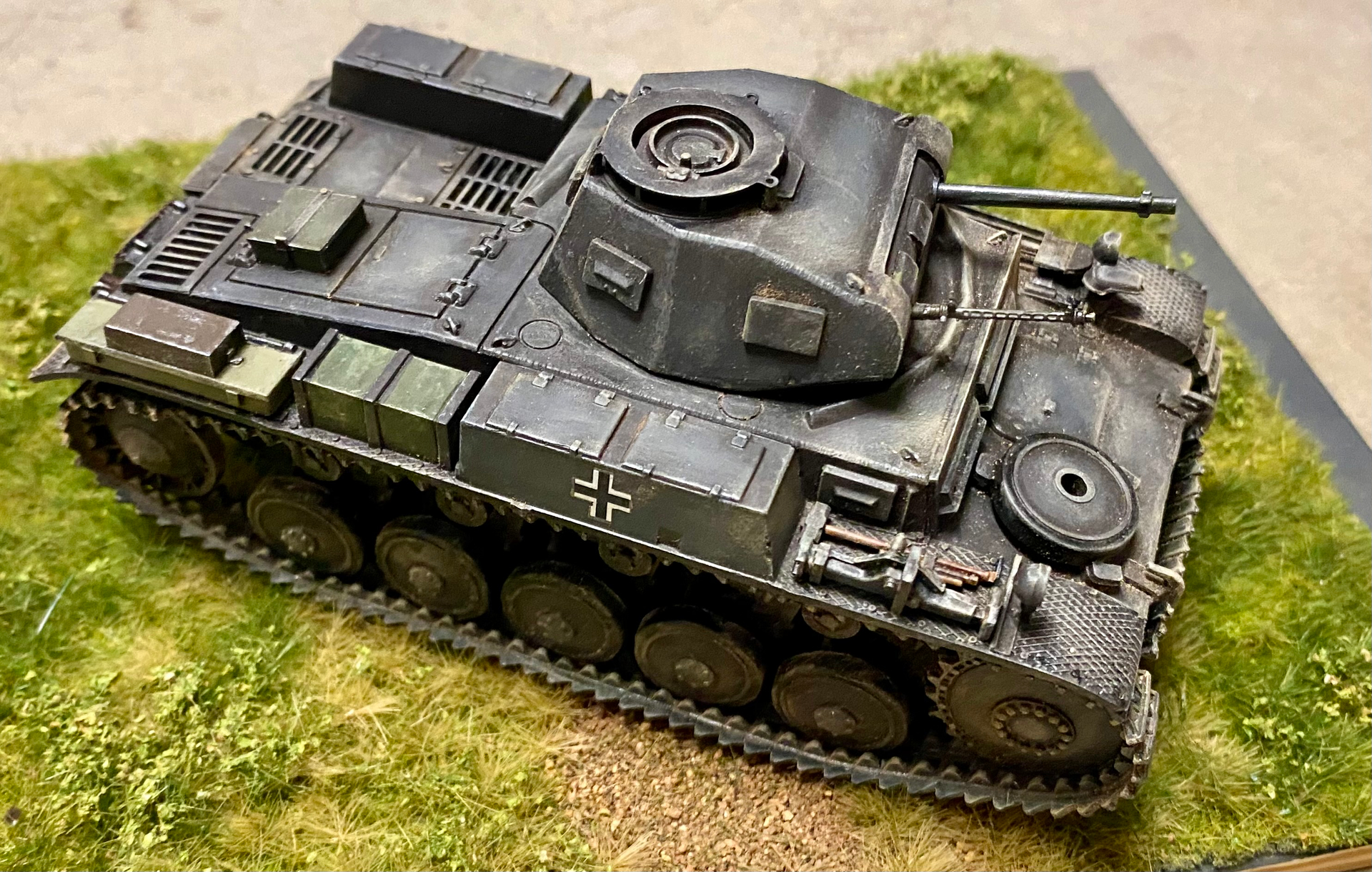
Sd.Kfz. 121 Ausf. F - Tamiya - 1/35

Introduction

My first model for this theme will be the classic Panzerkampfwagen II Ausf. F from Tamiya (ref. 35009), representing a vehicle from the 1st SS Panzer Division “Leibstandarte” during the battles in Kharkov in the winter of 1943.
Imagem

Although it is an old kit, the Tamiya base is great for those who want to use improvements and modifications. To elevate the level of detail, the following improvements will be made:

  • Replacement of rubber tracks with articulated metal tracks;
  • Replacement of the 2 cm Kw.K.30 cannon and the MG34 with resin and metal parts from Master (GM-35-046);
  • Inclusion of photoetches for fine details such as grilles, supports, and tools from E.T. Model (C35-026). The set is for the Dragon kit, so adaptations may be necessary;
  • Replacement of lifting hooks with parts from T-Rex Studio (TR35027).

The painting will be based on the winter pattern of the Eastern Front:

  • Base: RAL 7021 Dunkelgrau – Ammo by MIG A.MIG-008;
  • Winter camouflage: Washable white – Ammo by MIG A.MIG-050;
  • Wear effects: Rust (A.MIG-1400), dark mud (A.MIG-1407), and exposed metal (A.MIG-045).

History and Characteristics of the Vehicle

The Panzerkampfwagen II Ausf. F (Sd.Kfz.121) was developed as part of the 9th. Serie/La.S.100, with production starting in March 1941 and ending in July 1942, totaling 509 units. Manufactured by the companies Ursus (Warsaw) and Famo (Breslau), the Ausf. F incorporated significant improvements in armor and ergonomics compared to previous versions.
Although it was already obsolete as a frontline tank, the Ausf. F was widely used in reconnaissance and light support roles. In Kharkov, 1943, units of the 1st SS Panzer Division “Leibstandarte” were still operating with this model, especially in secondary and support tasks.
Technical Specifications:

  • Armament: 1 × 2 cm Kw.K.30 + 1 × MG 34 (7.92 mm)
  • Armor: up to 35 mm frontal
  • Engine: Maybach HL 62 TR – 140 HP
  • Weight: 9.5 tons
  • Speed: up to 40 km/h
  • Suspension: semi-elliptical springs
  • Crew: 3 (commander/gunner, driver, radio operator)

The idea is to represent an operational vehicle, with signs of heavy use, winter wear, and irregular application of white camouflage, as was common on the Eastern Front.

Sprues
The upper part of the hull.
Imagem

The lower part of the hull, still with the inserts to place the motor and batteries, which will be insulated.
Imagem

Traction set.
Imagem

Parts for the tower and tools.
Imagem

Rubber mats that will be replaced by metal ones. These metal tracks were purchased on AliExpress and seem to be a copy of Fruielmodel.
Imagem

Here we have the photoetches from ET Models and the cannon from Master.
Imagem

Some scraps left over from other projects, and from a Panzer II that I built 23 years ago and lost over time.
Imagem

11 Likes

Stage 1 of assembly completed.

There’s not much mystery or difficulty in this stage, just the assembly of the exhaust has been postponed because I’m going to add texturing in some areas.

The insertion of the rear plate did not present any problems.
Imagem

Here, the texturization effect will be applied to the hull.
Imagem

Removal of the screw heads and replacement with new photoetched ones. I also drilled the hitch pin hole.
Imagem

Now the controversy… It stays underneath and no one will see it, but I will always know that I didn’t fill the holes, so…
Imagem

That’s all for today, folks.

11 Likes

Stage 2 of assembly…

Wheels in place, I really like this Tamiya poly cap system; the wheels stay firm and are easy to remove during the painting and weathering process. To wear down the rubber of the wheels, I used a 180-grit sandpaper and then, with a craft knife, I made some scratches to simulate the loss of material from the wheels due to friction with the track.

sdkfz_121_build_06sdkfz_121_build_06 | Ricardo Duarte | Flickr

This one was a bit more work. To place the photo-etched part on the return pulley, I had to perform a microsurgery, but I think it turned out well.

sdkfz_121_build_05sdkfz_121_build_05 | Ricardo Duarte | Flickr

In terms of the manual, phase 2 ends here, so let’s move on to the changes.

I made the texture with this product I found on AliExpress. It was the first time I used it, and, honestly, it’s the same as using putty mixed with acetone. The advantage is that it’s already ready to use.

sdkfz_121_build_10-0sdkfz_121_build_10-0 | Ricardo Duarte | Flickr

After applying it and letting it dry for about 12 hours, I lightly sanded it with an 800-grit sandpaper, just a little, to remove the raised “nibs”. I really liked the effect, and I intend to use it in future projects.

sdkfz_121_build_07sdkfz_121_build_07 | Ricardo Duarte | Flickr

sdkfz_121_build_08sdkfz_121_build_08 | Ricardo Duarte | Flickr

Exhaust before the application of texture and photo-etching.

sdkfz_121_build_11sdkfz_121_build_11 | Ricardo Duarte | Flickr

Hugs to everyone and thank you for the company!

11 Likes

GREAT WORK on a true golden oldie. It’s a great kit from 50 years ago. You are proving that it’s not the model, but the modeller,

2 Likes

You’re off to a good start, nice work with the added detail. A word about that Tamiya kit just to clarify. I built the much newer Academy offering and it gives you the option to build one of several different versions. I did mine as the Afrika Korps tank that Tamiya based their kit on. It had a large stowage box, scavenged from some where, added to the left rear fender, as in the Tamiya kit. It’s the same as the one on the right fender. Also Tamiya has a ‘box’ on the right fender that should be a gas can rack. I just wanted to let you know about these details as a reference, in case you weren’t aware of them.

That added stowage box still had it’s Balkenkreuz marking on it, a detail that you can use on your build.

Hope this helps you a bit and look forward to seeing more of you build.

9 Likes

Thank you, Whitney.

Always trying to learn new techniques and blending the Spanish, American, and Japanese schools in search of the best path for me.

3 Likes

Thank you, Albert.

I don’t intend to make deep changes; I will keep the original boxes and try to follow that reference as closely as possible because I plan to build a diorama after that photo.

5 Likes

I’m afraid say that German armour plate of this period was actually quite smooth and well-finished:

11 Likes

I didn’t mean to imply the need to make major changes, just to give you some added info to work with.

3 Likes

The Tamiya II is always a solid kit. My co-worker has a grandson with autism, who is super interested in doing Lego WWII vehicles. I suggested picking up one of these as his first actual model kit, if they want to introduce it to him. He’s 14 & could probably handle it.

Damon.

4 Likes

Thank you, Albert.

I don’t intend to make deep changes, I will keep the original boxes and try to follow that reference as closely as possible because I plan to build a diorama after that photo.
Enviando: kharkov - 557 - color.jpg…

Yes, I understood your ideas.

4 Likes

Nice thus far Ricardo! I made this about 18 months ago as the first kit I finished.


It, along with most Tamiya kits, is an easy build and an excellent base if you want to add to it with after market additions or just want to build it as is. With your skills, this should finish up as an excellent model!

7 Likes

Thanks, @SamS. Nice work for your first kit.

3 Likes

I installed the 20mm cannon. It took some effort to fit the cannon into the turret base, but after a micro-surgery, everything went well. I also replaced the ax that comes cast in the upper hull with a scrap piece I had and a resin lock.

sdkfz_121_build_12

I used a lever that was left over from the Panzer I, because it’s definitely better than the 1976 mold. The resin latch broke, I’ll fix it later, because if I replace it, it will break again.

5 Likes

Continuing with the work…

Closing the bottom with a 0.5mm plastic sheet. The remaining putty that appears is because, to cover the tool insertion holes, I applied the putty underneath and let it show on top. Then it was just a matter of cleaning with a cotton swab and acetone, it made things much easier.

sdkfz_121_build_14(sdkfz_121_build_14 | Ricardo Duarte | Flickr

Here I made use of the scrap from my first Panzer II that was lost over time. At the time, I used the Eduard PE set and, after the accident, I kept some things in the spare parts box. Those colors will probably be changed.

sdkfz_121_build_15(sdkfz_121_build_15 | Ricardo Duarte | Flickr

Here we have the crew test and the finished machine gun. I was scared because the carpet monster had swallowed the tip of the machine gun, which I ended up finding by chance. The cannon and machine gun set are good, but they weren’t made for this kit, so some amputations and enlargements had to be done for things to fit.

sdkfz_121_build_16(sdkfz_121_build_16 | Ricardo Duarte | Flickr

In the exhaust, I had problems with the PE of the set, because, as it is for the Dragon kit (there the exhaust is in a different proportion), I had to use a 0.3mm plastic strip to make the handles that hold the piece. The screws used are the same ones previously used.

sdkfz_121_build_17(sdkfz_121_build_17 | Ricardo Duarte | Flickr

The support for the extra caterpillars was made with a 0.5mm plastic card. The left side had a slight break that I will have to hide with putty or something like that later. Unfortunately, there is no way to remove the mats to paint, so they will be painted on-site.

sdkfz_121_build_18(sdkfz_121_build_18 | Ricardo Duarte | Flickr

I gave the mudguard a slight dent, but due to the thickness of the kit’s plastic, it didn’t hold well. But now there’s no turning back.

sdkfz_121_build_19(sdkfz_121_build_19 | Ricardo Duarte | Flickr

The Notek lantern was used from the Hobbyboss Panzer I, leftovers from the previous assembly. I had to remove the base as well.

sdkfz_121_build_20(sdkfz_121_build_20 | Ricardo Duarte | Flickr)

Replacement of the original grill with the PE one. I had to make adjustments again here because of the difference between the brands. I believe that the dimensions of the Dragon kit are closer to reality because it is a much more recent production.

sdkfz_121_build_21(sdkfz_121_build_21 | Ricardo Duarte | Flickr

The positioning lights in the Tamiya kit are omitted, so I used the leftover from a Border Models Panzer IV. Once it’s finished, it won’t be very visible.

sdkfz_121_build_22(sdkfz_121_build_22 | Ricardo Duarte | Flickr

Simulation of the tower weld. Here I was making the marks with the utility knife and then applied a thin layer of extra-fine glue. I will do this in other places as well. This is my first time altering textures and welds, so mistakes and errors are bound to happen. I installed the 3D-printed lifting hooks from T-Rex, much faster and more practical than using the brass ones that come in the PE set.

sdkfz_121_build_23(sdkfz_121_build_23 | Ricardo Duarte | Flickr

That’s all for today.

A big hug to everyone and thank you for the support.

6 Likes

I for one am looking forward to updates and completion :smiling_face_with_sunglasses:

2 Likes

Overview of the completed assembly.
Image

Image

Extra boxes… These boxes don’t appear in several references, and since I didn’t have material to make the anti-slip sheets, I ended up keeping them. After making the PE lids, I realised I only had enough material for one set of boxes, so the other will be covered with a tarp.
Image

I swapped the Notek lantern for one from the Panzer I by Tristar that I had in stock. The shovel, I took the leftovers from the Border Panzer IV and the axe from the Dragon Sd.Kfz. 234. I also removed the texture from the side after discussions and consultation.
Image

I kept the original jack and inserted the pliers from the Border kit. I bent the dent in the fender downwards.
I straightened the dent on the fender. Image

Details of the side boxes all in PE
Image

I had to buy a head magnifier to finish, as my eyesight is no longer helping.
Imagem

6 Likes

Looking good Ricardo! I like the realistic little dents like on the fender and exhaust cover.

3 Likes

Was wondering what you were going to do about the idler, but it looks like you got it sorted. Good job!

Damon.

5 Likes

Primer applied.

I used the Ammo primer (A.MIG-2026), straight from the jar, with a 0.3-needle airbrush.

Image

Image

Image

5 Likes