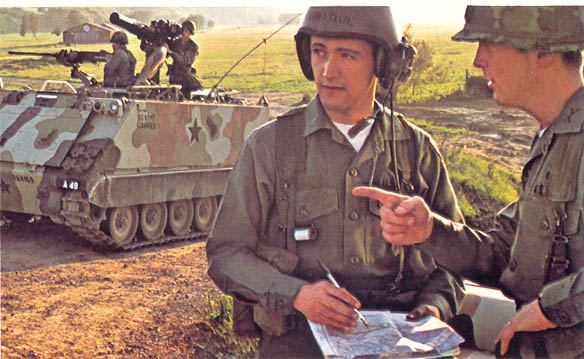
On the other hand MERDC had very specific patterns from manuals for each type of vehicle. Although there was over time a great variation by units adhering to those patterns and colors.
A friend who worked on the Cr2 gun told me of a meeting between engineers, officers, and manager-types where one asked about making the bore evacuator strong enough to survive being rotated into a roadside tree. Another then piped up with “what kind of tree?”. He said there was then a minute of nervous silence while the engineers all looked at each other before backing away from a potential new project to specify the NATO Standard Tree…
I recall during my somewhat extended training (2 years -odd) that tactically, there were 2 types of “Army” tree: Fir, and “Bushy-topped”. No ifs or buts, “Fir” and “Bushy-topped”.
I suppose even palms are technically “Bushy” - and our instructors were serious men, and had seen service in places like Malaya, Indonesia and Aden, (and in the case of our fearsome Company Sergeant Major, Sword Beach on 6th June 1944), so were technically at least, well -versed in foliage writ large!
Looks more like the Black spot in this case was applied by rattle can. This makes sense … Black being the “minority” of the overall colours and last one applied in this camo scheme. Having seen many MASSTER camoed vehicles close up the paint brush was the the tool of choice at the time. The crews would paint their vehicles in the motor pool with not much loved lost doing so.
You might also see the same kind of technique use applying the Sand stripes with the later MERDC camo.
“After the vehicle has been prepared, it is ready for pattern
application. Use only the printed pattern design (or
viewgraph projector transparency) obtained from the
TASO for the vehicle. This pattern is outlined on the
vehicle with chalk, using reference points on the vehicle and making a
conscious effort to maintain the relative shape of the
different color areas. High precision is not required in
marking if the shape and size of the patterns are kept
within reasonable tolerances (plus or minus 2 inches)”.
Ah, yes, you’re right — I misremembered that it wasn’t mentioned at all. However, compared to TB 43-0209 of 31-10-1990, mainly points b, d and g:
28. OUTLINING THE CAMOUFLAGE PATTERN ON THE VEHICLE
a. The black bands, located at the visual center of each side in a pattern, are the key to the three-color camouflage systems.
These bands must be in the correct place and must be the correct width.
b. To ensure correct placement and width, each pattern has between 10 and 25 critical reference points. Critical reference points are based on fixed features on the item and are reflected on the vehicle patterns in Section VIII.
c. All dimensions are listed in inches
d. All dimensional tolerances are limited to +1.00 inch.
e. The right side view is the primary view of the CPP drawings.
f. In the top view of the paint pattern drawings, the horizontal is established as being from front-to-back along the longest dimension of the item.
g. The edge of the band must be within one inch of a critical-location reference point and the pattern must be no more than one inch wider or narrower than stated at a critical-width reference point The rest of the item will mirror the camouflage pattern as much as possible.
h. Inspections will only be measured at reference points and will evaluate the overall effect at 50 feet. In addition, overspray which can be discerned at 50 feet will be considered sloppy painting and will be corrected.
Right Chaps, ‘need a bit of a steer here; which of the SNCO ranks below would be suitable for a SNCO in charge of the mighty M48? Also for the Loader?
And nor forgetting the MP - Corporal equivalent or Sergeant perhaps? Again, let me know.
‘Grateful you make this idiot-proof - ie ring the pic or give me a clear grid reference(!) Oh, and please let me know the right way up. I’m desperately trying to get this project finished - though obviously not trying that hard.