True, yes it has lots of good uses. All good advice and will have a new go to for diluting/cleanup. But yes, I first discovered epoxy for PE myself as an alternative to soldering PE!
My sad experience with that problem is that the plastic landing gear struts or wheel axels usually do break before the aircraft model detaches from the base. I don’t build many aircraft models, though. I have done this myself with a 1/48 scale plane glued down on a base. The fault for the rough handling was my own, though.
I did build a number of 1/72 single and twin-engine models for a museum display once. All were mounted on small glass mirrors, attached with tiny drops of clear epoxy. I KNOW the museum staff treated all of the models loaned to them with very little regard to gentleness, and still, none of those planes (at least the ones I loaned them) detached or broke from the mirrors. The museum staff did manage to break a number of small details off of them, nevertheless (pitot tubes, aerial masts, etc.).
Weight, mass, geometry of the landing gear / suspension, etc., no doubt, play a large part in how well any method of attachment might work out (for any model on any base).
On a total tangent: One thing that shocked me about the museum’s total lack of care and concern for artifacts that didn’t belong to them was that I also loaned them a couple of AFV dioramas for the same display. Both were returned to me infested with insects (silver fish) that had voraciously ate into the Celluclay groundwork. I only discovered this on close inspection to see if I needed to do any repairs (like the aircraft models required). I’m glad I caught the problem before I put those dioramas back into the display cases and possibly spread the infestation to everything.
That’s one of the things we’re studying right now is the care of artifacts. No mention of models though. But museums facing the problem of storage and care due to the fact they have many more artifacts than they can display.
Interesting. I know you’re doing a lot of college / university work right now. Are you considering getting into museum curator work to go along with your interests in history?
I’ve been collecting militaria (uniforms, field gear, electronic items, ephemera, etc. etc.) since the early ‘80s, and conservation and care has also been a topic that I’ve put a non-trivial amount of time into studying and then implementing.
FWIW, I’d classify scale models on landscaped bases as a type of multi-media artifact which would require attention according to each material that it’s composed of. The challenge is that more often than not, the different materials each have their own conservation protocols which might then be contradictory. An artifact that is composed of steel, wood, leather, faux leather, and Bakelite is something that presents some different “best practices” for each material that if employed might not be the “best practice” for all of the others. Sometimes, the best you can do is simply not harm anything, but generally, I look at the most vulnerable of the materials and handle and care for the artifact based on that vulnerability. (So, a multi-media item like a German WWII entrenching tool and carrier is cared for based on the leather and faux leather parts of the carrier. The other materials, steel, aluminum, wood and Bakelite are inherently more stable and less vulnerable.)
The “conservation” challenge for the dioramas was that the textured groundwork was made from Celluclay, basically paper mâché. Next to the wood for the base structure, this was the largest and most vulnerable component of each diorama. The museum should have care for these while they had them in their possession like paper ephemera. Clearly, they didn’t. I don’t know what sort of storage they used, but it was not the correct one considering the materials that made up the dioramas. Paper eating insects are not some sort of mystery threat to museum conservation.
At any rate, I treated the insect infestation by first isolating the dioramas from the rest of my models to prevent its spread. I used large, airtight plastic storage boxes for this, and the next stage was to eliminate the insects and larvae. I did this by putting small ceramic bowls in each box with a few naphthalene and paradichlorobenzene crystals (aka “mothball crystals”). I left them like that for a couple of weeks, then checked to confirm that all the bugs were dead. I made some small repairs and then they went back into their display cases with the rest of the models.
Fascinating! Thanks for sharing your knowledge!
Very good G2, Mike.
It’s funny, but I had never thought about it until taking two museum related classes. I’d be more interested in restoration, which is what I’ll start next week, or exhibit design, which I’ve been working on.
My exhibit design is diorama heavy (several 1/35, two in 1/48, and one is a 1:1 replica of the Berlin Wall) This explains the dioramas I’ve been posting of late.
It might be worth using your suggestions in a more proactive way - like putting those chemicals in the model before sealing it up in an acrylic cover.
My wife and I visited a museum a few weeks ago that had models, and several other artifacts - uniforms included. Her comment when we left was that someone really ought to spend some time cleaning the dust off of everything.
First, apologies to @Fanchmodel for hijacking his thread! I’ve gone beyond segues right now into far, left field tangents!!
That would be a great field to get into. I know from experience that far too few curators really appreciate the concepts and skills that many model makers take for granted. I could tell you hours of stories about the discussions I had with the last museum director and his curator of exhibits about the 1/72 Firebase RIPCORD diorama that our club built for them.
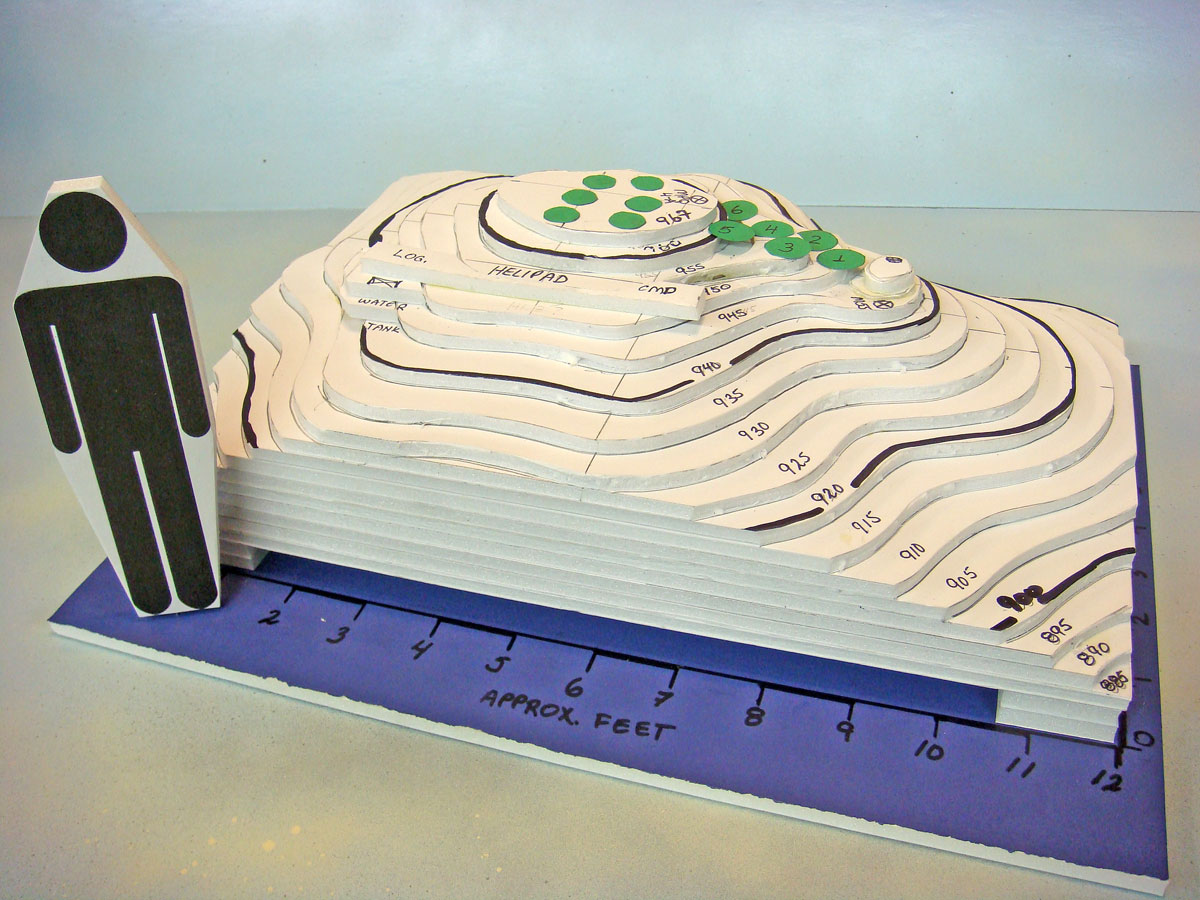
They were clueless (or nearly so as to make no difference) when it came to translating the diorama’s scale into the real-world exhibit’s dimensions. They wanted the entire firebase - a literal mountain top - constructed in 1/72 (which a summer intern had pulled out of her “fourth point of contact” when they tasked her with proposing the exhibit). Once I tracked down the 1:50,000 DMA topo map of the actual location and then overlaid a contemporary sketch map of the firebase onto it, the minimum real-world dimensions worked out to 12 x 8 x 5 feet. I offered up several alternatives to the full mountain top, but they had already made up their minds long before they actually had any real data to go on. Their intern had shown them some YouTube videos, and that was that.
The diorama is still on display in the atrium leading to the museum’s entrance (because it was, as we told them all along, too large to fit through any of their doors or into any available space inside).
I even built them a scale model of the scale model to try to help them wrap their heads around what they were commissioning us to make. I don’t think they ever understood it until the thing was sitting in the middle of the atrium floor!
In the end, they spent 4-5 times as much money on getting a company to build an acrylic display case around the thing than we charged them to build it. (We only charged them our actual cost of materials and donated the labor and research.)
Wow. That one was impressive.
There used to be one in 1/35 that I think was even larger in San Antonio near the Alamo. I don’t know if it’s still there, but it was truly phenomenal.
Ahah, that’s alright! Still very interesting.
Interestingly, one of the alternative COAs that I proposed to them (and one that would actually fit into their museum and in the display space they wanted to use) was a “generic” 1/35 firebase “slice.” I proposed it as a sort of long, but narrow “pizza slice” with the operations center at the apex and depicting different layers of defense and operations outward (to the wide end) culminating with the cleared fields of fire and the edge of the jungle. I suggested the wedge shape as something that could help the viewer to intuitively grasp that entire base was in a large, irregular, more or less circular shape.
1/35 would have allowed us to add a lot more visible detail while offering us model builders more kits to choose from. Each layer could have been depicted in vignette form to illustrate more details about daily life and operations. It could have been supported with a number of aerial photos of the many, many different firebases and base camps (thinking about all of the creative SFOD(A) camps with medieval fortress like perimeter shapes).
I also proposed a smaller footprint for the RIPCORD diorama that just depicted the very top of the mountain and used a curved, painted backdrop (like a lot of model RRs have). This could have fit into one of the rectangular “bays” that their museum is divided up into. (It’s located in what was once the foundation area of a large, multi-story textile mill dating back to the late 1800s, so the museum is divided up into rectangular spaces delineated by brick masonry piers, each about 2” square made on 10 x 8 centers. This way the diorama would have fit through their doors for installation in the museum, proper (rather than in the atrium leading into the museum from the rest of the building).
I always though the 1/35 scale proposal was the best and most informative one. On the other hand, the FSB RIPCORD Veteran’s Association became very involved in the overall Vietnam War exhibition that the museum was installing after we reached out to them for research information to construct the diorama. (They were quite helpful, but as with all model projects that demand a lot of research, you never get the final information you wanted and needed until you’re done…) That involvement has contributed significantly to the success of the museum’s exhibition, so I suppose in the end, the RIPCORD diorama turned out to be a good choice.
What about some silicone, or has that been mentioned already?
Not addressed yet. The question crossed my mind a couple days ago as I was redoing the caulking in my bathroom!