Could it be due to the propwash? One side the exhaust is being forced upwards while the other side it’s getting forced away from the wings?
@iflytb20 I do not recall the exhaust being thrown up across these top of the wing. My regrettable explanation of the difference of staining from the different engines is an annoying answer that one of the captains - Mad Jack - gave me when I asked him a question about an engine peculiarity, “Because it does and the other one doesn’t.”
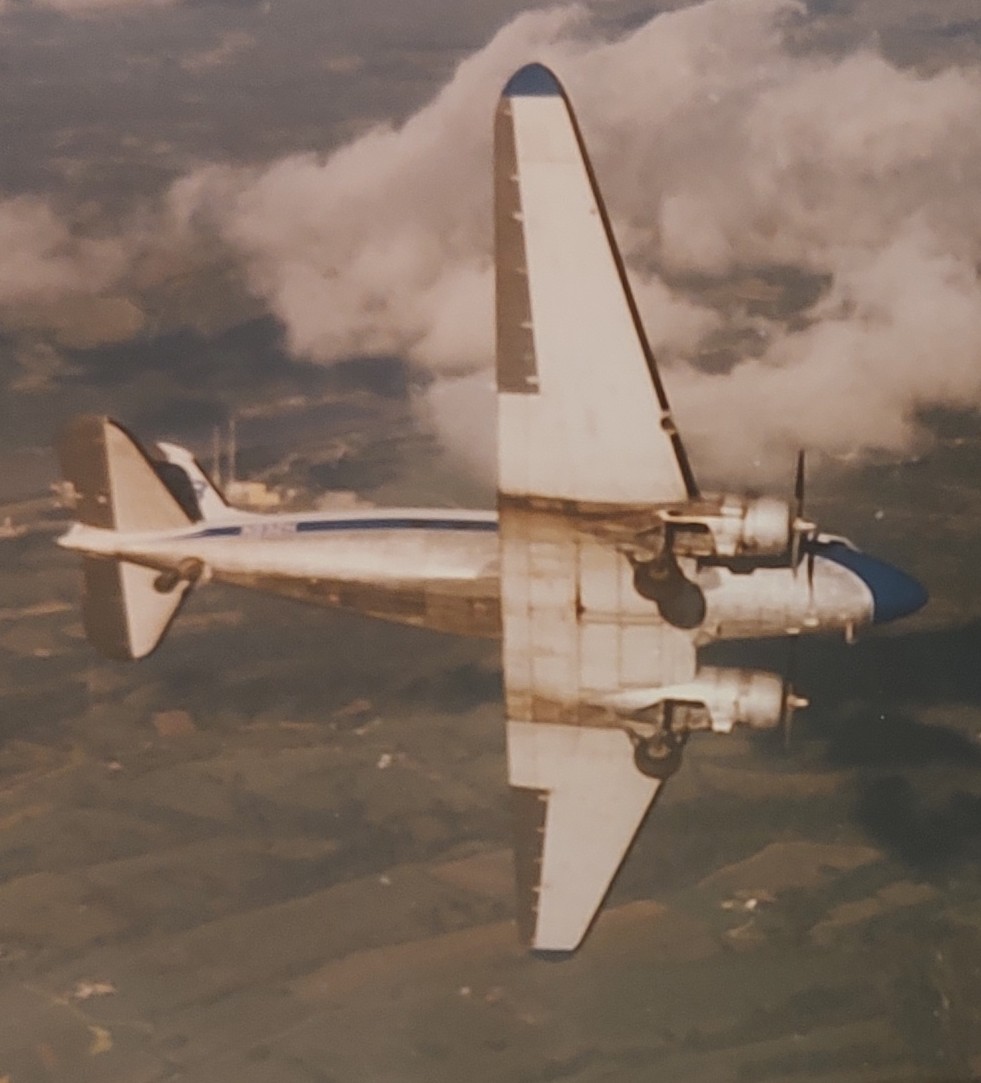
Here’s a look at the staining on one of our airplanes over Maysville, Kentucky, enroute to KGYH once upon a time.
Paul, your “Doug” looks awesome.
I have no idea what propwash might do to staining patterns. Fred, Mad Jack’s explanation is as good as we are likely to get. The motors may have started out the same but over the years ended up with different conditions. Who knows why?
Did you ever have occasion to examine the staining? Was it dry & fluffy or did it have an oily component to it? If the later, it might have been very messy on your clothing.
Paul
I only have vague recollections but I recall it being more like soot.
Somebody above suggested something about oil. Whether we flew an hour or 8 hours, one of us (almost always me, the co-pilot) what vault up onto the wing with a 10 gallon can of oil. You’d stick the engines and usually add 1 to 3 gallons. Always fun when it was rainy or snowy as the angle of the wing was probably a good 30° from the trailing edge to the spar.
The hind side of age. I wish I’d kept a notebook. The inside of the cargo hold of the DC-3s I flew were perk near an exact match too RLM 02. (Burying in mind that model paint manufacturers’ iterations of RLM 02 varied from a yellowish green too just a gray-gray. I remember imprinting in my mind that it was like the Tamiya and Pactra RLM 02s.
I know this from working on V twins - too much soot means you’re running too rich.
1 Like
Correct. Aircraft engine fuel air mixtures are “always” set for full rich for takeoff and landing, and often for climb - anytime that the engine will (or may immediately require) be running at high power settings. That’s at low altitude but if you’re flying out of higher elevations, 5,000 ft density altitude if I recall correctly, you lean the mixture or you will not achieve the highest power setting.
Excess fuel provides extra heat dissipation, provides full power, prevents detonation, and some other benefits that I can immediately remember. Today with general aviation aircraft there are a few newer engines that I’m not familiar with but I heard do not require full mixture on take off. One of them is the Diamond family with diesel engines. The other is an aircraft engine system with an alphabet soup abbreviation about electronic monitoring and injection whoopty doo golly gees.
IIRC, DC3 had three power settings: full power for takeoff; METO for climb for 1000- 2,000 ft; Cruise climb. DC-3 has an auto-rich mixture system. You manually set the mixtures to full Rich for takeoff and landing, but when she got out of METO and established in a climb you would bring them back to Auto-rich and let the gizmos decide the best fuel flow.
Have you ever seen an SR-71 or F-111 do their flametail flybys where they dump fuel into the afterburner plume? The DC-3 could do something similar - on the ground. Because you landed with full rich, there was unburned fuel in the manifold. You come taxing long under low power settings, and there’d be these lazy burps of flame gushing out of the exhaust stacks. All happy and perfectly normal and harmless, but for first-timers who don’t know about it, attention-grabbing.
I meant to include a story. Non-DC3 story.
Before I got the DC-3 job I was an aerial photographer. My second season the company gave me a low hour airframe with a brand new overhauled engine. After the joy of breaking it in at 500 ft, eventually here’s time for some oil changes. The mechanics would come to me and tell me that I was not leaning the mixture properly. They said from scoring inside the cylinders, I was running too lean. And another one would tell me I was running too rich. I read up on all I could about proper leaning of that Lycoming engine, talk to other pilots, and knew that I was doing it properly. Then one day in Ashland Kentucky my mechanic told me the cylinders look so bad that he is afraid of it would experience an engine failure (not again!). We talked about it and he looked deeper into the engine and found the problem. But the engine was overhauled, my company spent extra money to have chromed parts put in the engine. But the engine shop put chromed rings on the pistons in chromed cylinders! I’m not mechanically minded so I did not know that that was a bad thing let alone that they had done so. I had to sit around the hotel for about 3 weeks twiddling my thumbs while the engine was shipped back and rebuilt.
Affable as I try to be, kinda seems like everybody in aviation was trying to kill me.
I guess the term “Go chrome or go home” doesn’t apply here. Parts need to wear against each other so the piston rings can “seat” into the cylinder walls. With chrome on chrome, because both surfaces are hard, the rings won’t wear. The parts will eventually experience galling, and that’s when really bad things start to happen.
2 Likes
I finally finished the TWA DC-3 with Wright engines built from the new tool 1/72 Airfix C-47 kit. Airfix did a great job of getting the classic DC-3/C-47?Dakota shape right. It look right from any angle. I went a bit heavier on the exhaust streaking than with some kits thanks to the pictures posted here showing a heavy soot. I used model pigments with fixer and shaped the fouling with Q-tips, brushes & my fingers. This has sure been a great build and I highly recommend the Airfix kit for a C-47 or post-war DC-3 made from a C-47. This pre-war bird was a lot of work.
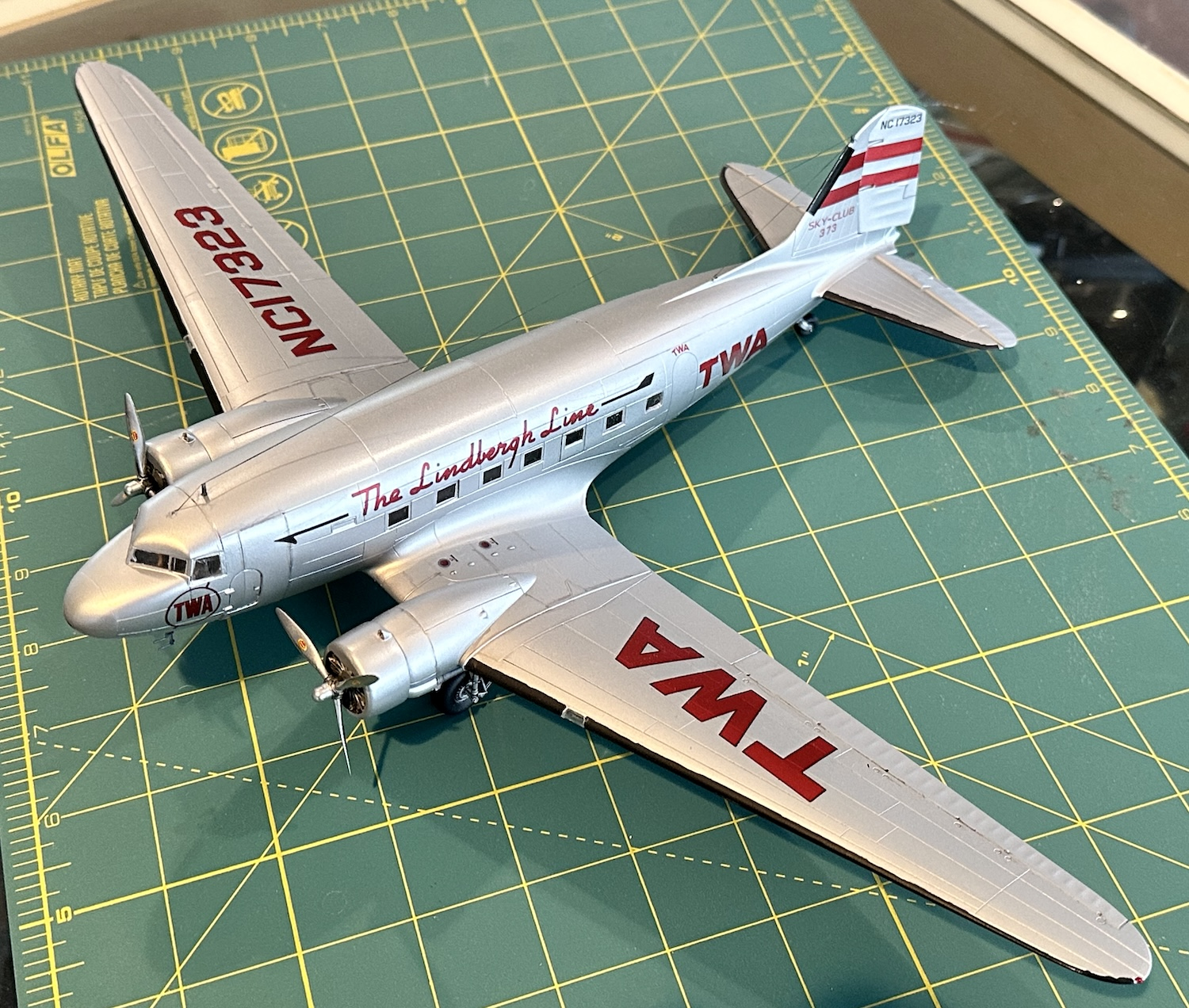
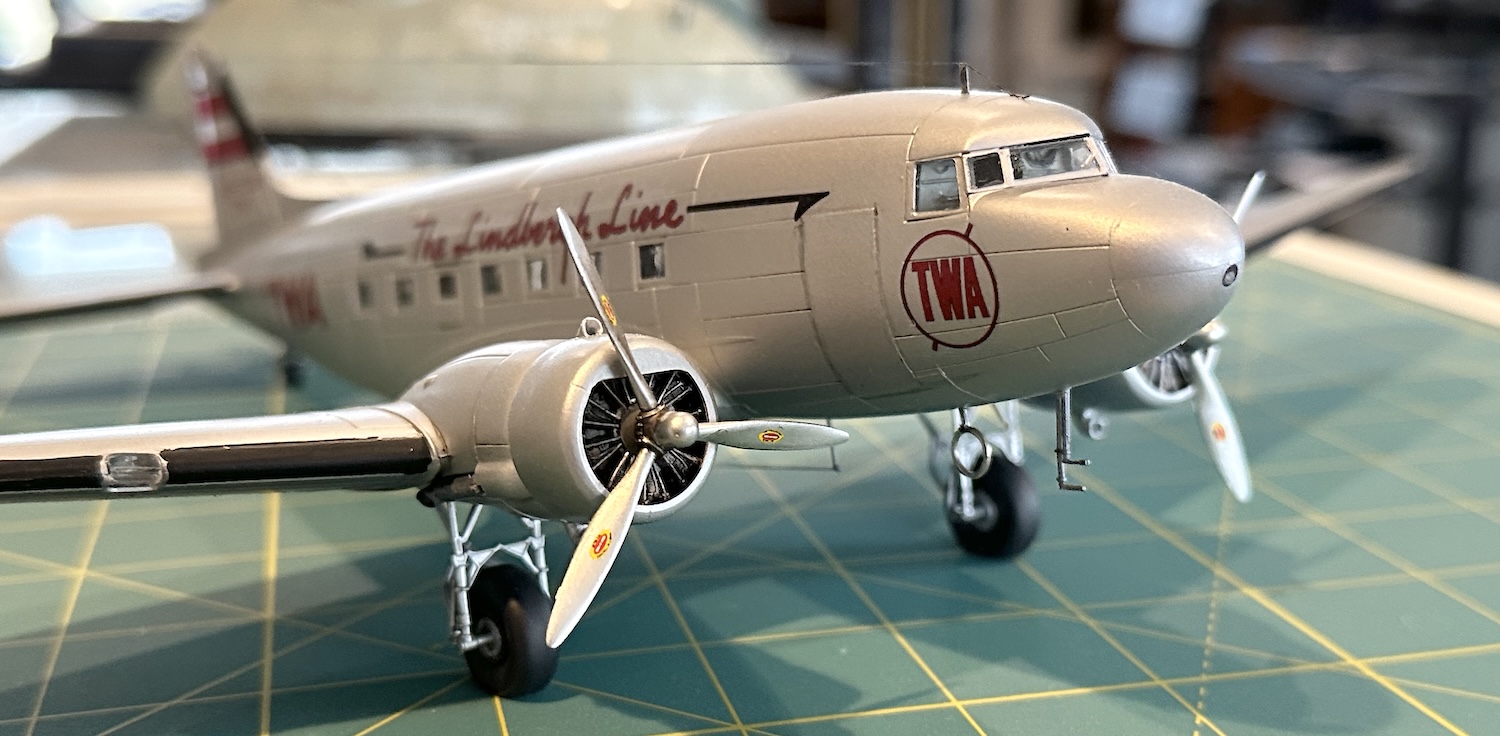

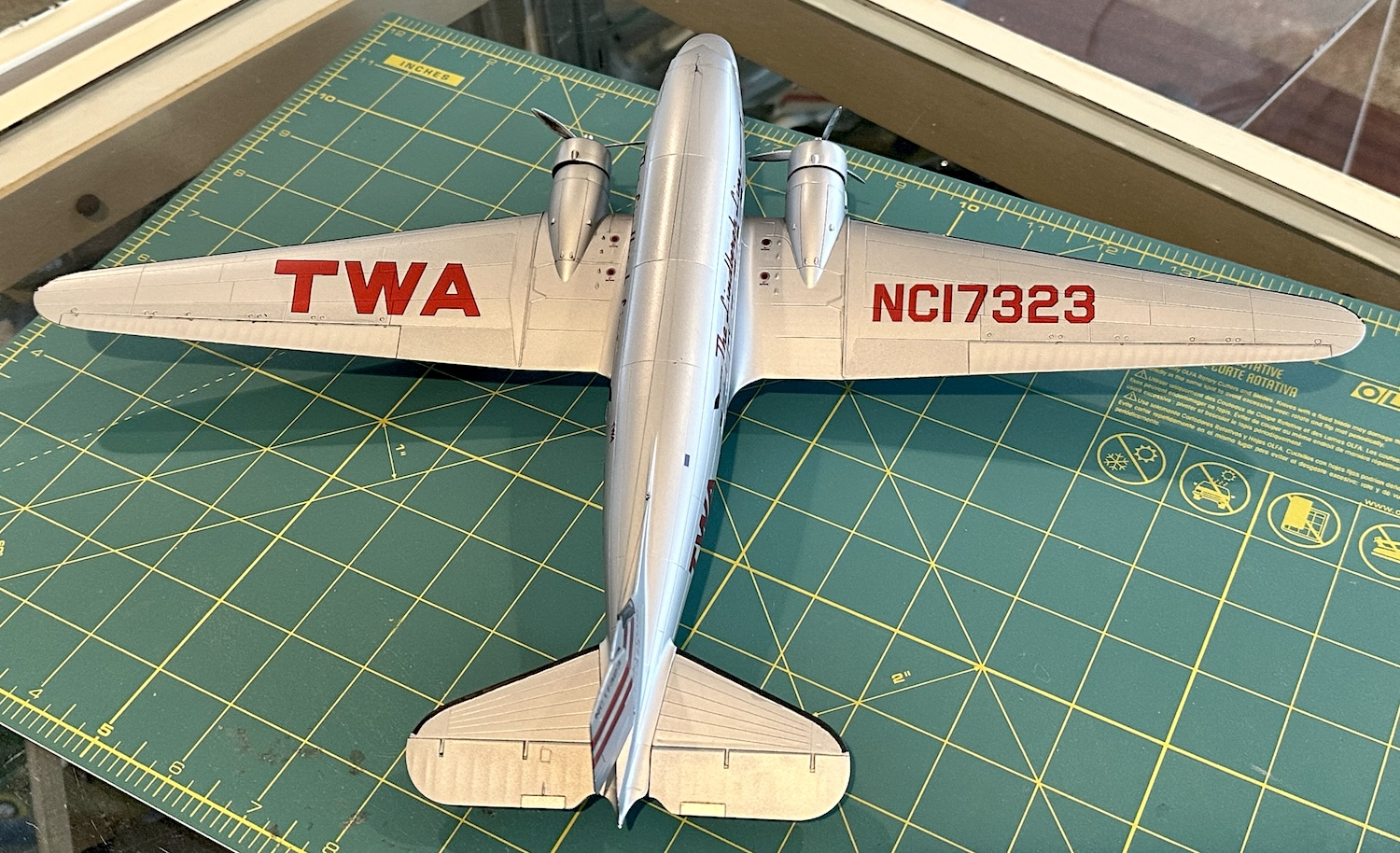
Now boarding, TWA flight 399 for Chicago at Gate 2 . . .
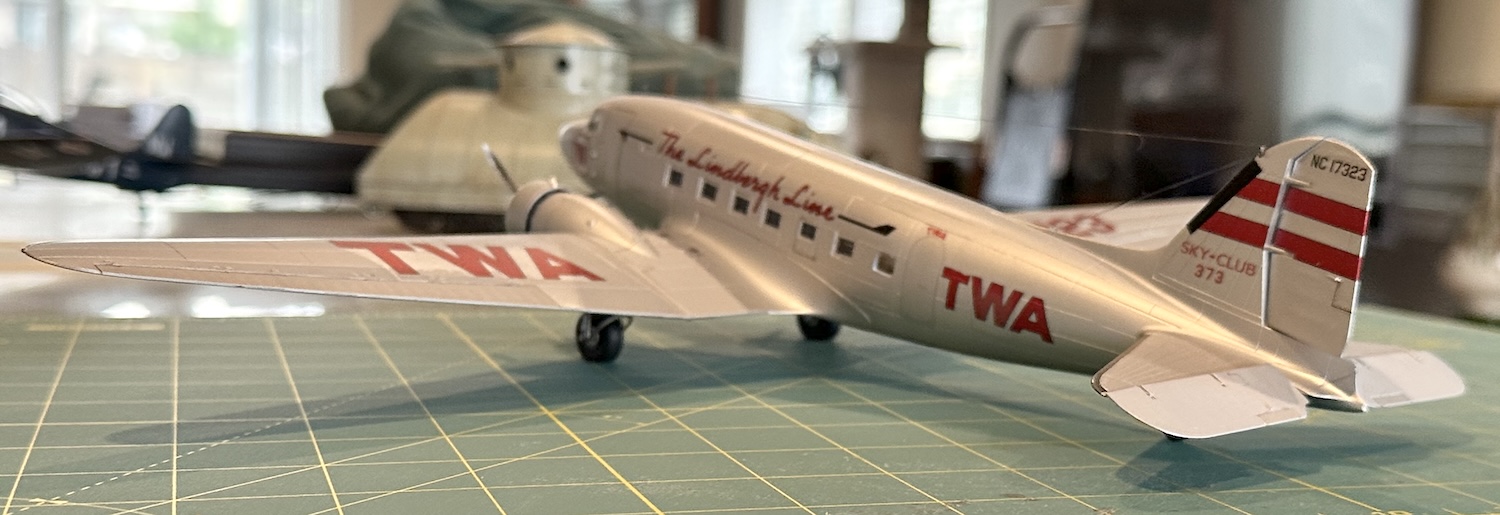
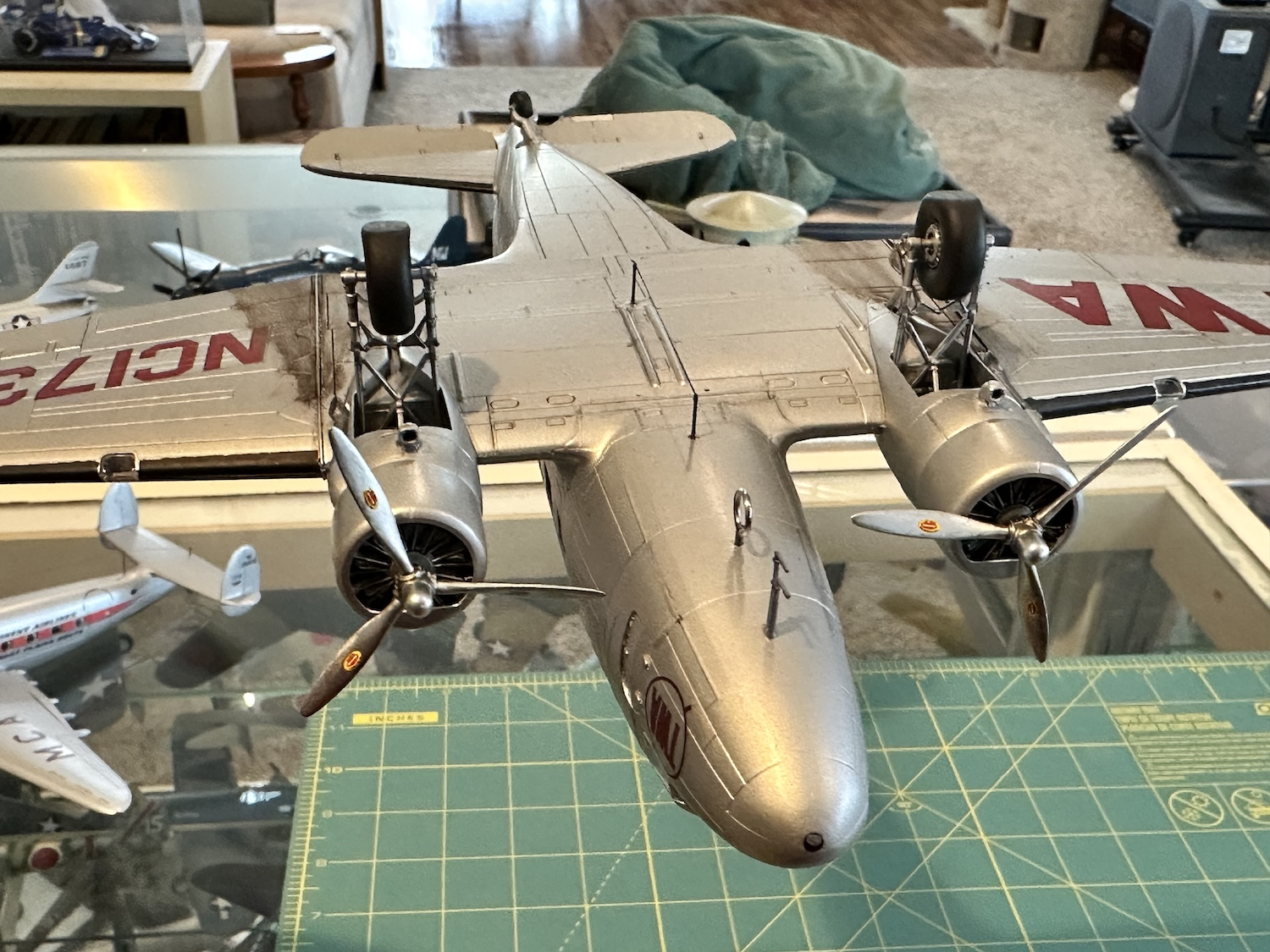
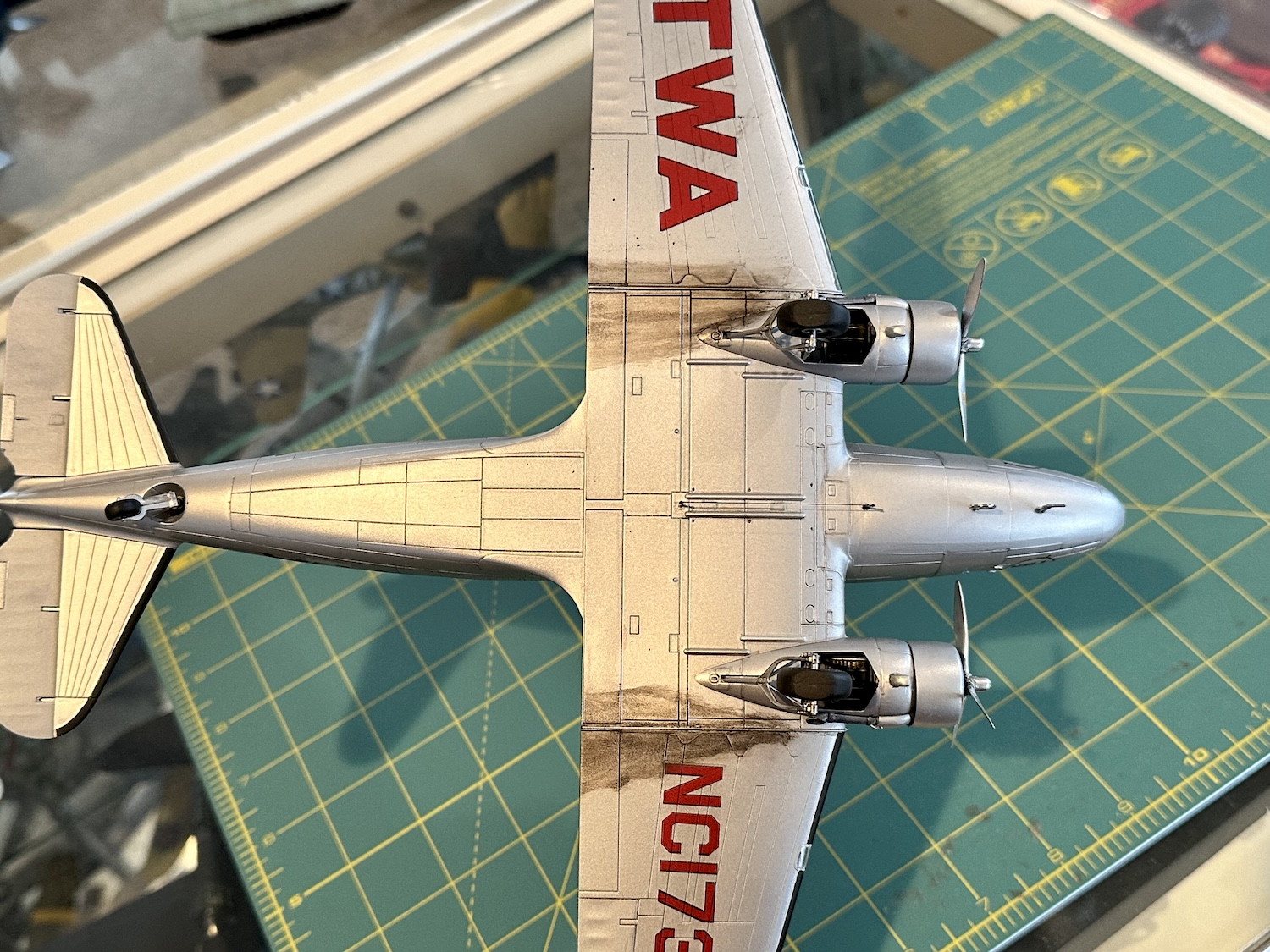
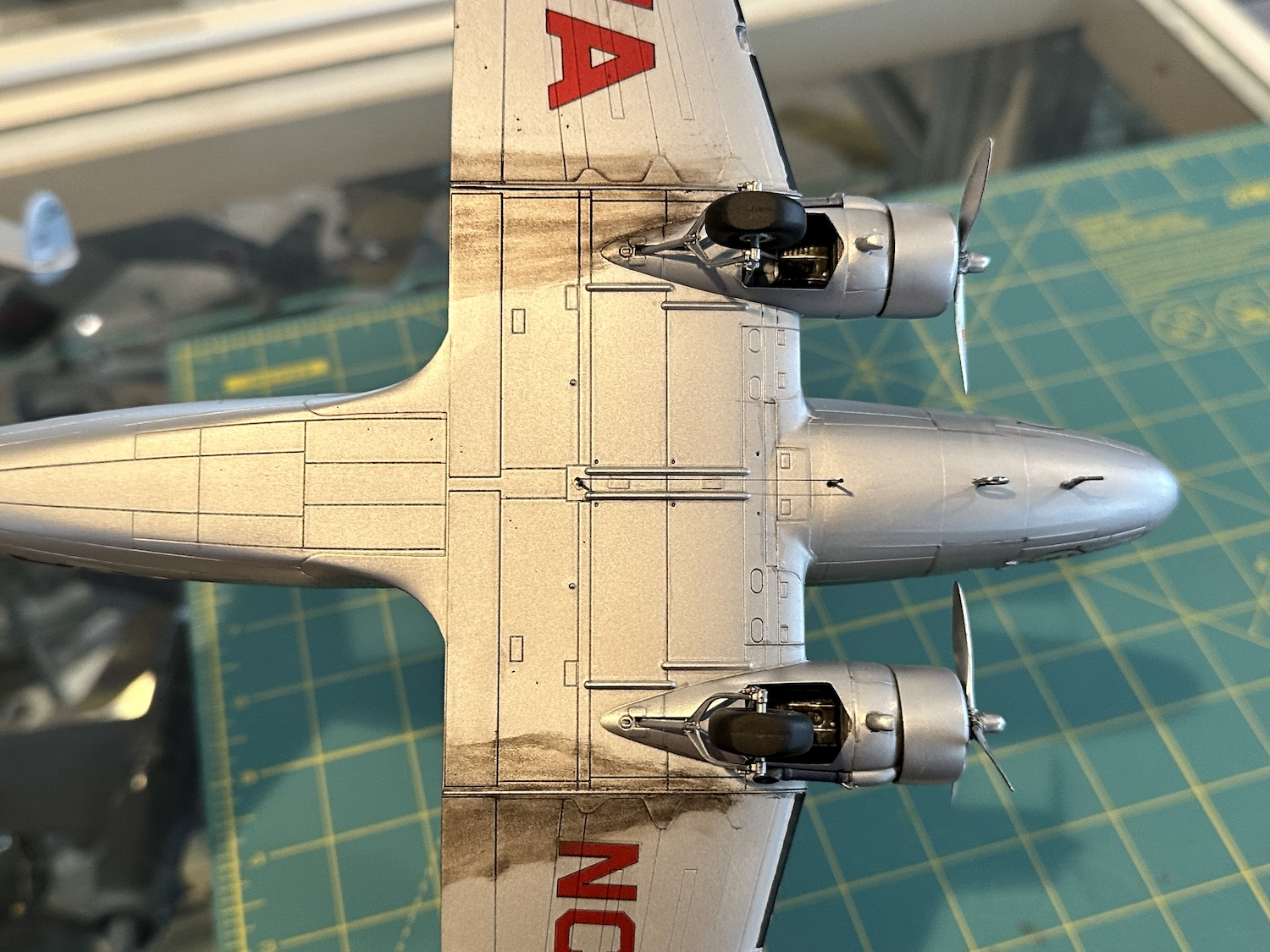
Paul
4 Likes
Here is the completion of the peewee scale 1/144 Roden DC-3 in 1936 United markings courtesy of the late lamented Pointerdog decals. I did the exhaust streaking the same way the Airfix kit was done.
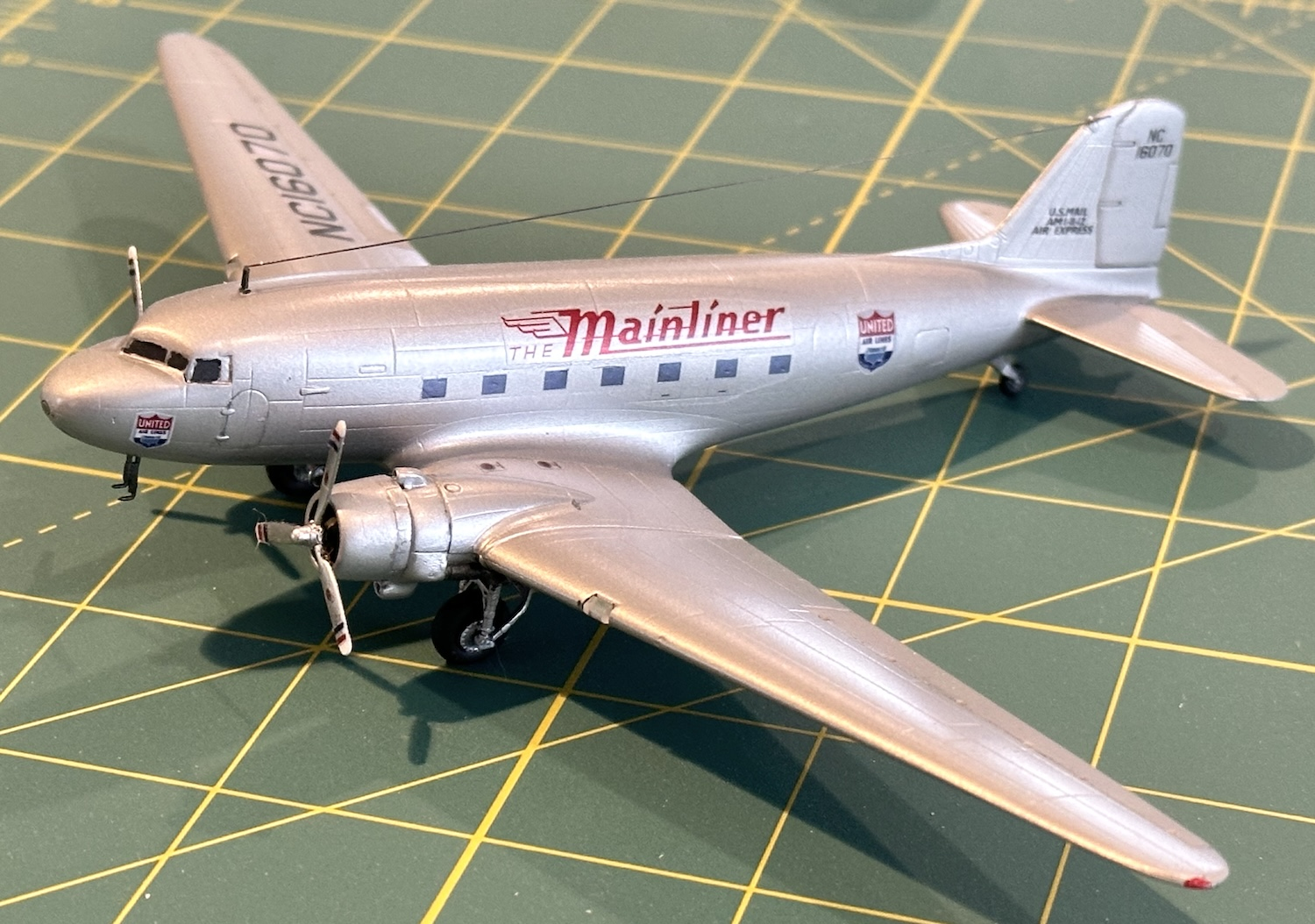

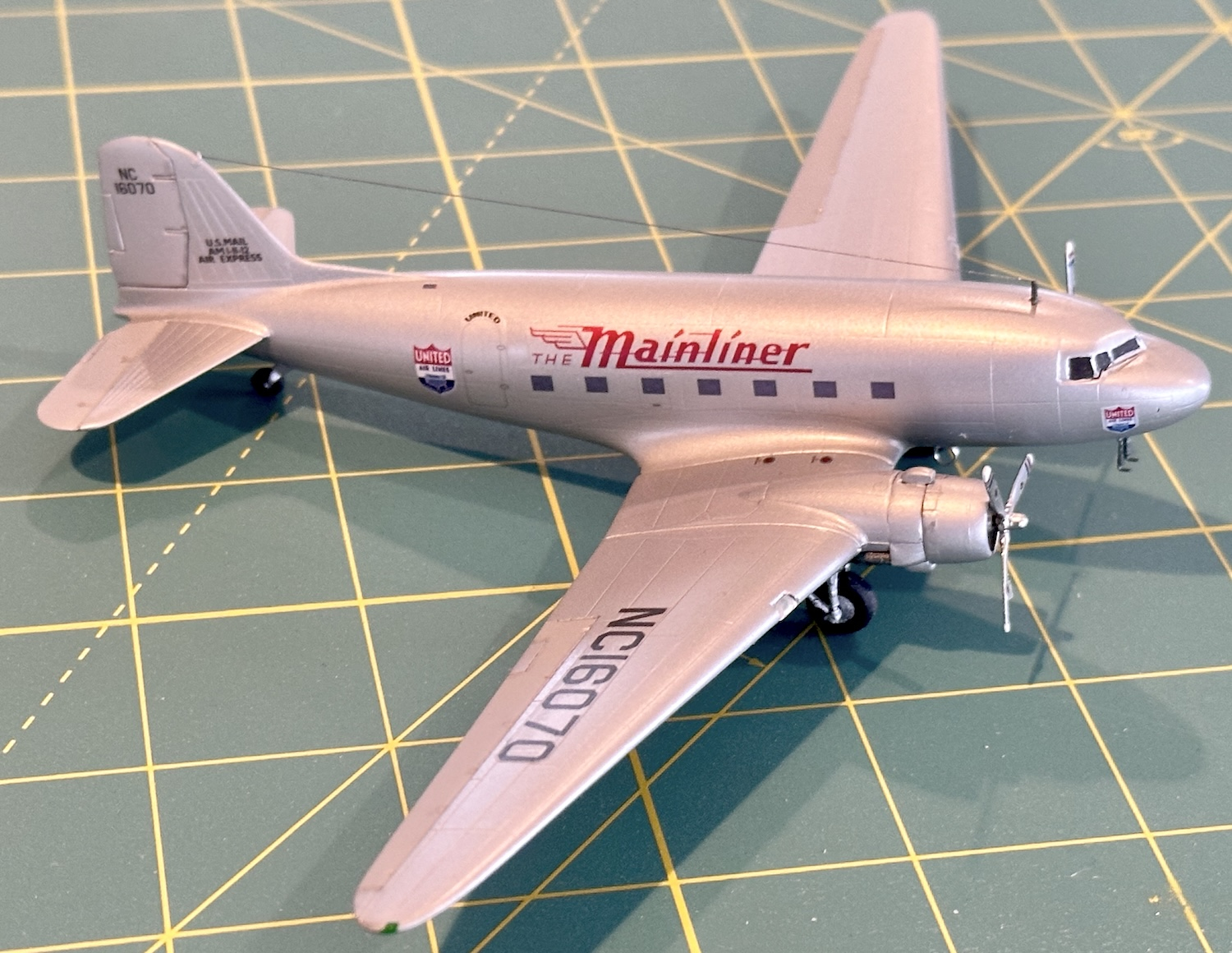
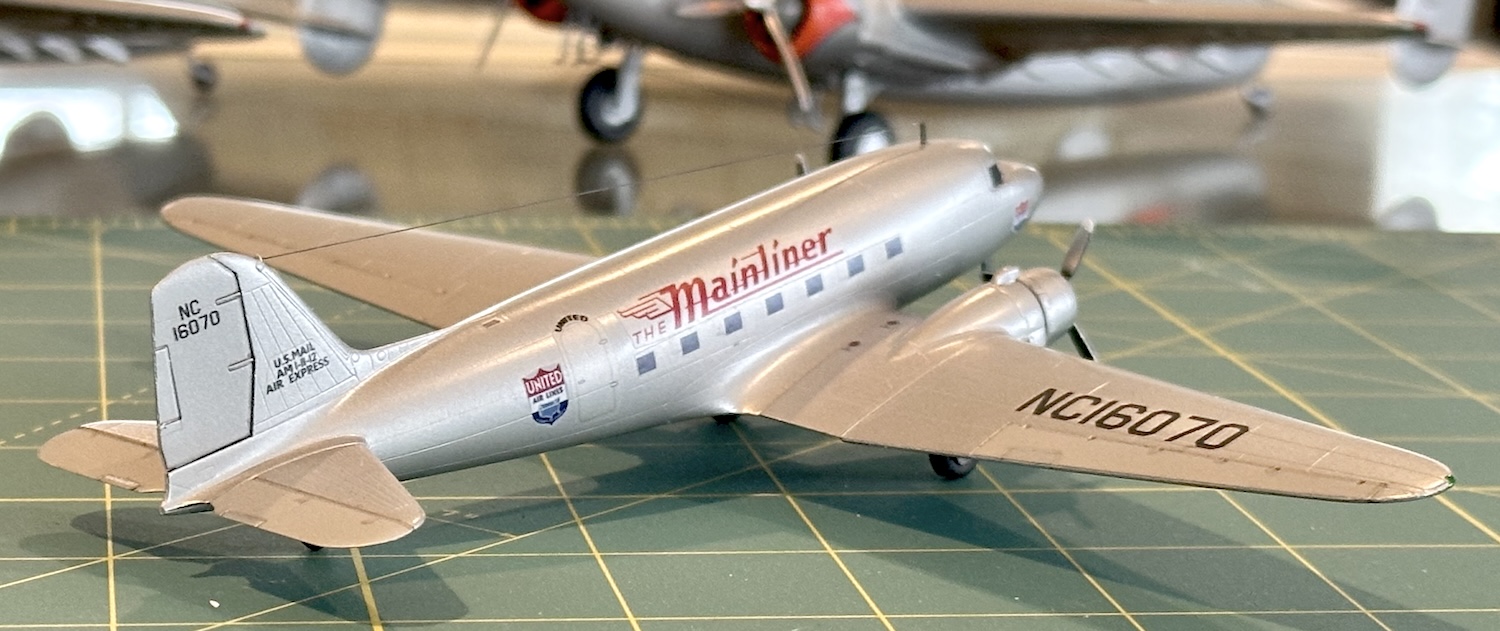
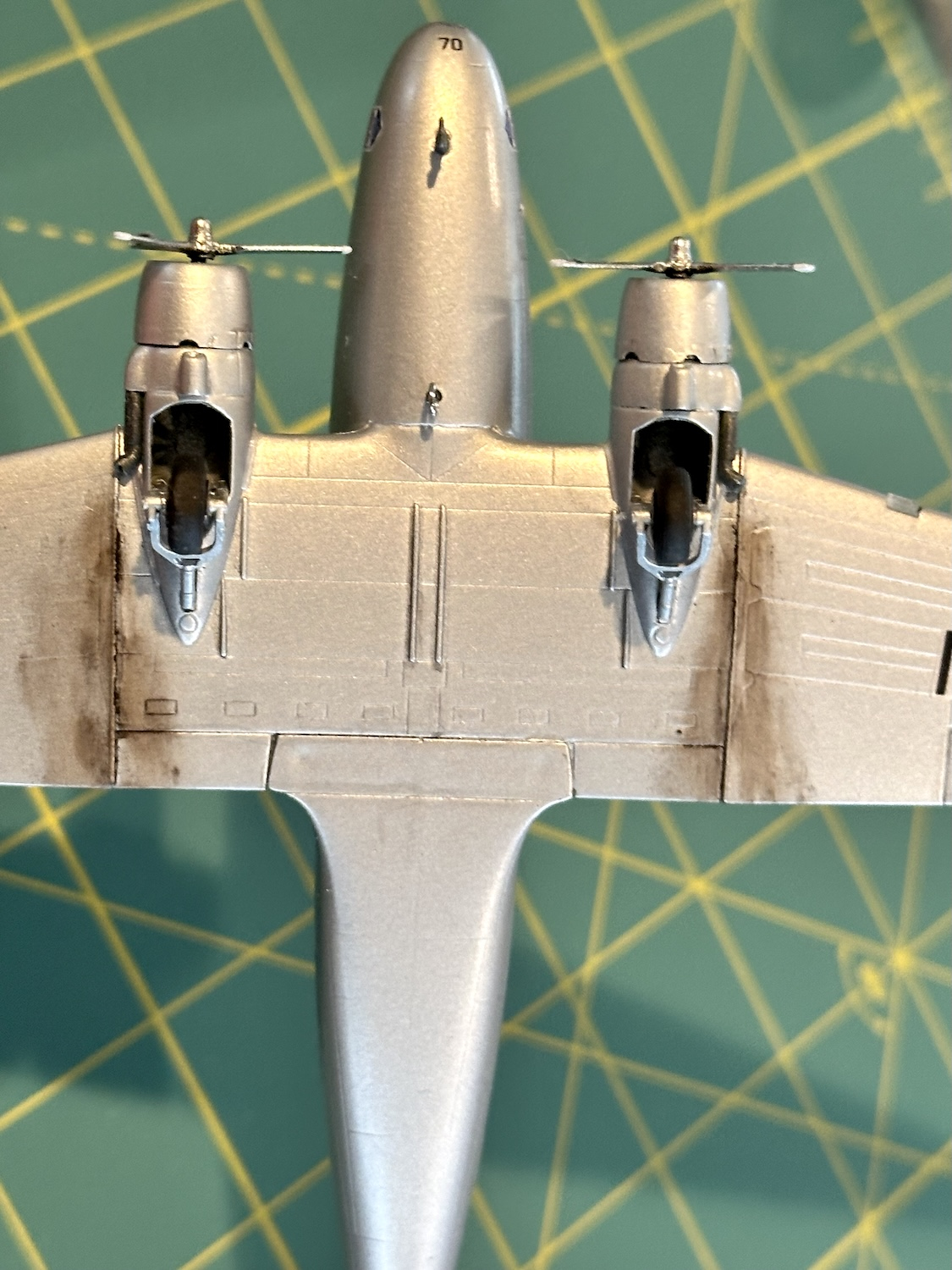
Here it is next to the Minicraft Boeing 707-320 also in peewee scale.
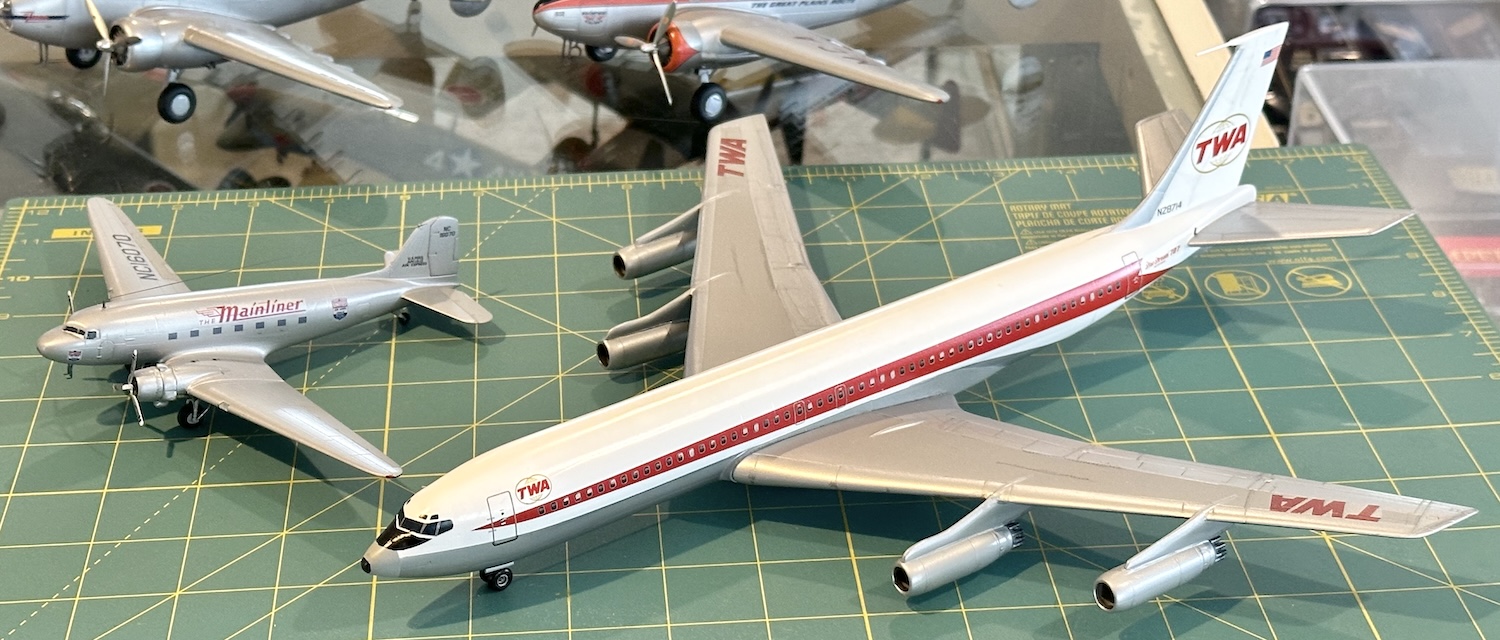
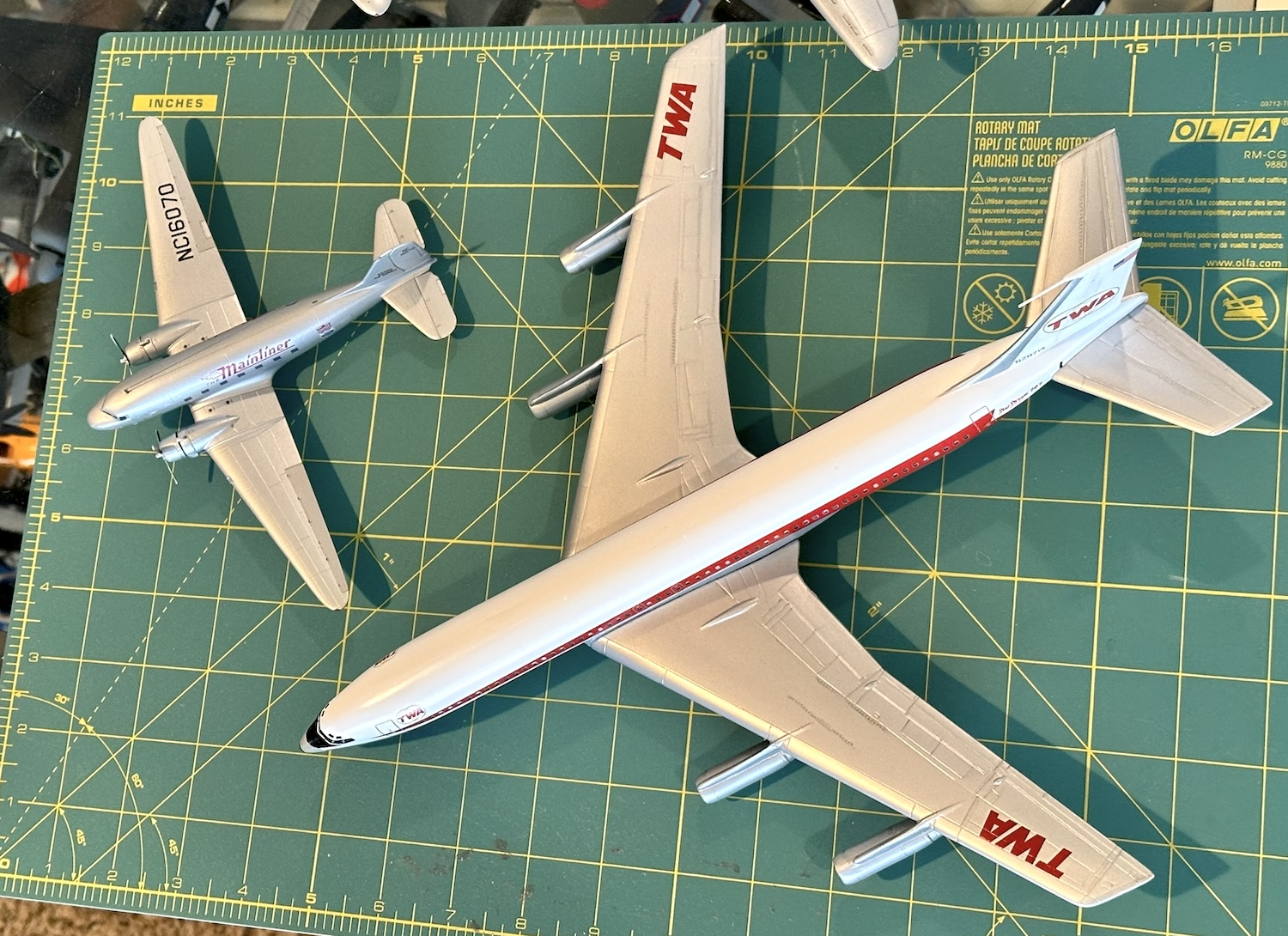
It seems almost beyond belief that these two aircraft were separated by just over two decades. Now it takes longer than that just to award contracts . . .
Paul
3 Likes
Paul, couple of beauties there.
You were side by side with the big jet is why I consider converting all of my airplanes to 1/72. The detail and quality of such small models today is as good or better than a lot of the new-tool 1/48 from the early 90s.
Wonderful models. Thank you for building them.
Less than a month and a half until this ends. I still have aspirations. I’d like to at least start one, even if I don’t finish the kid by the deadline. But no further progress on clearing out a space in my model room to start actually painting and gluing. Hopefully I’ll be able to get the initiative and inertia going, before I lose my mind.
Fred, please do find your mojo and get something started. Your contribution as a former DC-3 pilot would be especially meaningful. So far, only two of us have actually built anything for what I imagined would have been a rip-roaring campaign.
Scale is always a problem. Every modeler I know faces the problem of what to do with the completed projects. My display cases are jammed already and my appetite for building has only increased as my hands get more shaky & my eyesight more fuzzy. I know the time will come when I can’t build a satisfying model with my own skills such as they will be in a few more years. I build in four scales now, 1/144, 1/72, my “home” scale of 1/48 and 1/32. That 707 model in 1/44 is a reasonable size but imagine it in 1/32! I try to imagine rigging a 1/144 F4B . . .
Display space is only one factor, availability is another reason is that not everything is available in any one scale. I think 1/72 offers the most choice but if I can get biplanes in 1/32 that eases the build.
For anyone who would like to build that D-Day C-47, Dakota or Vietnam AC-47 now is the time. I have two more DC-3 projects in mind if I have time to get to them.
Paul
I finished the Western Air Lines DC-3 that was ordered by United but delivered to Western. Western Air Express (WAE) had just changed their name and this livery is a transitional one. United and Western had a close working relationship in those days so this United spec bird is not completely out of left field.
The kit is the Italeri DC-3 in 1/72. It is not as nice in some ways as the new tool Airfix C-47 with soft detail here and there such as the propellor hubs. On the other hand, it comes with the parts to make a DC-3 out of the box. Most airlines ordered the passenger door on the LHS and that is how Italeri made the kit. Also, the seventh window on the left side is outlined on the inside of the fuselage making it easy to add and there is even a window supplied in the kit so no messing around with clear plastic sheet.
The aircraft shapes are very good and it looks like a DC-3. Overall, for most DC-3 projects, I feel the slightly better detail of the Airfix kit is not enough to make a better choice for a prewar DC-3.
This is my last set of Pointerdog decals. I hope to see these back in production at some point.

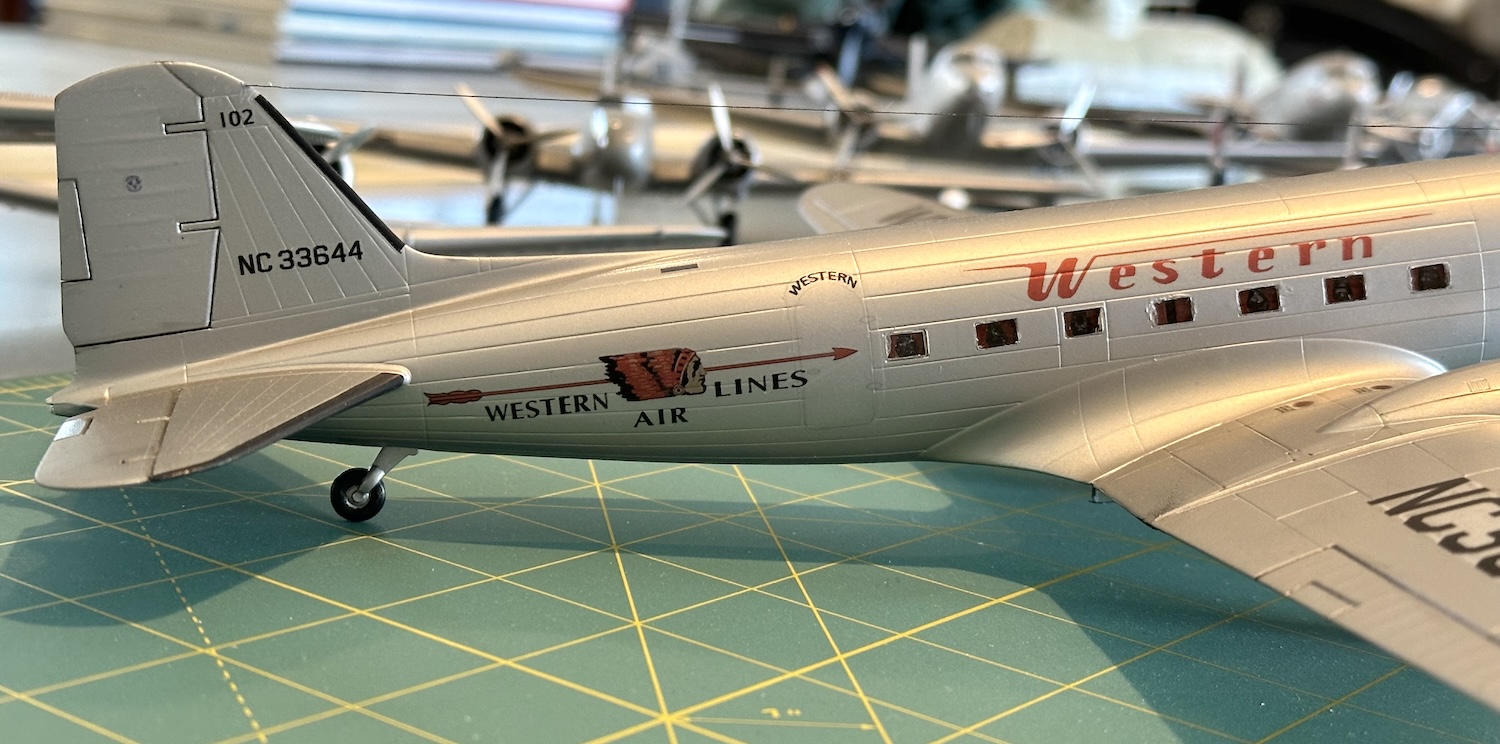
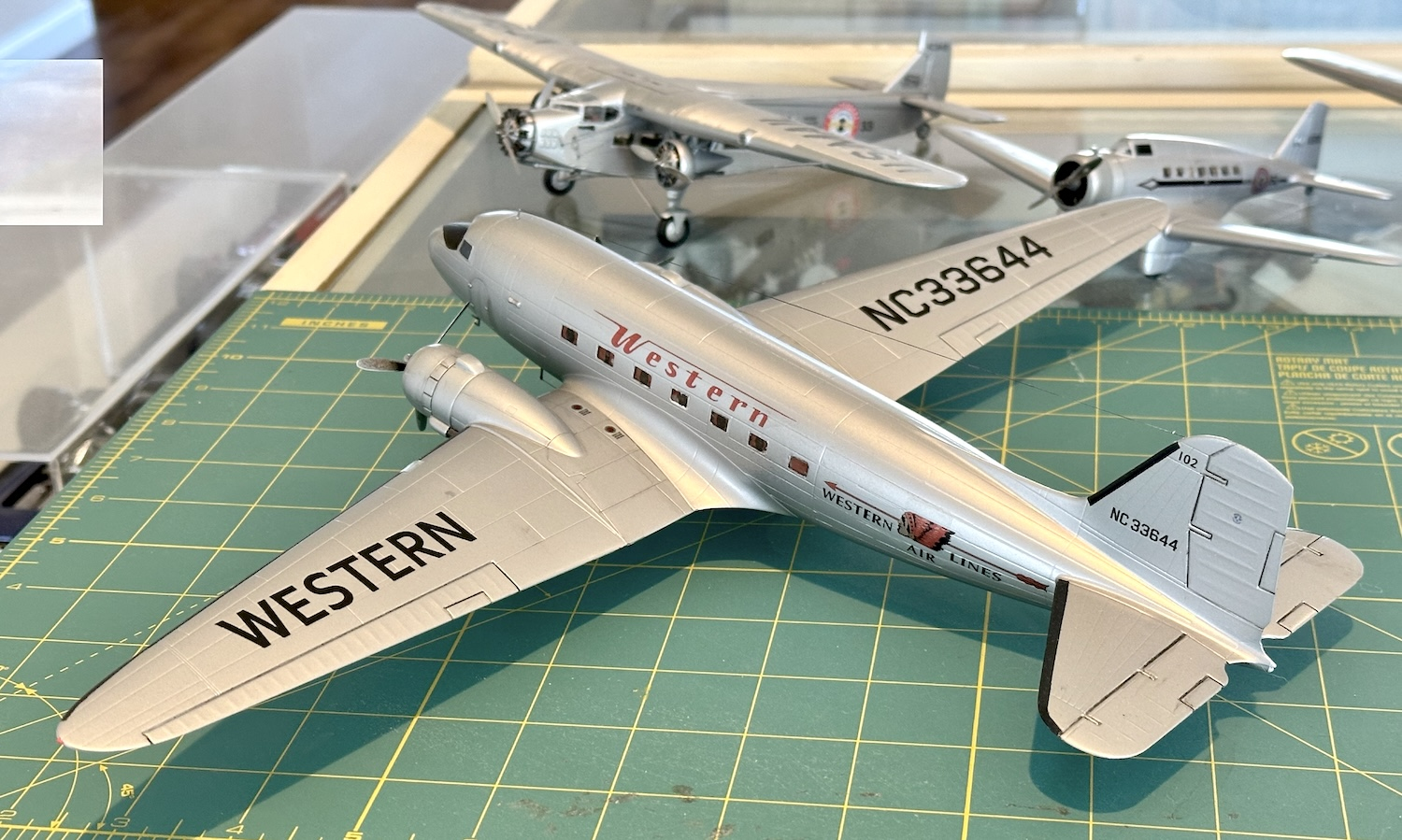
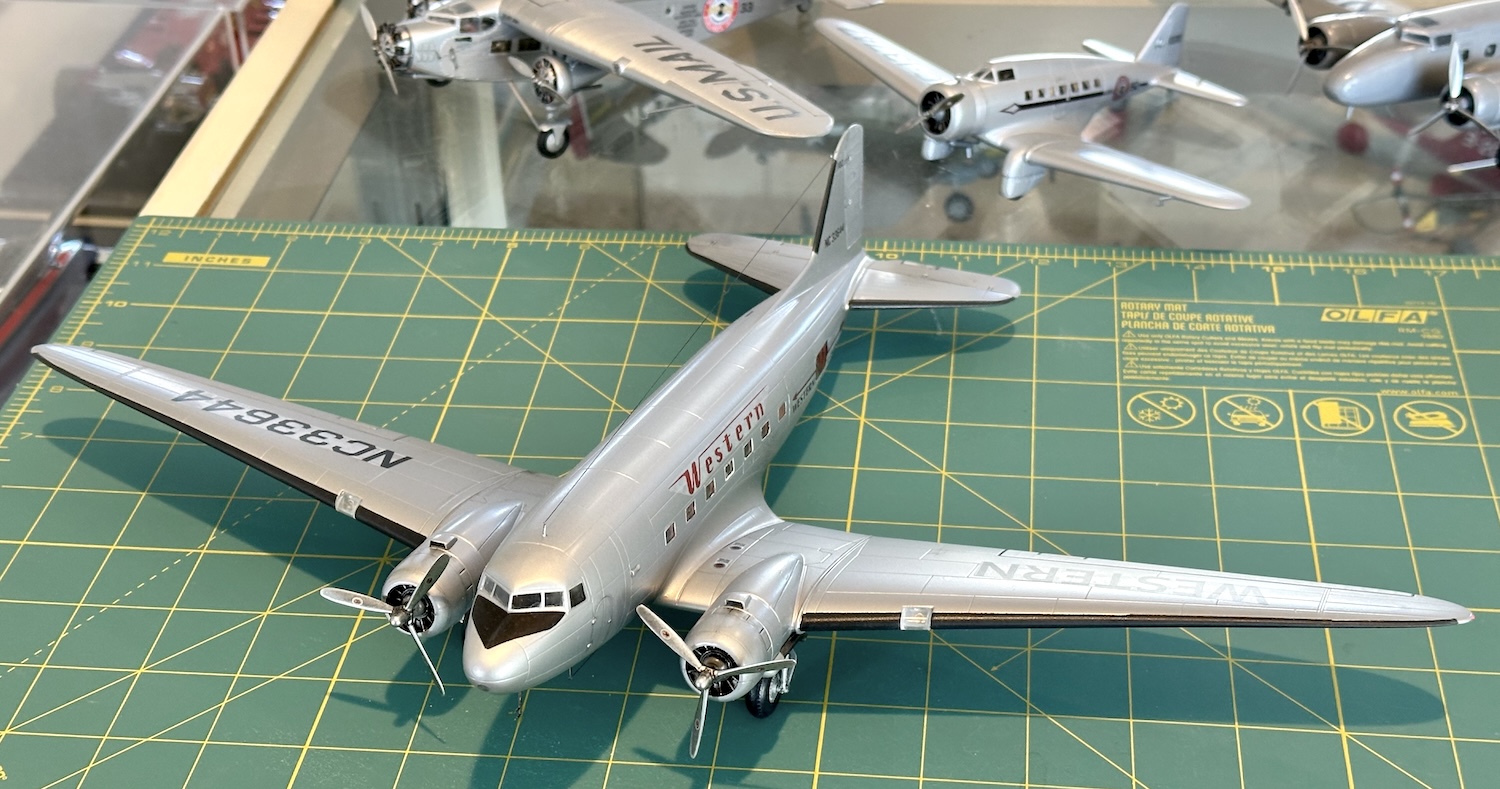
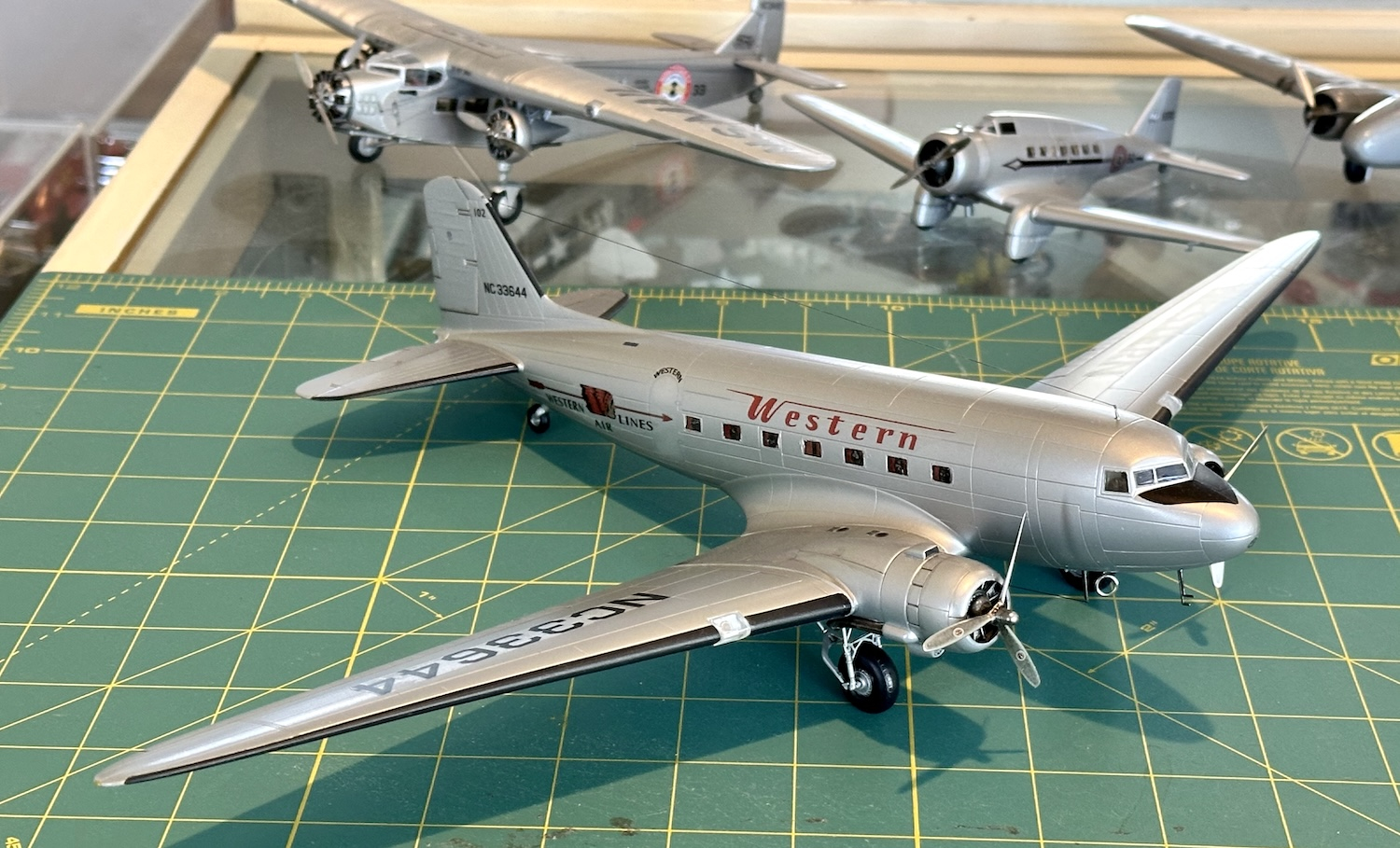
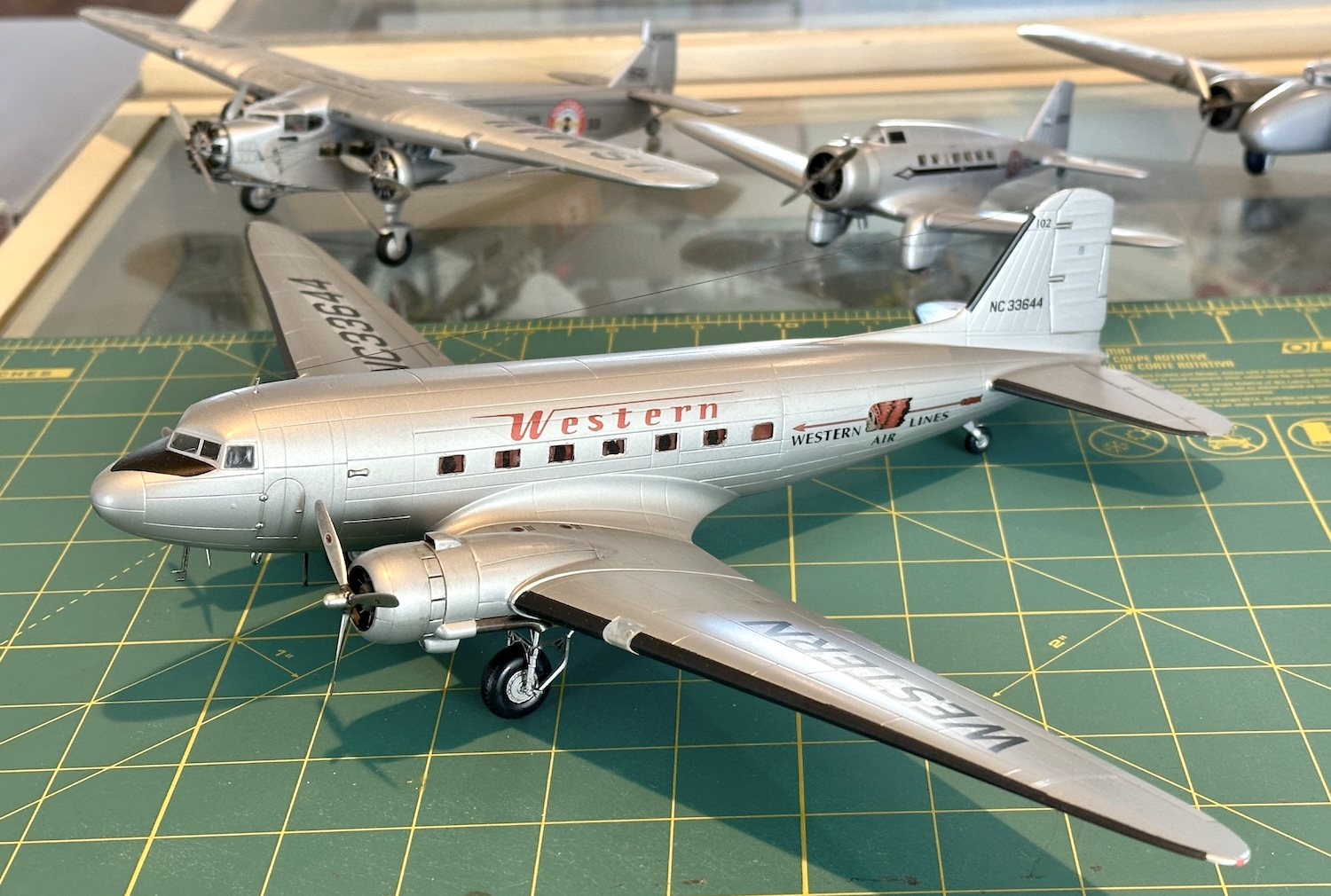
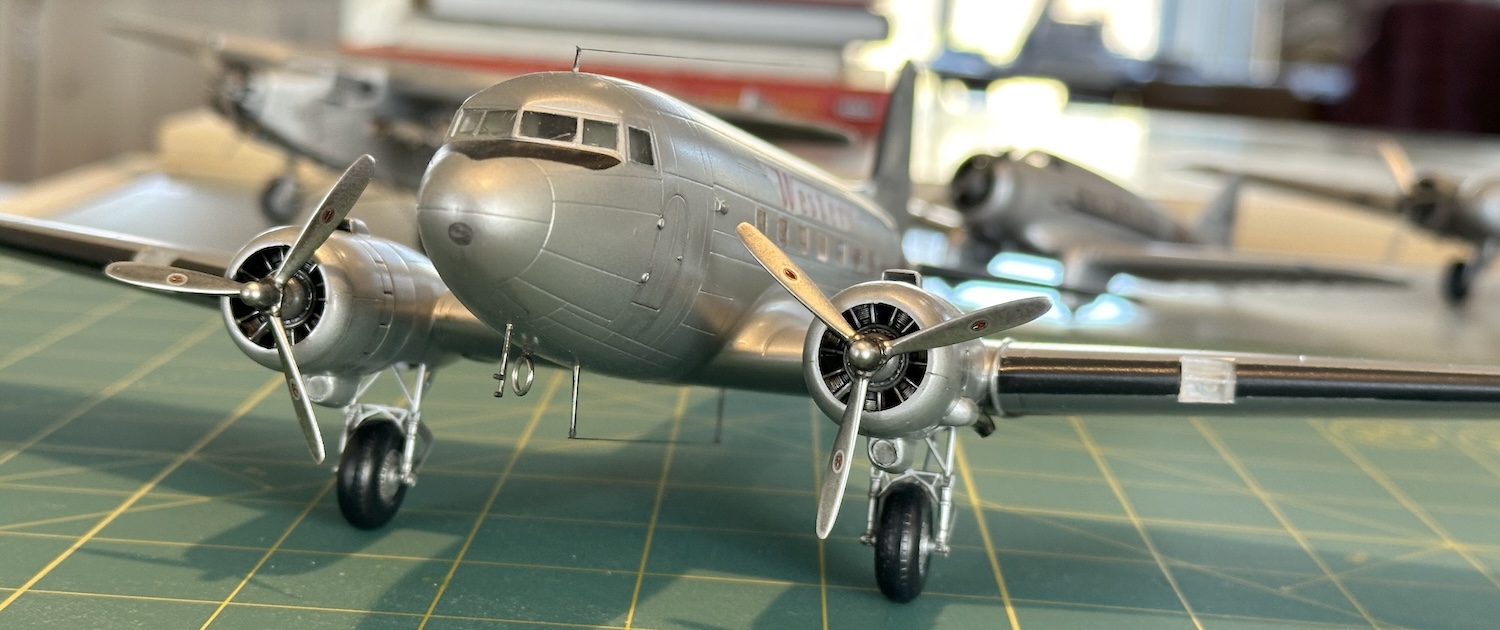
Here are a couple of shots of the TWA Airfix kit converted to Wrights & the Italeri Western Air Lines models together.
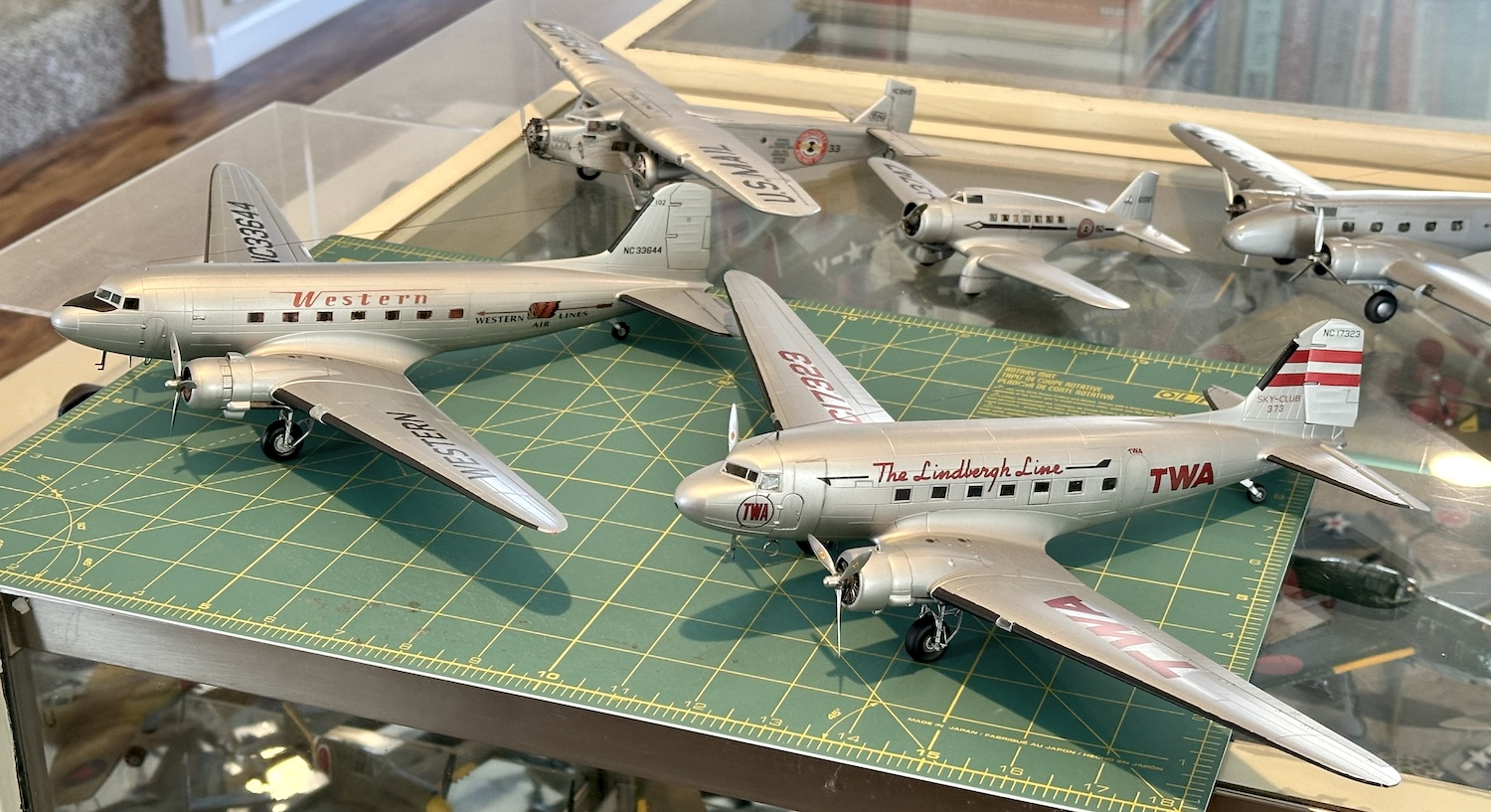
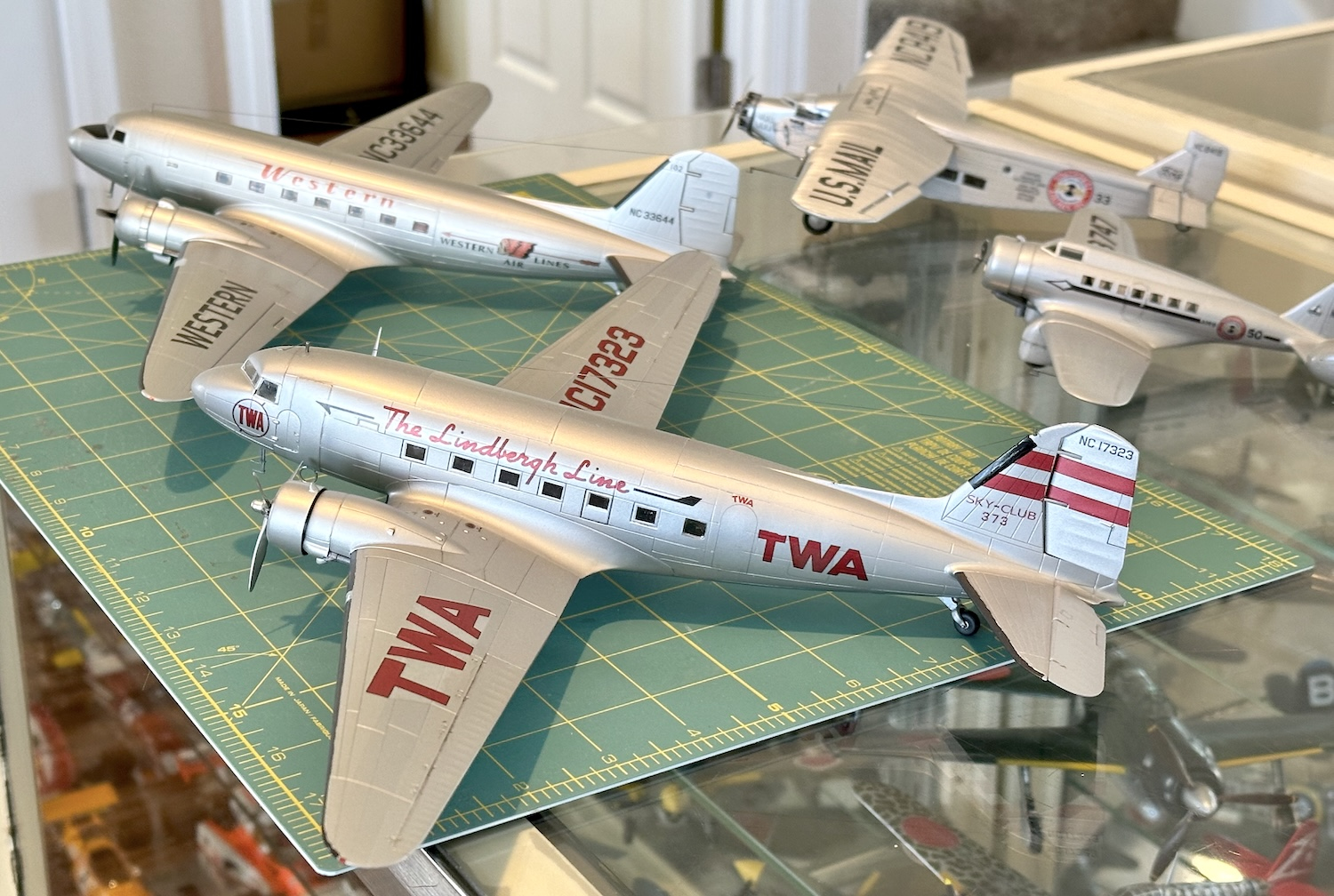
I still hope to build a couple of more DC-3s before the gong but am knee deep in other projects at the moment.
Just as a sort of editorial comment, I feel Italeri should get better model makers to build the models for the kit boxes. The kit is much nicer than shown on the box top!
Paul
3 Likes