No electrical engineer here but a tank acts as its own ground , tank radios are shielded and insulated , [ so are the radio trucks ] , whatever rf hits the tank is reflected and/or dispersed but recieved by the antenna . A free floating non grounded hunk of metal might cause more problems than its worth as far as the truck vehicle construction goes , weight /economy/material availability etc. Like I said far , far from an expert here but I did stay at a Holiday Inn once …
3 Likes
Always nice to check in here and get motivated. Nice progress sir.
J
3 Likes
Tim your blast center is the bomb (sorry had to) 
Enjoying the progress and looking frwrd to the radio room floor debris you’ll be adding.
Dave 
2 Likes
Looking good Tim and it’s building up really nicely. You are doing a great job with replicating the damage and how it would be. Painstaking work, but it will be worth it 
2 Likes
Thanks guys, I’ve no idea if it resolves the question about radio reception/transmission but these trucks had two 8 metre tall hand-cranked telescoping aerials, one on each rear corner. Presumably that meant they had to park every time to send/receive (?) Whatever the reality, how does this look?


If nothing else it should augment the blast effect. But if the consensus is negative it’ll just have to go topless…no rack…I’m sure we’ve all been there…
14 Likes
Looks f 'ed up to me , metal/wood , you’re only gonna find out after it’s built , someone with have photos of it . For my money it’s a go just as it is , beautiful work/destruction Tim !!!
6 Likes
I think it looks great. Wonder about some bit of window frame on the right side, remnants of the telescoping antenna fixture on the right rear. Would the left rear wheel tub remain that way or still to do some denting or other damage?
2 Likes
Thanks guys, that’s 2-0 which is encouraging - it may be subject to some reduction, depends how it looks nearer the finish.
Yep Jack all of that’s to come, with way more debris in (eg some u/s radios) and around the truck. The whole rear especially the left quarter hasn’t entirely disintegrated in my mind yet.
3 Likes
It looks great Tim… but there’s a but …
Before you go down the rabbit hole of destruction… Look at it now and see how the destruction looks and the explosive effect and what caused it … an AP would be through and through in reality on that type of vehicle … so you’d be talking tank or Arty HE and penetrating then exploding from within. What would any secondary explosions come from ? A tank you’d be looking at rounds cooking off and exploding and adding to the mayhem, on this truck …? Maybe 2 or 3 benz jerry cans of fuel, the fuel tank itself ? That would probably lead to a totally burnt out hulk once the fire took hold … just my thoughts …
3 Likes
Thanks John – well, way back in post # 42 I likewise pondered…
“And another gratefully received suggestion came from SamS over lunch last week, narrowing down the destroying projectile to an HE tank round. Pondering the effect of that on a seemingly all-wood planked cabin, I have a T-70 that survived the Kursk dios of yesteryear that’s still up to the job – it’s 45mm canon is probably enough for the kind of damage I’m thinking about (including fire), a 76mm or heavier likely too much.”
And yep I’m still mulling over whether it burned out – 2 fuel tanks were slung under the rear chassis. I think if the wreckage/debris looks OK just scorched, I’ll declare that the fuel tanks were nearly empty. Otherwise, I’ll declare that the rear half was well alight just before a torrential downpour extinguished it. As Tommy Cooper used to say, jussliethat 
The perp…

5 Likes
A couple of thoughts on the blast damage. I doubt that the blast from a 45mm would do anything to the rear of the chassis; detonating in the middle of the box. Some shrapnel damage maybe, but nothing more.
As for the fuel tanks and a fire. Shrapnel from the 45mm by itself would probably not ignite the fuel tanks, especially if they were full or nearly full. On the other hand; if the fuel tanks did burn, the entire box, and maybe the vehicle, would burn. At most I would just put some shrapnel damage to the fuel tanks, and maybe some discolored ground underneath.
Ken
3 Likes
So Ken, exactly when did you become a qualified psychic? This thread’s been dead for two months and yet, hours before I intended to post, here you are!
Firstly thanks for looking, and in reply, yes agreed. A subsequent fire’s too tricky, I’d come to the same conclusion i.e. a blast over almost-empty fuel tanks.
However, as has become obvious this thread has stalled, not for any Life reason but just a modelling mojo free-fall into a sargasso sea of disinterest.
After various attempts at a cure (benders, orgies, meditation, even looking at Glenn’s work) I decided it might be because every kit I’ve attempted in recent years has been heavily modified and/or wrecked. That has required a disproportionate amount of creative/destructive effort draining what’s left of my neurons.
And so, in order to prove or disprove that theory I walked into my LHS yesterday and stared at every kit on offer, from AFVs to planes to ships to cars to figures to accessories. I was looking for something/anything I could just build OOB without any modifications & screw its accuracy or otherwise. After an hour or so I’d narrowed it down to any of several 1:16 scale AFVs (when I grow up I’d like to build one even though it won’t fit in any display case)…or this…
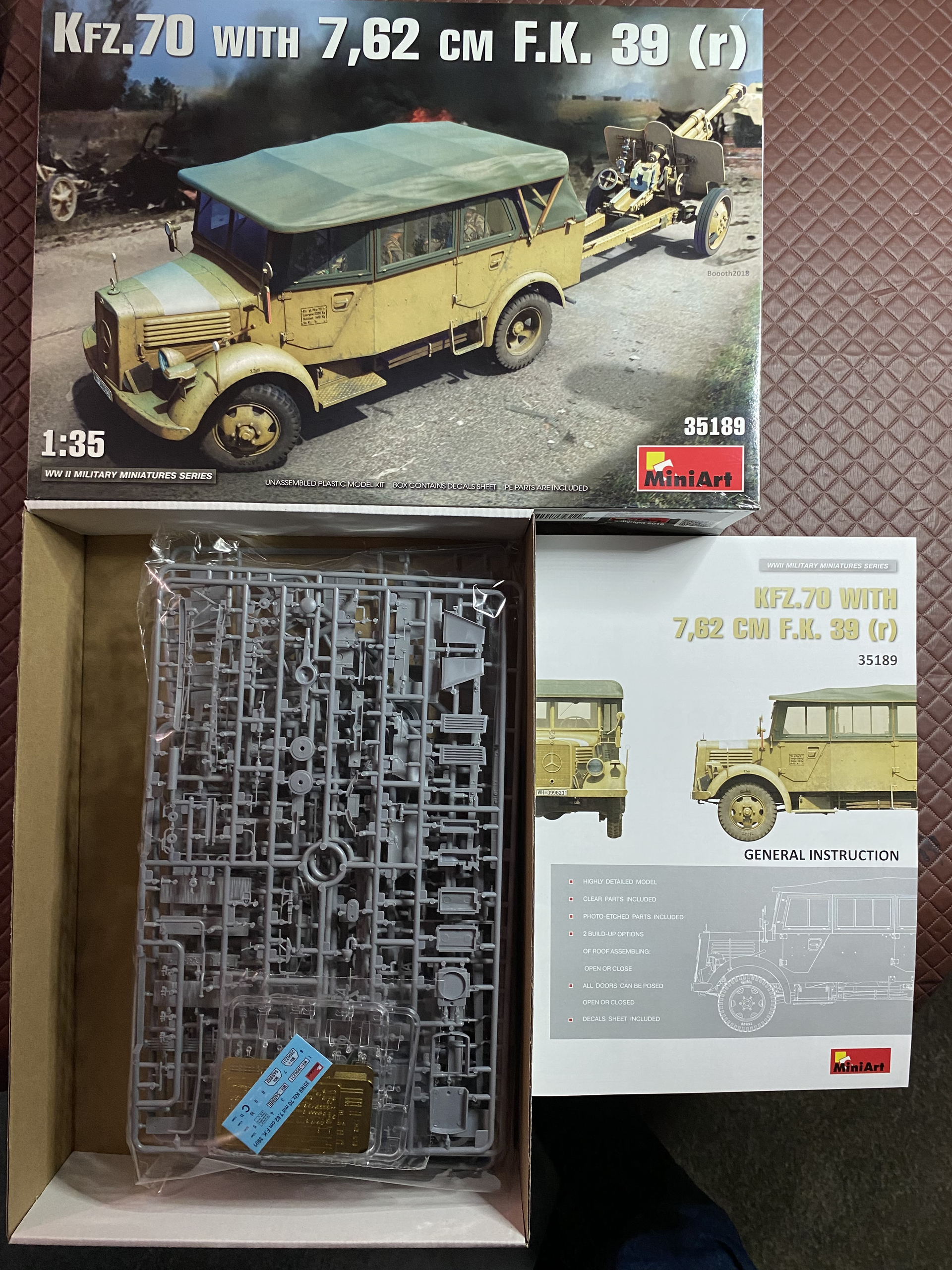
Why? (a) I’d never seen it before (b) it reminded me of the very first kit I built when resuming the hobby in 1992, Tamiya’s old Horch version (c) I like most MiniArt stuff (d) it might even appear in this project if I get re-inspired, not wrecked but just abandoned.
And breaking old habits completely I’m not going to look at any photo references - I really don’t care. WTF is wrong with me?
9 Likes
Sounds like a clear plan to reset and get the mojo back… We’ve all hit that wall a few times
4 Likes
Firstly, sorry for this extremely long comment. I’ve been following the build and the recreation of some type of explosive damage is massively impressive to someone who’s abilities where battle damage is concerned extends to a bent fender and bullet holes.
Following on from Ken’s comment, and without any deep knowledge of the kind of damage different kinds of blasts/explosions cause, I ran one of the images of damaged vehicle thought Google AI to see what it “thinks” could have caused the damage without there being a subsequent fire
Before going any further, I know the use of AI comes laden with caveats, but it may provide an alternative route to follow depending on any knowledge and personal experience of other forum members.
It’s initial assessment was:
"Based on the visual evidence in the image—which shows severe shredding, outward peeling of the roof, splintering of wood panels, and a complete absence of charring, soot, or heat warping—this structure was subjected to a high-overpressure physical or cold-gas mechanical explosion."
Having followed up asking what could cause an overpressure explosion from outside the vehicle, “we” arrived at the following;
"If a high-explosive (HE) mortar round detonated immediately next to the vehicle, it could produce this shredded, unburnt effect due to the distinct ways military explosives transfer energy.
Why an Adjacent Strike Works (The Physics)
The Blast Shockwave Overpressure: A mortar detonation produces a massive, instantaneous shockwave that travels faster than the speed of sound. If the round lands right next to the vehicle, this supersonic wave of high pressure would hit the flat wooden panels of the box body like a physical sledgehammer. It would instantly flex, snap, and shred the wood along its natural grain lines.
The Path of Displacement: The blast wave would easily punch through the lower side panels, rushing inside the confined space. Once inside, the high pressure would act as an internal lifting force, aggressively peeling the lightweight aluminum foil roof upward and outward—exactly as modeled.
The Absence of Fire: Military HE mortar rounds (like a standard 81mm or 120mm HE shell) are designed to maximize fragmentation and blast overpressure. While they produce a brilliant flash at the exact millisecond of detonation, they do not carry sustained incendiary compounds (unlike white phosphorus or thermite rounds). The heat is intense but disappears in a fraction of a second, which is rarely long enough to ignite dry, painted wood unless it lands directly on top of it."
It then went on to say, in the context of modelling such damage:
"While a mortar strike perfectly explains the clean splintering and peeling roof, a true external military explosion would typically introduce a few more forensic elements. If you want to make the diorama even more realistic for a nearby artillery or mortar strike, you could consider adding:
Fragmentation Pockmarks & Shrapnel Holes: The vast majority of damage from an external mortar strike comes from high-velocity jagged metal fragments shearing off the shell casing. The side of the vehicle facing the blast would normally be peppered with small, clean-cut shrapnel holes and tears.
Directional Blast Lean: Because the explosion happens to the side, the structural pillars would likely be sheared at the base and leaning heavily away from the side of the impact, pushed over by the explosive blast wind.
External Soot Spray: While the inside would remain clean wood, the lower outer chassis and wheel arch closest to the blast would likely feature a fine dusting of dark grey or black carbon soot kicked up by the explosive residue and dirt from the ground crater."
As I’ve stated in other threads on the forum, I use AI as the starting point for further research when dealing with a subject I have little/no knowledge of or want to find a fresh angle to approach and issue from.
I hope this helps you in some small part to get your mojo for the original build back on track.
3 Likes
I too have been in a bit of a slump recently. That’s part of the reason I am so behind in reading posts on this site. I am catching up now, trying to get some of my Mojo back. Looking at all the great work here can be very inspiring!
@Chepster Your AI search is actually pretty accurate. I have seen and created many explosions with the effect it described - a dusting of black or gray powder (sometimes with some dark brown in it) but little or no scorching or burning of surfaces.
The only discrepancy I see is that the AI focuses on an external blast, a mortar or artillery shell next to the vehicle, as opposed to an internal blast from a 45mm shell. In this case, any dusting, if present, would be inside the box structure. In either case, it may be too fine to notice at this scale. The amount of HE in a shell is really quite small.
Ken
2 Likes
My query to AI was to provide possible alternative explanations to an 45mm HE internal explosion.
An external explosion adjacent to the vehicle was what AI identified as the most likely cause of the battlefield damage modelled that would not result in truck body being destroyed by fire.
The alternative AI suggestion that I did not report was an internal pressure blast caused by something like an exploding gas cannister inside the truck.
1 Like
Thanks John, it’s good when it stops…so I’m told 
No problem, an interesting exercise I’m still processing – sometimes my intelligence becomes artificial too. First reaction is that AI didn’t consider a simple direct HE hit, but I guess it was assessing my incomplete representation as matching an adjacent ground blast rather than hitting the rear area. But as previously advertised, in my mind it was a 45mm HE tank round as Ken also mentioned. Either way, certainly more splintering/pock marking was/is the next intended step. I’m not sure if I’ll be interested in a 2nd AI assessment if/when I complete the wreck 
3 Likes
So far so OK, getting the Kfz 70 chassis together. But I’m reconsidering my MiniArt Cult membership - check this out…
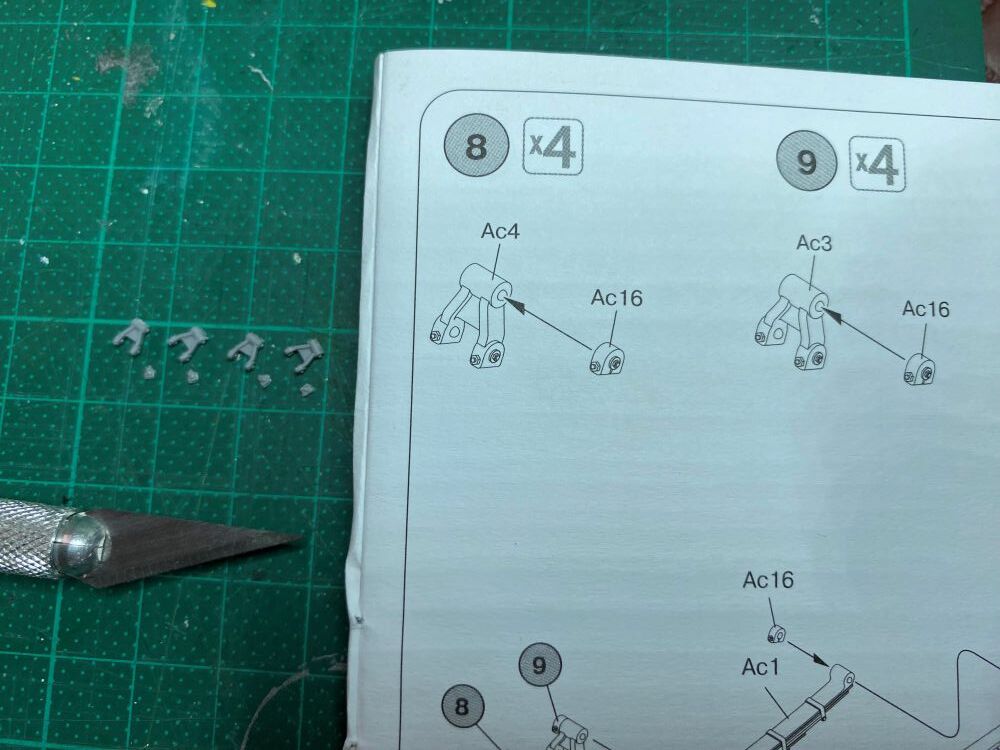
These are the leaf-spring supporting brackets. They are very, very small as you can see on the left. They will be barely visible when the kit’s finished. So, why wasn’t part Ac16 just moulded on the bracket? And spot the difference between set 8 and set 9………..that’s right! They have different numbers! (OK you spotted the web reinforcement is slightly larger in set 8…I don’t care)
I’ve decided to strike a momentous blow against Stupid Kit Design which will surely reverberate around the Modelmaking world (and deny my personal Carpet Monster any sustenance) by omitting part Ac16. Bite me.
6 Likes
Usually when I do something like that it bites me in the arse somewhere down the line …
Yeah , MiniArt can make some atom sized parts to be placed in some areas where it’ll never be seen . What you’re gonna do looks safe though .
Revisiting the destruction part of the build , an HE round with shrapnel isn’t the only visable damage , there’s concussive damage too , damage that is not directly related to the flying bits of metal . An He round can land next to your [ mostly wood ] vehicle , not even hitting it and still turn most of it to matchsticks .
2 Likes
I’d guess it’s because the slot on the flat side of Ac16 couldn’t be molded if it was part of the rest of the bracket.
2 Likes