First Kit (Journey of a Beginner) - Tamiya Panther Sd. Kfz 171 Ausf. A

Introduction:
As I mentioned in my introduction thread, I am new to the hobby. Yes, I did build a couple of sets as a kid/teenager, but nothing comparable to what anyone here in the forum builds. So I consider myself a total beginner.
I’ve already purchased a lot of tools and accessories to start building some kits. Now it’s time to discover what really helps me - and what was just wasted money.

In this thread, I will try to take you with me on my journey of building and painting my very first scale modeling kit! I can’t say how frequently I will post here or how long it will take me to finish the build, so bear with me and feel free to comment, help, and critique me!

.
Model Choice
I already purchased a hand full of kits before I did any research at all. I knew from what I had read that Tamiya is a good company, especially for beginners. I didn’t put much thought into the sets I bought - I simply picked up what I could find at my local shop for a reasonable price.
Looking back, I would consider that my first two learnings are:

1. Tamiya is not always equal to Tamiya
I now know (after reading and researching) that not every Tamiya kit is great, and not every kit meets the same standards. Sometimes there are newer manufacturers that may even offer better beginner-friendly builds of the same vehicle.

2. Purchasing with purpose
Even though I’m a beginner, I want to build a story around the model I’m working on. I want to do proper research about what I want to achieve.
If I build for example a Panther tank, I want to learn more about the tank and its history. I want to understand the details of the vehicle that I want to represent - what the differences are between versions, and how close my model kit is to the real deal.
Is there anything I want to add to make it more realistic? Can I maybe find photos of a real tank that I want to replicate? Or do I want to build a factory-fresh display model? Will I use it in a diorama? In what context? Do I want to build this tank in all different versions? Or in all known camouflage patterns?

All these questions - and more - came into my head once I started building this kit. Questions I don’t have answers to for this particular build. And I think that’s okay - I’m learning. Along my journey this tank might even end up in the trash bin anyway… although I’ll probably keep it as my “first model build.” and as a reminder how it started :slight_smile:

.
The Build (so far)
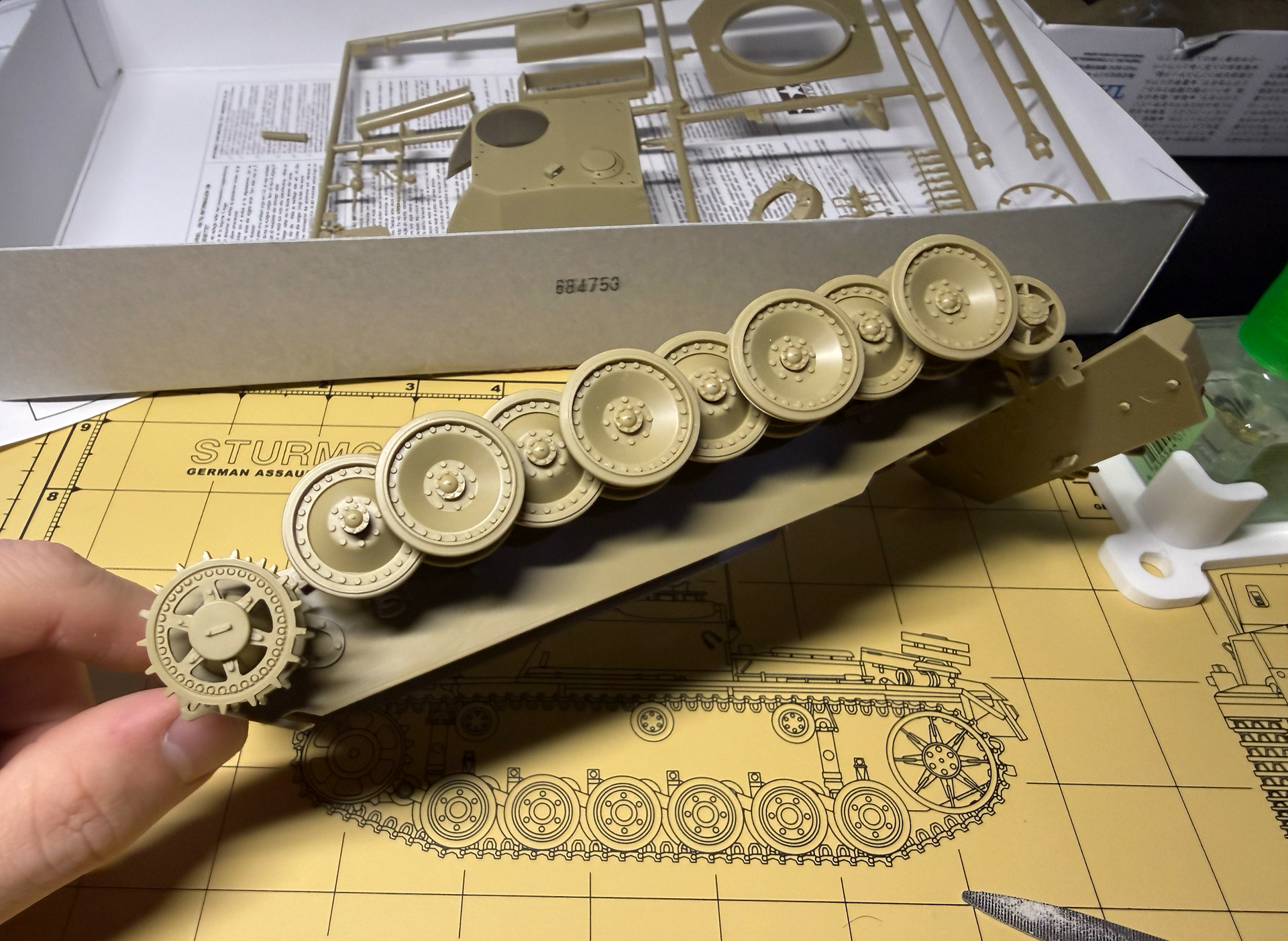
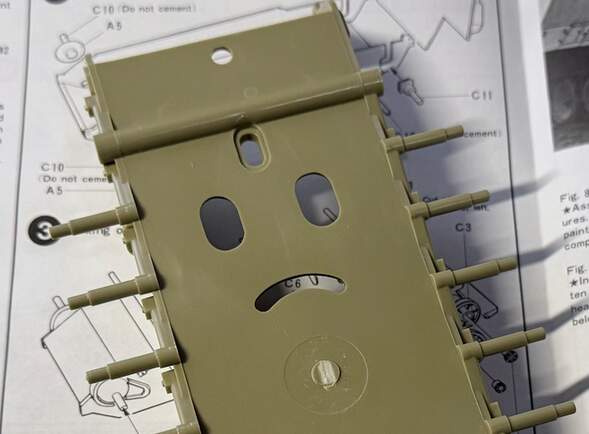
I don’t know why, but when I opened the box I immediately felt like I was looking at a really old model kit. And my research later confirmed that feeling - this kit has been on the market since 1968. Over the years they’ve added new parts and changed the boxing, but the core kit is still the same.It is kinda funny that the hull looks pretty scared to me :smiley:

For me as a total beginner, the kit looked okay, and I am a bit surprised that the part count isn’t very high. The instruction manual is kind of funny, because it has one single sentence in German: “Erst lesen dann bauen” (read before assembly) - but that’s the only German in the entire manual. So it was apparently important enough to tell the builder in German to read the instructions first… but then the instructions themselves are only in English.

The manual itself is okay, but I wouldn’t call it good. For example, in step 3 they reference part D1, but I couldn’t find “D1” anywhere. I assumed D1 was the lower hull, but the hull didn’t have a number on it. Later I discovered that on page 2, on the left side under section D, “1. Lower hull” is mentioned. In my opinion that’s just bad labeling. I know what a hull is, but someone new to the hobby with little or no military background might not know that right away.

Another thing that confused me was step 4, where the idler wheel has all the pins cut off. Why? Why didn’t they just mold it without the pins in the first place? Did they not know at the time that the pins were wrong? From my newbie perspective, that mold could only be used for this specific tank anyway, right? (Since it’s attached to this sprue.)

I stopped today at step 4. The build to this point has been pretty straightforward and not difficult. I’m not sure yet why the wheels need to be moveable, but I simply followed what the instructions said.

So far, the overall quality is okay. The parts are fairly clean and the fit is decent. I personally think there is a lot of room for improvement - even though this is my first kit and I don’t have anything else to compare it to yet.

Please share your thoughts with me and do not hesitate with feedback on my build or building process!

P.S. This text was written before I went for my one week vacation. I came back last night and will hopefully find some time this week to continue building.

13 Likes

A good first kit…it does have quite a few inaccuracies, but probably everyone in the armor building world has built this Panther at one time or another. Welcome to the hobby!

9 Likes

The kit does date from the late 1960s so don’t use it to judge more modern Tamiya offerings.

4 Likes

It is a great kit to dip your toes into the scale modelling world!

Accurate? mmm..not really.

Easy? Yes and can be made to look decent, while also gaining experience and have fun (key component)!

It was one of my first kits 40 years ago and it was my son’s first kits more then 15 years ago.

8 Likes

It is a LOT cheaper to edit the instructions (ink on paper) than to “edit” the steel tools/molds used to force molten plastic into shape.

The answer is here:


That kit was originally designed to have an electric motor powered by two C-size
batteries. Those holes are for the forward - off - reverse switch and attaching the motor and battery holder.

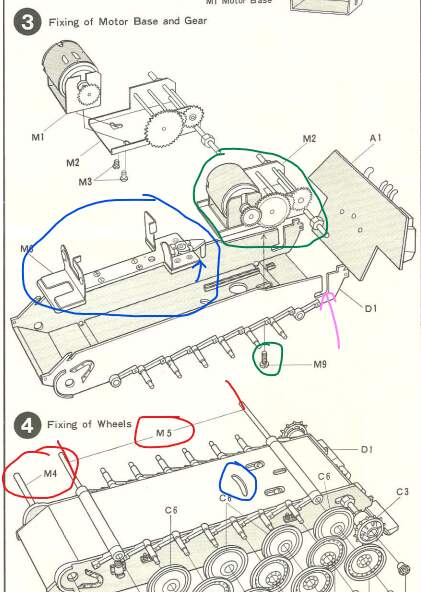
The instruction images below are from the 1969 edition of this kit.
Red: Metal axles to handle the force from the tight tracks.
Blue: Battery holder with switch and the curved opening for the switch
Green: Installing the motor and reductions gears
Pink: Slot for the metal axle from the “gearbox”

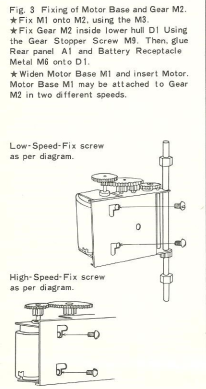
The electric motor could be attached to the gears in two different positions, high speed and low speed …

The width of the C-size batteries forced the designers to widen the hull (out of scale)

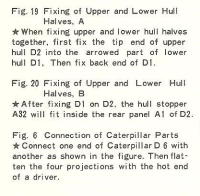
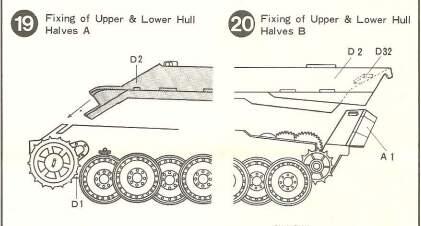
The upper and lower parts of the hull must be possible to separate since batteries need to be changed when they are empty …

10 Likes

Well. here is my two cents for what its worth… First welcome to building models. Second, for me, and I can only speak for me. The point purpose to building any and all kits is to have fun and enjoy the build. Whether or not the kit is any good fundamentally has little bearing on the overall journey. Now having said all that, I get it about that kit. I would bet most of the old timers like me, cut their teeth on that very same kit. If I was looking for accuracy, well that’s NOT the kit for that. If I remember correctly, the kit is actually 1/33 scale, speaking mathematically of course. BUT it was a fun build, I really liked it, that is until I learned more about building and accuracy.
Here is a little slice of experience, you can take it as advice or simply the ramblings of an older builder. I ALWAYS went after the vehicle not the company producing the kit. Example is and always will be, ESCI 1/35th Demag 1 ton Halftrack. A HORRIBLE kit for beginners. But a cool build once you know how to work the issues.
Anyhow, BEST of luck. Learning and Foul-up are part of the journey

7 Likes

Horrible kit. Period.
There are worse but not many …

Me too. Adding a bit of accuracy adds to the fun but the lack of accuracy does not prevent the fun of building & completing. Sometimes it may take a little longer …

4 Likes

Now lets not pick on ESCI lol they have (had) a consistent track record. They were all consistently horrible not just one kit but all of them. Like ARII consistently horrible unless they managed to finally make a descent model.

2 Likes

I so remember building a few of the Tamiya motorized versions in the 70’s. Tiger I, KT, HT and T-55 the last 3 had rubber tracks before they switched to vinyl. Accurate no, fun to build heck yeah! and they all had their little tube of Tamiya glue all you needed was some batteries and paint.

3 Likes

You clearly haven’t built their BMP-1 :slight_smile: Contemporary with Dragon’s effort, and having built both back then, I would take ESCI’s version over Dragon’s.

Yes, by modern standard they’re both not-great kits, but remember we’re discussing this in a thread about a Panther kit that’s about as far behind modern standards as you will get in 1:35 scale :slight_smile:

2 Likes

LOL yes Dragon does have its many issues and no you are correct I have not built the BMP-1 and doubt I will. Like I said I don’t know if ESCI improved and at the heart of it, it doesn’t matter. In the late 60’s and through the 70’s Tamiya did open up the 1/35 scale modeling, they weren’t accurate in hindsight but when you’re young boy/teenager that didn’t matter. They are still good beginner models to the scale and while I did berate ESCI they too are a good beginner models, we’re just getting crustier as we age.

3 Likes

The ESCI Demag is a real disaster.
I own two of them. The tracks can be replaced but the twisted bottom plate is hard to get straight.
Definitely not a job for a beginner (unless the beginner owns a golf club …)

2 Likes

Okay so not good for beginners without crushing implements or torches

2 Likes

Explosives or projectile weapons can be alternatives …

2 Likes

Hi folks,

Thanks to everyone for giving me some feedback! :slight_smile:

I did a really short “research session” on the kit after I started building because I had a feeling it was an older model. But I’m impressed by all the information you guys shared about the set (special thanks to @uncle-heavy with all the details!).

I had a feeling it was once a powered tank, but I definitely did not expect what the “face” was used for. That’s a really interesting and cool detail to know!

I also like the fact that it’s not truly a 1:35 model and that the details aren’t really accurate. Honestly, I didn’t pay much attention to the details yet. I’m not a Panther expert - I like the tank, but I don’t know all the small variations and historical differences (yet). Normally I like a lot of details and can’t stand inaccuracies, so knowing this tank is actually not 1:35 is itching in my brain pretty badly. That means this tank will never stand next to any other tanks in a display… :smiley:

.
Further Thoughts

I was wondering how many of you still have your first tank - or your “newly first” tank after returning to the hobby? I’m also curious to see other people’s Tamiya Panther builds. I assume there is already a thread somewhere showing these models, so I’ll do some searching. :slight_smile:

During my vacation I caught myself thinking about scale modeling every now and then and “what to build next.” I know, I know… I haven’t even finished this build yet and I’m already thinking about the next one. But the reason was mostly about how I should approach my research in order to find the right kit and the right manufacturer for my next project.

I know about Scalemates and I like using it, although I’m not sure how to determine “what is the best kit” that isn’t extremely complicated for a beginner but also not something like the kit I’m currently building right now. As some of you said: it’s fine to dip my feet into the hobby with this kit, but I know it won’t make me truly happy.

Another topic that kept running through my head was:
Do different model kits use different plastics? Or in other words: are some kits easier to sand than others? The kit I’m working on seems pretty “hard to sand.” My sandpaper clogs up quickly and it barely removes material. If I use rougher sandpaper, I end up with visible grooves and scratches.

So I’m wondering:

  • Is this “bad sanding experience” just because the kit is old and uses older plastic formulas?
  • Do you guys have any tricks or tips when it comes to sanding?
  • What is the best method for really small parts that are hard to hold? How do you keep control while sanding such small pieces, especially when the plastic itself is so hard?

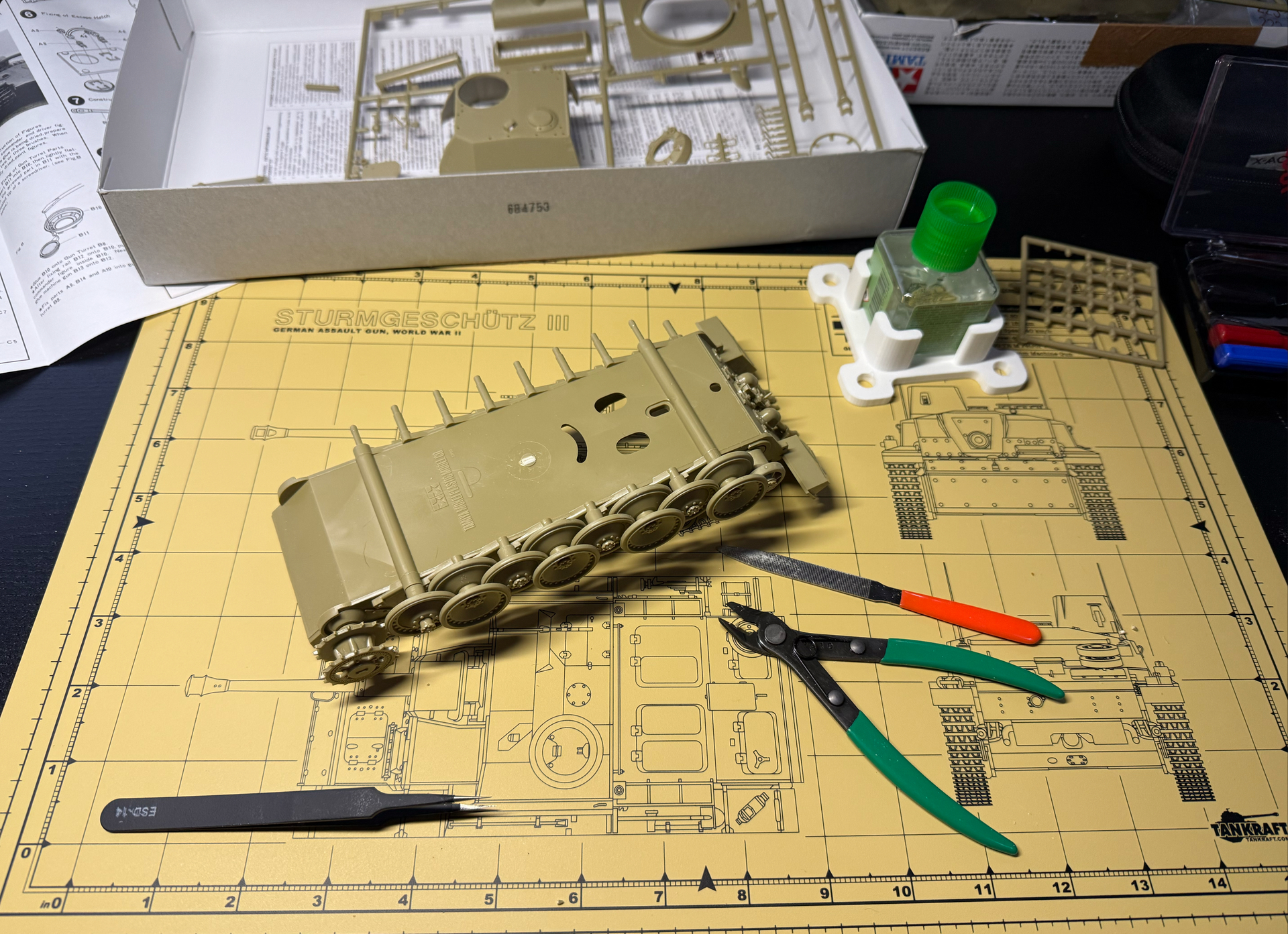
I tried using a file (you can see the one I’m using in the second photo), but as I mentioned, the plastic feels really hard to sand. I also tried a sanding stick, but that didn’t make it any better. I’m pretty sure I’m doing something wrong, so I’d be happy for any tips. :slight_smile:

By the way, I’ve seen photos of people washing or rinsing their kits with water before building - what is the goal behind that idea?

1 Like

I do, they are all in the display cabinet (tanks, trucks, jeeps, artillery), more than 200 of them.
There are also some half finished kits on the Shelf of Shame, someday when the time and motivation is right …

Use it to practice building and painting.


Ask here. There is a lot of combined knowledge and experience among
the members of these forums.


Yes. They do. Some of Trumpeters first kits used some polymer that none of the glues/cements/solvents that we use would work.
Some plastic is hard and brittle, some is too soft. It is a learning experience …
To some degree it depends on the pigments they use to colour it. Some have filler materials to reduce the amount of expensive styrene. One kit in my stash feels like it has been molded of very hard soap, uurgghhh …

and soap or dishwashing liquid, make sure to rinse it thoroughly with water.
Some even use alcohols to get rid of the last molecules of grese/fat …

Remove dust from sanding/filing, remove mold release agents (grease) from the factory, remove grease and fats from our fingers. It depends on which paint we use, some paint types absolutely require a clean and totally grease free surface.

Sanding/Filing.
Use a stiff brush, old toothbrush for instance, to remove the dust from the file.
File in one direction. Sandpaper: try using less force.
Grease will act as glue and make the dust stick to the file.
I prefer the files since they give me more control.

Small parts: I leave them on a small piece of sprue for as long as possible.
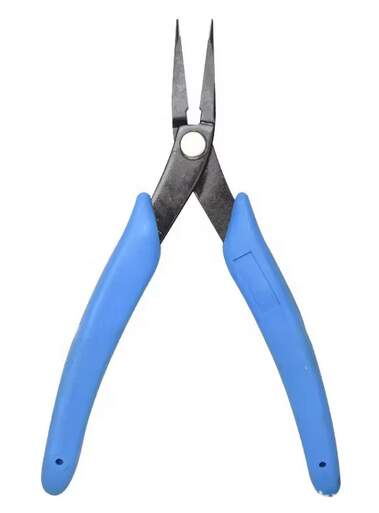
Flat nosed pliers can hold small parts with less risk of “tweezer launch”.
Something like this:


Look for narrow jaws to be able to hold small parts.

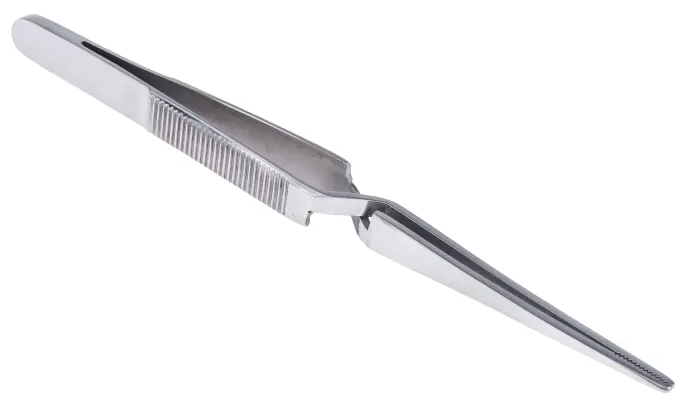
There are also “reverse tweezers” where you apply pressure to open them.
These also reduce the risk of launching parts into a different dimension where they
will only be found when the model is finished …
Many different designs, this is just the general design:


There are also those with thermal insulation on the handles to hold parts when soldering.

Files: Look for sets of needle files, there are many different shapes and some are quite pointed to allow filing in tight corners. Finer grade files make it easier to file small parts, less risk of the small part getting caught in the grooves of the file.

3 Likes

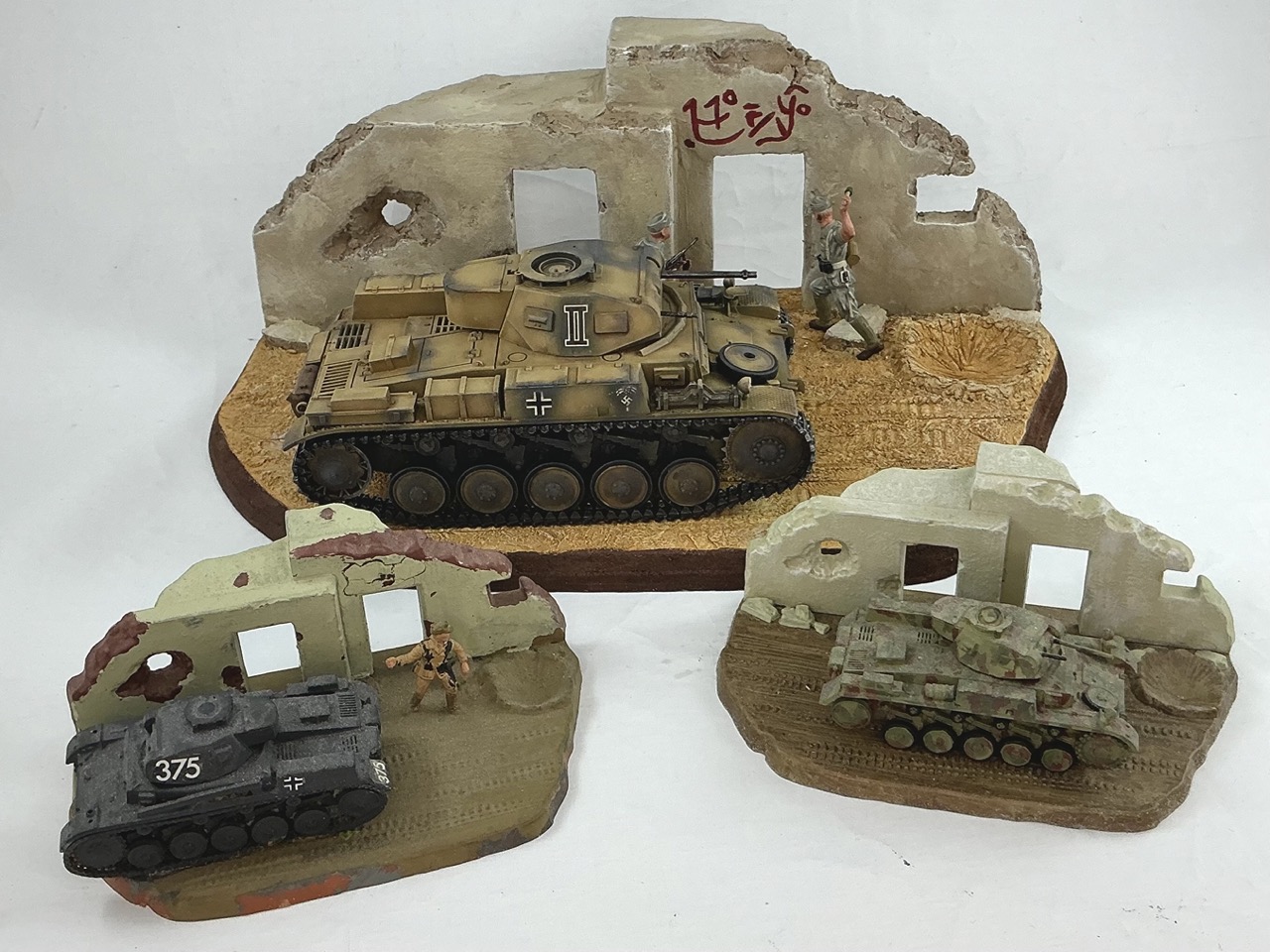
My very first tank kit, built when I was probably seven or eight years old in the early 1980s, is the small diorama at the left front — that is, the Matchbox 1:76 scale Panzer II. I painted it some years later, which is why you can see the outline of the decal on the ruin under the paint above the right-hand door.

The small one at the right front is a Revell reissue of that same kit, that I bought and built (but never quite finished) maybe fifteen years ago.

The large version is a scaled-up copy of these, using the equally ancient Tamiya Panzer II, a piece of plywood for the base and styrofoam for the building, both covered in wall filler. More photos here :slight_smile:

8 Likes

This is really cool

3 Likes

Assuming you’re talking about my Panzer IIs: Thanks :slight_smile:

1 Like

Just noticed that somehow the rest of my comment isn’t there :person_facepalming:

This is really cool the way you have upscaled the original mini diorama.

I don’t think it was my first but the Panzer II dio was one of my early armour models.

2 Likes