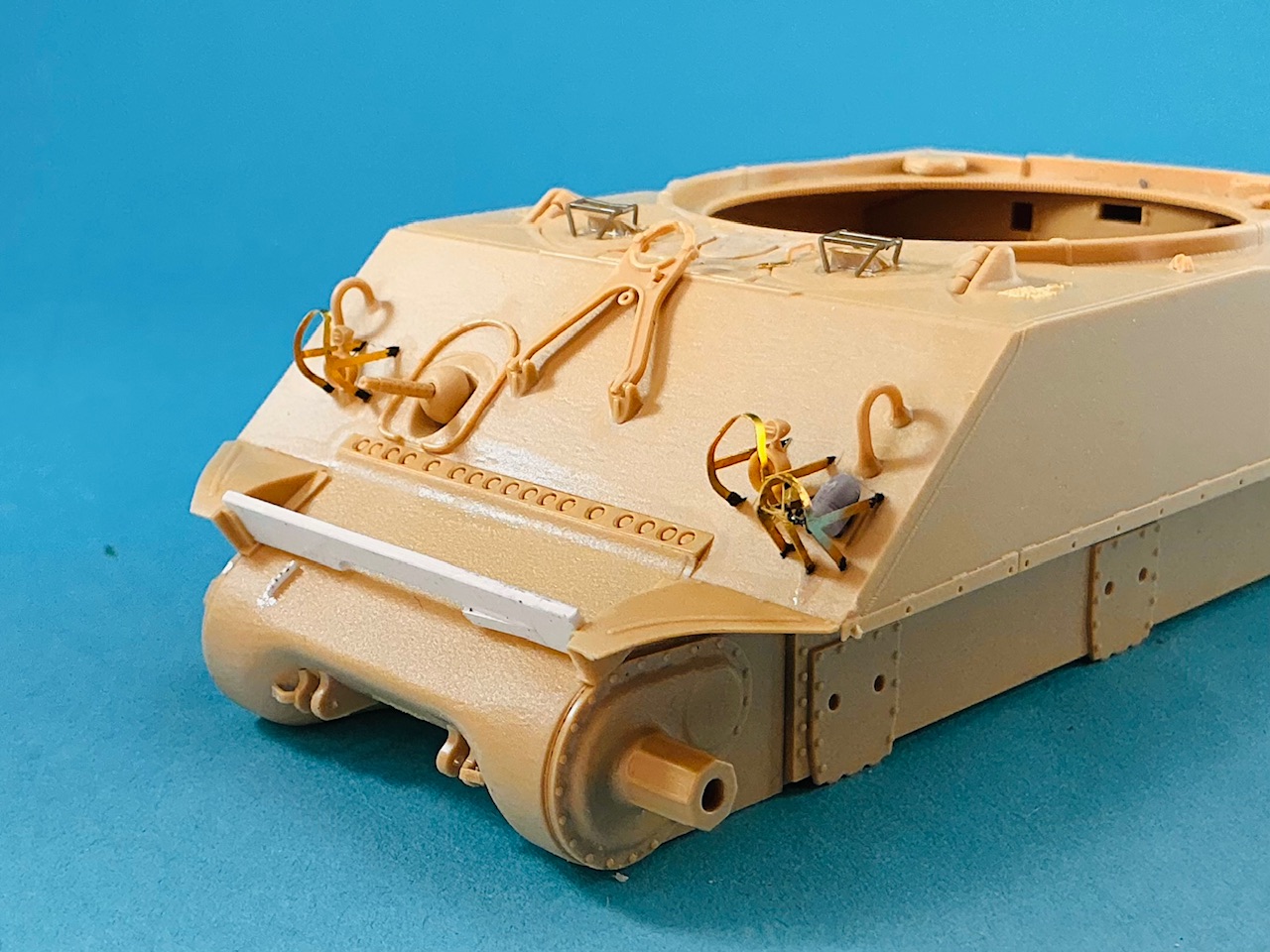
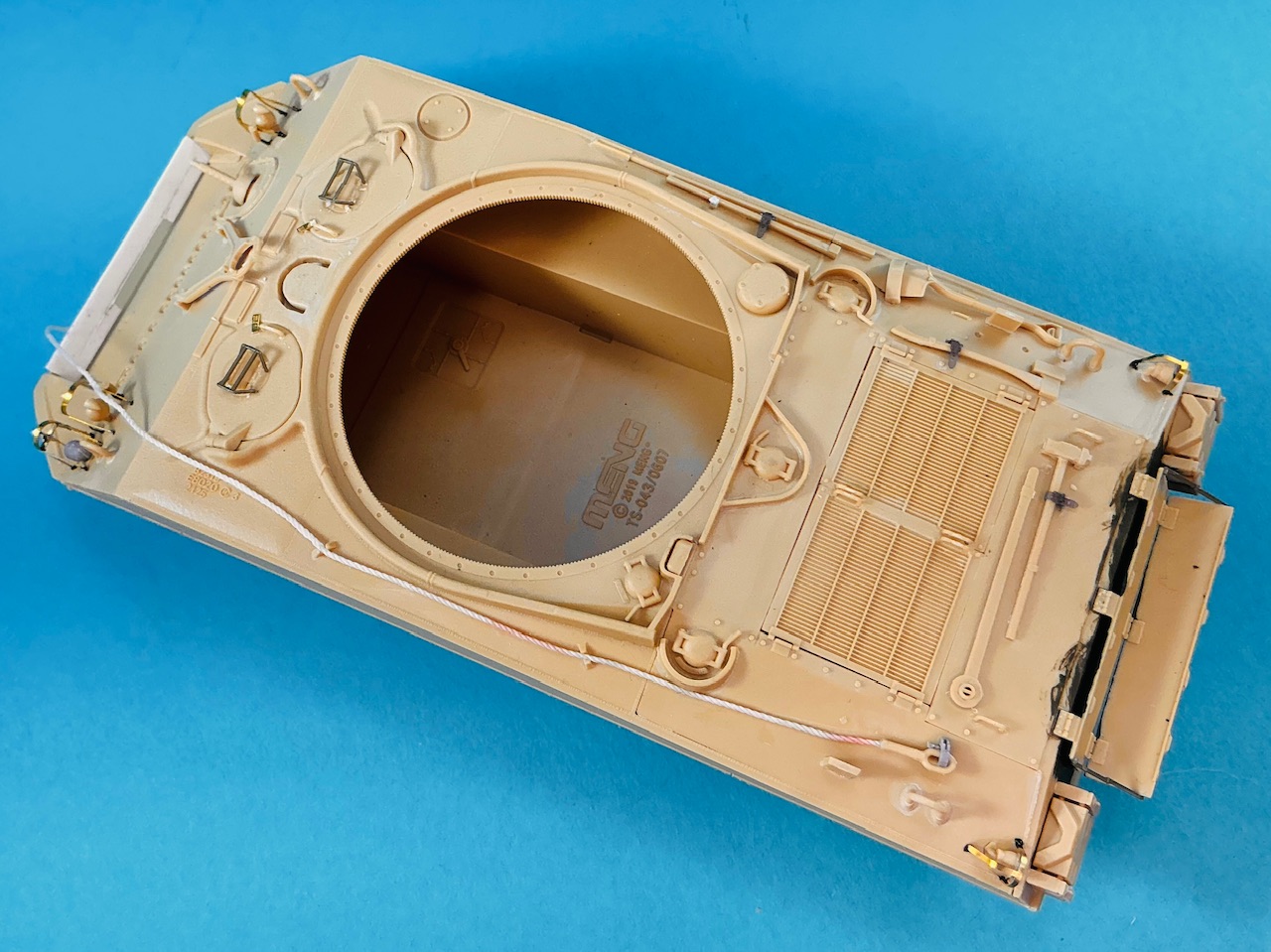
Quick, Champagne!

Now that the Dutch Army M4A1 Sherman, that I was planning to build as a quick change-of-pace model, is suddenly impossible because of a missing sprue, I delved into my loft insulation to see what other uncomplicated things I have there to build. The first thing that caught my eye were two Carriers, a Universal and an MMG, that I bought recently, but after browsing their instructions I didn’t feel like building either of them just now, mainly because they look like they’re much more work than I want to do at the moment. I then considered an early Asuka Sherman at El Alamein, but eventually picked this kit after a good look through its instructions and sprues:
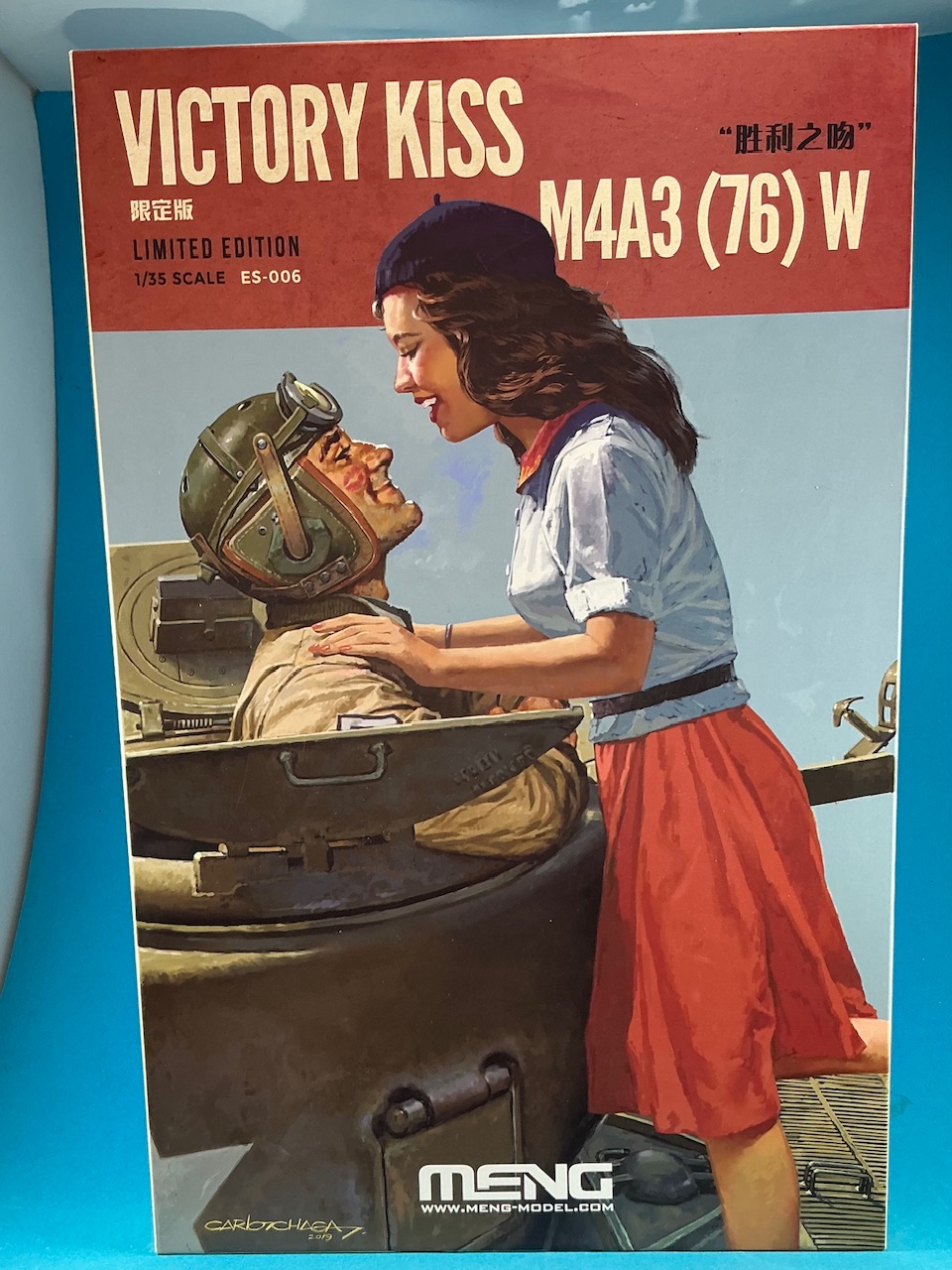
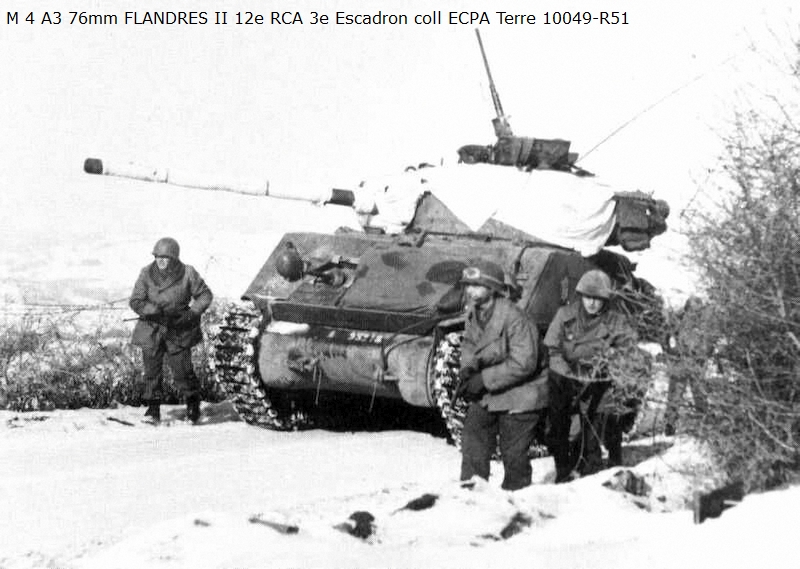
Meng’s M4A3 (76 mm) VVSS kit. I bought this second-hand a number of years ago and soon hit on the plan to make it into Champagne, a tank of 3rd Squadron, 12th Régiment de Chasseurs d’Afrique in 1944. This tank still exists: it was hit and burned out on 13 September 1944 near Ville-sur-Illon in France and turned into a monument after the war, including the damage it sustained.

I’ve got the following accessories with the kit:
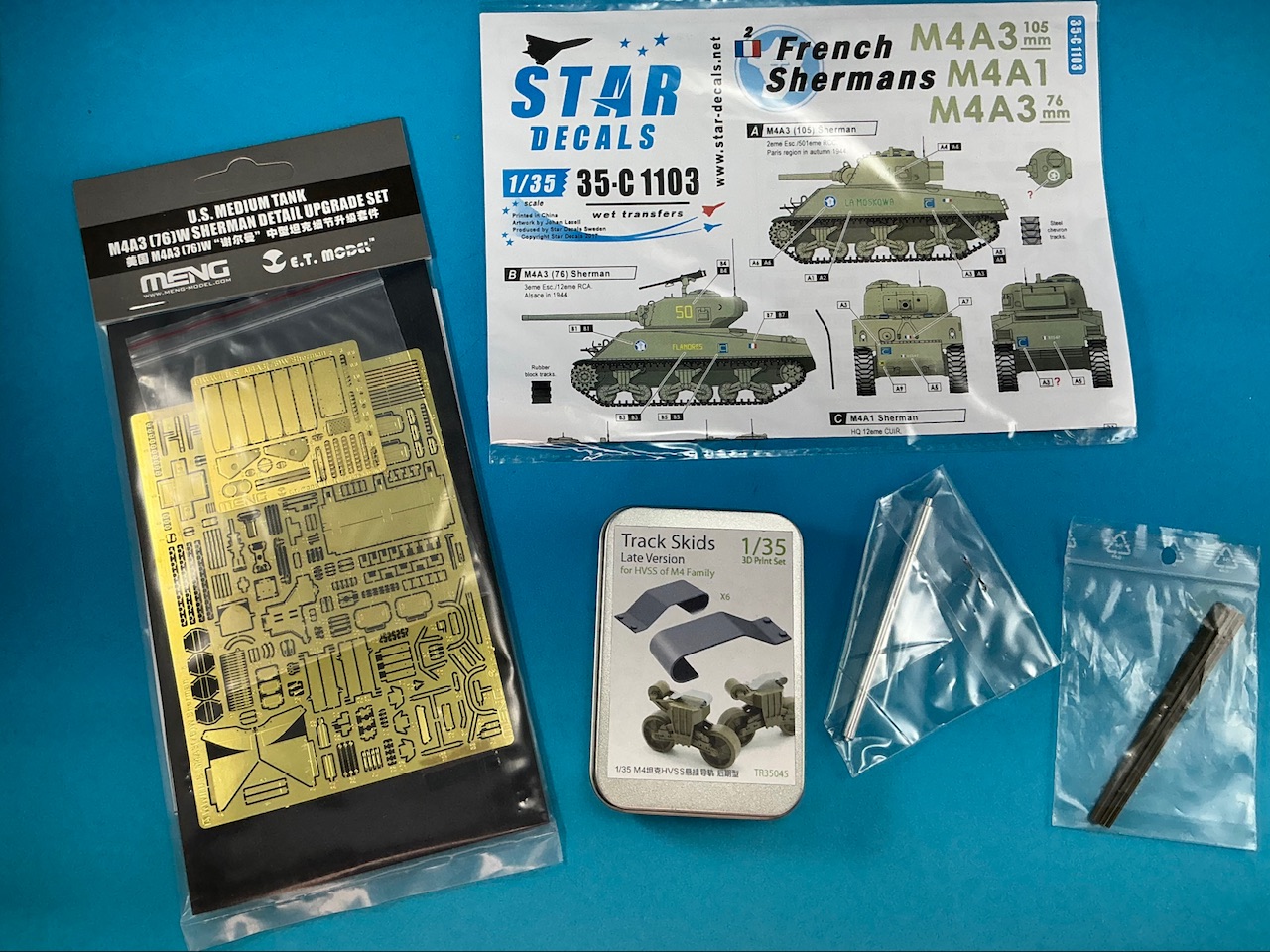
The set of decals at the top has the necessary markings for Champagne, and I purchased them straight from Star Decals. The etched set is, I think, normally bought separately but it was in the box when I got it, as was the aluminium gun barrel that isn’t mentioned in the kit’s instructions. I don’t need this barrel, though, because Champagne had a barrel without thread on it to mount a muzzle brake, which is why the other bag has such a barrel from an Asuka kit. The track skids are 3D-printed parts and come from a big box of Sherman parts that I bought from someone else a few years back. I’m not sure if I’ll use them, but I already know that the etched set won’t be.
8 Likes

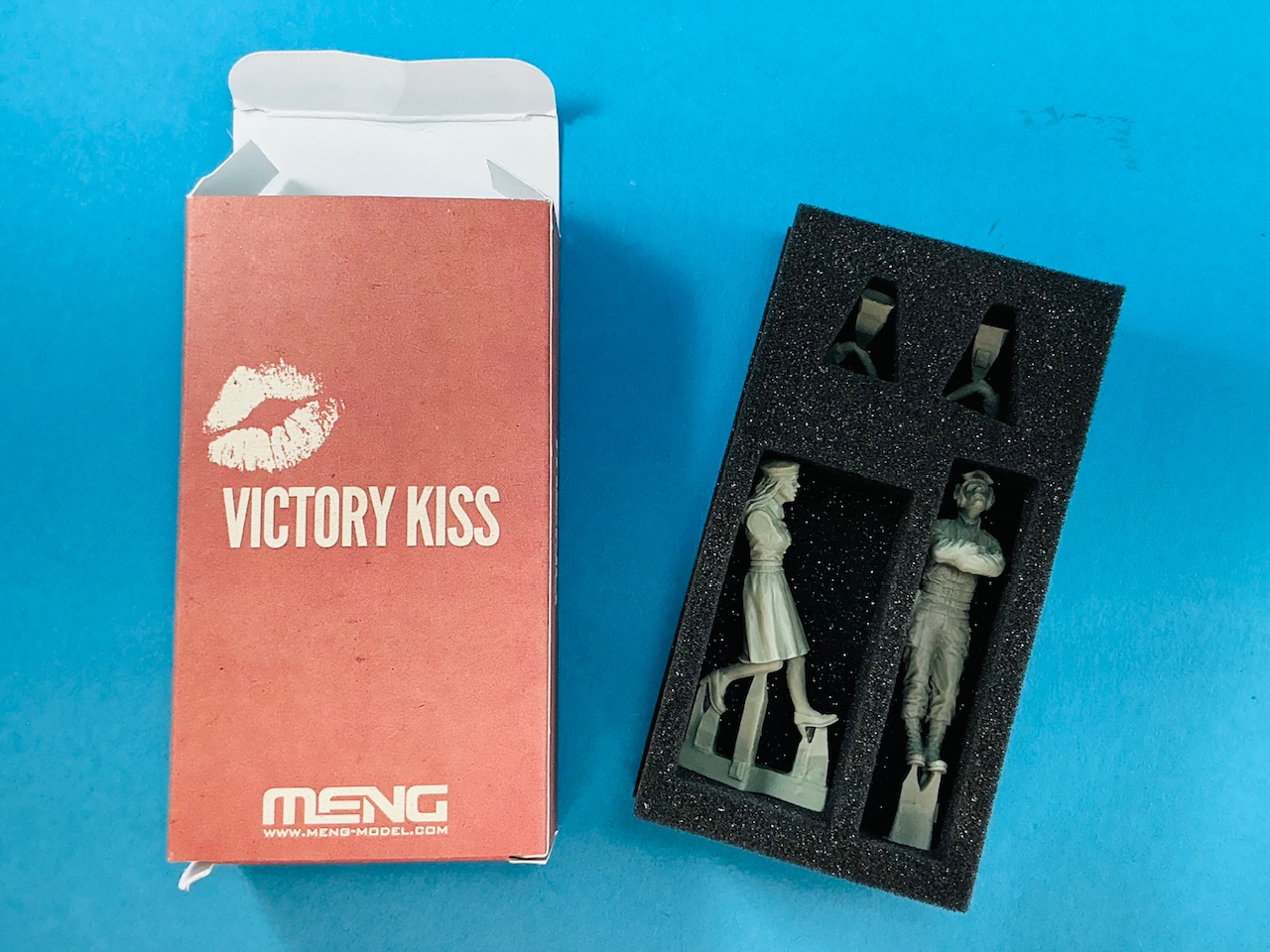
Something I’ve forgotten to mention: the reason this kit is called Victory Kiss. This is because it includes:—

A figure of a tank commander and a French young lady who likes him better than the Boche she has had to look at for the last couple of years.


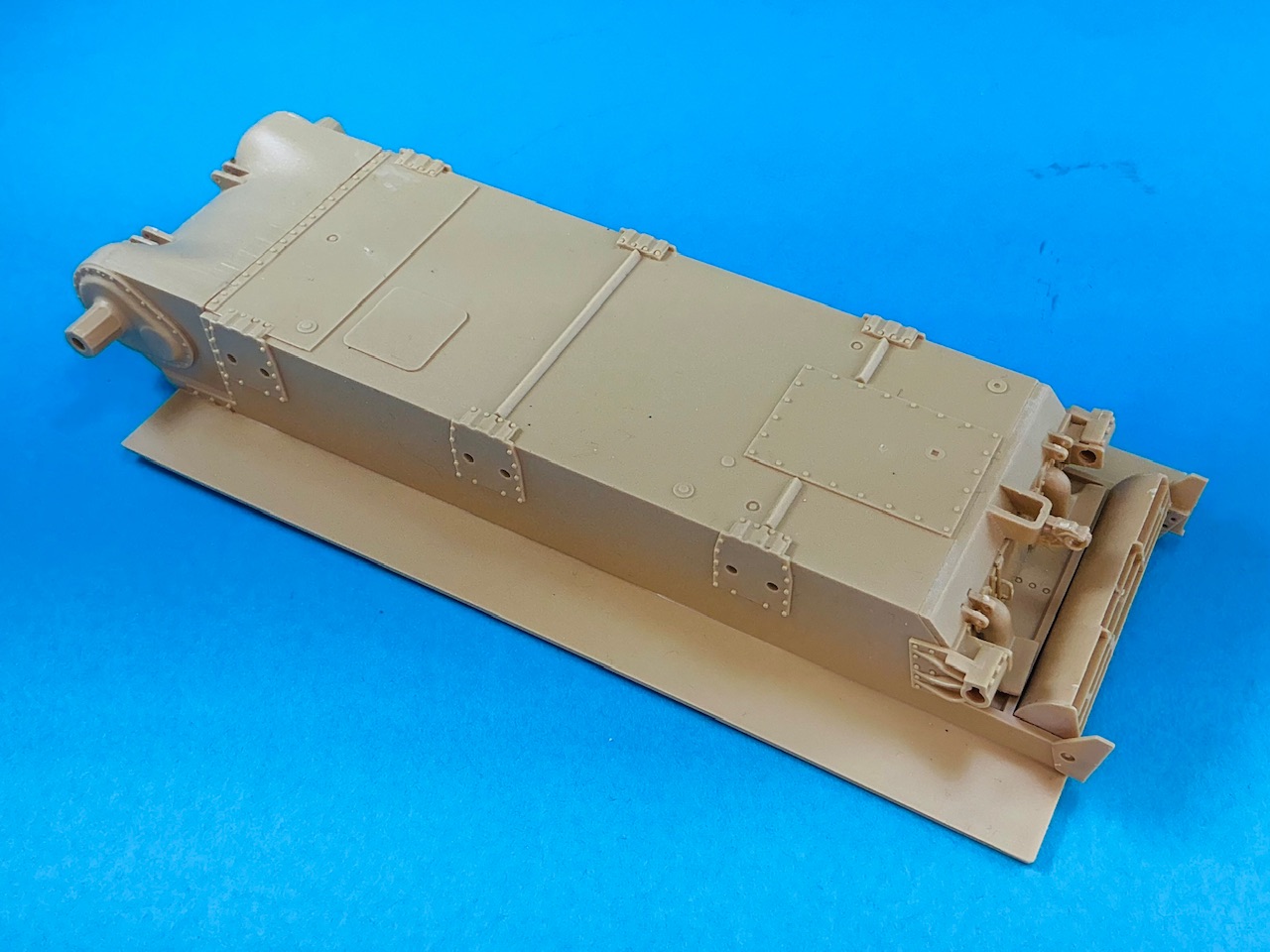
Anyway, I treated myself to Champagne tonight. For the most part, I’ve followed the instructions:

Only the pins for the tow shackles and the idler wheel axles are missing here. The exhaust deflector can also be folded up:

On the real tank this was necessary to be able to open the engine access door. After taking this photo, though, I glued it in the “down” position, because I don’t intend to build a diorama showing engine maintenance :slight_smile:

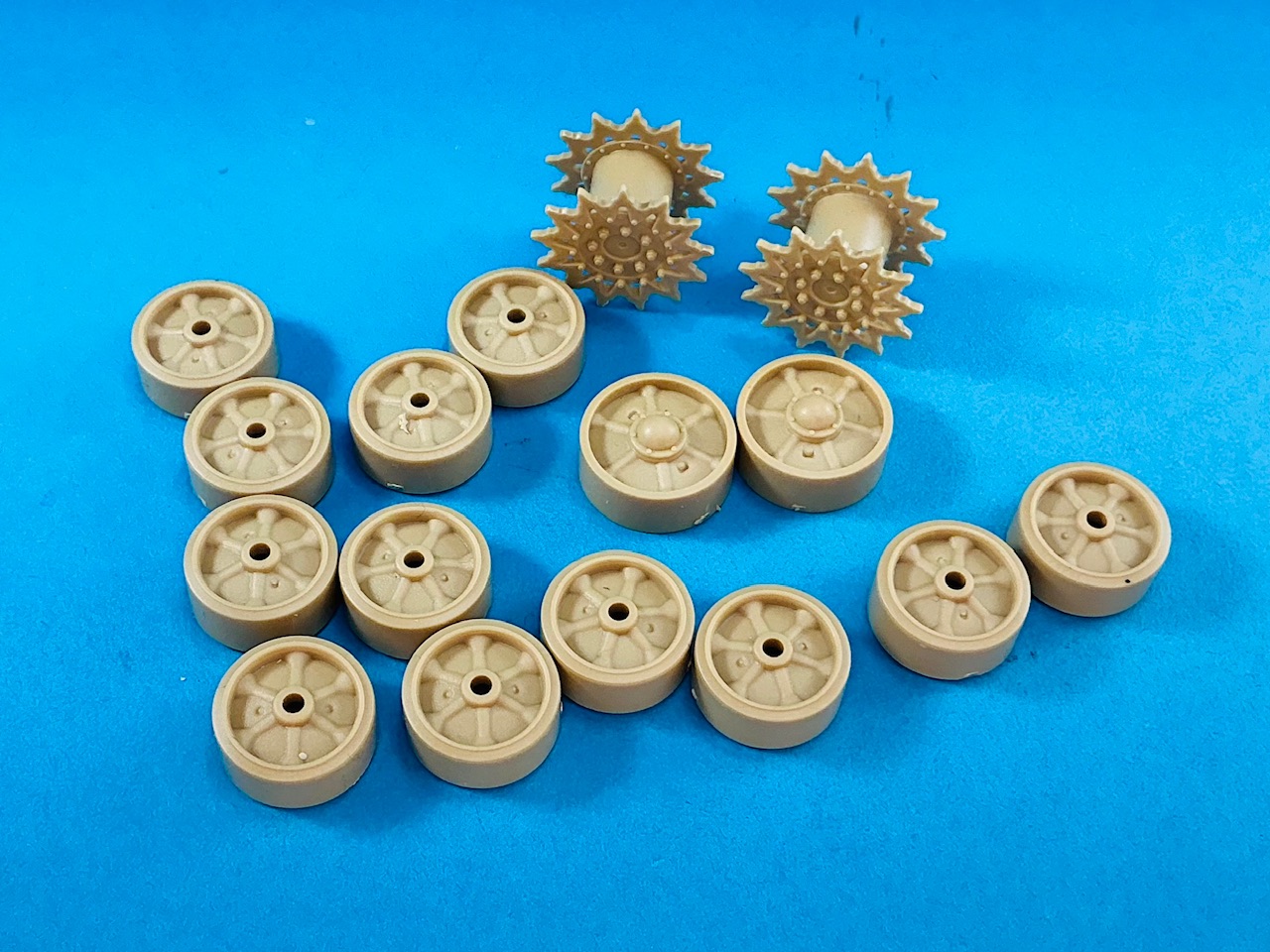
And the wheels:

Unlike Asuka’s, they don’t have a seam running down the middle, but they do have an unnecessary feature in that there’s a locating lug to ensure the spokes on the inside and outside line up. Except they didn’t on the real wheels, AFAIK. My only real (minor) complaint is that the idler wheels don’t have a folded-over rim, but because I don’t have any on hand that do have this, I’ll leave them as they are.

6 Likes

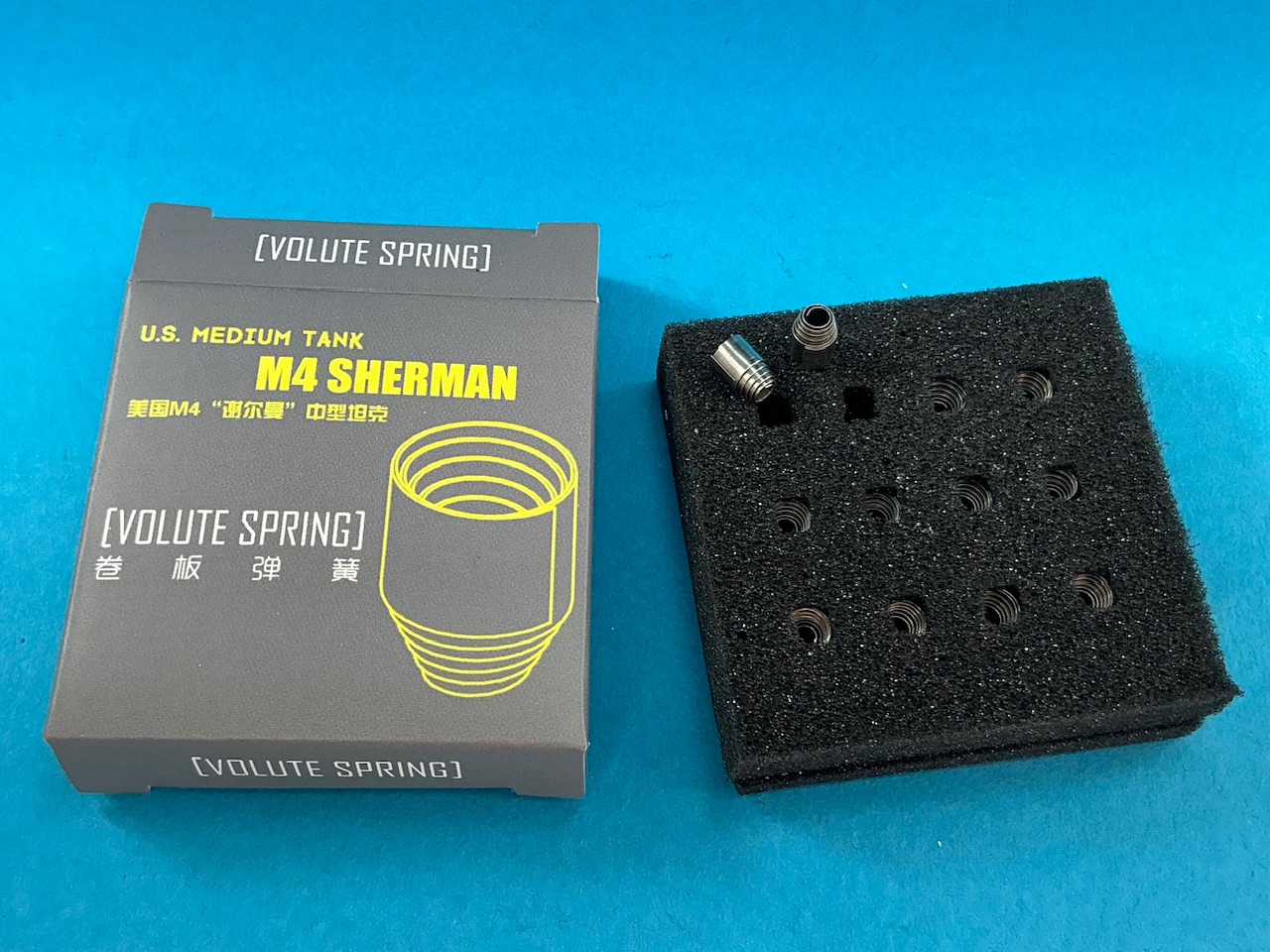
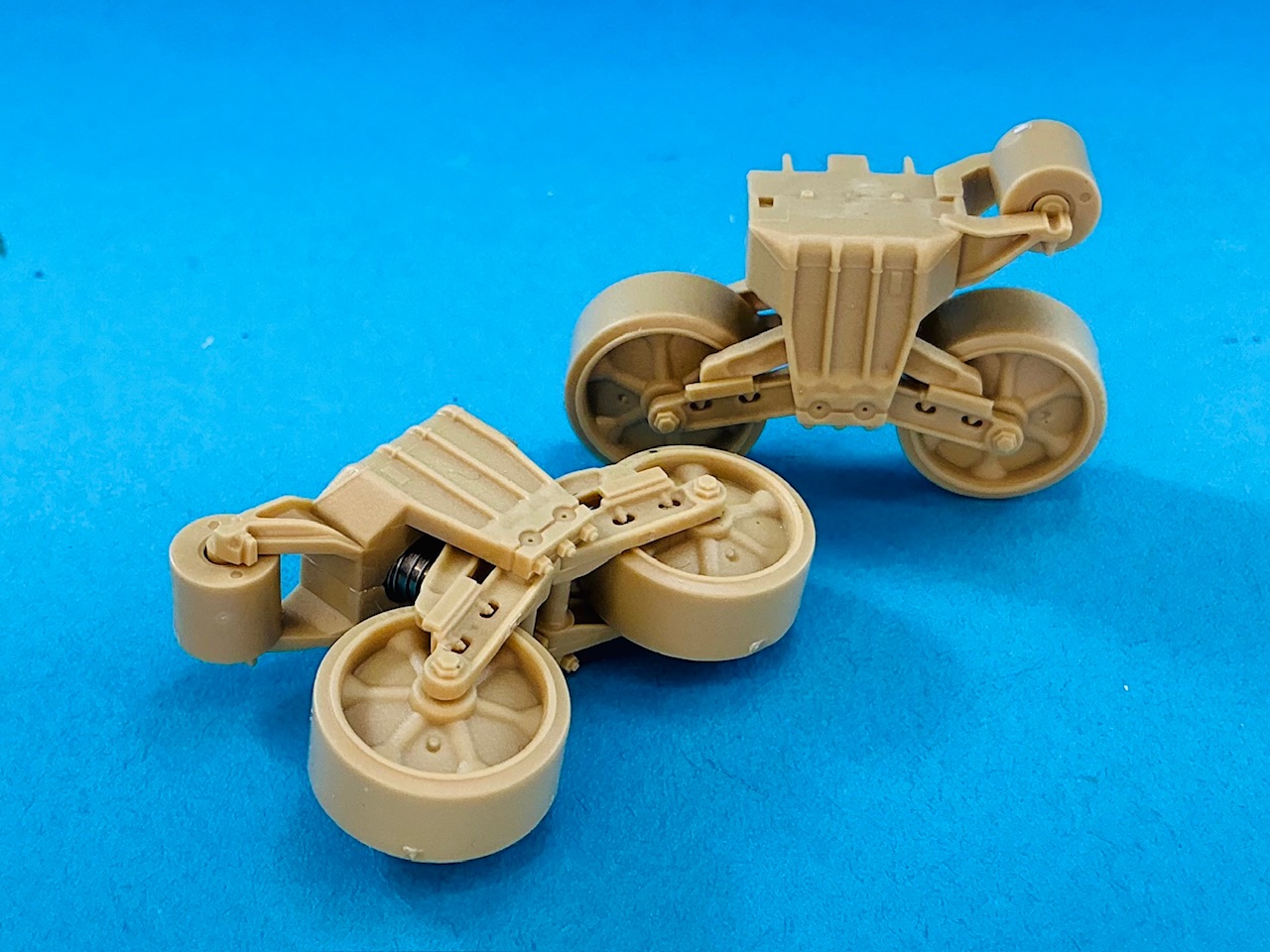
On with the bogies. Tamiya has them moulded solid, Italeri’s (and therefore Dragon’s) pivot but not like on the real thing. Asuka has fully working ones with foam rubber for springing action (or plastic parts to lock them solid), RFM copies that but with coil springs instead of foam rubber (and no “official” alternative if you don’t want those). Meng takes it a step further still with:—


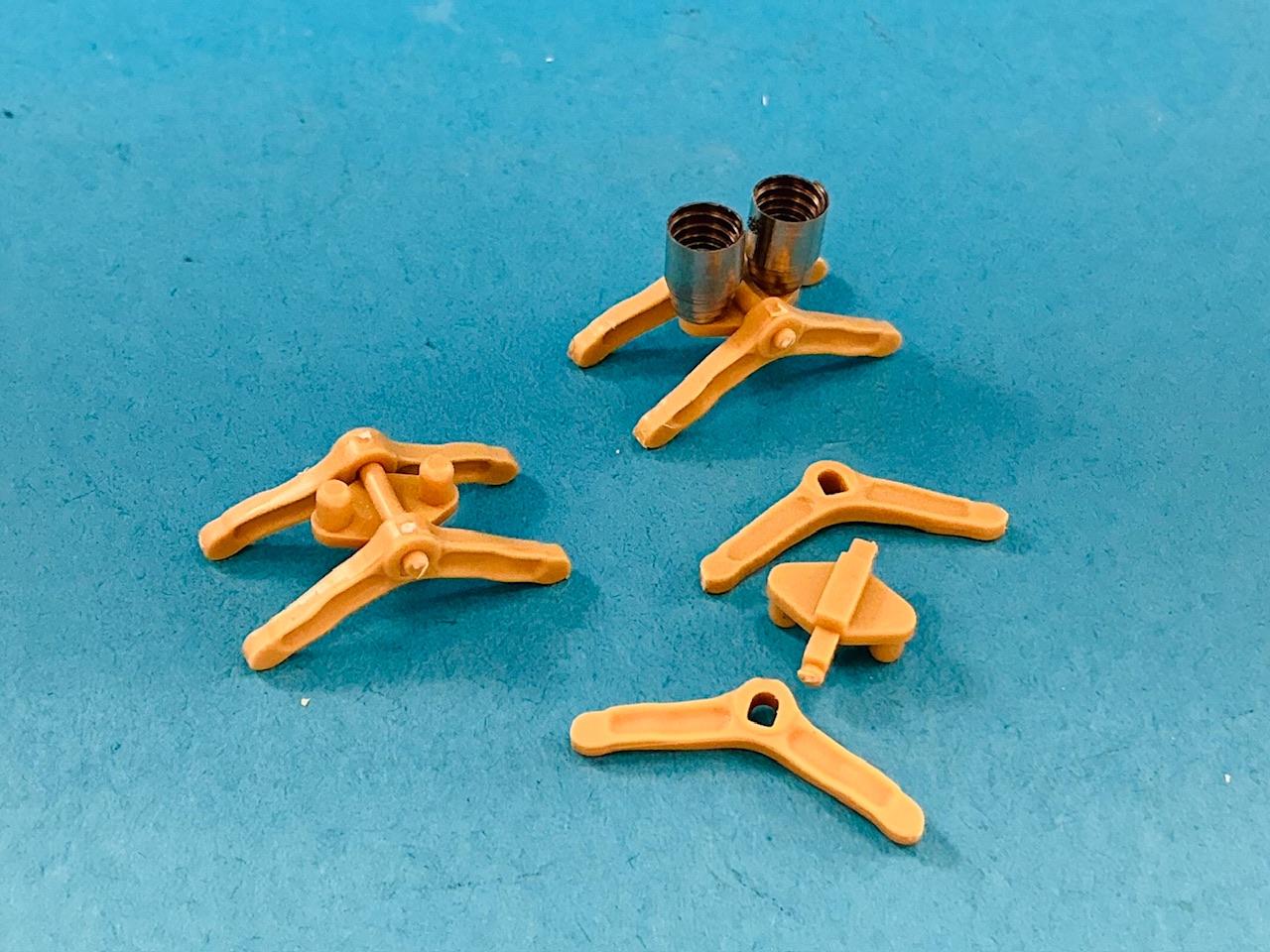
… springs just like on the real tank. They look like this once the bogies are assembled:

This is all well and nice, but I mostly find it pointless. At least they’re in the right attitude for a “loaded” tank, but making them sprung in for a heavily laden tank or to follow a diorama’s contours will be difficult, I suppose.

Champagne had bogies with upswept return roller brackets, photos show. For those who aren’t well-versed in Sherman details:

Meng supplies both flat and upswept brackets. The instructions tell you to use the former, but nothing stops you from using the other one instead. Just don’t mix them on a bogie :slight_smile:

9 Likes

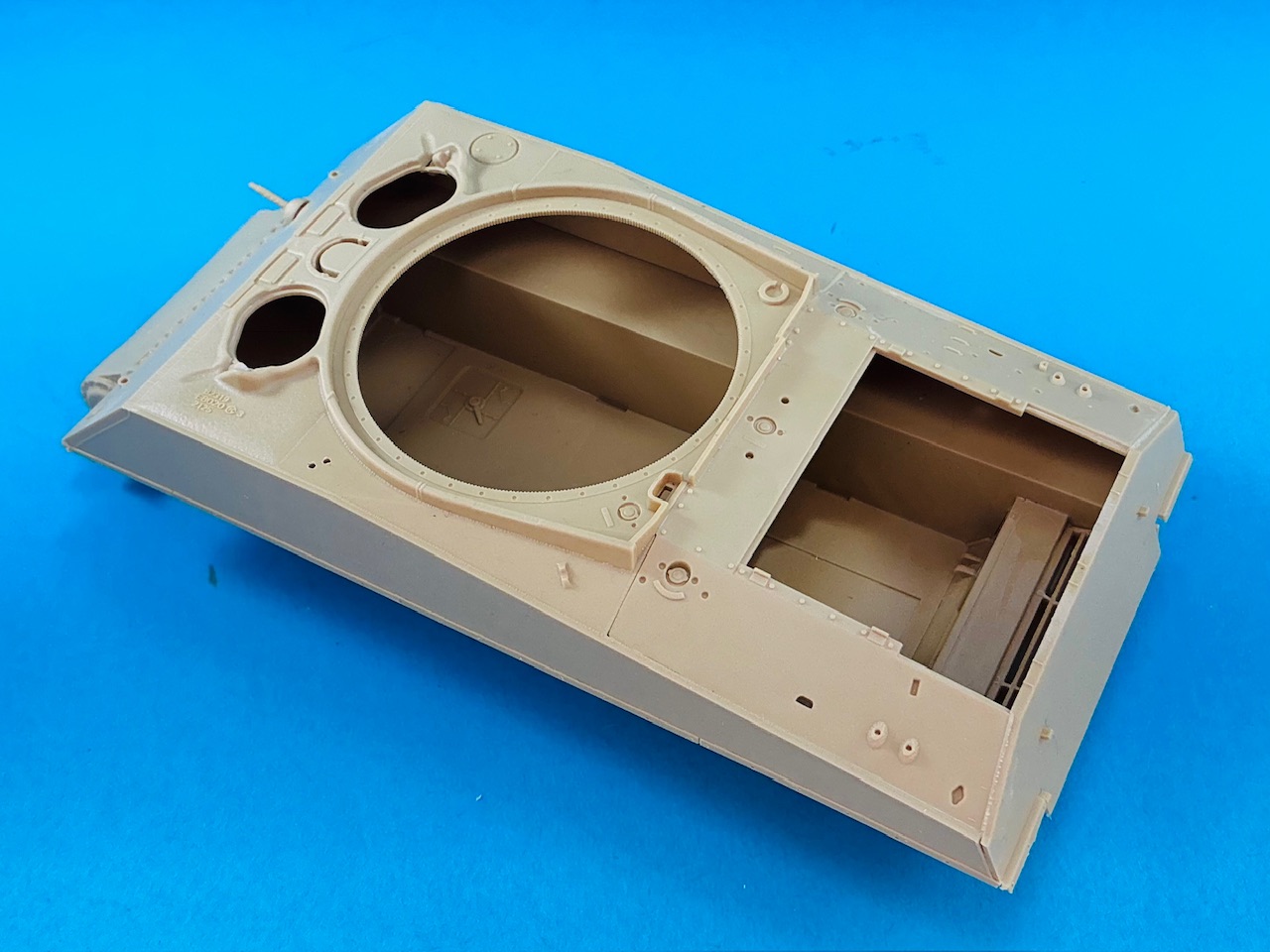
The upper hull is now attached to the lower:

There are a few things to note here if you’re building this kit, too. The rear plate is a separate part, and I had glued it to the upper hull first with the idea that this would make it easier to get the upper hull properly on the lower. But it doesn’t work that way. The rear plate doesn’t fit that well on the upper hull and comes loose easily while the glue is still soft. But without the rear plate, the upper hull falls over the lower. The solution is the firewall, which I had intended to leave out as being unnecessary, but by fitting it anyway it will support the upper hull in the correct position. Only install the rear plate when the upper hull is correctly in position, but before the glue on it dries.

The strips for mounting the sand shields, along the bottom edge, are moulded with the upper hull, which avoids faffing about with etched strips. However, the holes for the bolts on the real thing are moulded only as shallow dimples, so I drilled them through.

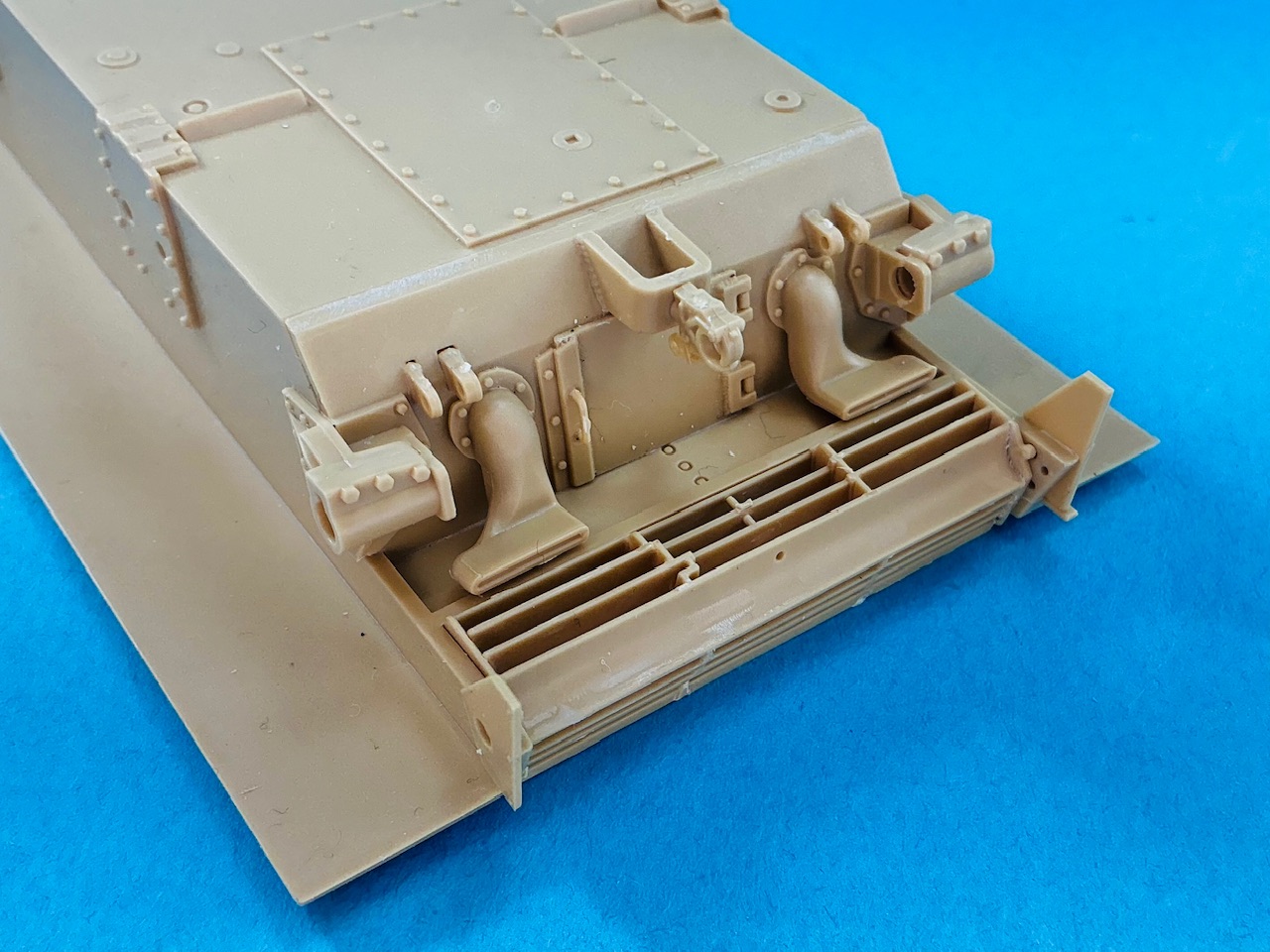
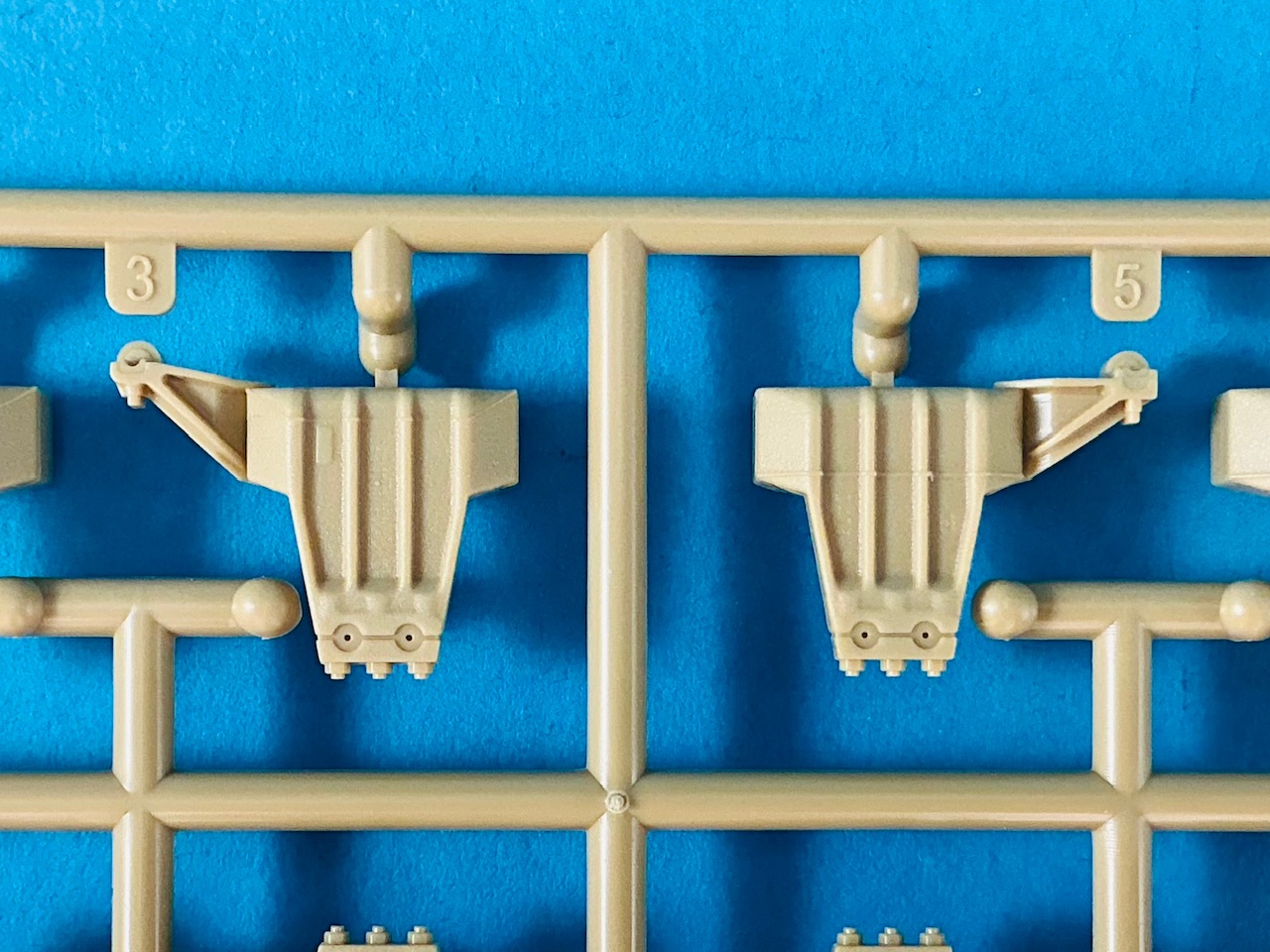
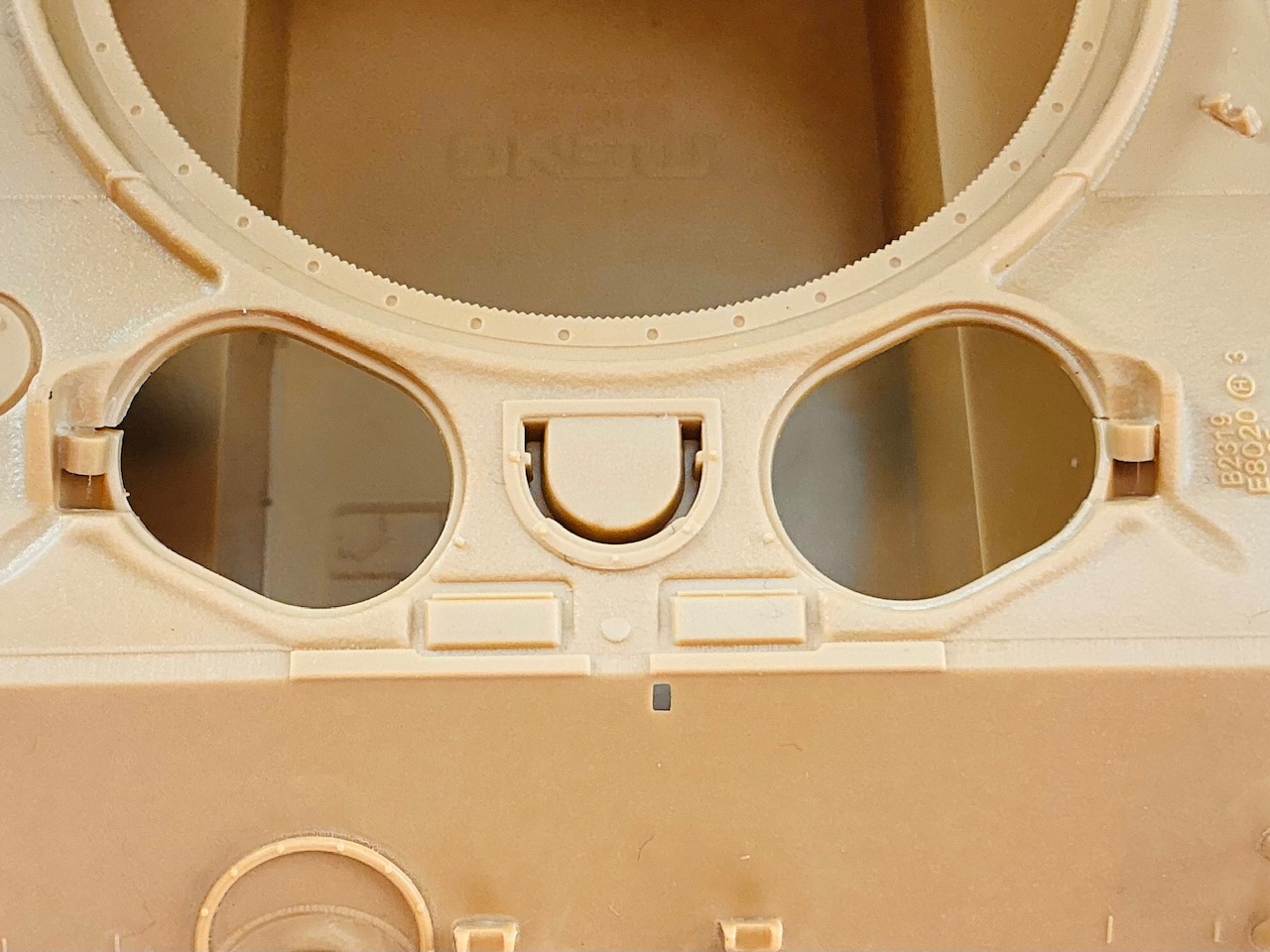
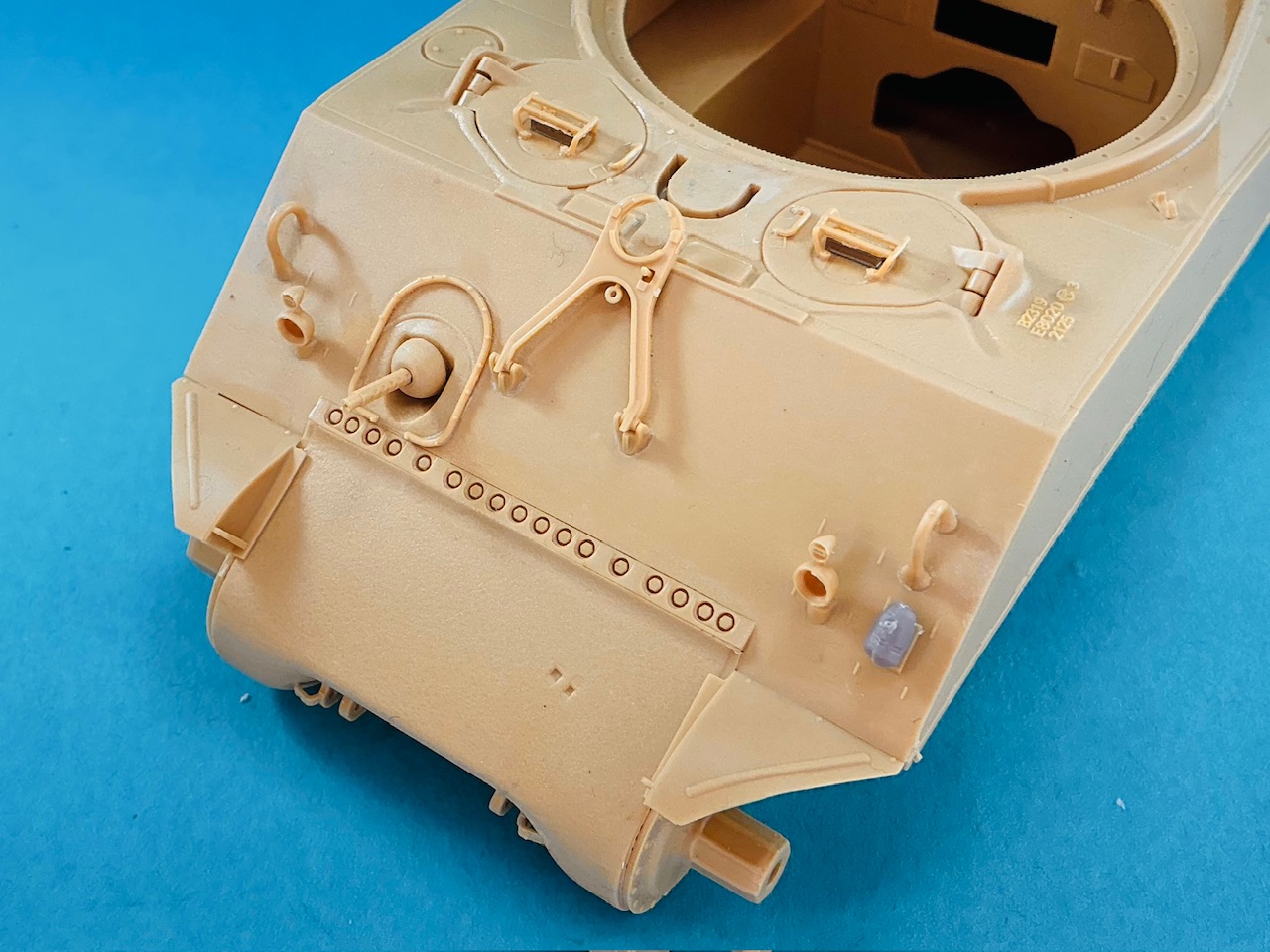
At the front, between the hatches, Meng supplies a rain cover and mesh for the U-shaped ventilator opening, but Champagne was a very early M4A3 (76 mm) tank, and those had neither rain cover nor mesh over it. A slight snag with leaving them off is that the mounting strip for them is moulded to the hull:

Time to chisel, cut and scrape it away, then, followed by some liquid cement and a stiff, old brush to add some casting texture (as the whole upper plate here is a casting):

I then added most of the details on the glacis plate:

The kit includes a horn, but just visible in the photos of Champagne in 1944 is that it had a siren. I found one of those in my Sherman spares box, which I think comes from RFM’s Sherman VC kit. The brush guards over them will come later, as I didn’t feel like bending etched parts tonight anymore :slight_smile: For the periscope guards, I used the plastic parts — though the kit includes etched ones, those are too flat: the real ones were made from steel wire.

O, BTW, I had a hard time fitting the assistant driver’s hatch. I suspect this is because the hinge for it (which is installed from below) didn’t fit well either, and that may have caused me to set it slightly wrong. Only after I pressed that part down a little with the tip of some long-nosed pliers (because the glue had already set) did the hatch want to fall in its proper place.

For the Shermanophiles: the hooks for the tow cable, on the hull roof, are next to the turret ring (just visible on the right in the picture above) and not next to the driver’s hatch. This is again because Champagne was a very early M4A3 (76 mm). They were moved forward on later tanks.

7 Likes

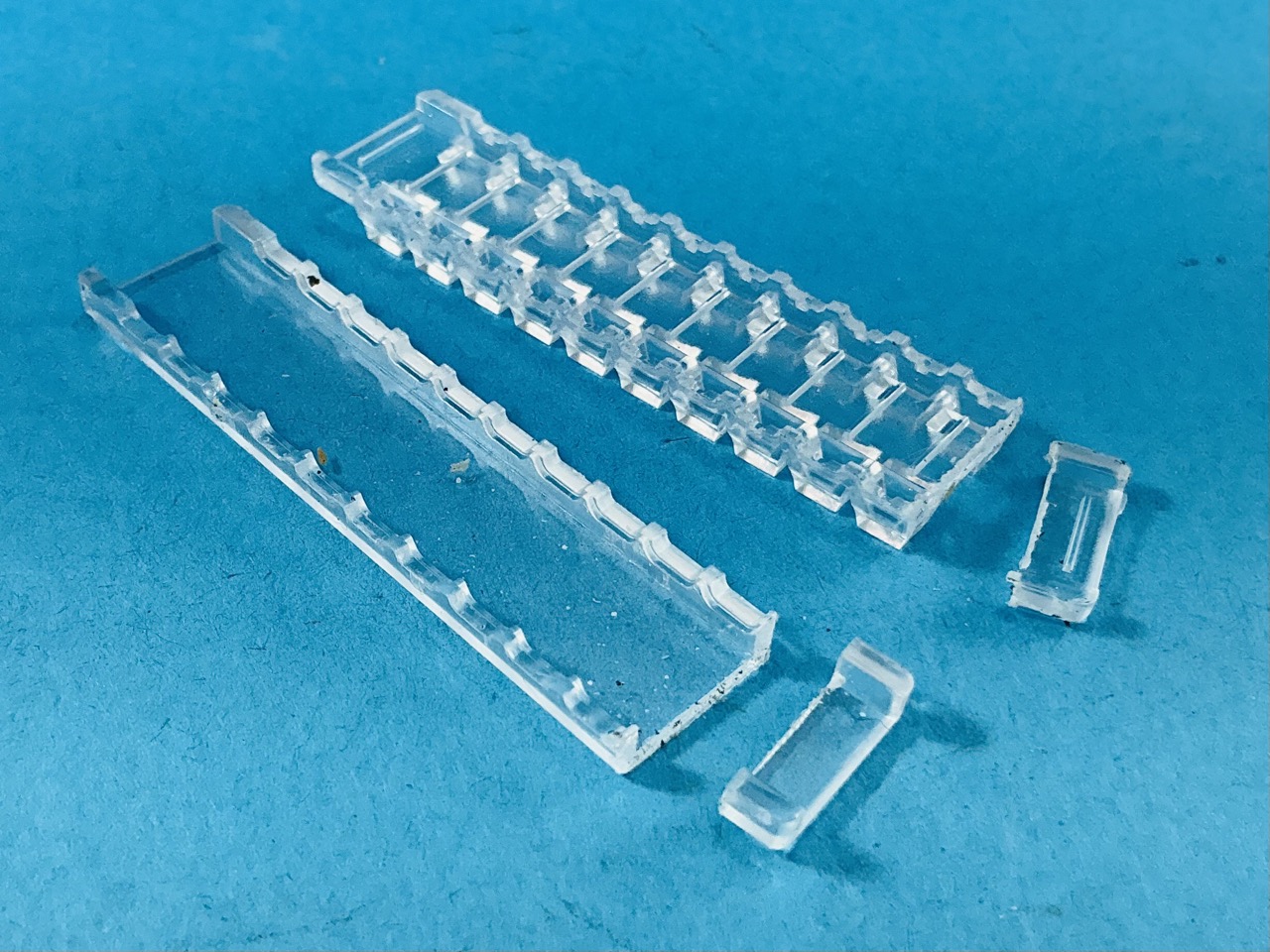
Today, I started on the track, Each link consists of six parts: the block has an inner and an outer half, there’s an end connector to go on each side and everything hinges around two steel pins. Those are supplied already cut to length, which makes things a lot easier, and there’s a two-piece jig to put together nine blocks and ten sets of end connectors. Easy.

Except for that one little sentence in the instructions:

That turns out to not be an unnecessary tip. This whole track is a great big missed opportunity …

Had they made the holes in the end connectors slightly smaller, or the steel wire slightly thicker, it would have been a press fit needing zero glue. But as it is, if you just push the pins in (using pliers) and then take the track from the jig, half the end connectors just fall straight off again. So yes, you do need to use a cocktail stick or something to put a little bit of superglue on each end connector, but at the same time you need to keep the jig pressed together so it doesn’t open and lets the links fall out. This is most easily done by holding it in a glue clamp.

Once you’ve made a couple of sections, there’s the issue of how to join those, because the jig isn’t made to accommodate a length track hanging out of it. Presumably, it will if you saw the end off, though. Oh, and then there’s the risk of glueing the track to the jig. In the fourteen links above, that happened with two or three connectors already, so the one thing to not do, is leave the track in the jig until the glue dries.

This type of track is a solved problem: mould the blocks with two plastic pins sticking out of both ends, with end connectors that slide onto those and stay on by friction without being too tight. But no, almost every manufacturer appears to want to reinvent the wheel :frowning:

I’m undecided what to do. Building these isn’t very difficult, but I also have a set of Gecko T48 tracks in my stash, and those go together just like MiniArt tracks that I have little problem with. But at the same time: if I saw one end off the jig, the largest secondary problem, the difficulty of joining sections, is also solved.

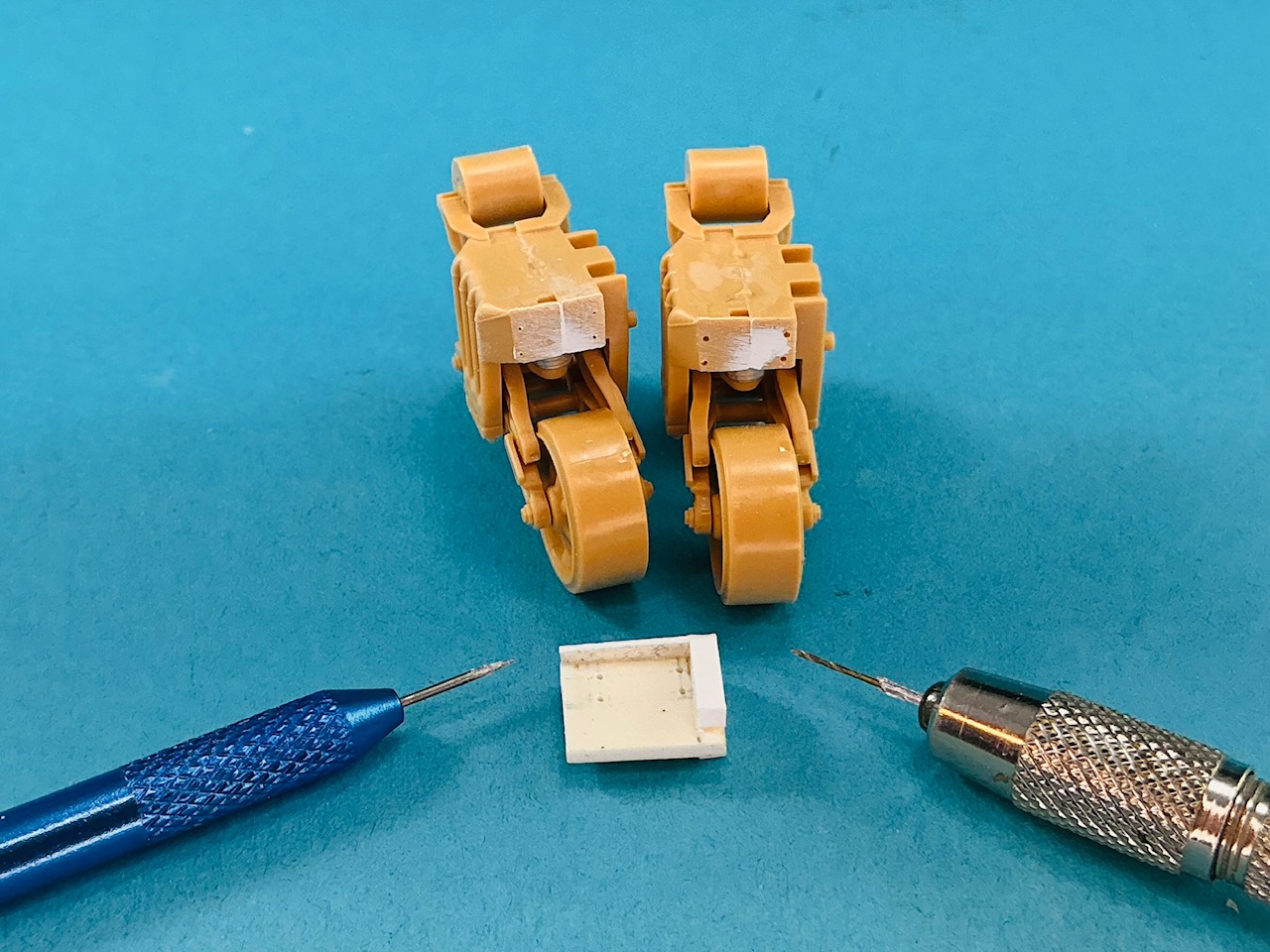
As for the bogies, I drilled bolt holes in them:

I first filed the front face flat, but the seam between the halves remained visible on many bogies. It took some putty and more filing to remove it, so I could use the home-made jig you can see in the photo to poke four holes in the bogies with the needle, and then drill them out with an 0.5 mm drill bit.

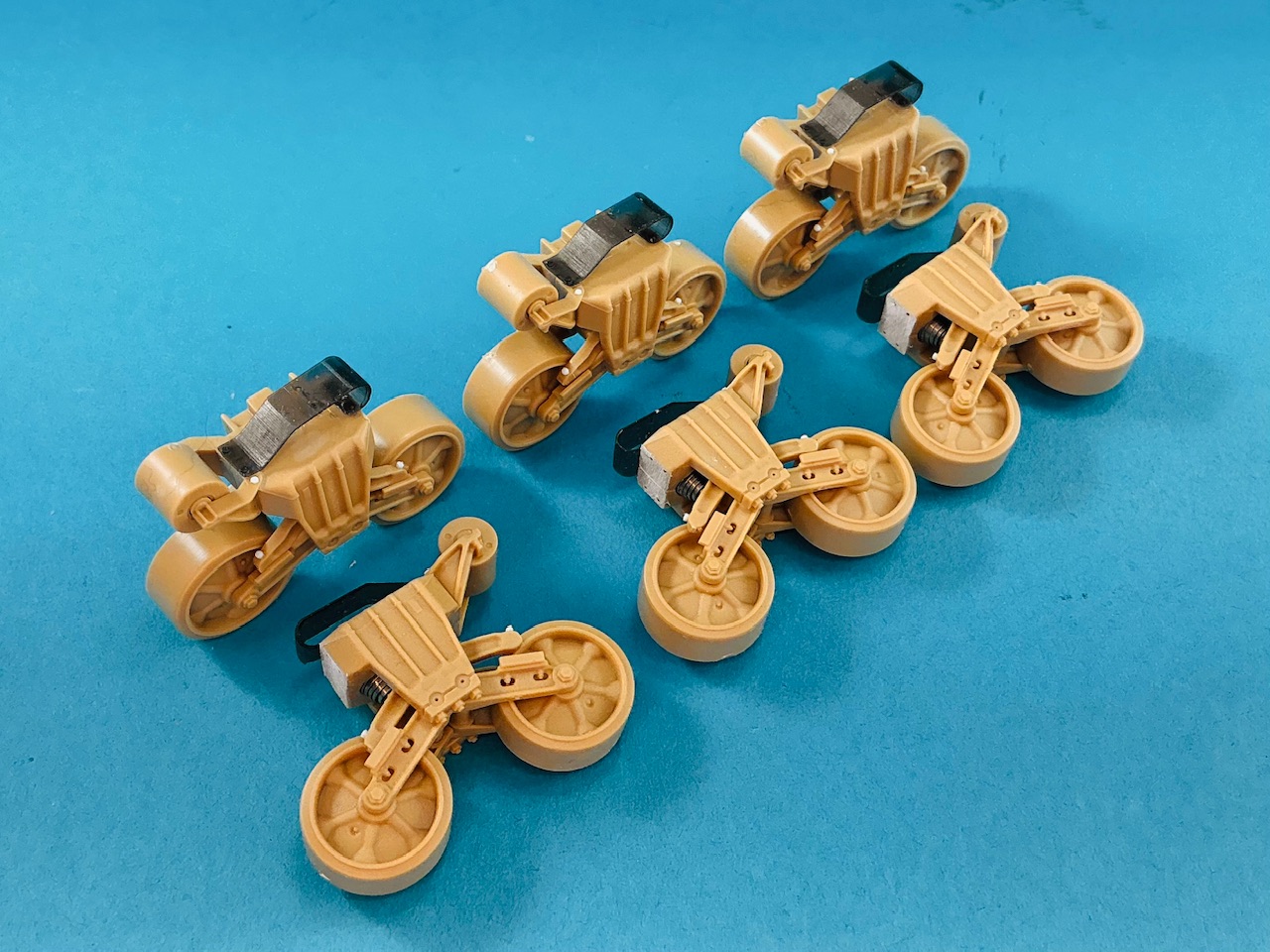
And then I could finish them:

The skids are from the T-Rex set after all, because the ones Meng supplies are far too thick. A reliable source, Kurt Laughlin, informed me that the real ones were made from 0.400 inch steel plate, which converts to 0.29 mm in 1:35 scale, but Meng’s are 0.6 mm while T-Rex’s are 0.3 mm. An alternative is to scrape the outer edge of the Meng parts thinner, but as I had these anyway, I didn’t feel like that. (Another alternative is skids from Asuka. Those are 0.5 mm thick on the inside but have a bevelled edge to the outside, so that they look like they’re about 0.3 mm.)

And I added a couple of bolt heads that Meng forgot. Only on the outside, BTW, because even though there should be ones on the side facing the hull as well, those will be almost or completely out of sight, so I saved myself the trouble :slight_smile:

7 Likes

Very nice job so far Jakko, thanks for the heads up on the track, rear hull and bogie situations.

2 Likes

Thanks :slight_smile:

1 Like

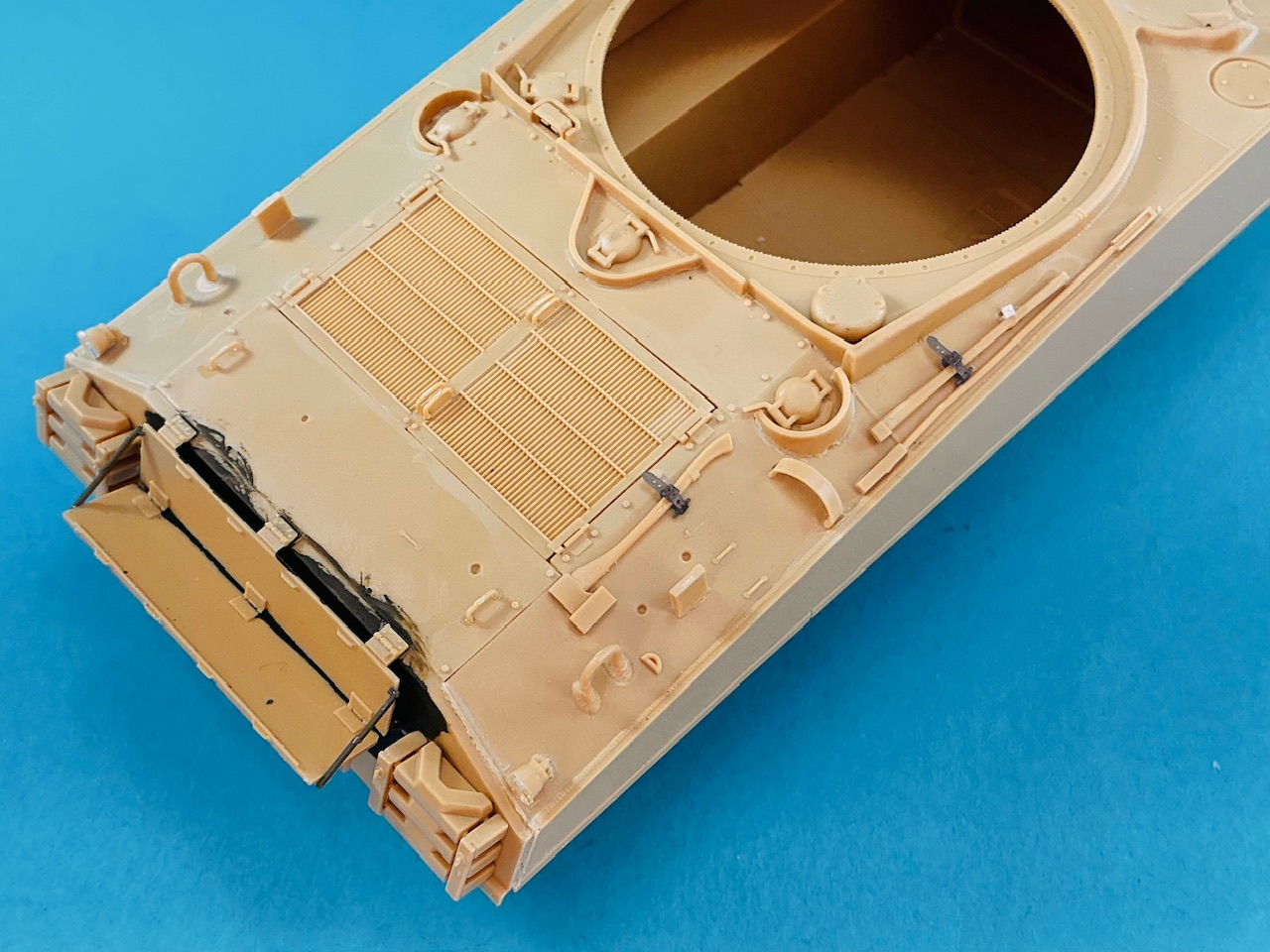
On to the rear deck:

When I was removing the parts for the stowage shelf from the sprue, one of the two stays broke in half and flew away into oblivion. In my Sherman spares box, I found some from Asuka that I used instead — that’s why they’re green plastic. I painted the rear plate Tamiya XF-62 olive drab, and also the side of the shelf that faces the rear plate, to avoid bare plastic possibly showing later, after spraying.

For the spare track holders, you have to drill holes through the rear plate, but I had failed to notice that before I glued it on. Oh, well, cut off the locating pins from the racks and stick them to the plate.

Some of the pioneer tools are now also on the model, with straps from MJ Miniatures. They’re fiddly to use, especially to get them over the shafts. And then I got one end of the shaft for the pickaxe in the wrong place, but I only noticed that when the glue had dried — I suppose I must have accidentally pushed it, as I had taken care to get it in the correct position. I solved this by cutting away the bracket that was moulded to the shaft, and making a new one from some plastic strip next to it, so it looks like the crew didn’t strap the shaft down properly.

As far as specific details of Champagne are concerned: the rear part of the engine deck is in one piece, instead of two. Meng supplies both, but only tells you to use the two-piece plate. This tank, though, had the earlier one-piece plate, as the photos of it as a monument show

6 Likes

Count me in with this one Jakko.Got my chair pulled up.Following with interest,I quite fancy doing an M4A3 Flandres with the improvised white sheet snow camouflage.Great start mate.

Richard

3 Likes

This one? That certainly looks different. Also a good choice if you’re using a kit whose turret shape is off :wink:

2 Likes

Thats the one dude.Ive got an Afv Modeller book Modelling the Sherman and it has some stunning models in including this one.I think the 76mm Sherman isnt sadly in my 1.35th stash apart from.a Dragon 1.72nd one.

3 Likes

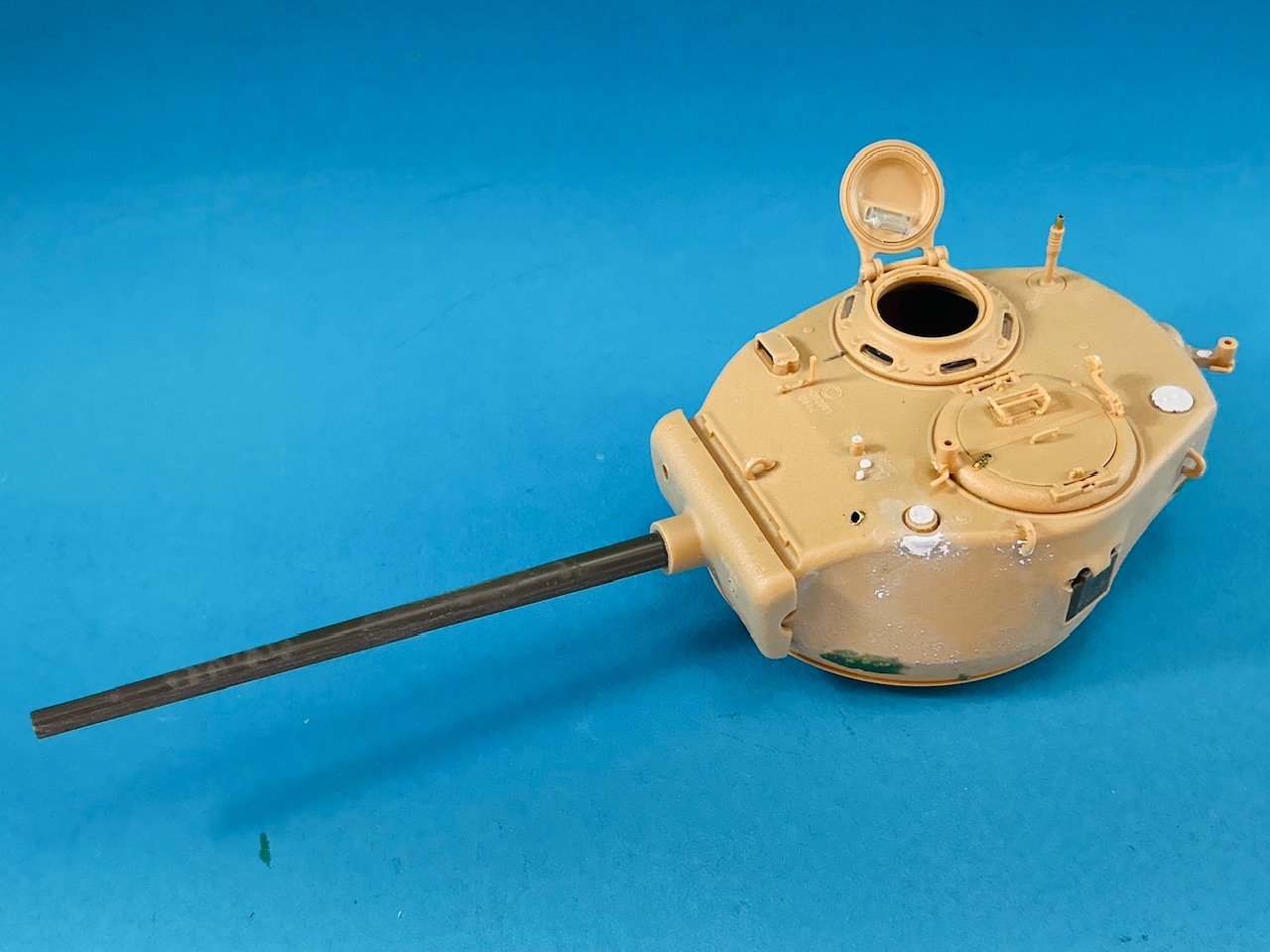
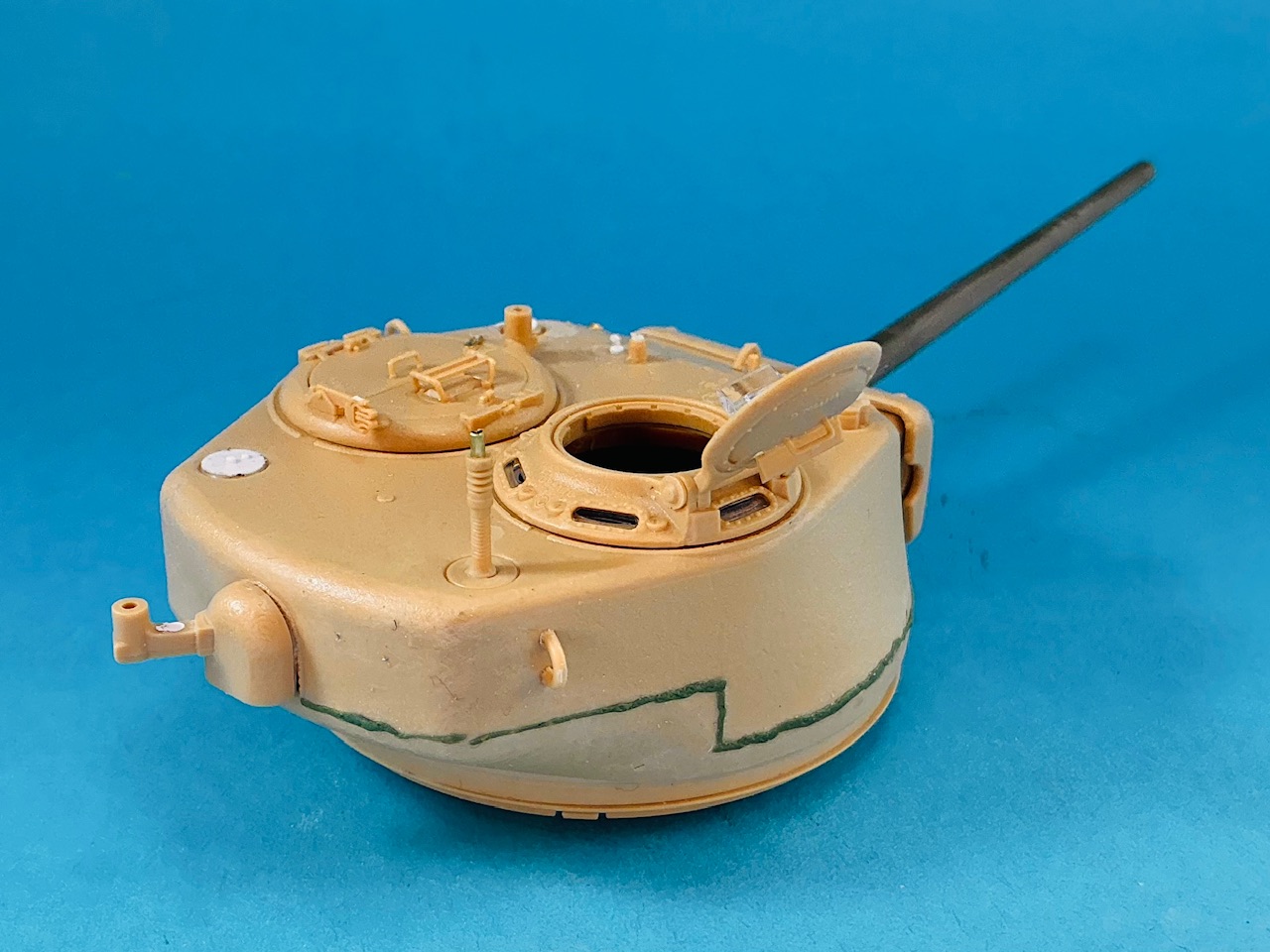
The turret is done now. There’s not a lot to report about that which makes pictures of construction worth the effort, so here are two “finished” photos:


As mentioned earlier, the gun barrel is Asuka, because Champagne had an M1A1 gun but Meng provides an M1A1C or M1A2 (the difference between the two is impossible to tell from the outside). This barrel fits the gun shield directly, no changes necessary. The shield itself is still loose, BTW: it gets attached by two pins from the outside, but I suddenly realised that painting would be easier if I left it off until after I sprayed the turret.

The pistol port hatch is also Asuka, because the Meng part has a really nice casting number on it that isn’t on the real tank, so I felt it would be a shame to cut it away :slight_smile: I also reshaped the channels near the top, in line with the hatch’s hinge, as they weren’t deep enough on the kit turret.

The weld seams and a small casting defect are very thin sausages of Green Stuff, but I didn’t put the seams all the way along because in the photos of the tank as a monument, they’re more prominent on the right than on the left. On the left front, next to the empty antenna base, I made extended the turret slightly with some plastic card and putty. The empty base itself is a punched disc with four punched bolts, because Meng’s doesn’t stick up above the turret enough compared to the real tank. The cover plate at the left rear is also punched but from thinner card.

On the back, I cut away the rails for stowing the machine gun barrel, because Champagne’s turret was a very early version (actually a turret meant for the cancelled T23 medium tank) that lacked those rails. I drilled out the antenna base and glued a length of copper tube in so I can easily fit an antenna from spring steel wire later. On the front turret roof, there are a few bits and bobs for the searchlight, but on Meng’s turret they’re in different places than in the photos of the real Champagne, so I sawed them off and moved/rebuilt them.

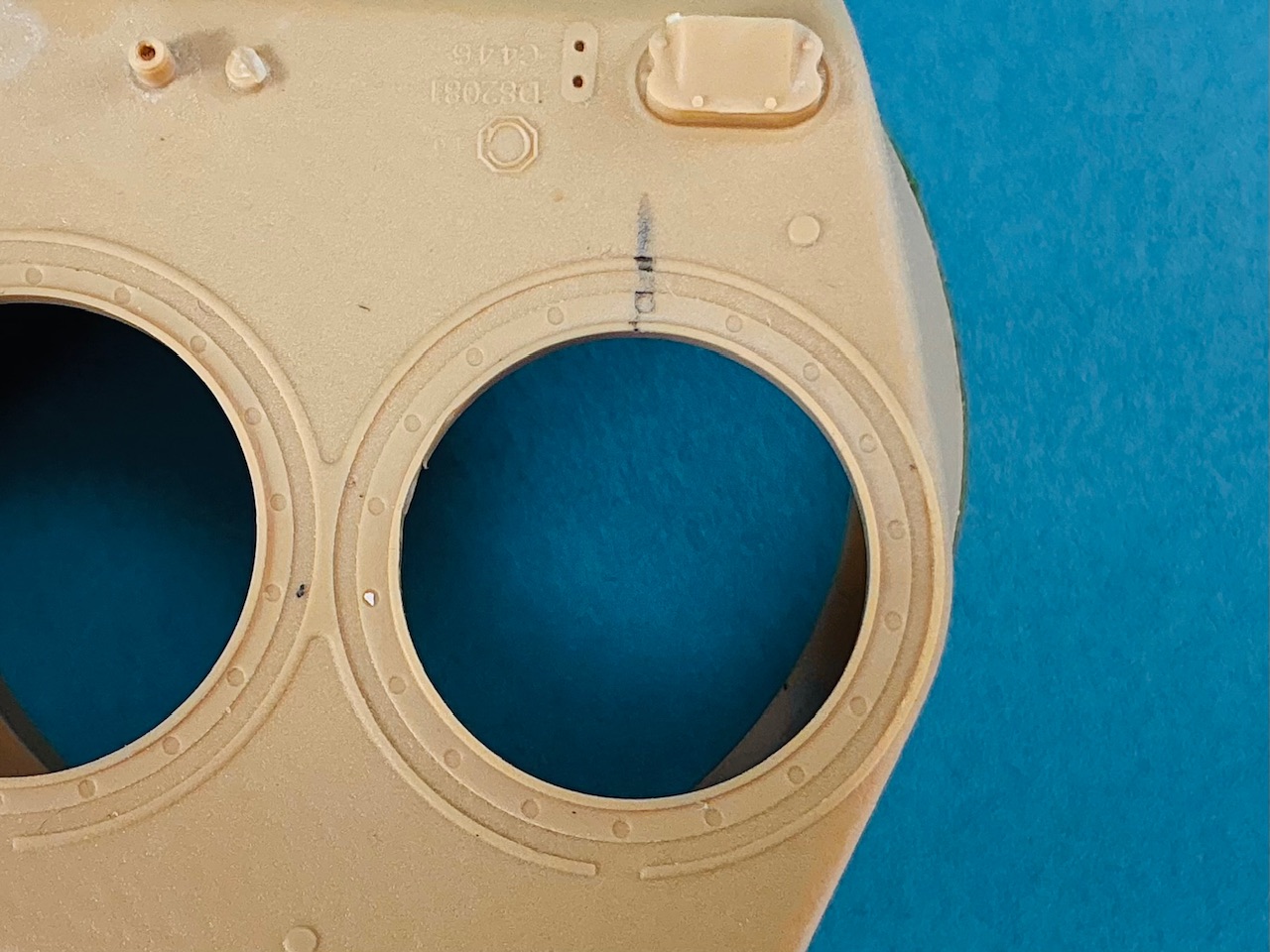
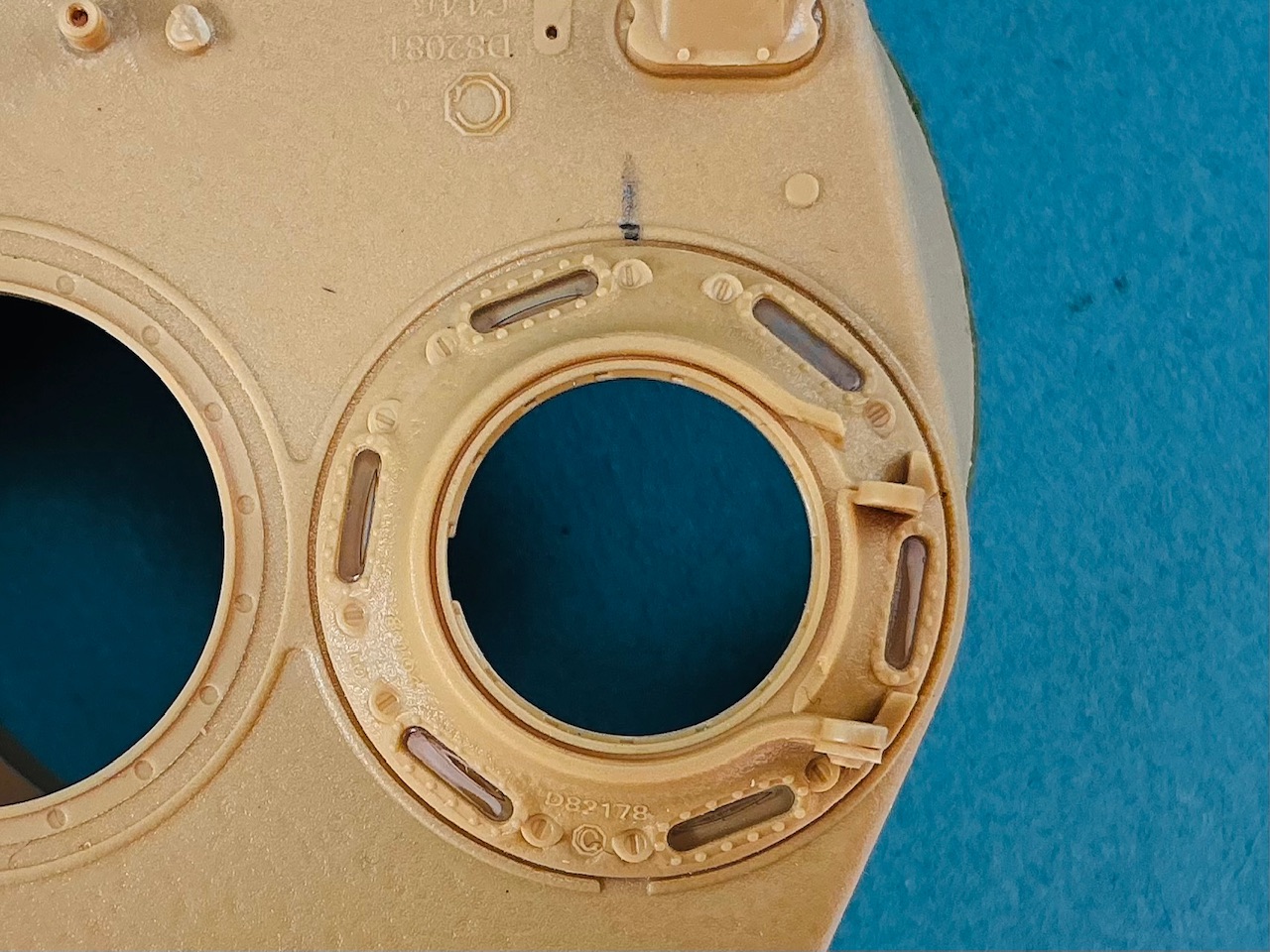
And then there’s the question of how to get the commander’s cupola in the correct orientation. It has no locating lug or anything, so you can put it in any direction you like. Except that it can’t rotate on the real tank … The easiest way is to put a pencil mark by the frontmost dimple in the ring that the cupola sits on top of:

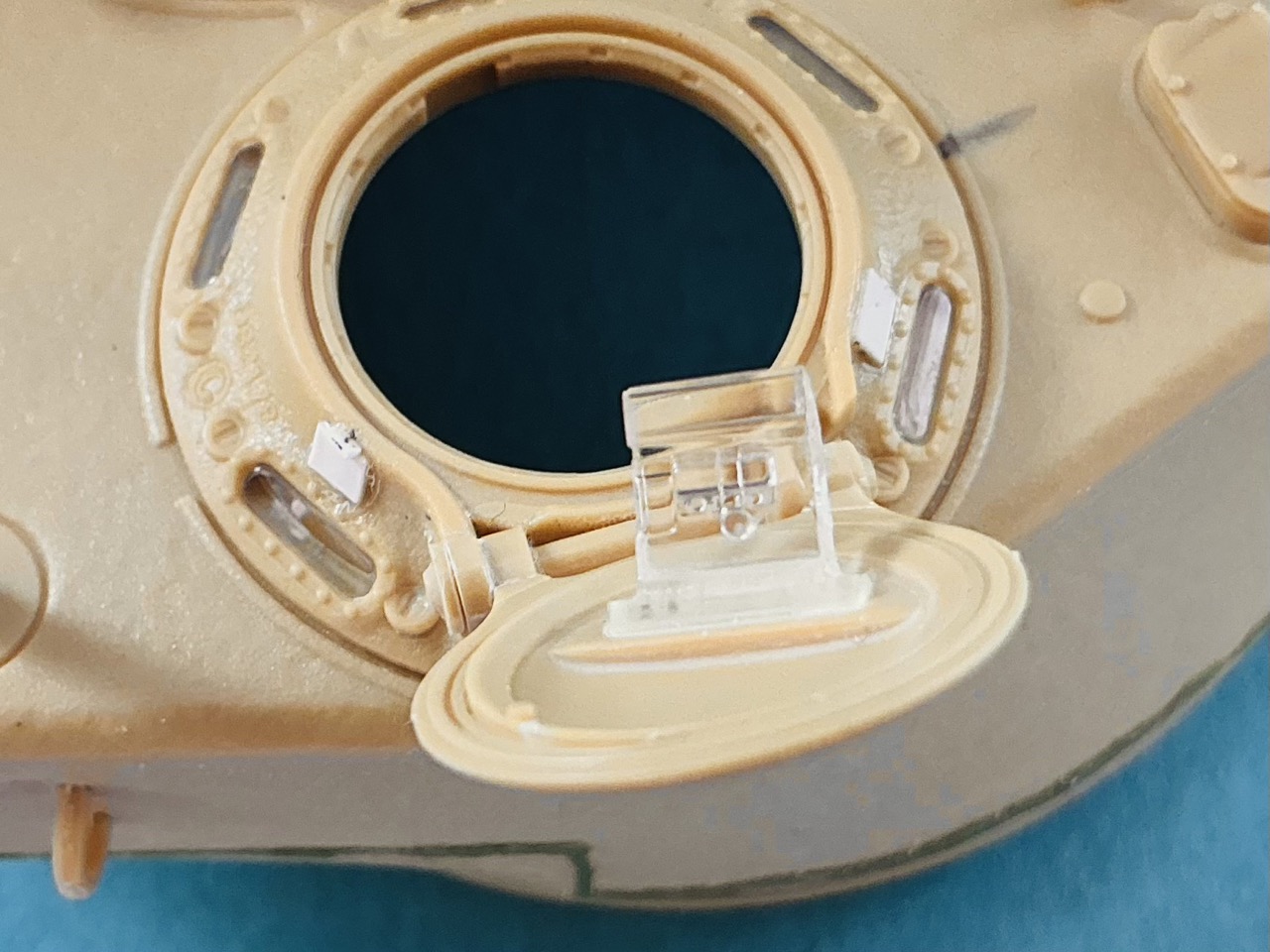
Then put the cupola on with the hinge at 3 o’clock and turn it clockwise until the screw head to the right of the vision block at the left front, lines up with the pencil mark:

This puts the hinge slightly beyond 3 o’clock. The front vision block should not be straight forward! In that position, the commander would mainly see the back of the gunner’s periscope housing. (On a 75 mm or 105 mm Sherman, though, the front block should be directly forward, with the hinge at 4 o’clock.)

7 Likes

It was pointed out to me that Champagne had two blocks on the commander’s cupola, purpose unknown, that I had missed in the photos of the real tank. A few bits of plastic strip later:

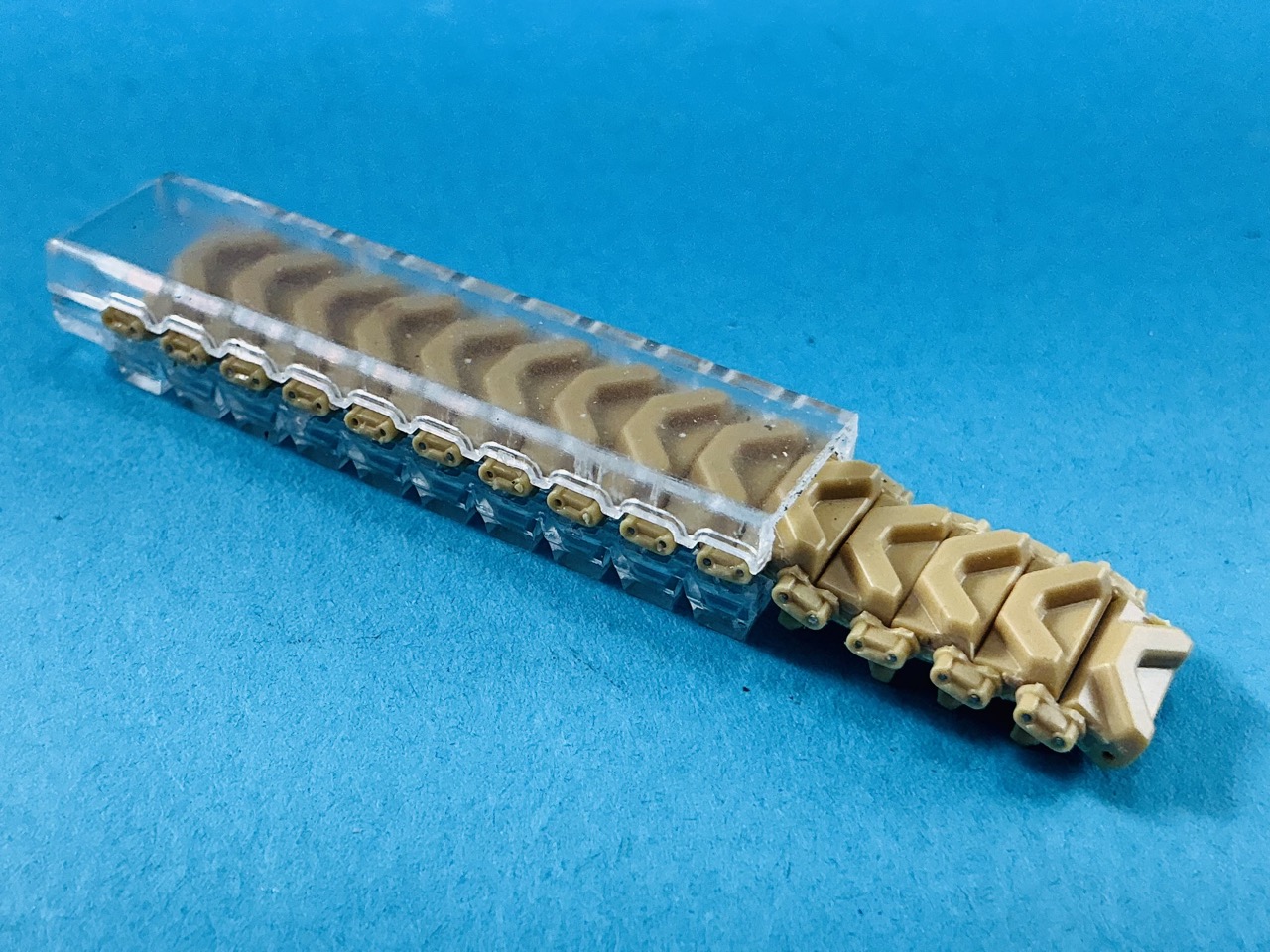
For the tracks, I modified the assembly jig:

By sawing the end off, the track will fit in it like this:

This should make it easier to join lengths of track together, because it proved to be harder to insert the pins outside the jig than in it.

4 Likes

We’re getting there …

The kit includes both plastic and etched guards for the headlights, taillights and horn (or here: siren). The plastic headlight guards are quite good, those for the taillights are a bit on the thick side and the one for the siren is much too thick :frowning: So I used the etched ones, for which a neat bending jig is provided. I did use a cigarette lighter to anneal the centre section of each of them first, where the curve is, else it will be much harder to bend them into shape. They’re all glued on with that Chinese black phone glue, which proved to be much easier for something like this than the superglue I used to use. The cross inside the horn guard was a troublesome as always, though :frowning: The little tubes with the stoppers for the headlight sockets still need to be added on the guards, as I didn’t want to fit them while the glue was still drying.

I also replaced the periscope guards by ones from Asuka, as they’re clearly a lot thinner.

Next, I added the plank on the front. Looking at photos of the real tank, it looks to me like it was a single plank with a cut-out in the bottom edge, and that the plank split on the left, in line with that cut-out. I also glued the comb device on the nose, which is clearly visible in photos of the real tank.

5 Likes

Finally: the parts for the track have all been cleaned and the halves for the blocks have been glued together:

Now all I need to do is assemble them :slight_smile:

The hull is also finished, I think:

The tools are again tied down with MJ Miniatures straps, except the shovel (it’s too far above the plate for those to fit) and I didn’t fit the pick axe head. There will be a rolled-up camouflage net over both of these, so they shouldn’t be obvious :slight_smile:

Meng provides two tow cable eyes, the one for the rear with a clamp moulded on, which most kits miss. Too bad that Champagne’s tow cable was attached to the clamp by its eye instead of the eye’s shank, so that the forward end of the cable could be attached to a tow lug instead of the in the clamp on the tank’s nose. So I cut the clamp away and replaced it by one from Tiger Model Designs. The tiny wingnut from this jumped out of my tweezers, though, just like every one of those I’ve put on a model, which means it’ll just have to go without.

Do note here that the cable length Meng indicates is totally wrong: 123 mm, but I needed about 4 cm more than that. If you use Meng’s length, you can’t have the cable in both clamps at all in the way the instructions tell you to. Oh, and I didn’t use the aluminium cable that comes with the kit, but used my usual nylon thread instead. The aluminium doesn’t look or feel that great and it doesn’t seem to want to bend as well as copper would, so away with it. It might be useful somewhere else at some point :slight_smile:

And then we get to these two:

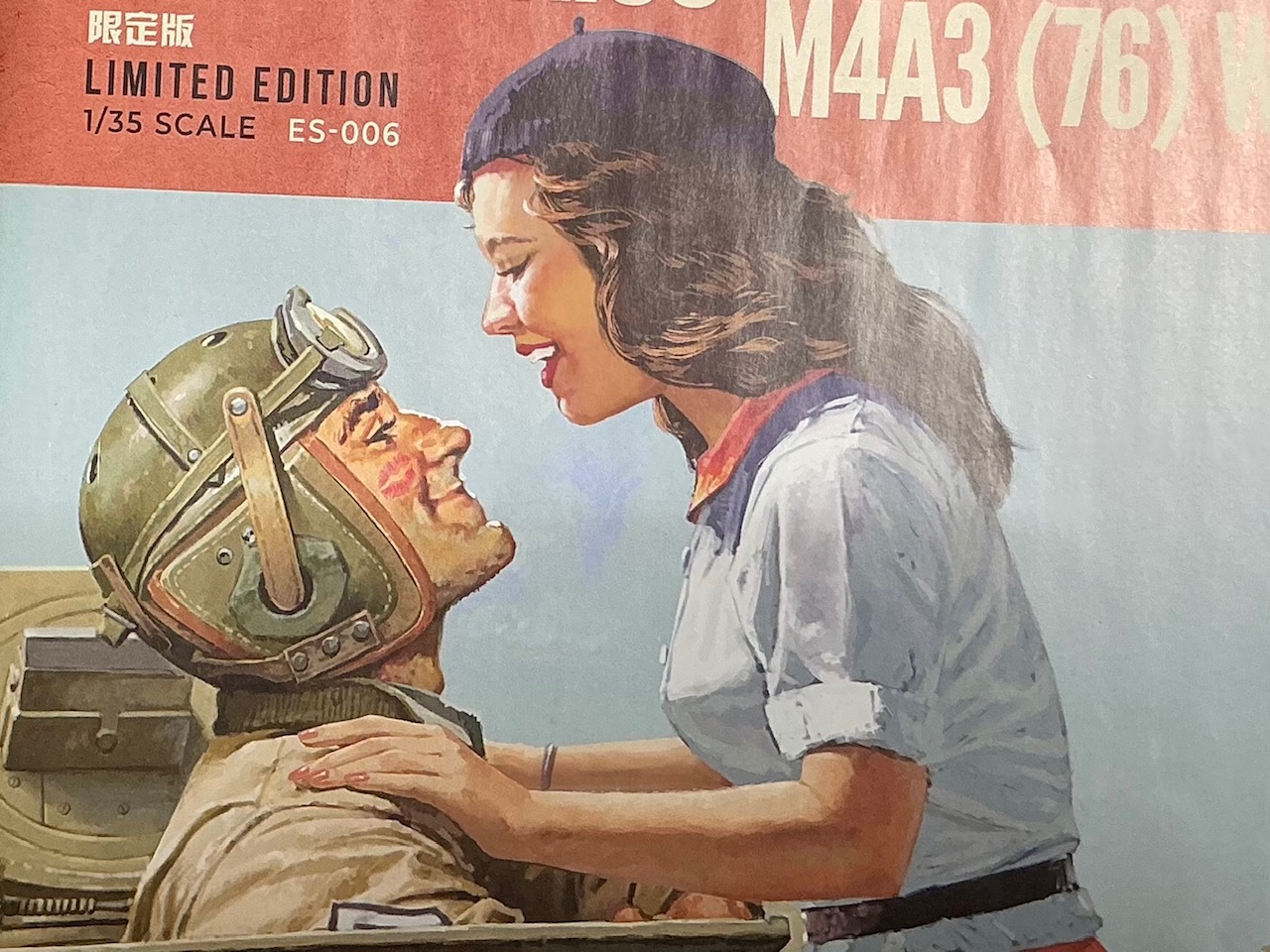
I must say I find them a bit of a disappointment. The soldier is just hanging like an idiot (and you have to find something yourself to put under his feet inside the tank so he doesn’t hang vertically) and has a look on his face as if he’s daydreaming. The girl looks like she’s running rather than standing on one leg, which her face matches. The two of them are not really anything like this:

But she at least has two right hands, so she should have a good career in engineering in front of her.

6 Likes

Doh! That is less than ideal.

3 Likes

It was actually the first problem I noticed when I took the figures out of the box to test-fit them on the tank. It’s not a major problem, as I’m sure I could have found some suitable ones among my spares, but it is a bit unfortunate.

Still, as I won’t be using these figures now,[1] it’s a far-future concern anyway :slight_smile:


  1. I would have if they actually looked like the box art ↩︎

2 Likes

You seem to be having some bad Sherman ju-ju lately. This woman with two right arms and another kit with a missing sprue. Sucks.

4 Likes

That thought had occurred to me as well. Add the Sherman III kit that was missing two of the detail sprues last/this year, too.

1 Like

What shade of lipstick did the instructions call for?

2 Likes