90 Years of the DC-3/C47

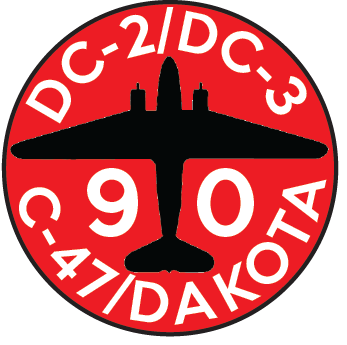
Paul, that looks like a group or squadron patch - I can image that being sewn onto a flight jacket. Good work.

The only suggestion I have is to add “90” to it. Perhaps large numeral 9 and 0 tucked up to the tailing edge wing roots? Or…you know how military pilots love Old English fonts and roman numerals? “XC” in place of “90”.

Your thoughts?

Fred

Thanks Fred, some good ideas here. The problem designing something like this is the tiny size of the award. I can’t recall the exact dimensions but I seem to recall something like 80 pixels. Old English might be fun but I do not believe it will reduce well. Here is a redesign with black text:

DC-3 Logo 90 blk 80

I tried it with white text and think it might be better in the tiny size:

DC-3 Logo 90 wht 80

What do you think? How do we get the award into the campaign descrition so other prospective builders will be able to see it?

Paul

2 Likes

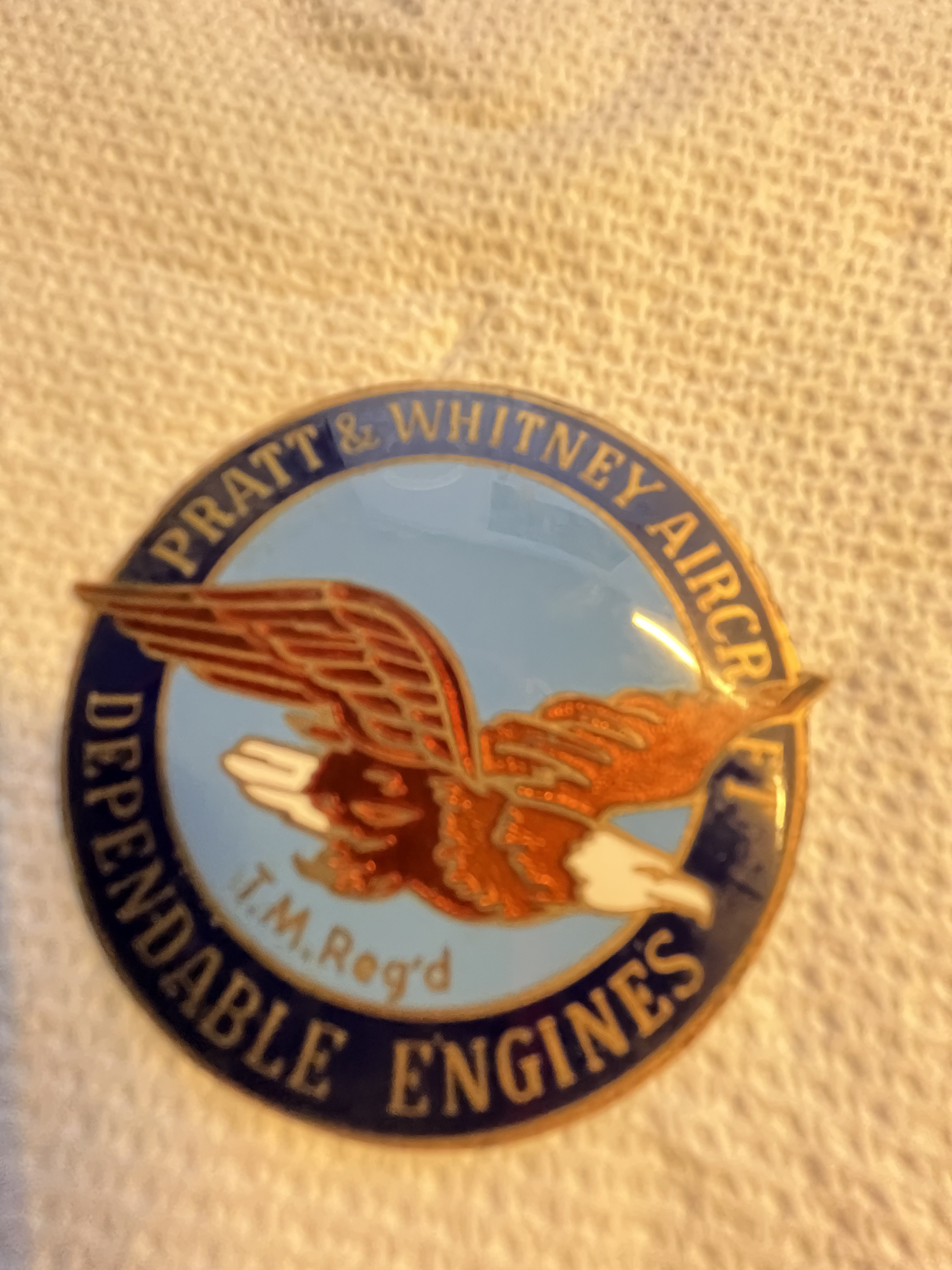
On a slightly related topic - a friend sent me this today. He found it on an engine hulk - about two inches across:

2 Likes

Great logo! These used to be mounted on the crankcase drain section at the very from right where everyone could see it. BTW, one of the pearls gleaned from the research on the DC-3 was that the name Pratt & Whitney came from the name one an old and empty tool manufacturing building that the engine building company used when they started out. Everyone knew the building as Pratt & Whitney so they just kept the name.

Paul

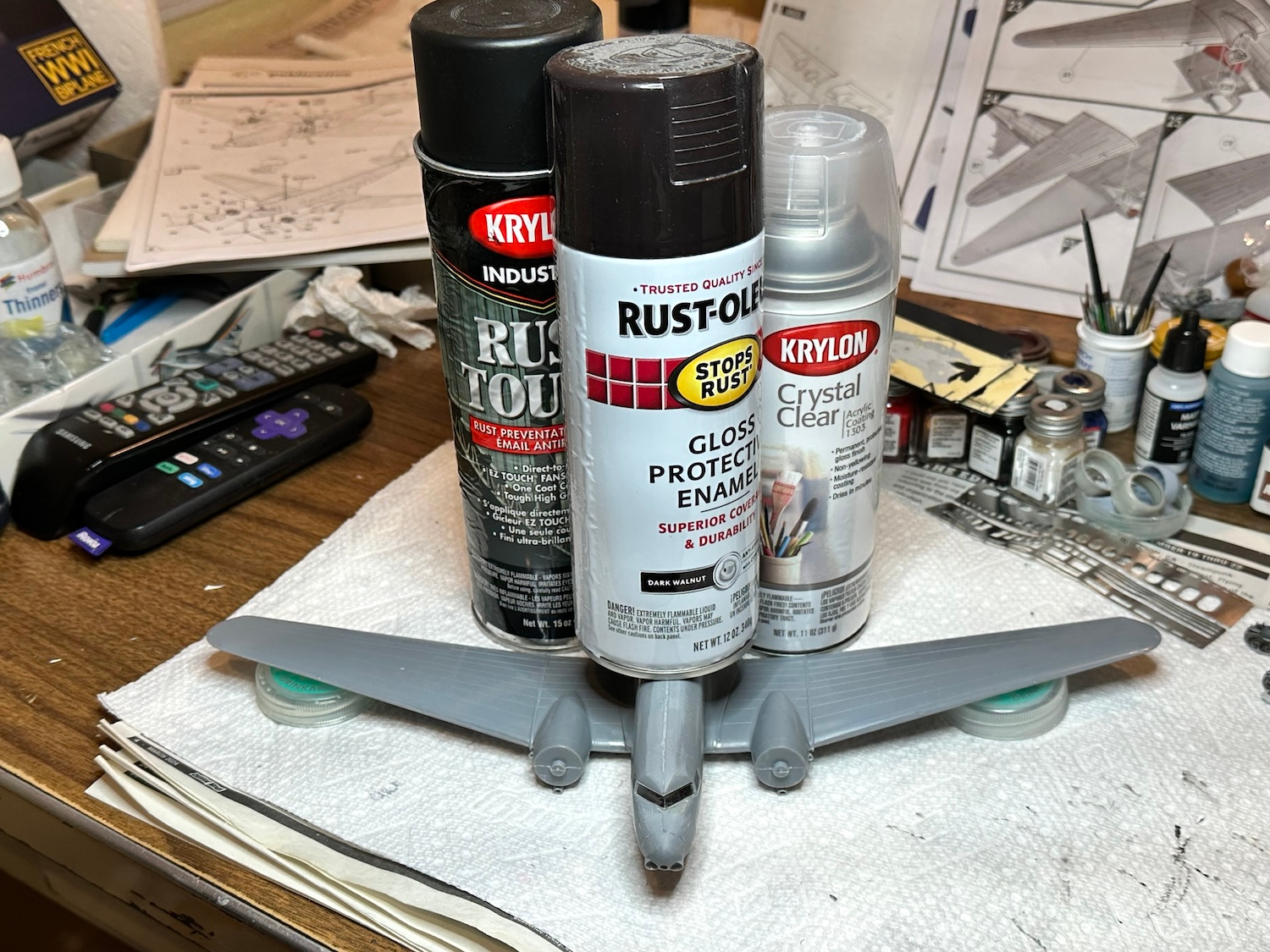
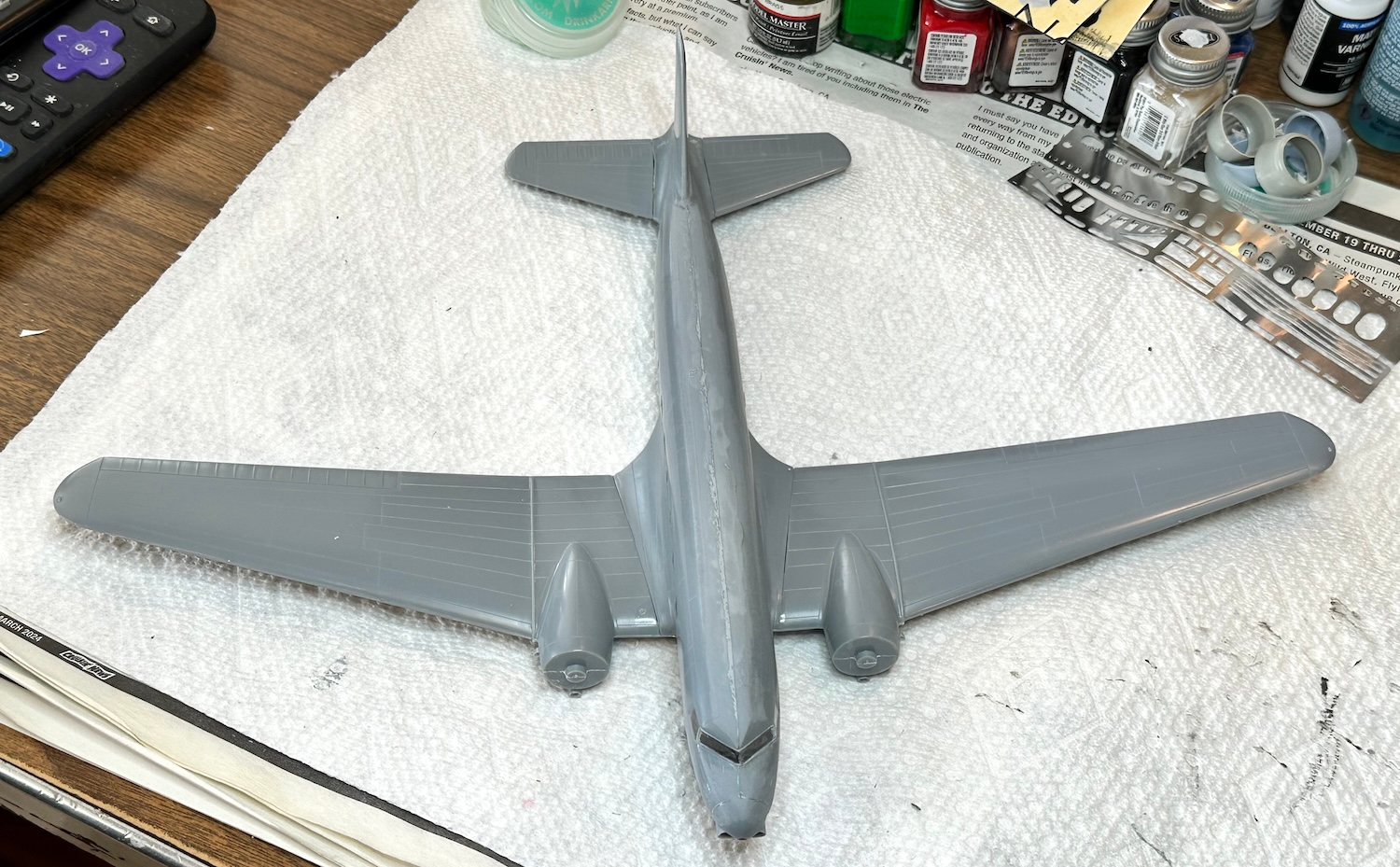
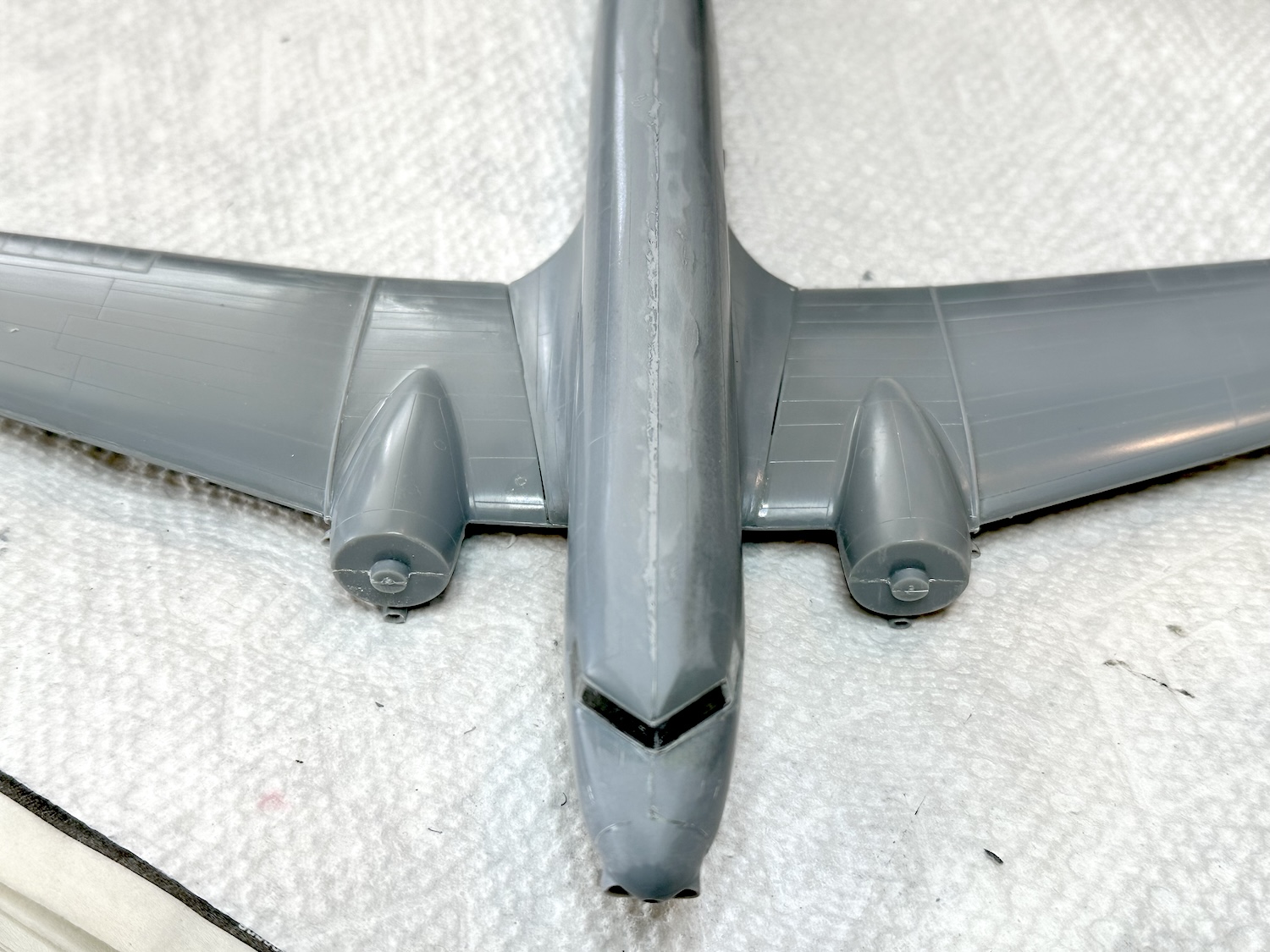
Just a bit more progress on the MPM DC-2. Last night I glued the fore & aft sections of the fuselage to the lower center section of the wing. There was a small gap along the top wing/fuselage join that could be closed by flexing the wings up a bit. Once the glue had dried completely and would not separate with wing flexing, two bottle caps were used to hold the wing tips up and some weight was added to keep the fuselage down. Then glue was run into the gaps and the whole assembly was left overnight. The gap is largely gone now.

Paul

3 Likes

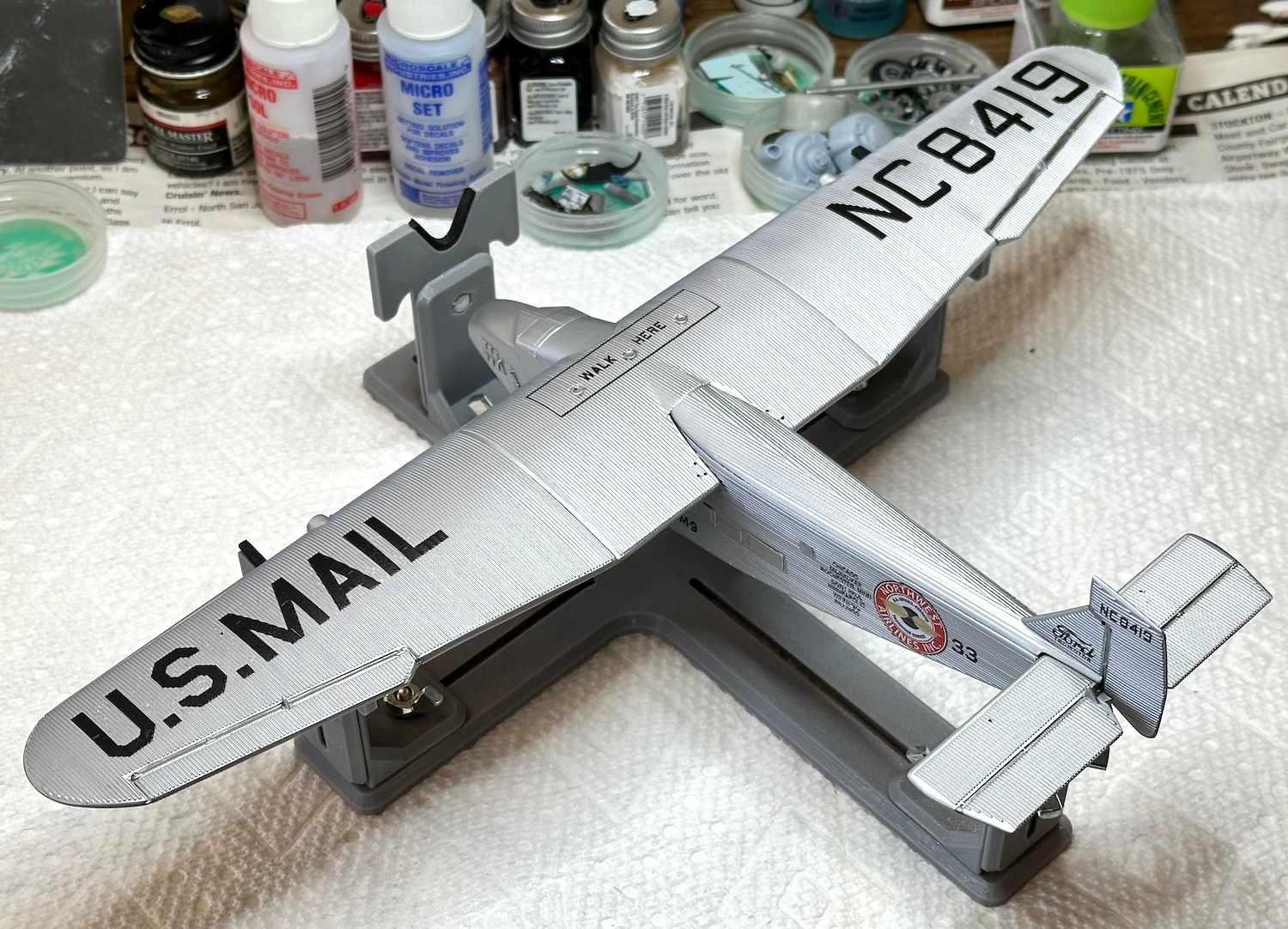
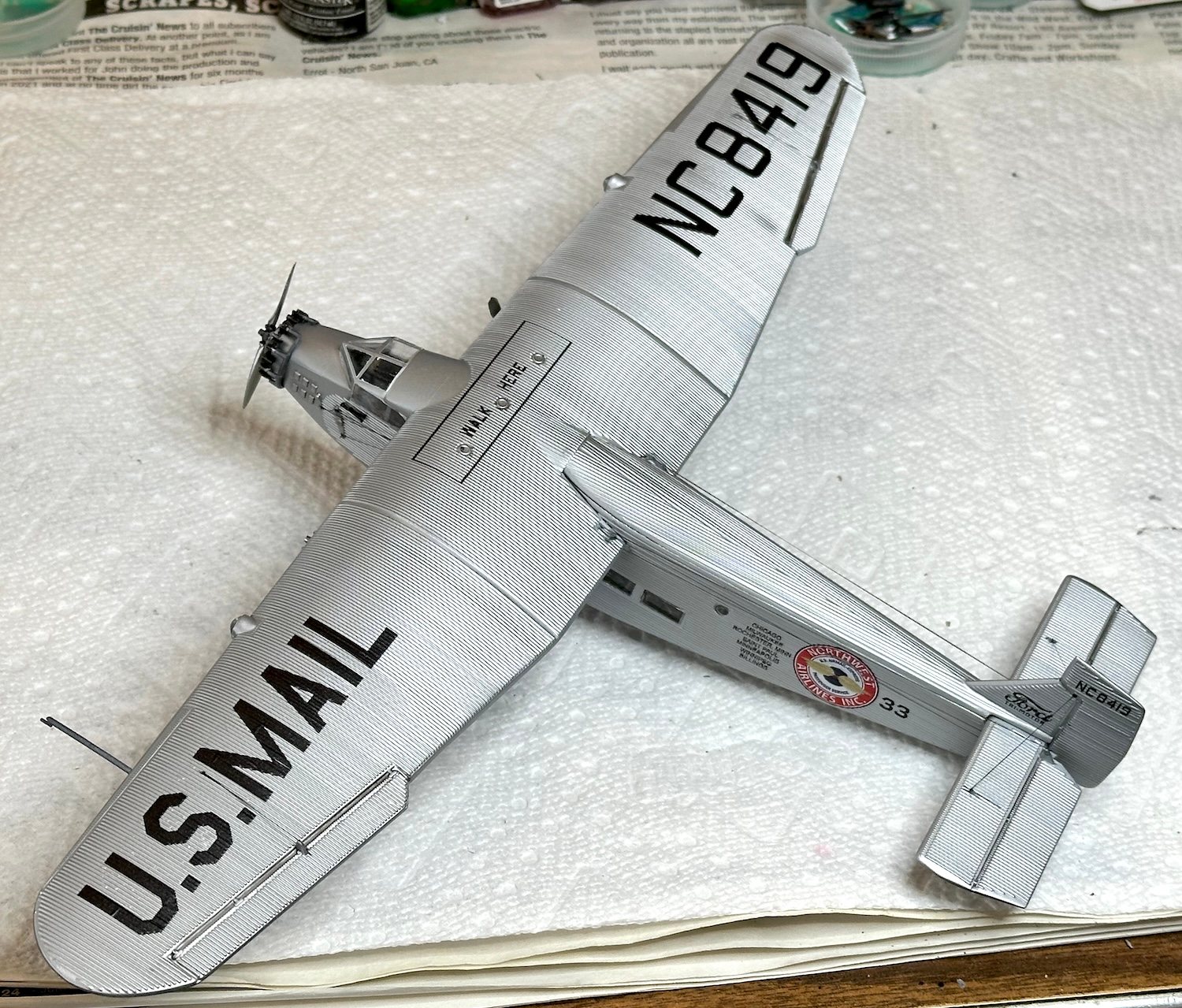
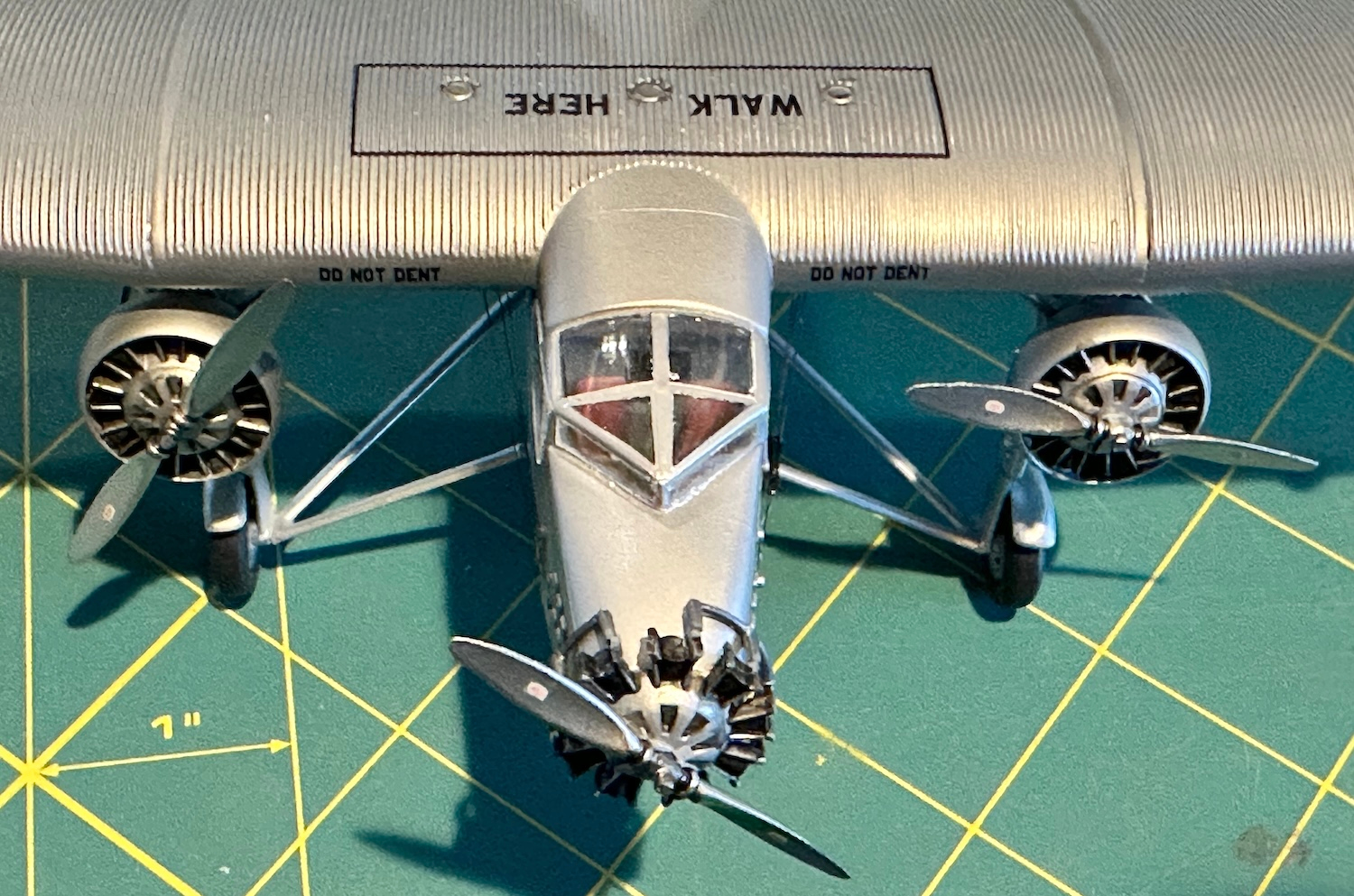
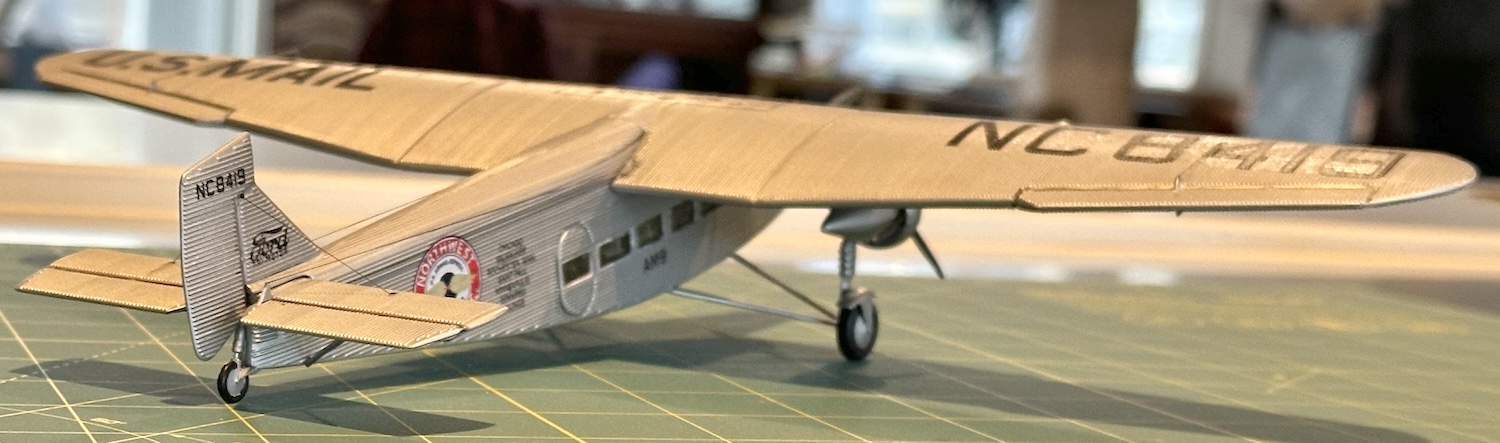
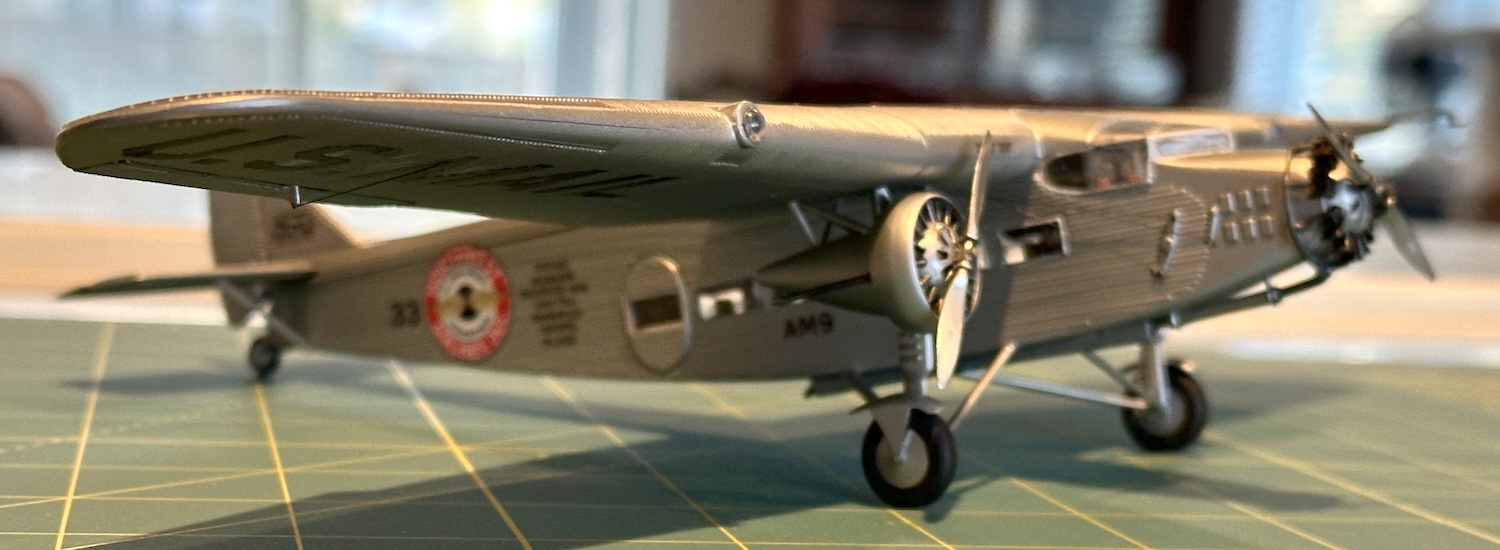
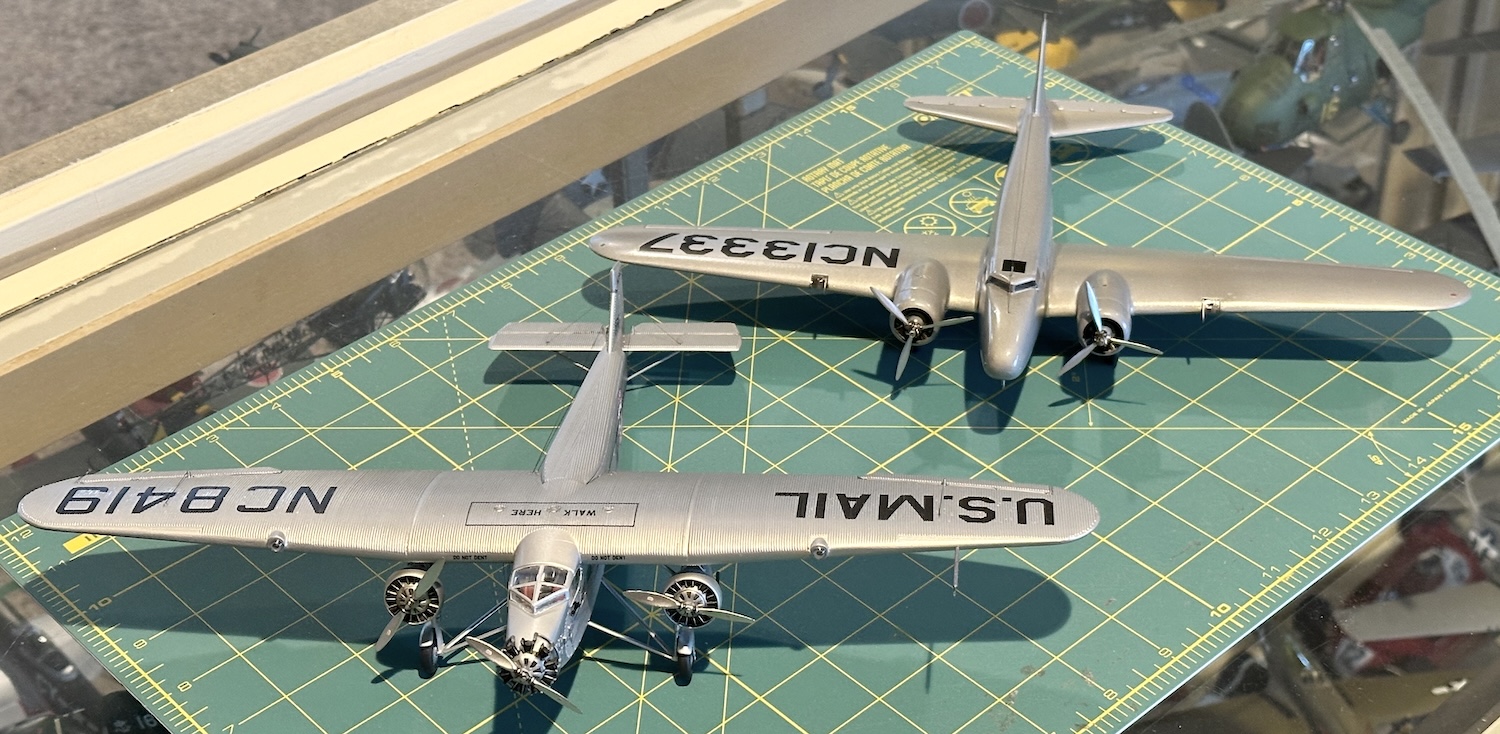
As promised (threatened?) here is just a bit on the Ford Trimotor. As I was reading books on the DC3, DC-2 and the only book I could find on the Boeing 247, I kept running across references to the Ford Trimotor. I’ve seen these wonderful machines around over the years and even built the old Monogram model when I was a kid. I knew they had a significant place in aviation history and thought I had better learn more after hearing repeatedly that the Ford was a milestone in the opinion of Boeing, Douglas and the airlines.

One of my modeling buddies (thanks Herb) suggested that the Airfix kit, though old was pretty good. Ebay provided one and Amazon provided three books including a reprint of the manual put out by Ford for the 1929 AT-5, precisely the aircraft Airfix kitted in 1/72 scale. I’m no fan of Airfix decals and now look for aftermarket decals for any Airfix kit. Happily, Draw Decals offered a Northwest airlines set for the Airfix kit. These were very well printed and proved to be an asset to the project.

The kit itself looked pretty good in the box and construction started right away. I always have several kits going at once so I can squeeze in a bit of modeling whenever an odd bit of time needs filling. These builds always seem to be interrupted waiting to bits to arrive or paint or glue to dry.

Just a bit of history about the Trimotor. In the early twenties, Henry Ford was often reckoned to be the world’s richest man. He was personally a very modest fellow, often sitting on a box or overturned bucket when talking to an engineer or craftsman. He was also a visionary. He set out to put the world on wheels and did. He wanted to do the same thing with aviation. He and his son Edsel were introduced to Bill Stout, another visionary. Stout had been in government service during the Great War and his job brought him into contact with aeroplanes. He rapidly came to the conclusion that these flimsy machines needed to be made of metal.

When he met the Fords, they could see his point and agreed to back Stout’s small company and start an airline themselves to prove the concept of regularly scheduled routes. The Fords built an airport, the largest & most modern in the world at the time and with some of Stout’s all metal single engined monoplanes powered by surplus Liberty 400 hp V-12s began their private air service. The sole customer of the Ford Air Service was the Ford Motor Company. They moved parts, tools & personnel from one factory to another. Ford found that he was able to keep factories running far more efficiently than with rail service. He promised the public that he would publish complete records of his air service so others could see for themselves the reliability and costs of such a venture.

The Liberty engines were expensive to run and had reliability issue in such constant service. Stout & Ford both wanted a larger multi-engined aircraft to improve speed, reliability & load capacity and started on a trimotor version of the basic Stout aircraft. After a false start or two, the came up with an instant winner in 1926. Trimotors were a popular layout at the time. Several other makers were already using them including Fokker who had even setup a US factory. The others were made of wood & fabric.

The Ford was somewhat larger and powered by the reliable & powerful for the trime Wright Whirlwind, the same 225 hp motor that took Lindberg to Paris. After the first test flight, the pilot told the assembled throng that this plane would do the job. Ford ordered some for his own air service and the airlines rapidly stepped in to order some for their own use. They sold so many that a sort of production line of sorts had to be setup.

More on this later, a bit about the build now.

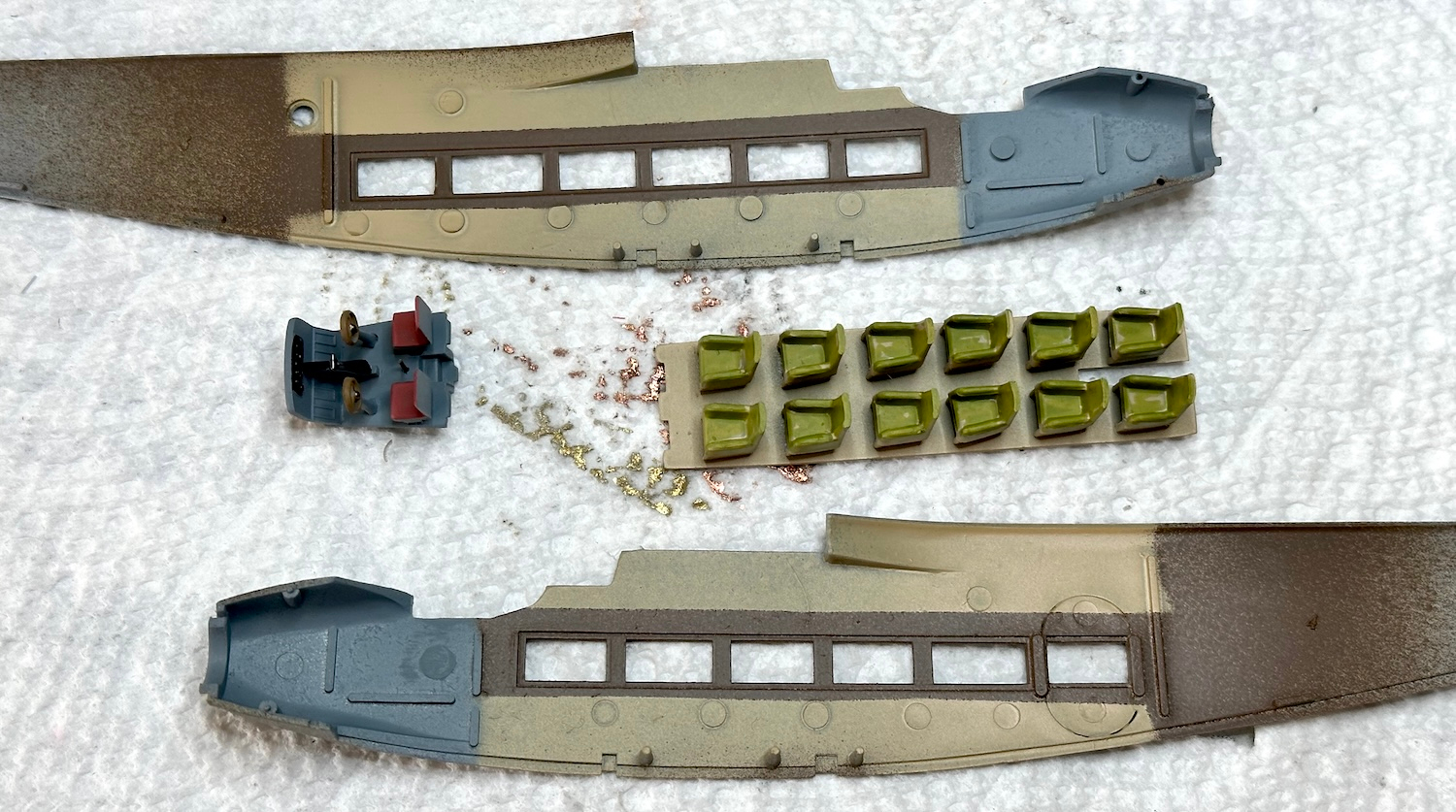
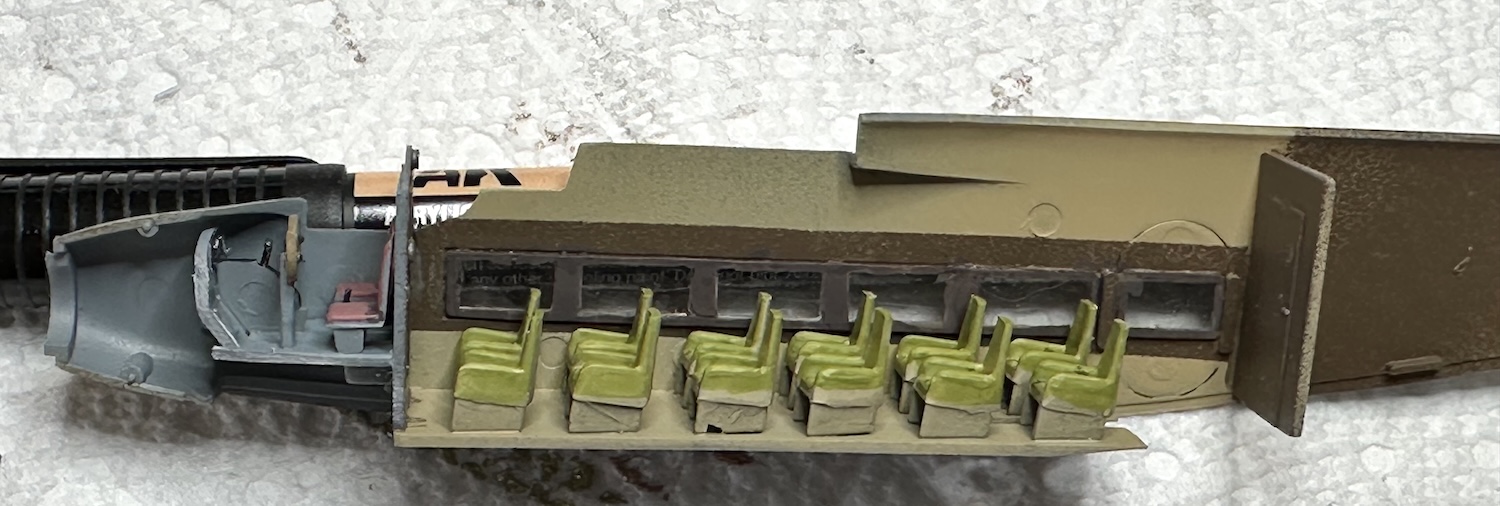
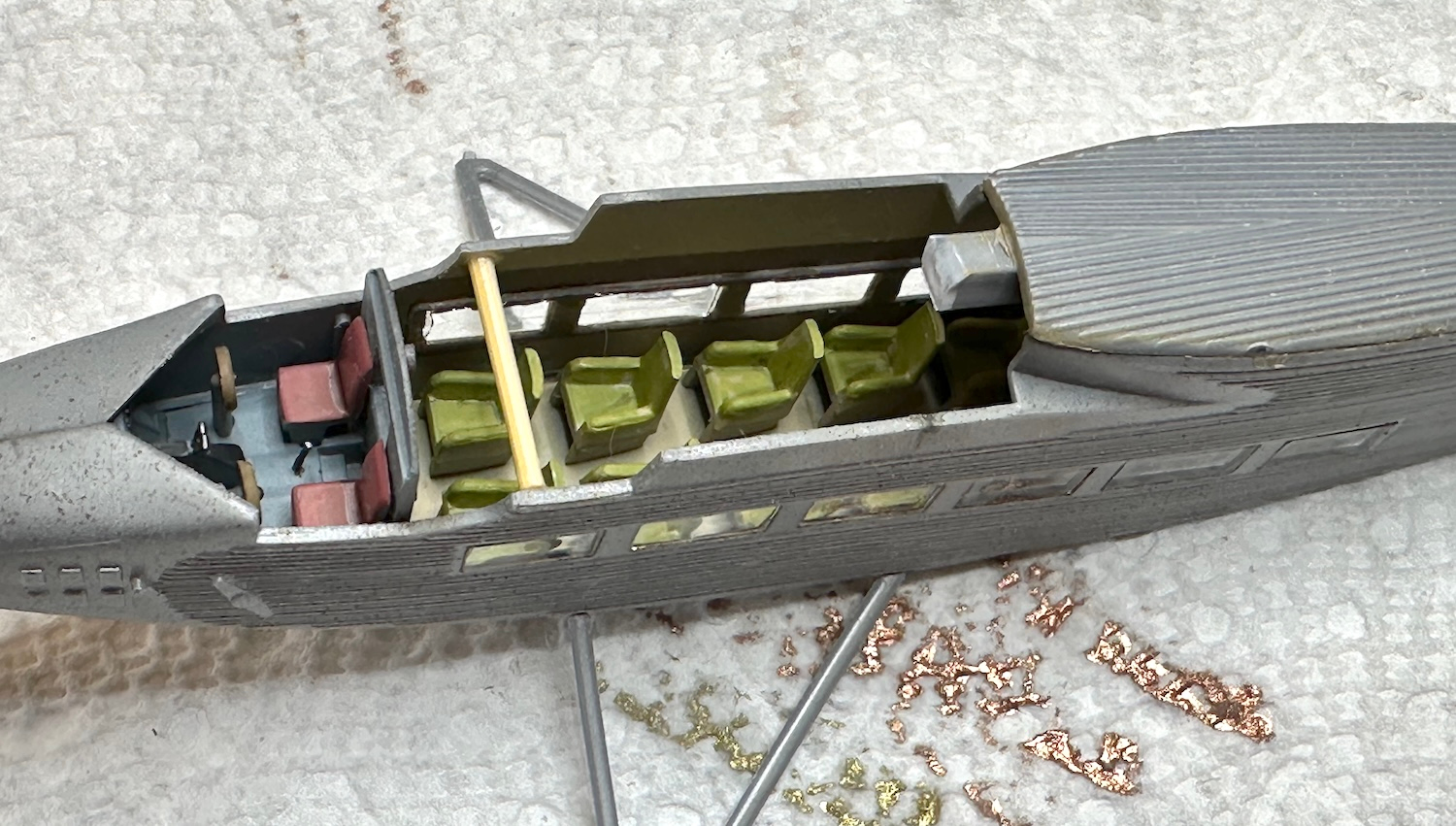
Interior colors were a guess. The books mentioned a few of them and it appears they were all fitted out to order. I used colors that were common in Pullman cars and parlors of the time.

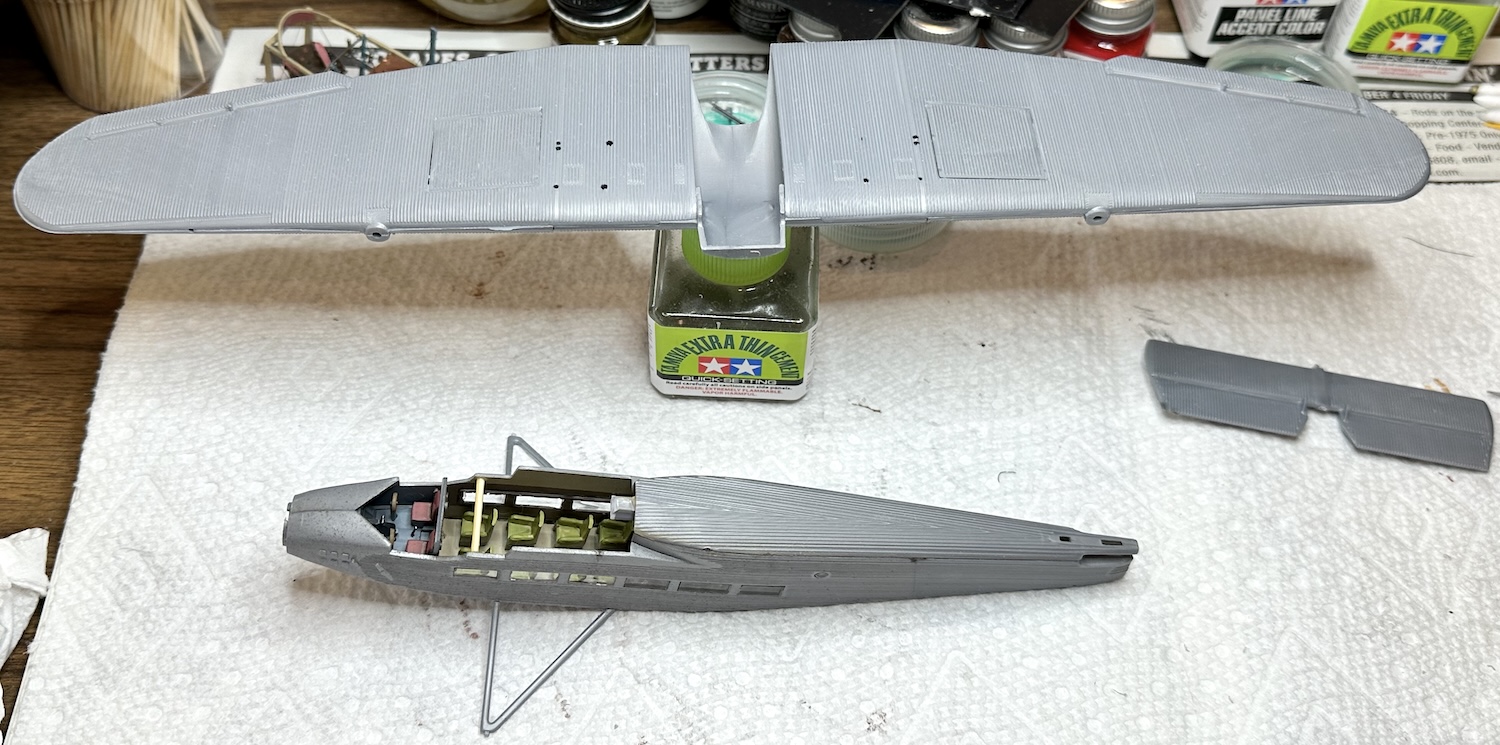
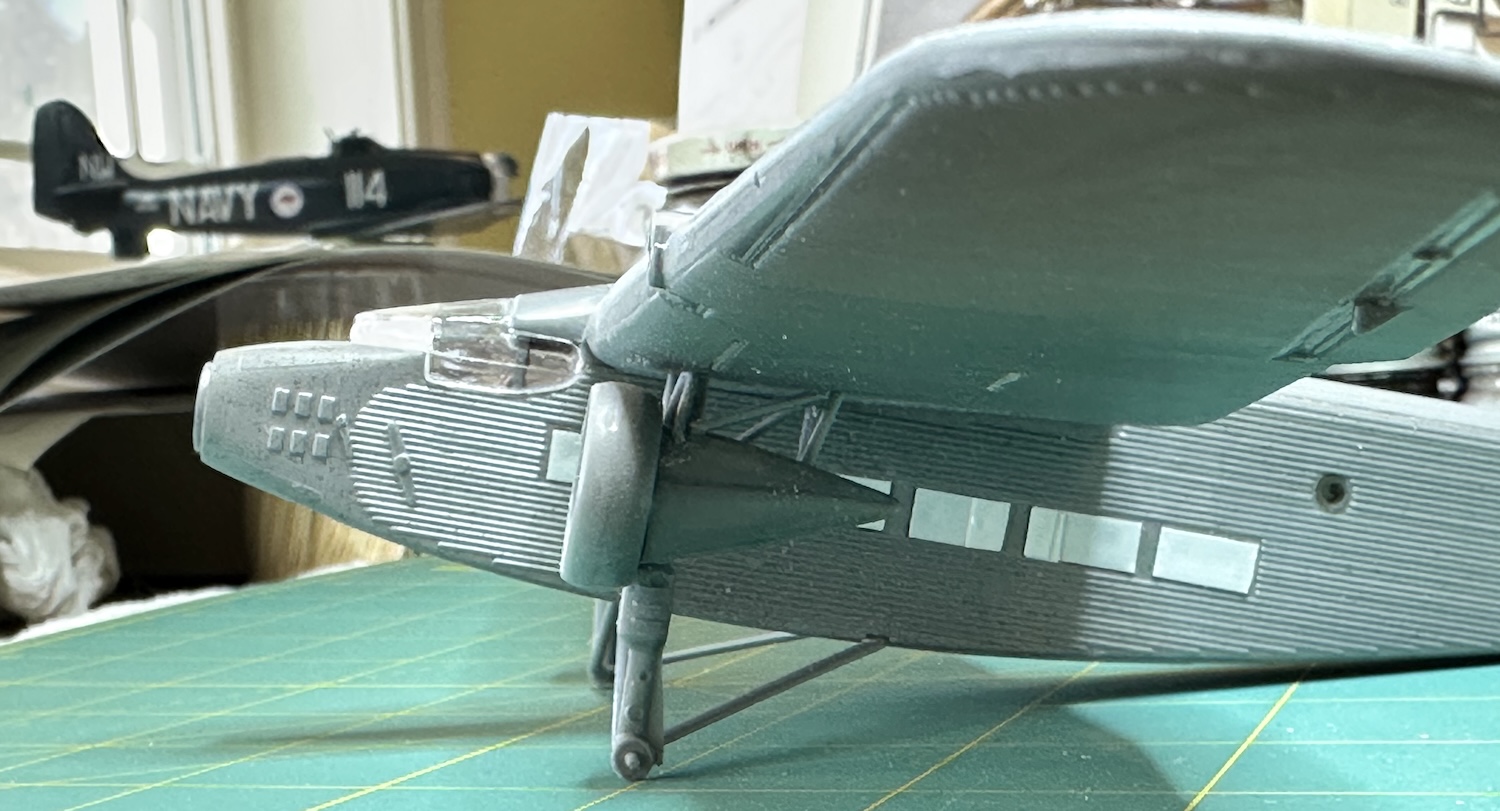
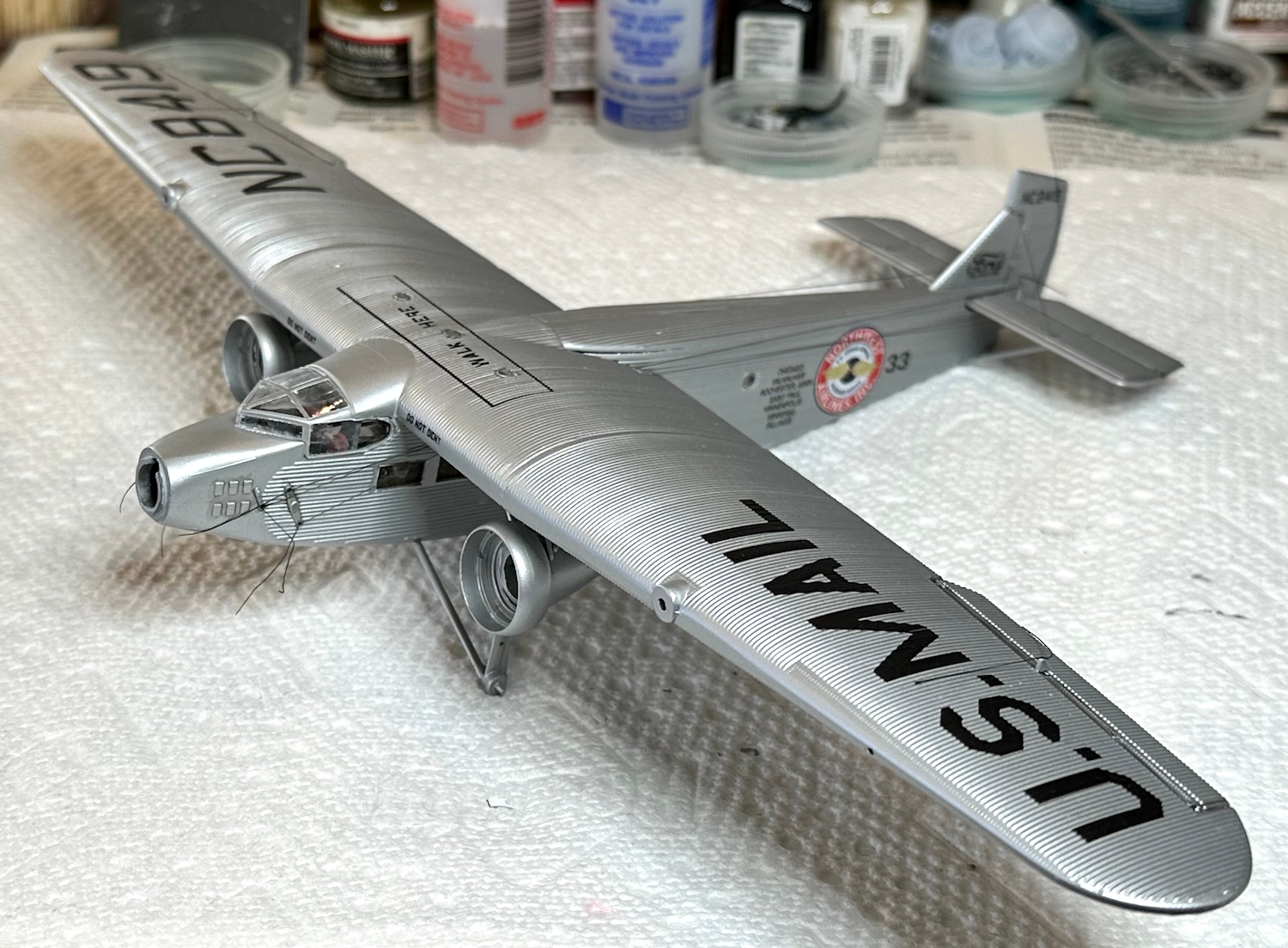
A toothpick was cut & glued into place to spread the top of the fuselage apart. This kit has a bit of an odd construction with the wing fuselage joint looking very weak to my eyes. The windscreen is an intrigal part of the structure and has to be glued in ahead of the wing. a tab was added to the back to give it a bit of support there.

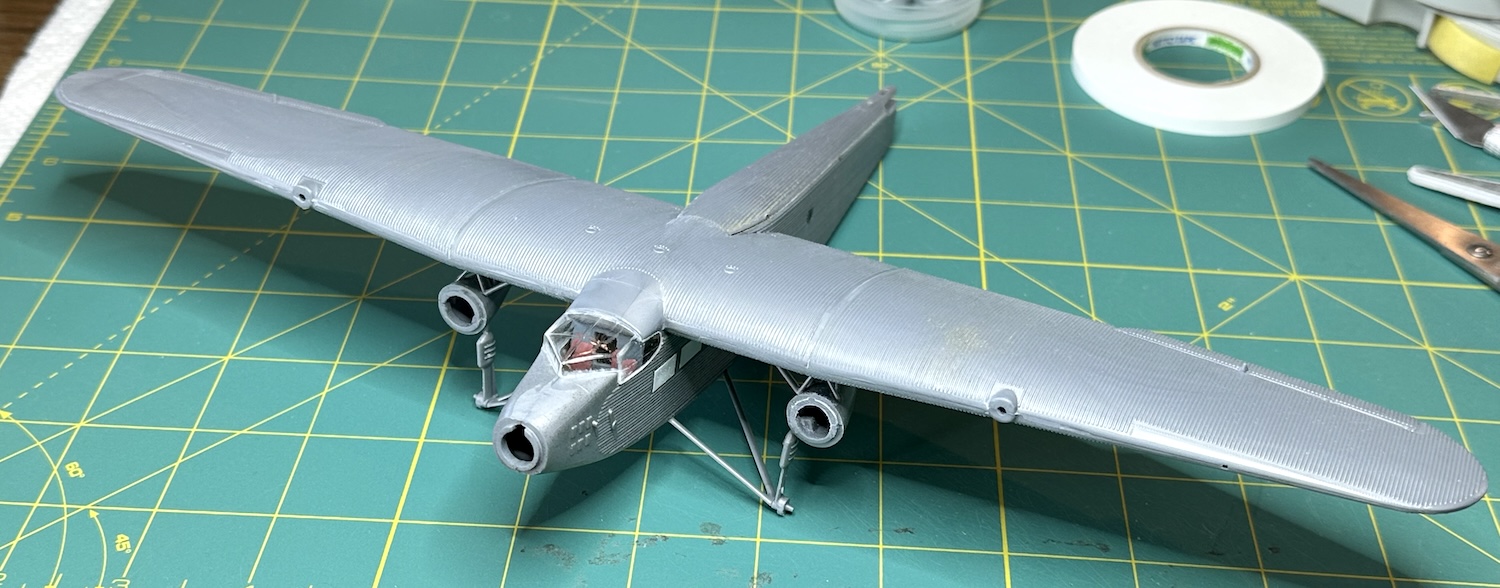
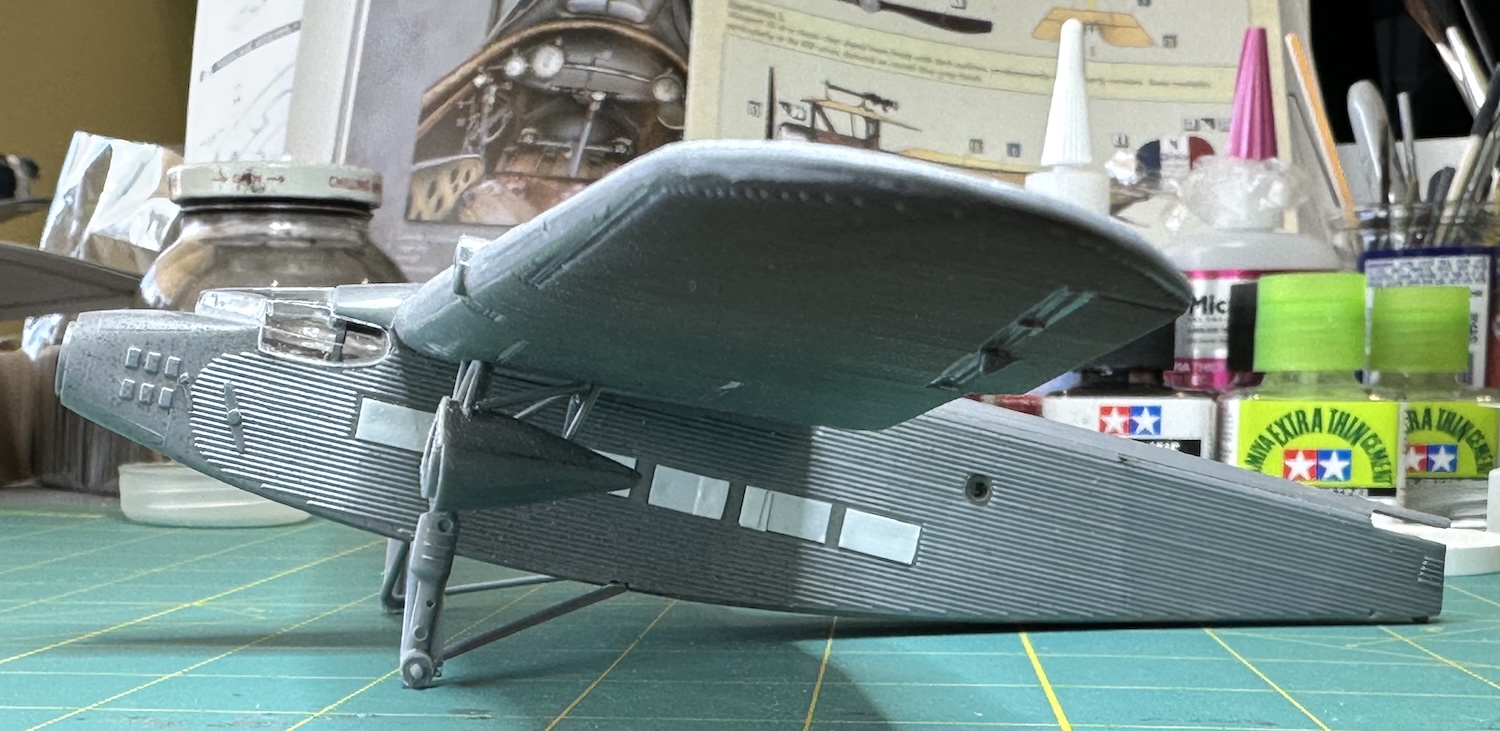
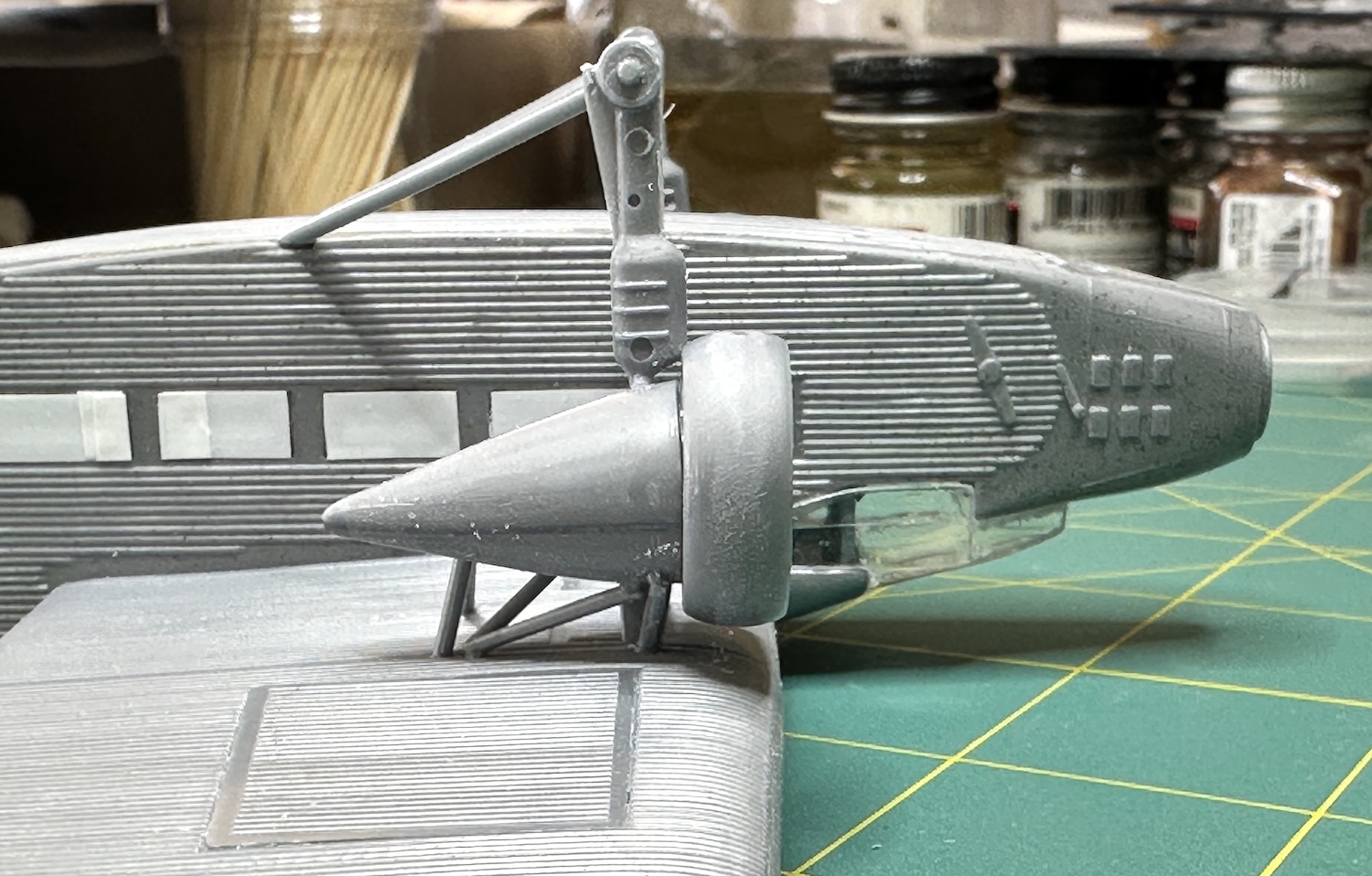
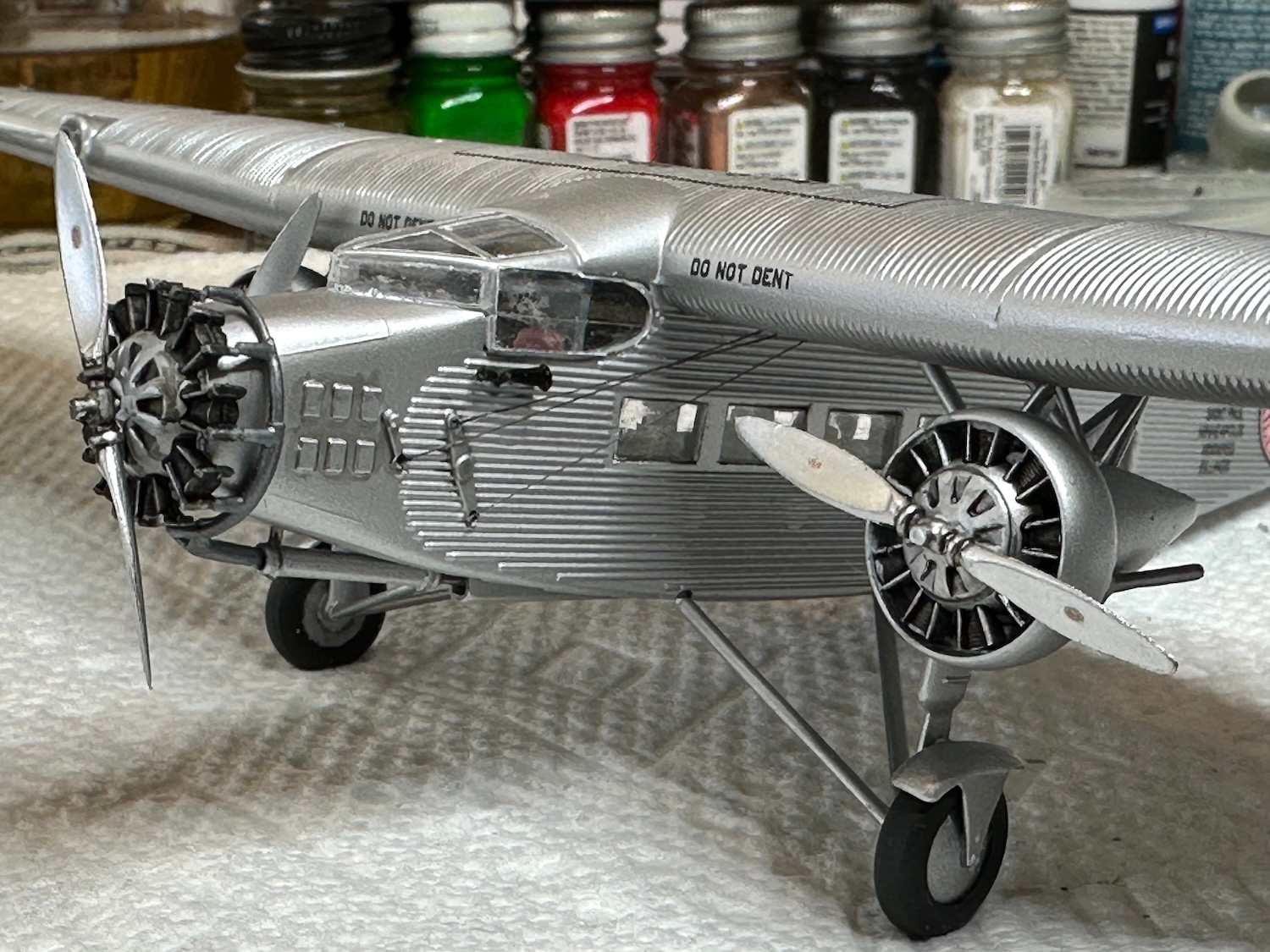
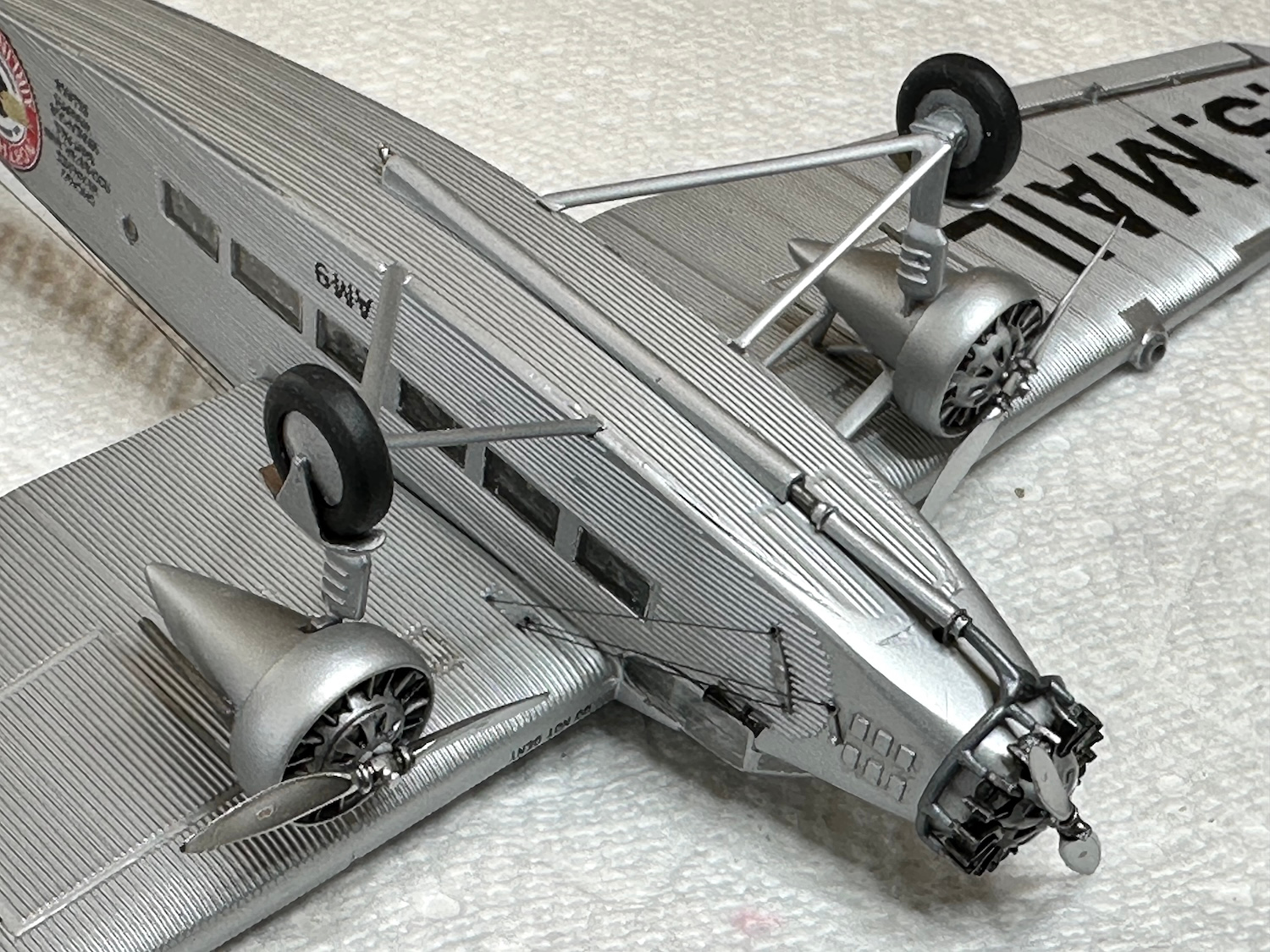
The worst part of this kit is the very imprecise location of the struts to the nacelles. I had intended to build the nacelles with the struts into sub assemblies and then add them after painting the model. There was no way this was going to happen! It was a real struggle to fit all of these struts into place and hold them there while working on other ones. Nothing seemed to fit very well and I ended up laying the struts & nacelles out and just trying struts in places where they would actually fit and that would leave the nacelles in the place they needed to be. This resulting in a downward thrust line that would not do.

Some adjusting of the thrust line was done with files & sanding sticks. The nacelles are still at the wrong angle but at least the motors & cowlings are happier. No one will see this & I won’t mention it to anyone . . .

More on the story of why the Ford Trimotor was important to the DC-3 story and painting, decals & rigging of the model next time.

Paul

4 Likes

Keep up the good work Paul. This is great history.

That looks good. I’ve always wanted to have a crack at the Airfix Ford but it’s not been available for years. Hopefully they might reissue it as part of the Vintage range.

This kit was released as part of the Vintage series. I just bought it a month or two ago on eBay for a reasonable price.

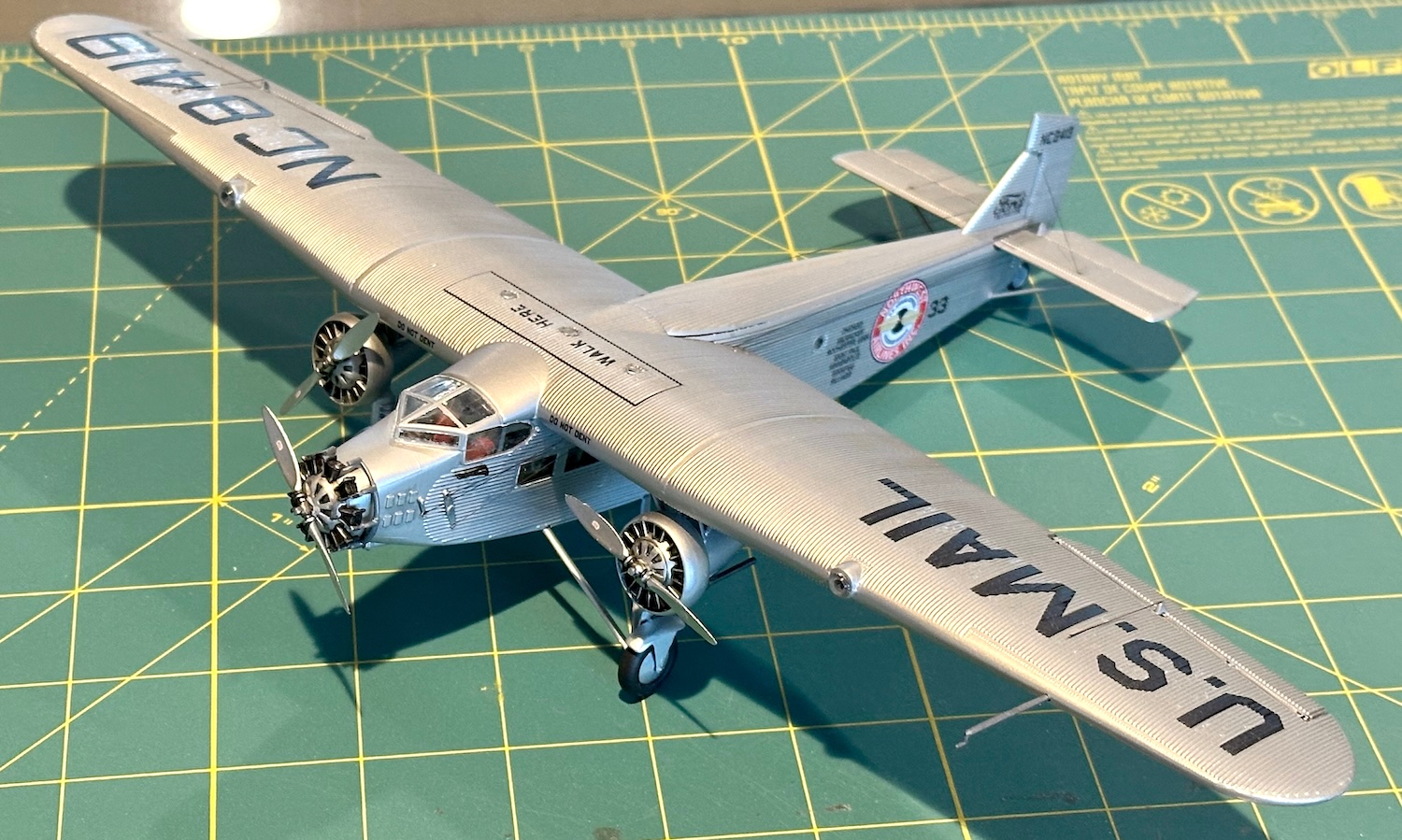
Decals are for American Airlines & US Marine Corp. I was very pleasantly surprised at how good this kit is. I have little bitches about things as you have seen but the bottom line is that the model looks like a Ford, Airfix got the proportion right and the corrugated metal surfaces are a standout feature.

Paul

1 Like

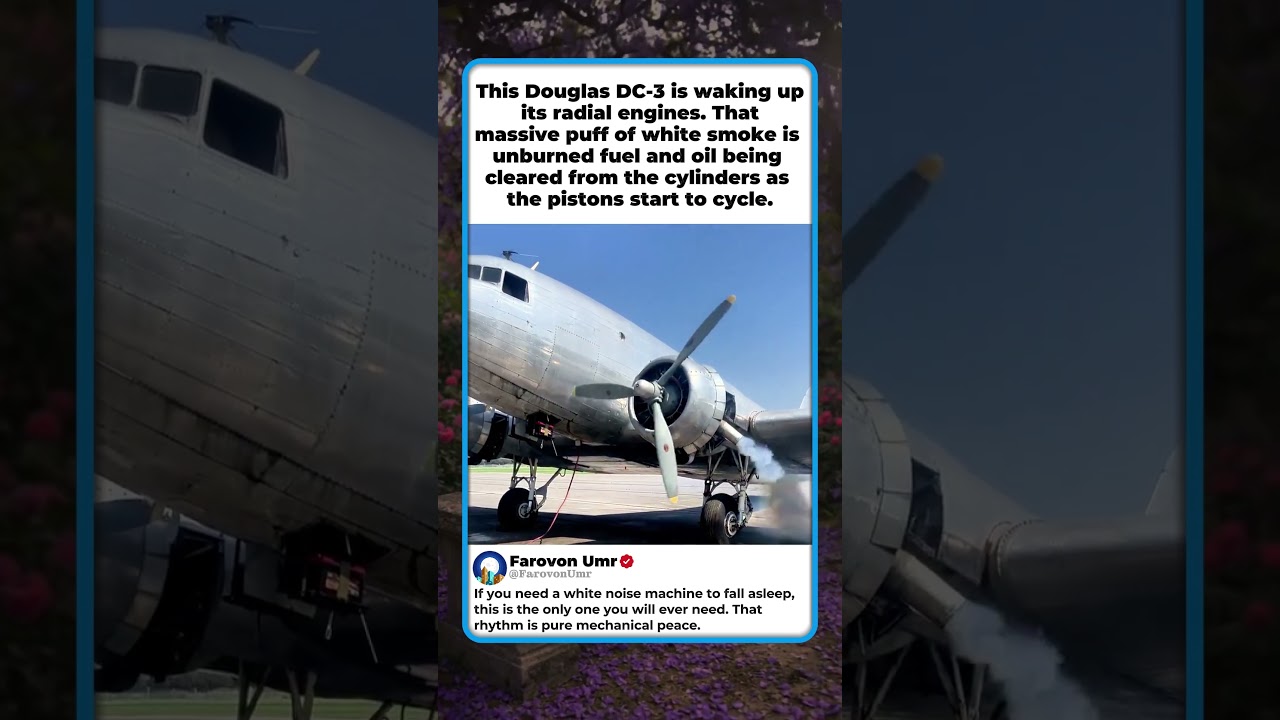
Some inspirational sounds:

1 Like

Yes, wonderful sounds. I’m glad there are still examples around to see & hear.

Paul

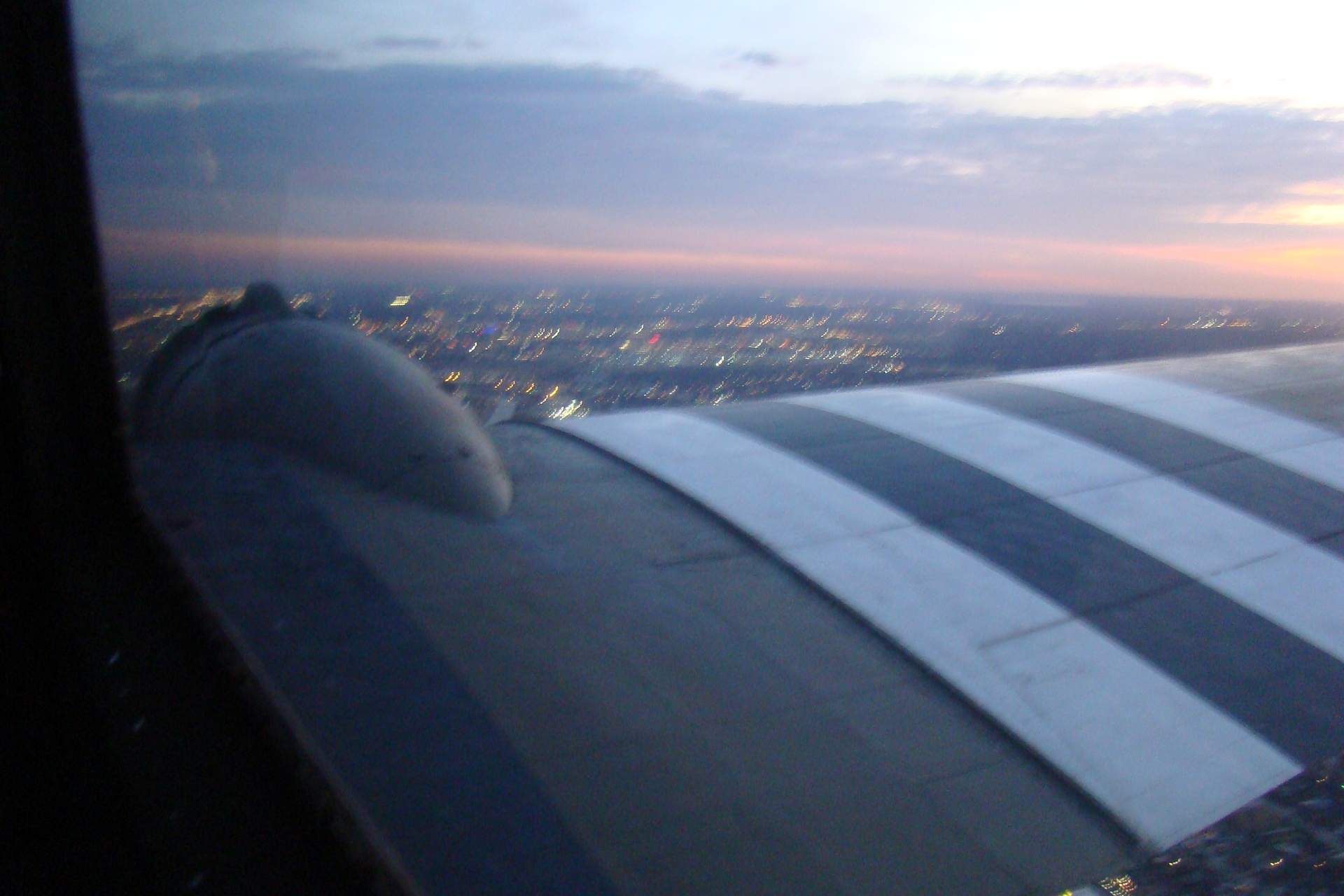
Let’s just say when they fired those engines up for our flight, the blood went to all the right places.

2 Likes

It was said of the Ford Trimotor that it took US air services from barnstorming to airlines. While there were a few cabin airplanes before the Ford, they were built in tiny numbers and all but those of Hugo Junkers in Germany were built of wood & fabric. When the first Ford Trimotor took to the air in 1926, the vast majority of US air services were flying open cockpit biplanes.

I recently read a history of Western Airlines. As Western Air Express, they launched their service in 1926 from a cow pasture in Montebello, CA south of Los Angeles carrying mail to Salt Lake City. The M-2 had two cockpits, the rear one had a seat for the pilot. The front one was just a mail compartment.

Western started selling passenger service if there was enough room after the mail was loaded. The passenger was handed a greasy flight suit and leather helmet & goggles and in very few words briefed him on how to use the parachute. The passenger then boarded to make himself as comfortable as possible on top of the mail sacks.

While a few air services had cabin aircraft, by far the majority operated like Western did. It was into this climate that the big powerful Fords entered. Here was a fast (105 mph cruise) reliable and long lasting aircraft that quickly replaced most other aircraft in the service of airlines and set the bar considerably higher for all competitors.

Between 1926 & 1933, the last year they were made, Ford built 200 of them. Not since the Great War had aircraft been built in such numbers. The Fords were everywhere and the majority of US trunk carriers operated them.

As great as the Fords were, even in improved form, they were rapidly outmoded by the Boeing 247 & the DC-2. In 1933, the year the 247 came out only two of the trimotors were built.

Ford figured he had accomplished what he set out to do and got out of the business. Stout ran his own airlines and did many other productive things in his long career.

In reading about the climate that created the DC-3 it was obvious that it was produced as a part of a lineage that really began with the Fords.

Back to the model!

These aircraft were painted in a silver anti-corrosion lacquer, they were not NM. I used Tamiya’s AF-12 in a rattecan.

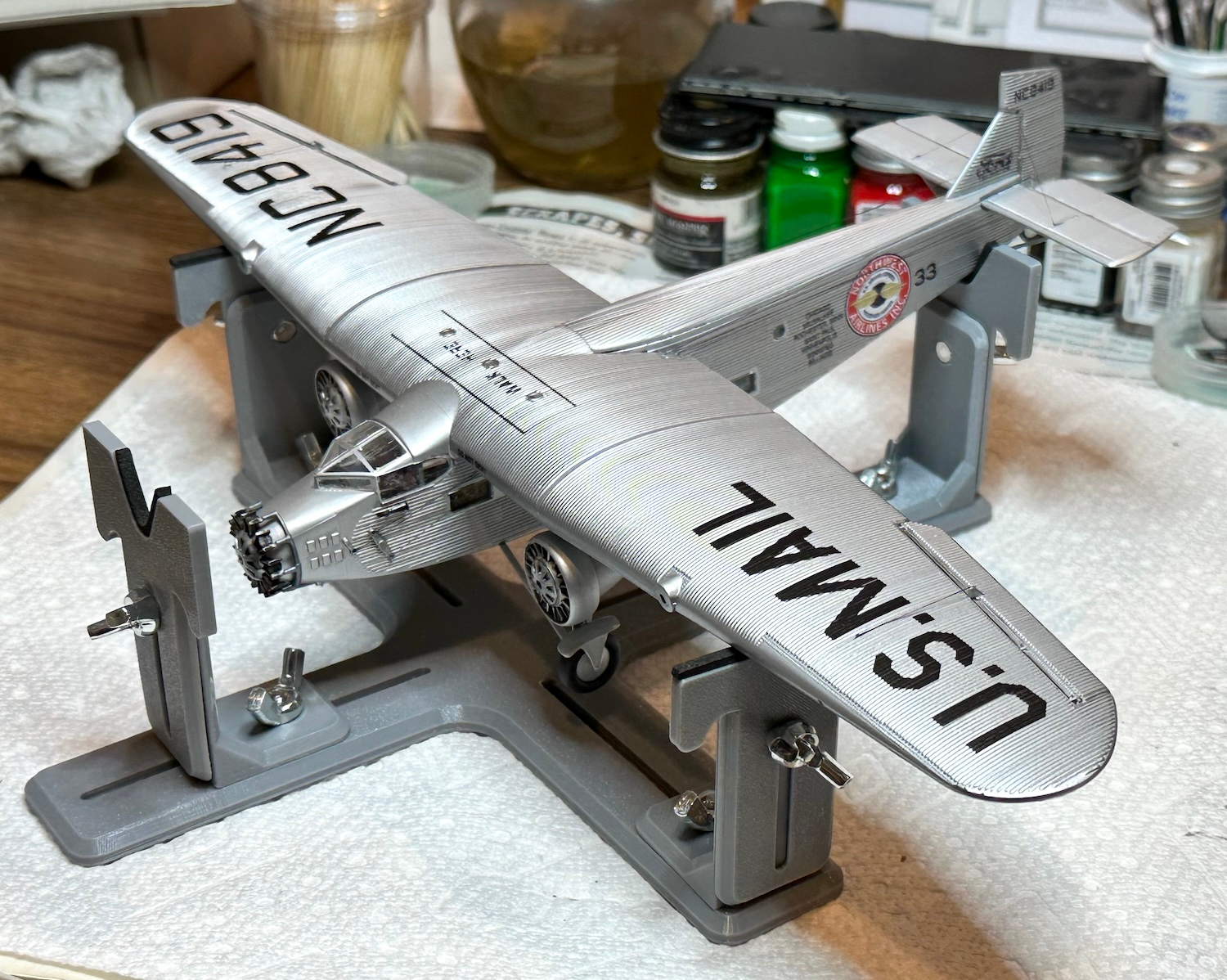
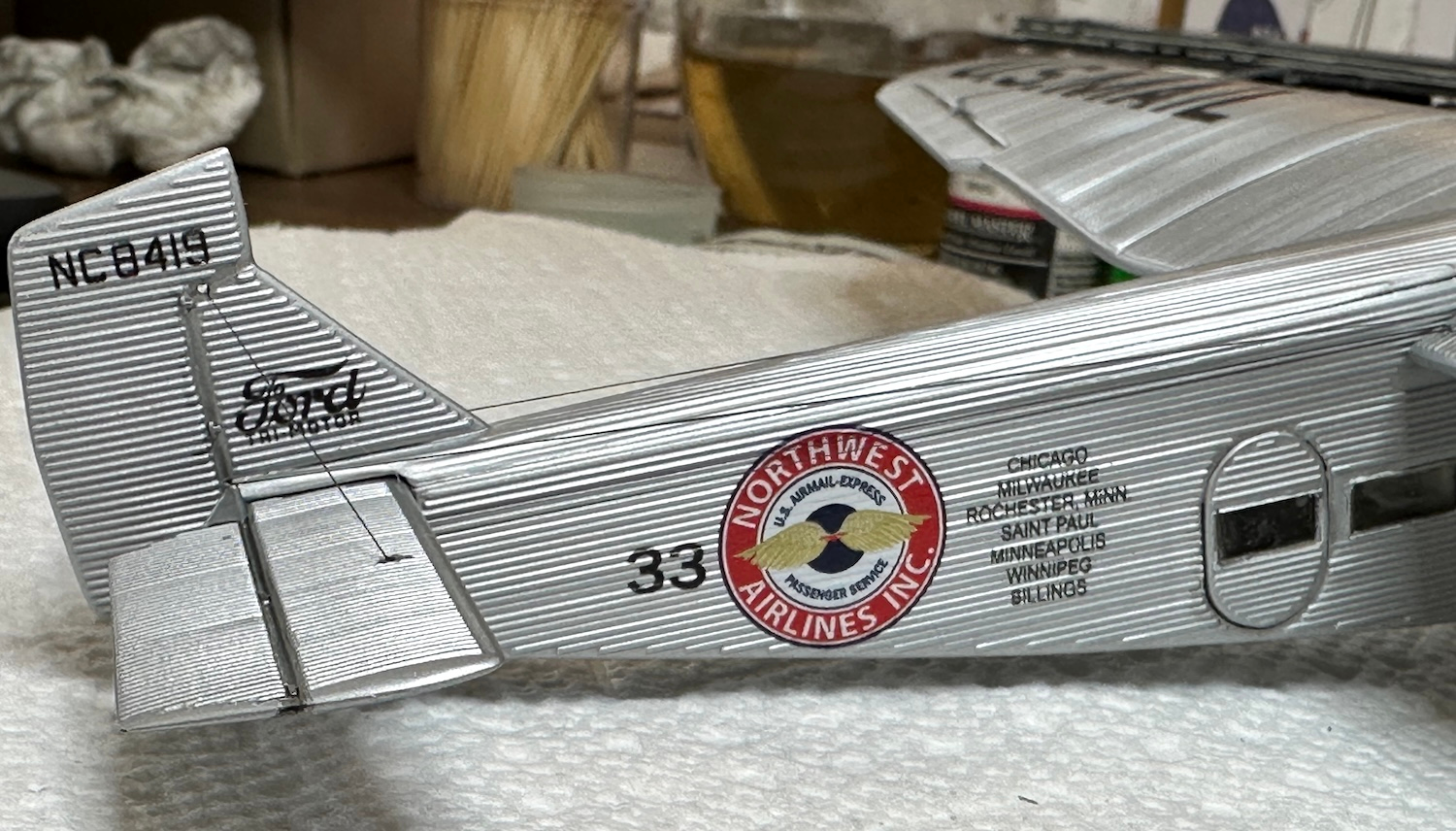
The Draw decals were very nicely printed and look great. They were hard to adjust on the corrugated surface but for the most part, laid down well with nearly invisible carrier film. The exception was with the large wing decals. The decal simply could not be made to stretch as far as needed to sit into so many corrugations. No amount of Micro Set & Sol and finger work trying to massage them down would make them stay in place. Were I to build this kit again, I would tape out a baseline and mark the tape with a pencil indicating where each letter and number needed to go. Each figure could then be cut out and applied individually. I know this sounds tedious but I think it might have saved considerable time over the way I did it. The whole model was overcoated with Tamiya semigloss.

There was a lot of rigging to be done, all with EZ Line Fine. Some of it went smoothly, other lines were very frustrating. I leave the untrimed ends for a few hours until the CA glue has fully cured.

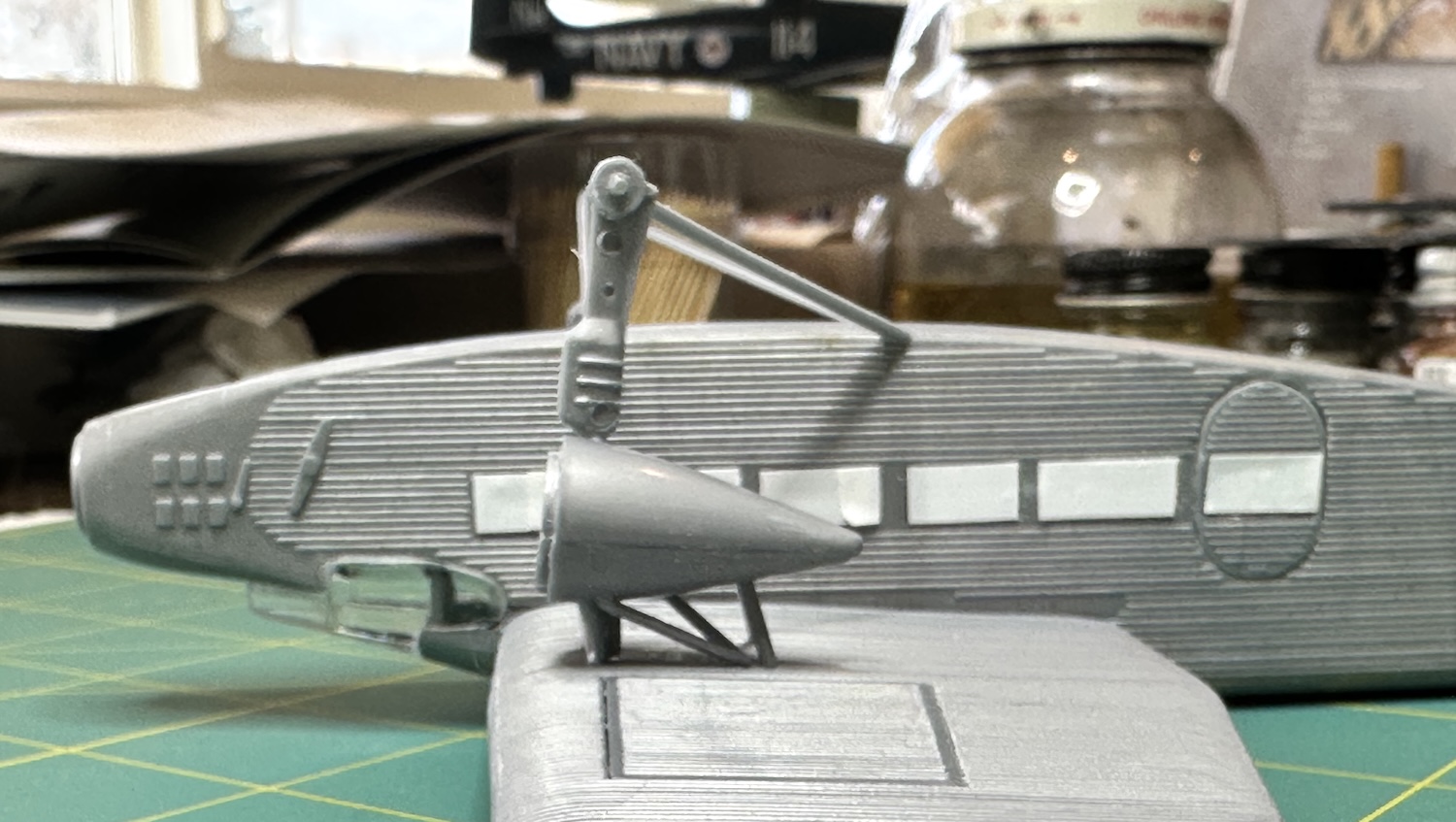
One area I would like to have seen changed in this model was the control bellcranks outside of the cockpit. Airfix molded then into the fuselage sides which did not allow the rudder lines to pass under the elevator bellcrank. Few observers will pick this up but I know . . .

This little jig was very handy for holding the model while it was rigged.

One thing I noticed is that Airfix has the propellor blades on backwards like they were intended to be pusher props . . .

The Fords operated from dirt or grass fields for the most part. Fenders helped keep them tidy.

Had I realized so much of the cockpit would be visible, I would have made up some seat belts. Oh well!

This is the way a passenger would have seen the livery, up close and personal. Now we never see our airliners except from long distances which has forced the airlines to adopt some very boring schemes. Not everything is better now then it was then.

Done!

Paul

6 Likes

@18bravo nice find! Those P&W 1830s never failed me in 600 hours. (I can’t say that for a Lycoming engine that afforded me an unexpected landing in the Great dismal swamp. Or the P&W that failed when my friend was taking off from Tenerife.). (I just neither of those are complete failures because they produced some good stories.)

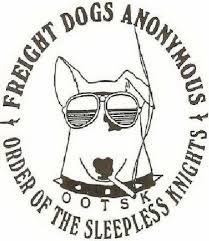
My P&W emblem disappeared long ago but thanks to this group build, I finally ordered my OOTSK Freight Dogs Anonymous shirts, mug and sticker.

One of these days I’ll have to start telling some of my stories. I told him to you and some people on the side tell me I should start sharing them with the rest of you. I don’t think you’re all that interesting. They are more like reminiscences than stories.

Here’s one. We had a overnight run where we would fly up to Chicago O’Hare, load the airplane up with components for Chrysler Le Barons, and fly them down to Tullahoma, Tennessee. One early morning (for the date I recall tornado warnings around Muscle Shoals, Alabama but they must have not been confirmed because I’ve never found a record for any hitting there about that time) we were at 4,000 ft in turbulence getting the snot kicked out of us, but we had intermittent ground contact and requested lower from Nashville approach. They gave us 3,000 and down we started. About 3,500 ft, we flew into a strong updraft and up we went. Eventually, we had those Pratt and Whitney’s at idle, gear extended as airbrakes, nose down (and floating in our seats against the lap belt), airspeed approaching red line, and ATC asking us to “say altitude”. We flew out of the updraft at 4,500 ft. The landing gear lever on a DC3 was this giant multi-cooked bar that was behind the copilot seat; I had to climb myself around the seat to reach that thing to lower the gear. Finally, we were able to tell ATC what happened and they cleared us back down to 3,000.

That was a memorable trip. Another memorable trip was a two ship heading up to Chicago that had penetrate a narrow line of thunderstorms. Aboard the DC-3 that I was not in, was Herman. Herman was a friend of my Dutch roommate, who was hitchhiking around the US and occasionally would come by to visit. He’d fly with us at times. But he wasn’t ready for thunderstorms. Two of the three ‘Threes” I was sure if I had to fly in had the same type of radio, but the other one had a fancy sweet out of I think a Hawker business jet. Most were push to talk to the outside, pushed for the intercom. The one Herman was in had a hot mic for intercom. We’re flying along in all of a sudden we hear a familiar voice asking, “What’s wrong? Are you okay? Are you sick? If you’re sick, tell me and we can do something about it.” Kevin keyed up with a terse, “Jack, you are hot”, followed by ATC saying “say again”. Poor Herman had barfed all over himself, the airplane, and even into the louvers of the janitrol heater. It took a couple months before the smell got out of that airplane.

1 Like

What a great story! When were you flying the threes?

Paul

2 Likes

We need more stories like that. I posted a story once about Navy SEALS and Green Berets “yakking it up” in a C-130.

2 Likes

I just love those stories :smiley:

1 Like

I flew for Miami Valley Aviation, formerly Hogan Air, summer 1989 until spring 1990.

In one of the flying magazines, Plane and Pilot or Flying, a retired Flight Standards District Office check airman named Martha Lunken pens a monthly feature titled Unusual Attitudes. She really liked Hogan Air/MVA, and frequently writes about or at least mentions them. She is a character in and of herself, and MVA really liked her. I met her once or twice, hardly had a contact other than a very reverent “hello”.

One of the pilots was Stan Bagnall. He was a Fifth Air Force C-47 pilot in New Guinea up into the Philippines. You know those photos of C-47s dropping paratroopers onto Corregidor? Stan was the pilot of the lead C-47 of that mission, even though he was not scheduled to fly that day. Stan said on-demand charter was the closest thing to WW2 Pacific flying he experienced, sans an enemy trying to bomb you or shoot you down.

If you have about 2 hours, an interview with him is below. Stan was a class act. Stan could handle any airplane as well as anybody else, was very knowledgeable and patient with new guys. Taught me a lot. He and Kevin were my favorite Captains to fly with. He did not mind answering questions. One of my embarrassing events was explaining in detail to him adverse yaw…with a stuck mic! Columbus Approach was not happy, but they never knew who we were. I was flying a Twin-Beach (the real Beach 18, with short fuselage, tail wheel, and round engines) through the outer bands of Hurricane Hugo with Stan, and definitely yielded the airplane when it came to landing. As expected, he masterfully set it down in a nasty crosswind with nary a bump.)
When I went to work with him he was in his late 60s or early seventies and yet he was still so spry, he could take a running start and vault himself up onto the trailing edge of a DC-3. I’m 6 ft tall and I recall the trailing edge came up to my rib cage. My first attempt to jump the wing (you were too busy to wuss out and use one of those dandyfied fancy ladder contraptions) I missed and caught the trailing edge in the saddle of my crotch. Had a really nice bruise fortunately nothing important was damaged, although people called me squeaky for a few days because of my voice. (I saw an episode of Ice Pilots where a new guy who wanted to get into the cockpit tried that, only he was not as lucky as I was.) Necessity is the mother of invention and skill, and I had no other problems jumping the wing after that, even in rain and snow.

Excluding one of the owners, there were five captains when I was there, Stan being one of them. One of them, if you read about DCs, you’ll see his name mentioned occasionally. Another was Jim - also chief of maintenance - I flew with him a couple of times but he was mainly in the hangar. Those two were universally worshiped as the kind of awesome excellent pilots everybody wanted to be like; both were willing to talk to her new co-pilots about how to become better pilots. ( Kevin’s dad was the curator of the US Air Force Museum at the time.).

The two other captains were “J” and “C”. Like Kevin, “J” had the reputation of being able to fly anything in any situation and handle it properly. But he was a jackass - surly, pompas, condescending, and a smartalek. He also thought the rules never applied to him and did a lot of crazy crap. He ended up quitting the company, buying a Twin-Beech, and starting a one-man on-demand charter outfit. That is, until he had a severe engine failure at night, in a snow storm come and had to land on the Ohio Turnpike. (Like I said, he was able to handle any situation.). They said he quit flying that night and went back to the Midwest and started a concrete business. Nobody I’ve talked to knows for sure; out in Phoenix 10 years ago there was a construct project and the concrete company logo was a Jolly Roger-style skull, wearing a hard hat, with two crossed concrete trows where the bones would be. (Pretty dang cool in my book!). I’ve always wondered if that was his company because that was his personality. “J” I did not like flying with because of his personality, but except for a couple of instances, I always felt comfortable that he could get us out of any bad situation in the air. Then again, he put us into several sketchy situations and the only time that I wasn’t sure if I would get out of the airplane unhurt was due to one of his antics.

“C” was the opposite. He had the seniority and position over me, but I was never completely comfortable with his ability as a pilot. Or that he was a 45-year-old 14-year-old. I eventually we came familiar with his quirks but I was never always comfortable flying with him. One time, I actually took the airplane from him, an incredibly serious fracture of all standing conventions between pilot and co-pilot. After narrowly escaping with my job because of that, and learning a little more tact, I have more instances where I kept “C” (and me) from FSDO’s magnifying glass.

I have stories about J and C. Most of which are not complimentary. Although, I know they had plenty of complaints about me, according to my two roommates.

All in all, I really enjoyed my time there, but I was too much of a nerd, had too obtuse a sense of humor (and “assumed” everyone understood it), did not fit in with the company culture, did not understand how to “play the game”, and filed too many IFR flight plans for their tastes. (Read between the lines.). Ah, live and learn. But I’d had left the company before they made national news. But those are stories for the future.

Here’s the interview with Stan.
3 Likes

Paul,

Those patches look wonderful. Personally, the black one looks like someone in a military Squadron would wear, the white one shows up better for an award. At least in my eyes. Great job!
What was a DC-3 like to fly? As a single engine pilot I’ve never flown any twin much less something like the DC-3. I imagine they were pretty nice with few vices. Maybe heavy on the controls?

Ernest K Gann thought the DC-3 was stable and easier to fly than the DC-2. Oddly, he said the DC-2 would carry more ice. I wish he had elaborated on that.

I read somewhere that the B-17 which was even bigger was a pussycat, one pilot described it as a big J-3 Cub.

Paul