Space Shuttle Launch Complex 39A with Challenger STS-6 (1:144)

Hello everybody,

after the wearisome Gutter chapter has been finished except for the paintwork, I want to take a relaxing look ahead and bring the highlight of the lighting of the MLP back into the game, which will soon be back on my agenda. https://modellbauforen.de/Smileys/default/gut.gif

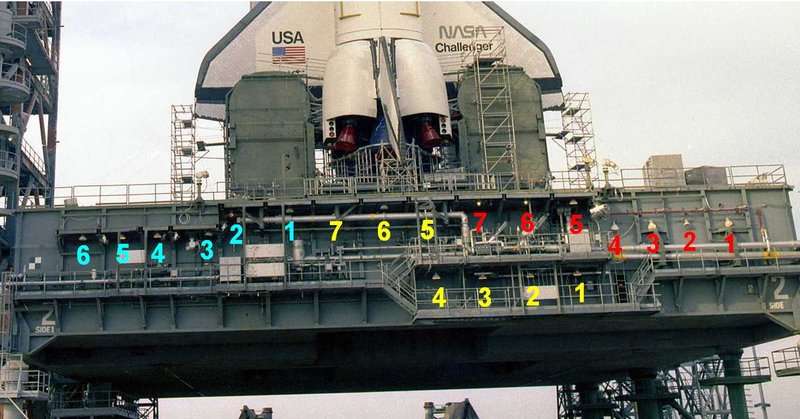
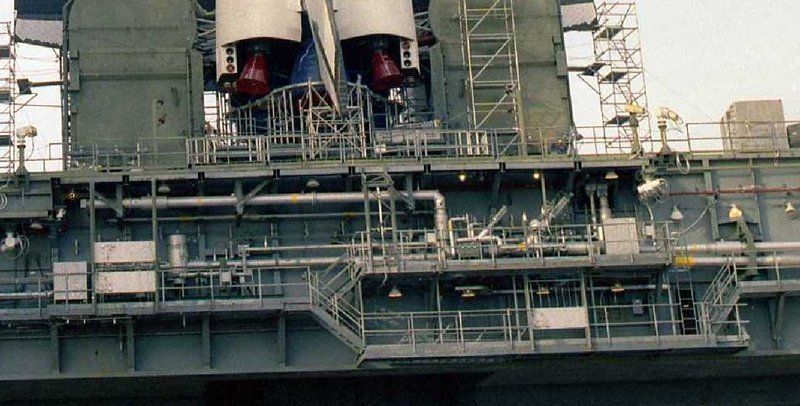
During my first inventory (2014) I had found these 21 lamps on the Side 1,
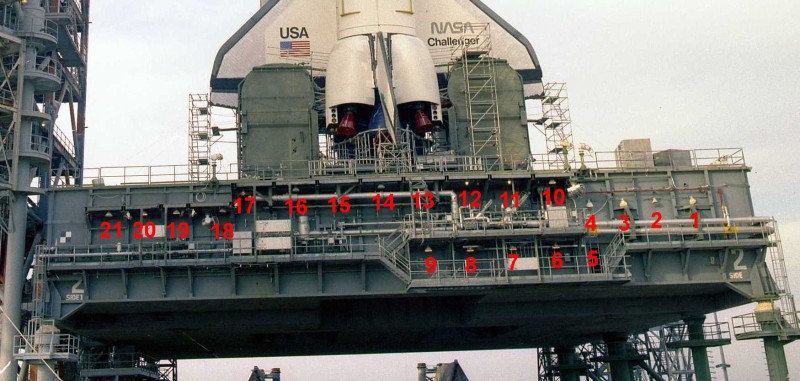

Source: retrospaceimages.com (STS-6)

which I had to correct in hindsight, since the Lamp 5 during STS-6 (1983) did still not exist, like one can see in this image of [STS-28 (1989)/color, but rather much later, whereby the number of lamps is reducing to 20. https://forum.raumfahrer.net/Smileys/yabb/huh.gif


Source: NASA

Since the wiring design of the Super Power bank was construed on max. 8 LEDs per circuit, my original lighting plan included these 3 circuits with a total of 20 lamps. cool1

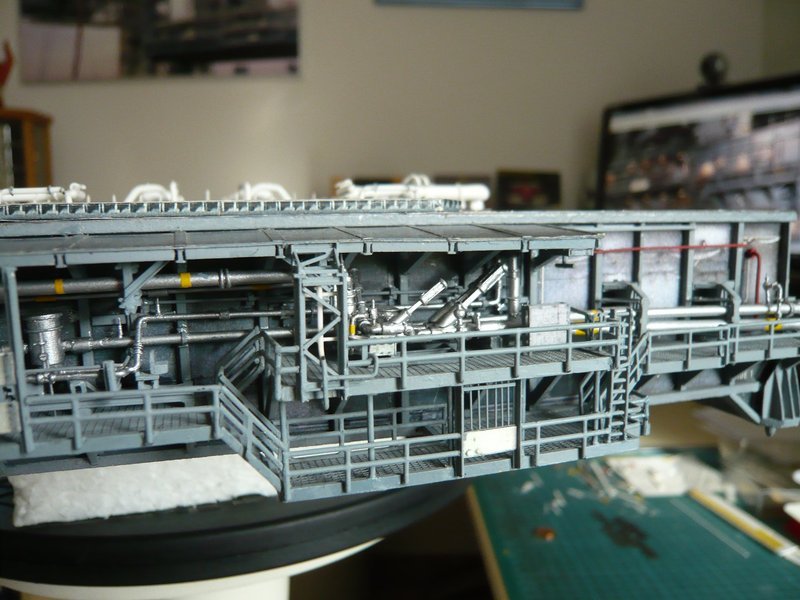
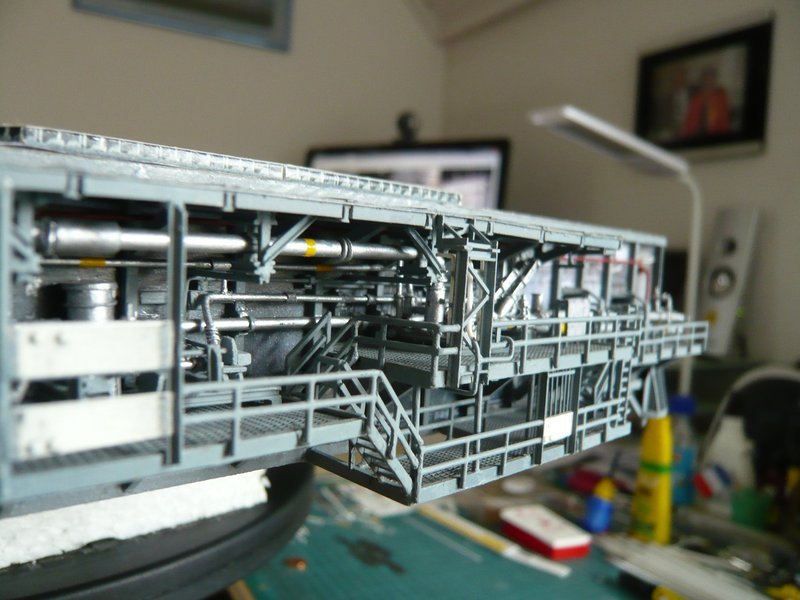
During the preparation of the later installation of the circuits on the model, it is important from a practical point of view to think about how the thin supply lines and the return conductors of the individual circuits should be laid preferably. Withal it is necessary to consider how to pass with supply lines and lamps through the narrow spaces under the canopies between the pipelines and struts and past the tiny fittings and also to glue them, what should not be so easy.

In my first lighting trials, the matter was easier, because I had then only provisionally laid the individual LED cables under the canopies, which now inevitably needs to be done differently in the final solution.

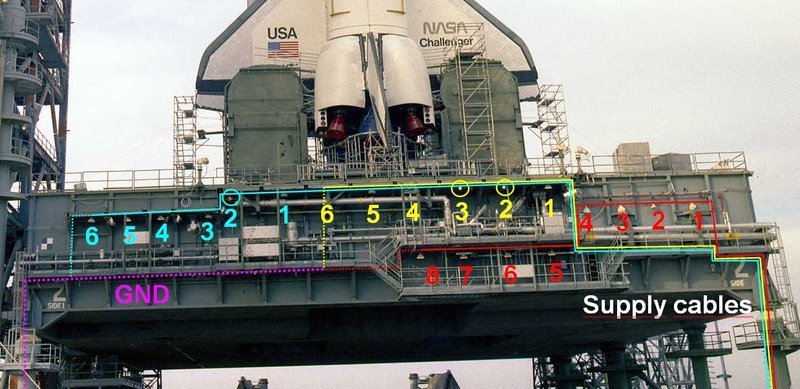
That’s why I have changed the division of the circuits, which now looks like this. Thus there will be 1 circuit (red) with 8 LEDs connected in series, and 2 circuits (yellow/cyan) with 6 LEDs each.


Source: retrospaceimages.com (STS-6)

Therefore I imagine the installation so that the three supply cables are led through the front right Pedestal, preferably detachable via mini-connectors, https://www.britmodeller.com/forums/public/style_emoticons/default/hmmm.gif in order to be able later to let drive the Crawler with the MLP a short way on the Pad diorama.

In contrast to my original plan, it will be more favorable to lead the first circuit (red) along the wall to the right Access Platform and then under the LH2 Access Platform. As with the other 2 circuits, the return cables then run via a Ground (GND) bus (pink) below the left Access Platform and the front left Pedestal.

The installation of the second circuit (yellow) will presumably be the most difficult act because the place under the Blast Shield over the valves of the LH2 Valve Skid is very tight, as one can easily see here. https://images.raumfahrer.net/up035091.gif

But we’ll work it out somehow …

The installation of the third circuit (cyan) hopefully will be a bit easier, because there is more space above the LOX Valve Skid and under the left Blast shield.

As far as with this little trip to the illumination of the clouded minds. https://modellbauforen.de/Smileys/default/gut.gif

I’m sure that this Lighting subproject will be a lot more enjoyable and inspiring than the tricky Gutters were! https://images.raumfahrer.net/up040577.gif

5 Likes

Wow lighting will take this to another level…which is already in the stratosphere - it’s looking fantastic already :rocket:

1 Like

Thanks Tim for your superlatives, https://www.britmodeller.com/forums/public/style_emoticons/default/bow.gif it almost sounds like ‘Across the Universe’. https://images.raumfahrer.net/up035091.gif

Hello friends,

then let’s go to clarify a few last details with the MLP lamps and try out. cool1

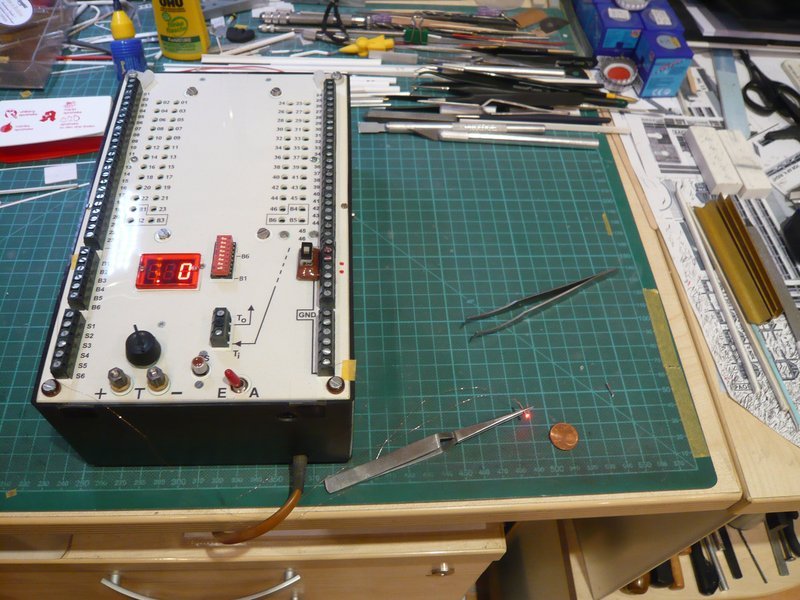
First of all, I want to introduce my Super Power Bank[/color], which a good friend of mine had designed and built in an ingenious way for illumination of my Launch Pad Diorama.

Here again briefly to the profile of this ‘Marvel Box’, whose performance capability we deliberately generously constructed, which provides the following Constant current circuits:

In each of the two circuits (220 mA), 2 LEDs can be connected in series. In each of the other circuits, however, up to 8 LEDs can be connected in series. That gives the impressive number of total 464 LEDs (368 + 48 + 48), which I will not exhaust corresponding to my previous planning.
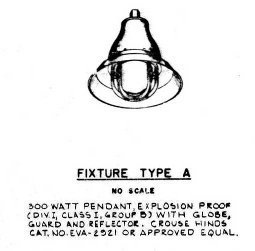
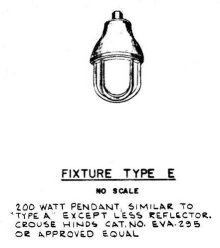
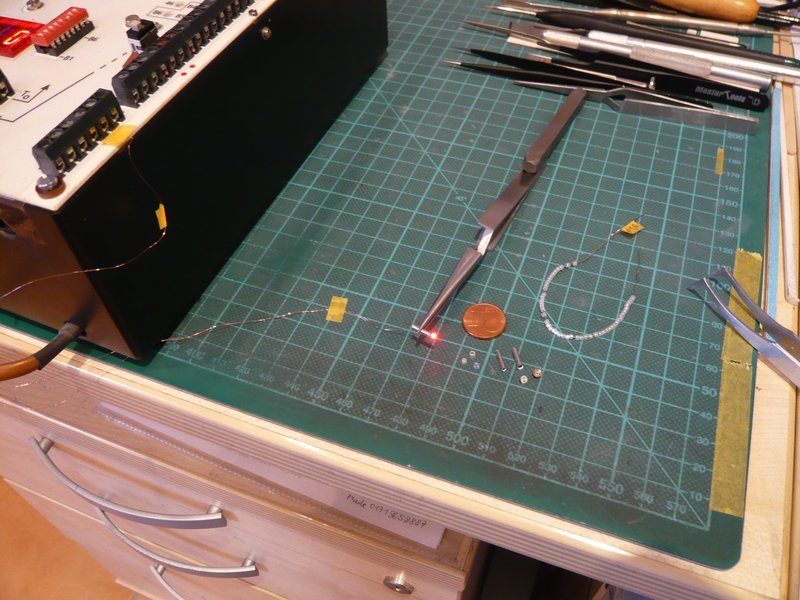
Before I react to the red LED (0401) for the Warning lights connected to the Power bank in the image above, I have scrutinized once again the relevant lamp shapes for my pad model, initially adopted by the Apollo LUTs at the beginning of the Shuttle program and later replaced by more modern lamps.

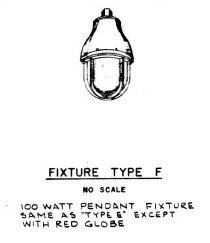
At that time there were lamps both with reflector (Type A) and without reflector (Type E), and this type also with red globe (Type F), as it was used for the warning lights.


Source: NASA

In the Tower (FSS) and on the RSS the lamps with reflector were mostly installed,


Source: NASA


Source: NASA

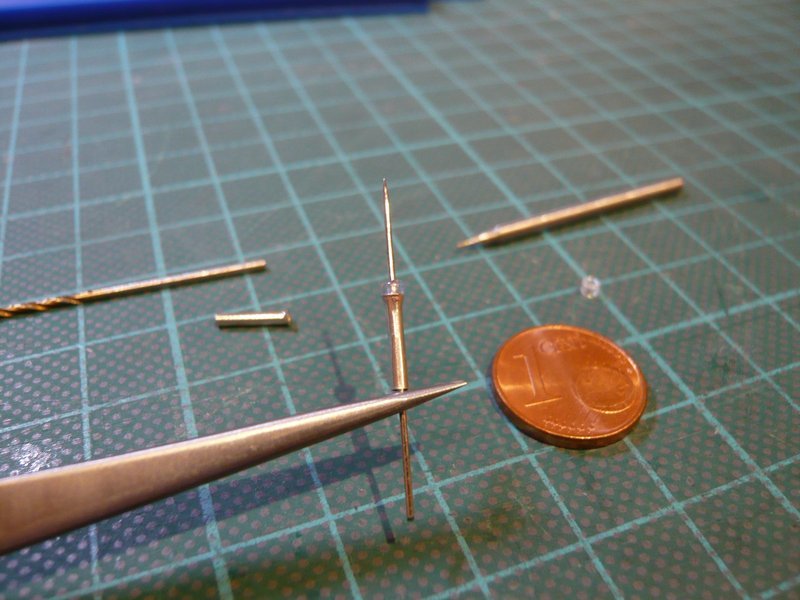
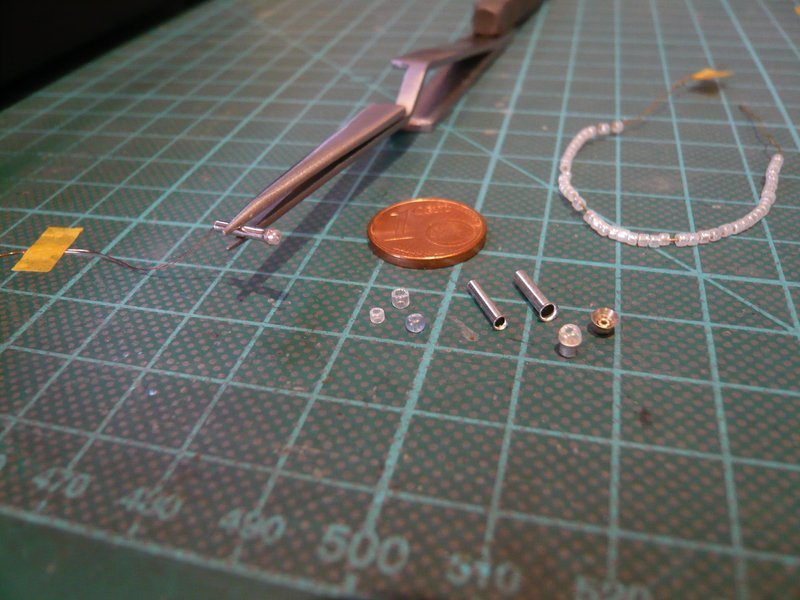
for which I have used expanded ferrules (1 mm²) with inserted beads for fixing the LED wires. cool1

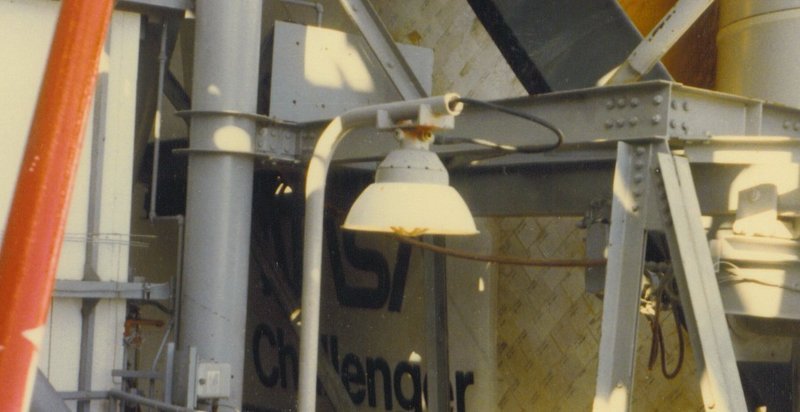
With the exception of lamps 2 and 3 (yellow) and lamp 2 (cyan), all lamps on the Side 1 are Type A and have a reflector,


Source: retrospaceimages.com (STS-6)

what one can see a little more clearly in this pic section.


Source: retrospaceimages.com (STS-6)

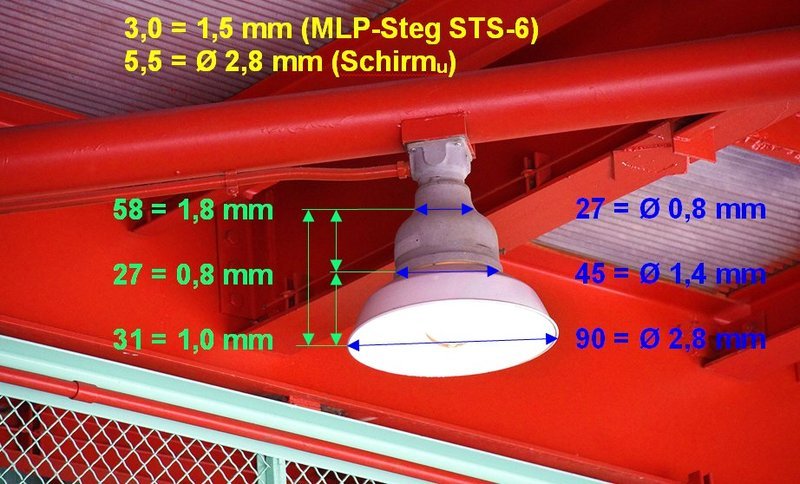
As a reference measurement for the dimensioning of both lamp shapes served me the width of the webs on my MLP walls of 1,5 mm.


Source: NASA

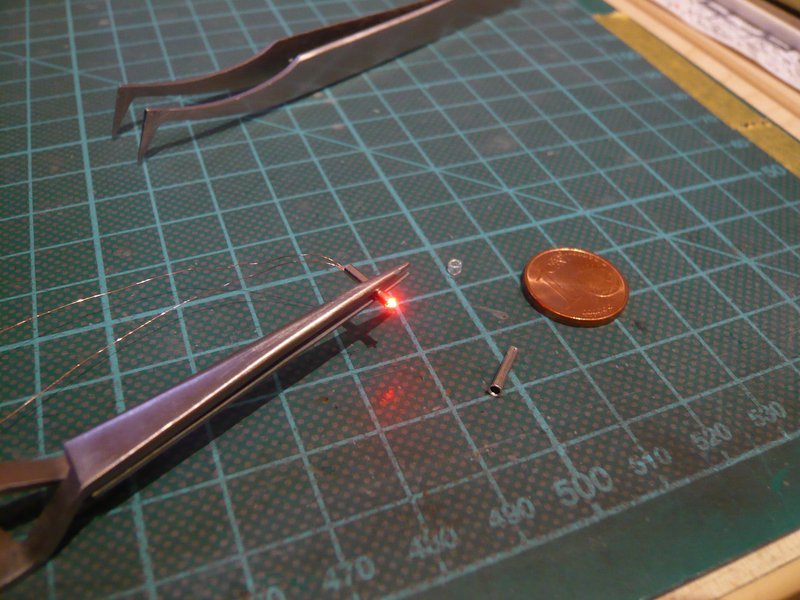
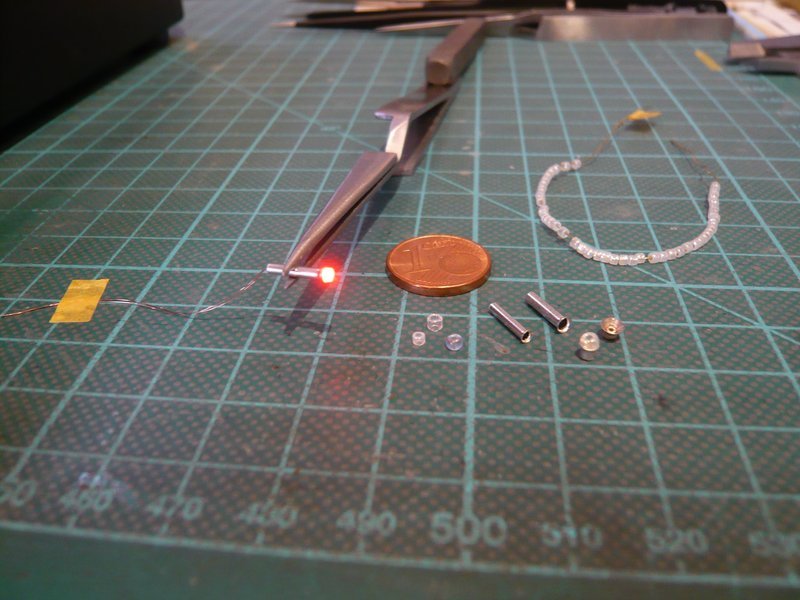
And so back to the first image with the red LED for the warning lights, which works perfectly with the Power bank, only it does not blink quite as fast as this one.

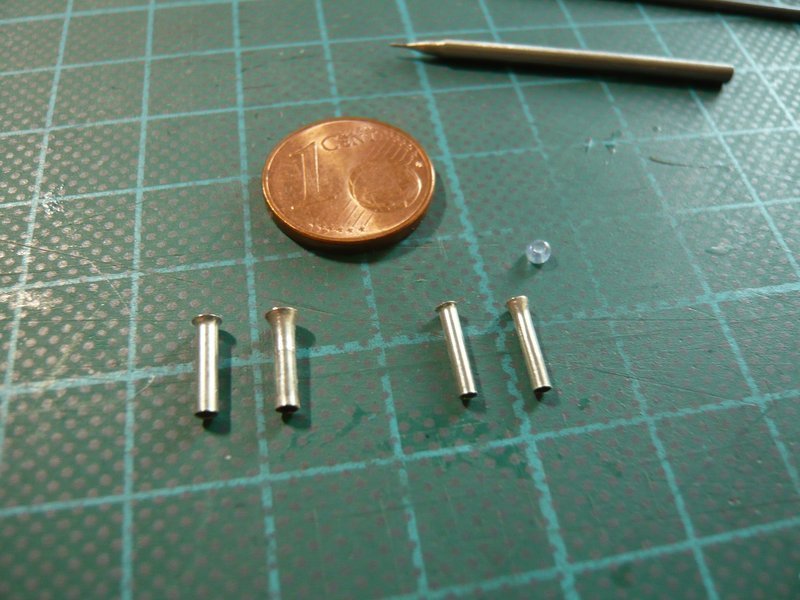
Since these lamps without a reflector are slightly smaller, I have used slightly smaller ferrules (0,5 mm²), which need not be widened as much as the sleeves for the lamps with reflector (left in the picture).

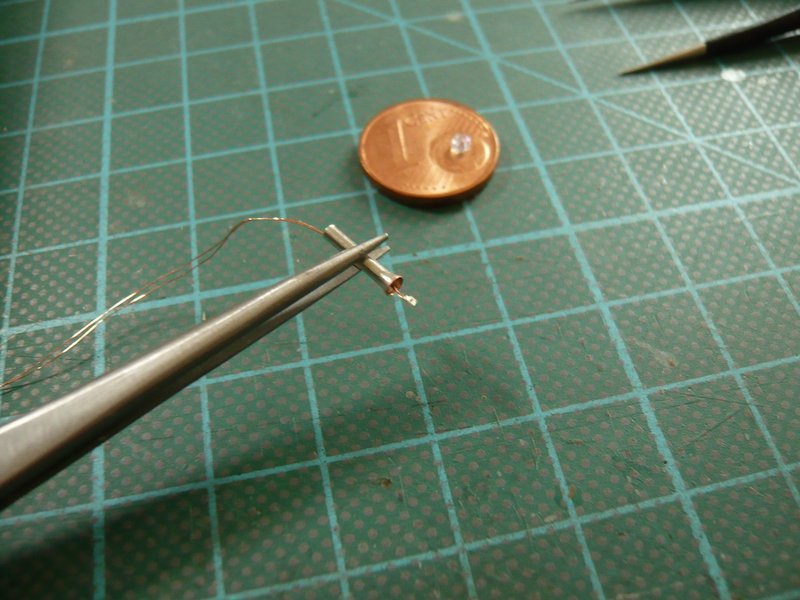
The difficulty with these lamps without reflector is to find a suitable glass bead for the glass body, for which I have tried different bead sizes.

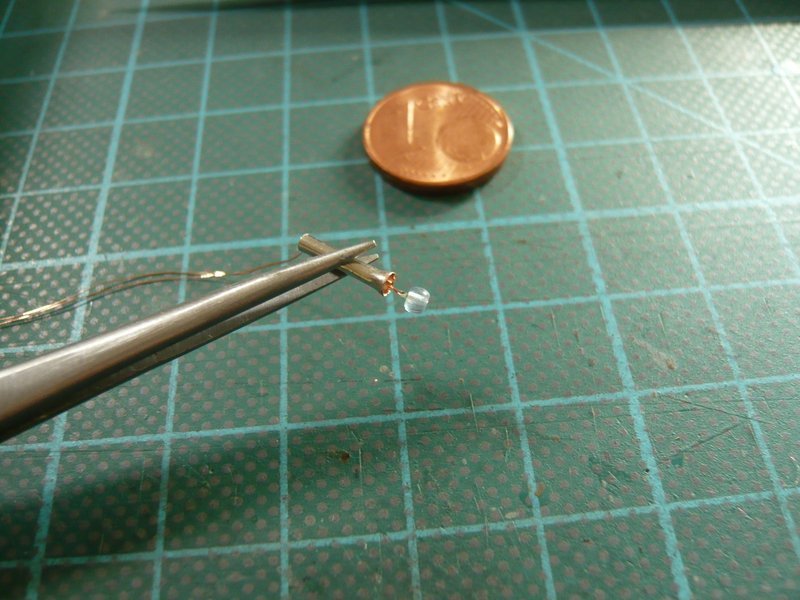
Here is e.g. a cylindrical shape,

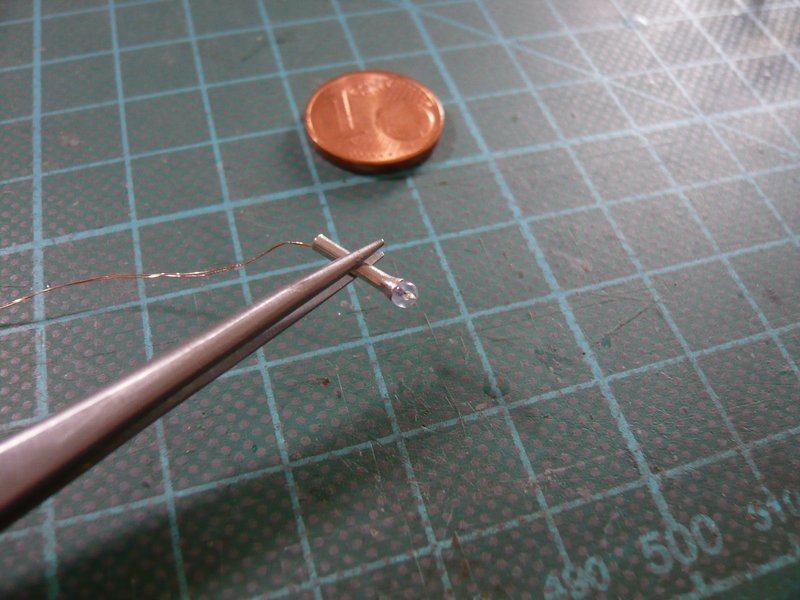
and here a roundish bead, which should fit better in size.

The sticking point here is that the LED also has to fit into the bead, which is why only the smallest types 0401/0402 with dimensions 1,0 mm x 0,5 mm x 0,5 mm (LxWxH) are suitable for this.

Then I still found this smaller bead, which fits even better with this lamp shape without reflector.

And with that I want to content myself for today. https://images.raumfahrer.net/up040577.gif

7 Likes

Well, I thought I was running out of things to be amazed at during this build/recap, but you have outdone yourself Manfred. Those lights and that gantry/walkway section are just stunning, even more so when you see it lit up.

1 Like

Thanks John for your unwavering loyalty and staying interest. https://www.britmodeller.com/forums/public/style_emoticons/default/bow.gif

I understand your excitement because the Gutter chapter was a bit tiring, so it’s time for new and more interesting tasks. https://images.raumfahrer.net/up040577.gif

1 Like

Hello everyone,

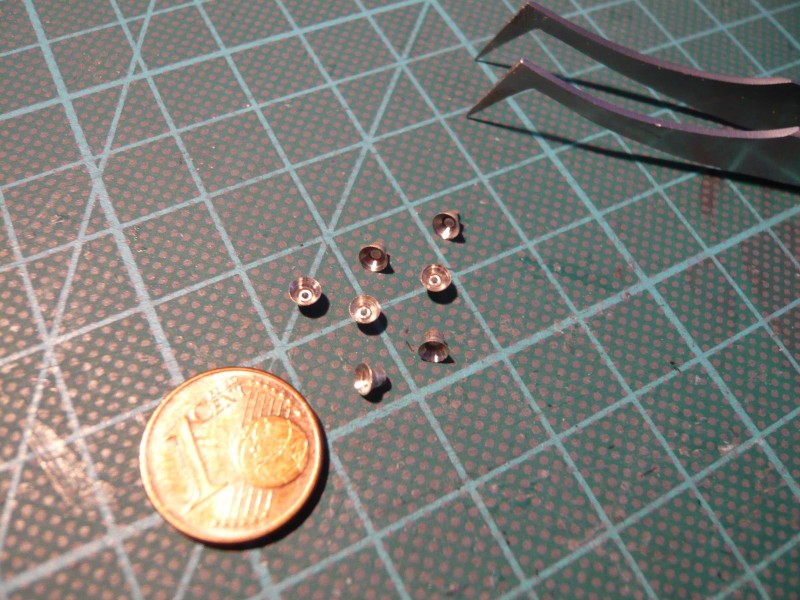
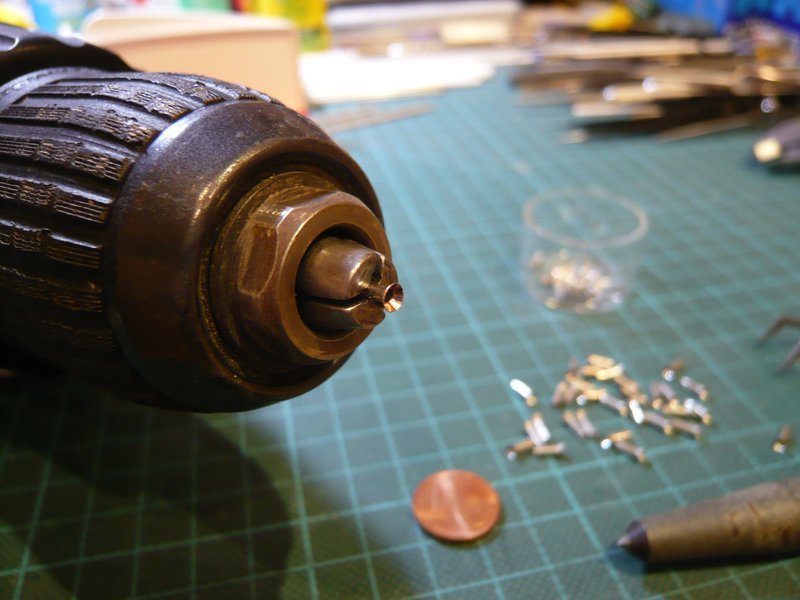
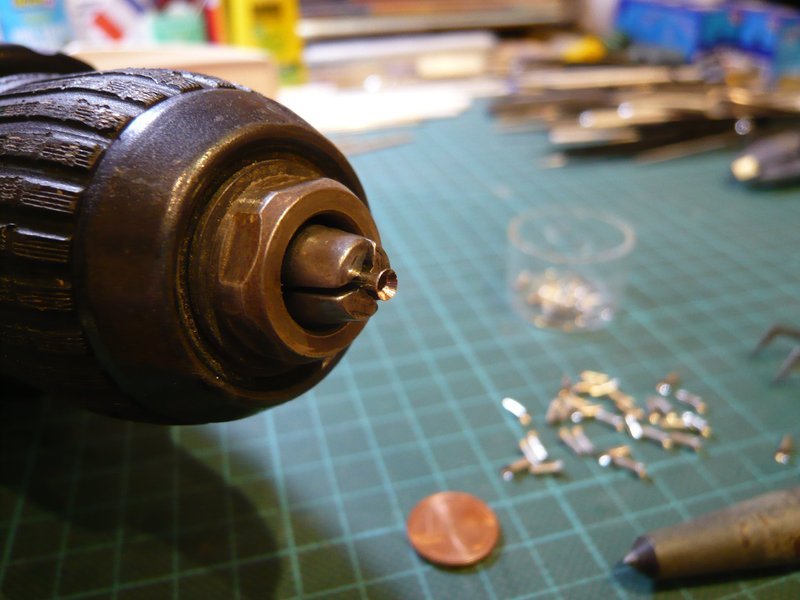
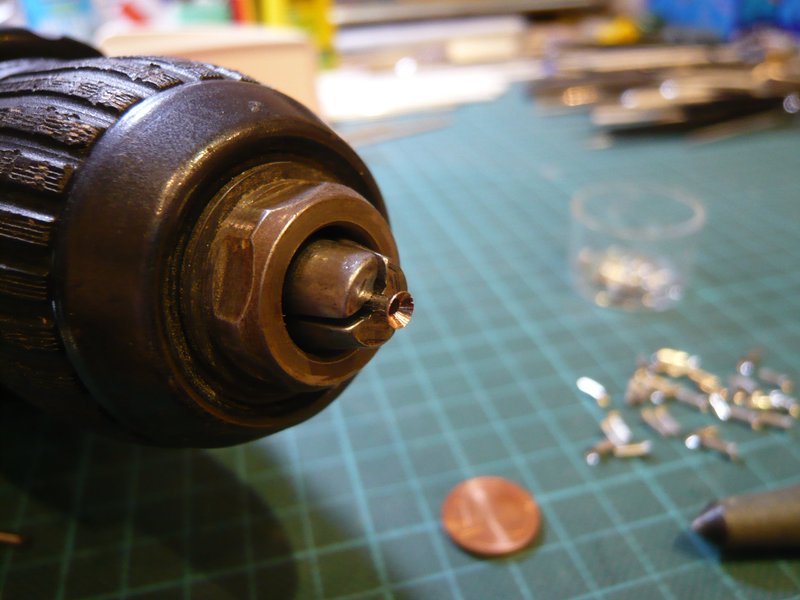
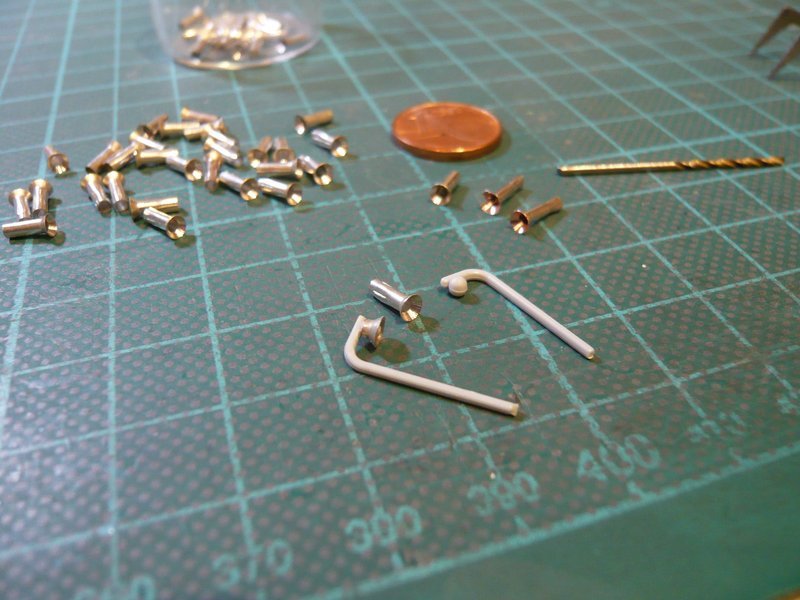
today I have first expanded a handful of the larger ferrules (1 mm²) with a center punch from 2,3 mm to 2,8 mm diameter, for which the cordless screwdriver only needs to run a few revolutions, otherwise one is fast at Ø 3 mm or more. https://forum.raumfahrer.net/Smileys/yabb/rolleyes.gif

Then I experimented a bit further and tried to expand also the slightly smaller ferrules (0,5 mm²) to Ø 2,8 mm.

At this sleeve, the smaller diameter of the tube with 1,4 mm is still slightly smaller than that of the larger ferrule with 1,8 mm, which would fit much better to the socket diameter of my lampshades.

The only question was whether the sleeve would endure the expansion, or whether the lampshade would crack.

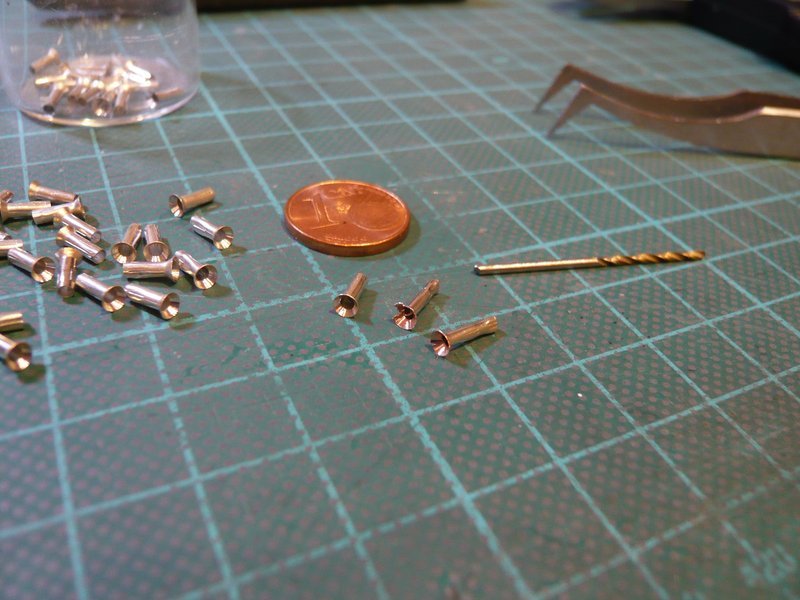
On my first attempt, I was probably a bit too impetuous, which can be clearly seen on the cracked lampshade on the right in the picture. To the left are the expanded 1 mm² ferrules, which did not mind this expanding.
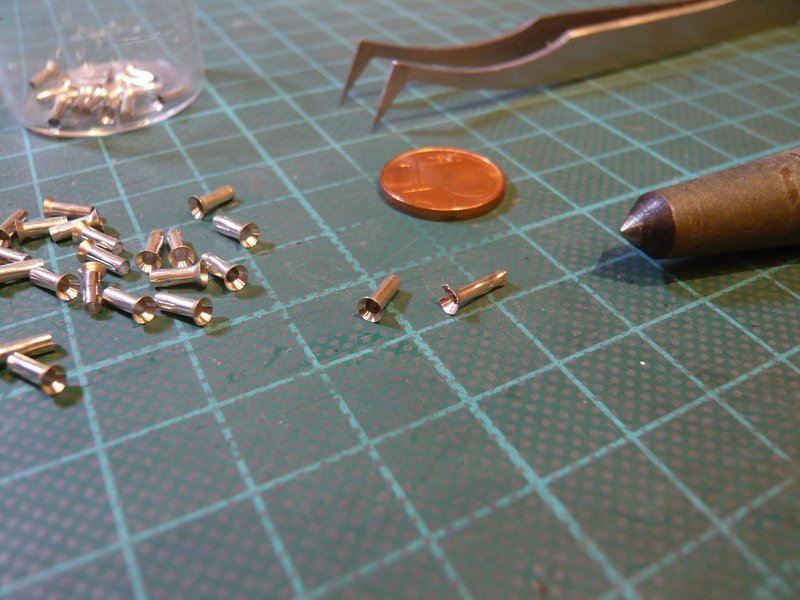
Therefore, I proceeded much more cautiously on the second attempt and checked the lampshade diameter from time to time with the caliper gauge. cool1

Everything went pretty well up to Ø 2,5 mm, as you can see here,

but at Ø 2,8 mm the first mini-cracks appeared on the edge of the lampshade, https://forum.raumfahrer.net/Smileys/yabb/rolleyes.gif which is why I will rather use the larger ferrules.

And here’s already a look ahead to the mainly installed lamp shape on the RSS, here on Pad 39B during the preparation of the Challenger on her last, unfortunately fateful mission STS-51-L (1986). https://www.britmodeller.com/forums/public/style_emoticons/default/analintruder.gif


Source: forum.nasaspaceflight.com (James MacLaren)

And here are my first attempts compared to a simple lamp from the Revell Kit (right).

Probably for these lamps thin brass tubes will later be used into which the LED wires then will be threaded respectively soldered. https://images.raumfahrer.net/up040577.gif

6 Likes

Wow, wow, wow…

3 Likes

Very good :+1:

1 Like

Thanks Mike for your divine enlightenment. https://www.britmodeller.com/forums/public/style_emoticons/default/bow.gif

Hello everybody,

on closer inspection, however, the lamp Made by Revell is too rustic for me, which I can not make friends with, https://www.britmodeller.com/forums/uploads/emoticons/default_fraidnot.gif especially as the tube seems also too thick to me. https://forum.raumfahrer.net/Smileys/yabb/rolleyes.gif
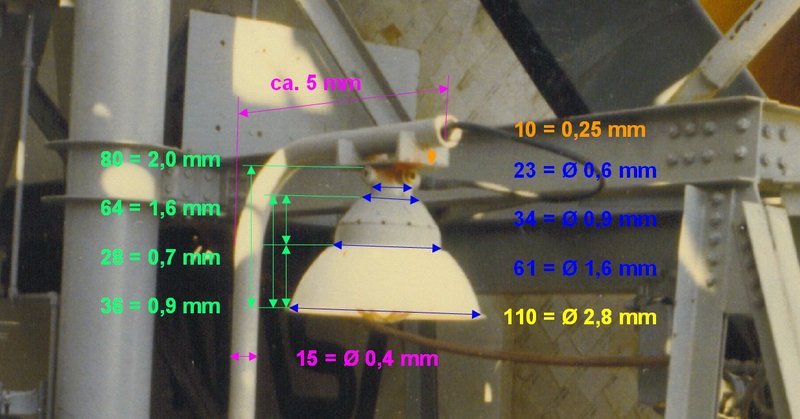
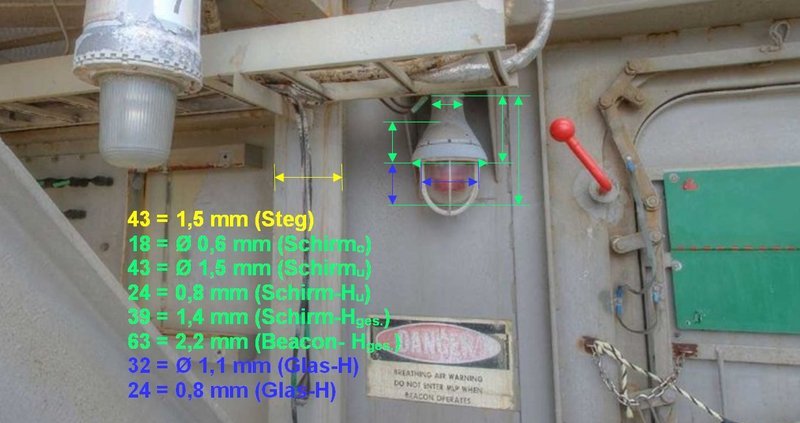
And since the lamps are getting a bit more filigree anyway, I have taken measurement at the RSS-lamp once more.

And behold, my sense of proportion has not deceived me again, https://forum.raumfahrer.net/Smileys/yabb/huh.gif because the tube should have a diameter of 0,4 mm,


Source: forum.nasaspaceflight.com (James MacLaren)

while the Revell Kit tube with 1 mm is twice as thick, which can be seen in the following photo.

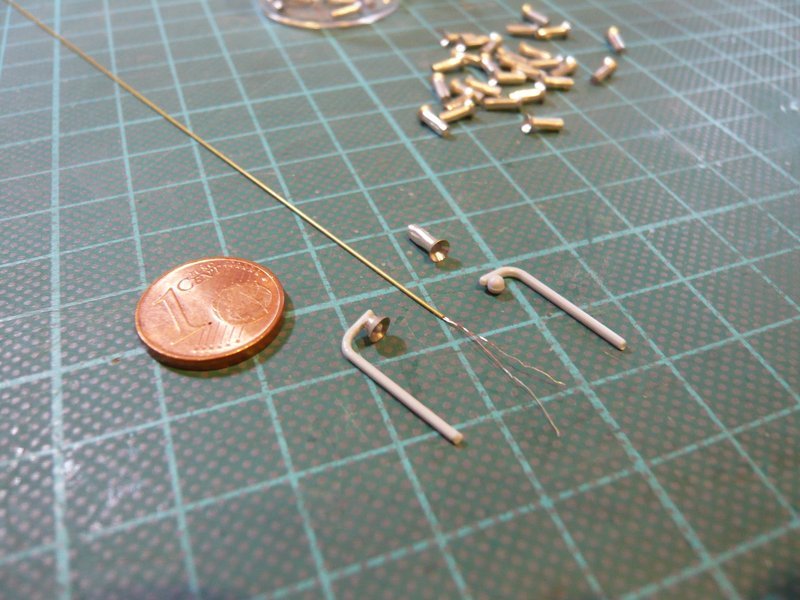
This is for comparison a brass tube with Ø 0,5 mm, which would match the lamp size well, compared with the overlying lampshade, which is a little smaller with Ø 2,8 mm than my first samples with about Ø 3 mm (left).

And as one can see, the 0,1 mm thin LED wires let also thread into the tube, so everything is okay.

All we can hope is that one can bend the tube cleanly around the rounding without a kink, but we’ll manage that too, I guess.

Oh well - pipe bending is always such a tricky thing and can also become a complete flop.

But what’s the name of it? https://www.britmodeller.com/forums/public/style_emoticons/default/hmmm.gif Well begun is half done!

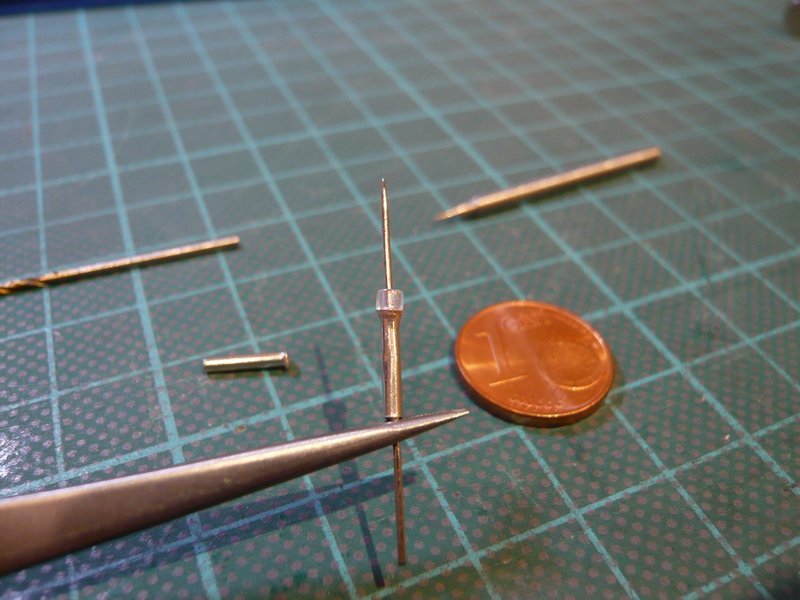
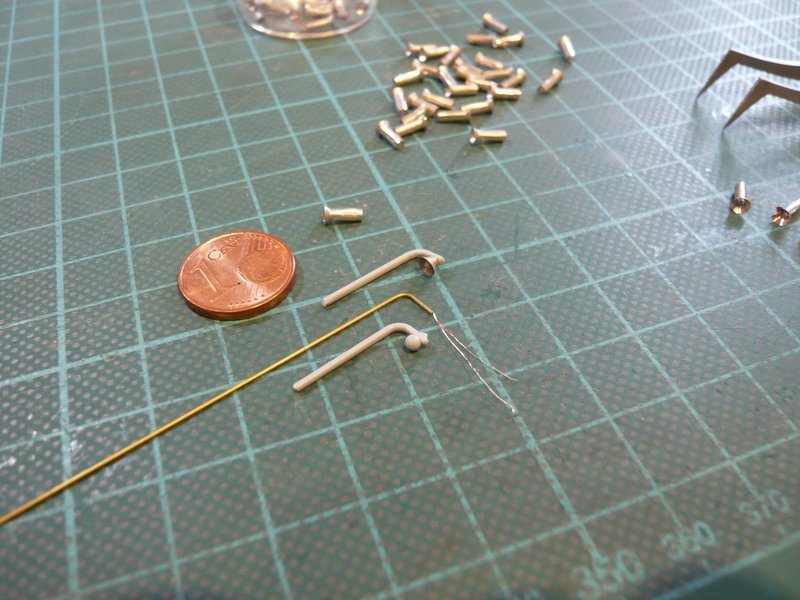
And my first bending test with the Ø 0,5 mm brass tube looks quite useful already, right?

Which in turn confirms my credo: Nothing is impossible!!!

BTW, maybe the pulling in of the two 0,1 mm wires is even favorable for the bending of the brass tube, since its inner diameter is 0,3 mm, which both wires almost fill. https://images.raumfahrer.net/up040577.gif

3 Likes

Those Revell light offerings really are a very sorry effort….

Let’s forget it! https://images.raumfahrer.net/up040577.gif

1 Like

Hello friends,

here is another update to the marked three lamps without shade on the Side 1, as well as for the Hazard warning lights with this shape here. cool1


Source: NASA

In my search for even better matching ferrules for this lamp shape, I’ve actually found something, and indeed at Voelkner, who offers the smallest available size 0,1 - 0,3 mm². And although that are equal to 100 pcs, which I guaranteed will not need, so I grabbed it, and today the package arrived, so of course I had to try it.

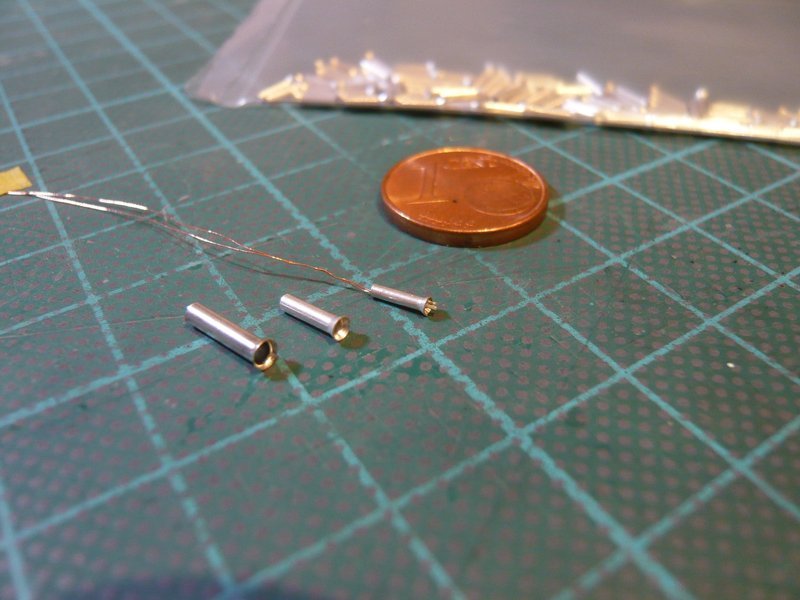
These sleeves have a shade diameter of 1,5 mm, which corresponds exactly to the width of the MLP girders, and would therefore be even better suited than the previously tested 0,5 mm² sleeves with Ø 1,9 mm (shade).

An LED 0402 can also be threaded into the sleeve, as you can see on this picture. To the left are the 0,5 mm² and the 1 mm² sleeves.

And if the back part of the shade is slightly widened, then the shade looks like this (right) and its shape would therefore fit even better.

But since there probably are no matching transparent or red glass beads for this size, which should have a diameter of approx. 1,3 mm, one would have to apply the glass body above the LED with transparent epoxy resin. But wether that would work, I do not know … https://www.britmodeller.com/forums/public/style_emoticons/default/hmmm.gif

Let’s try and see. https://images.raumfahrer.net/up040577.gif

3 Likes

Hello everybody,

once more back to the Tube bending. The wires I have threaded before, especially since that would be one of the two options in the later installation. But since I for myself was unsure how far I had threaded the wires, I have checked it out. cool1

And as one can see here, the wires actually went beyond the arch,

so they might have been a bit of a bending aid.

But there is also this second option here, which had brought a friend at the Raumcon forum into play at that time.

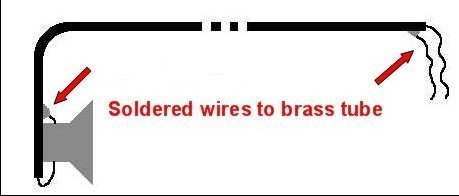
In this case, only one wire (anode) needs to be threaded into the tube, the other wire (cathode) could be separated and then soldered at both ends with the brass tube and thus use it as a return conductor (GND).

When using brass pipes, of course, there is the risk of sharp edges, which is why you have to debur the separation points at the tube ends carefully or round off, so that the protective varnish of the LED wires stays intact and there is no short circuit is caused. https://forum.raumfahrer.net/Smileys/yabb/huh.gif

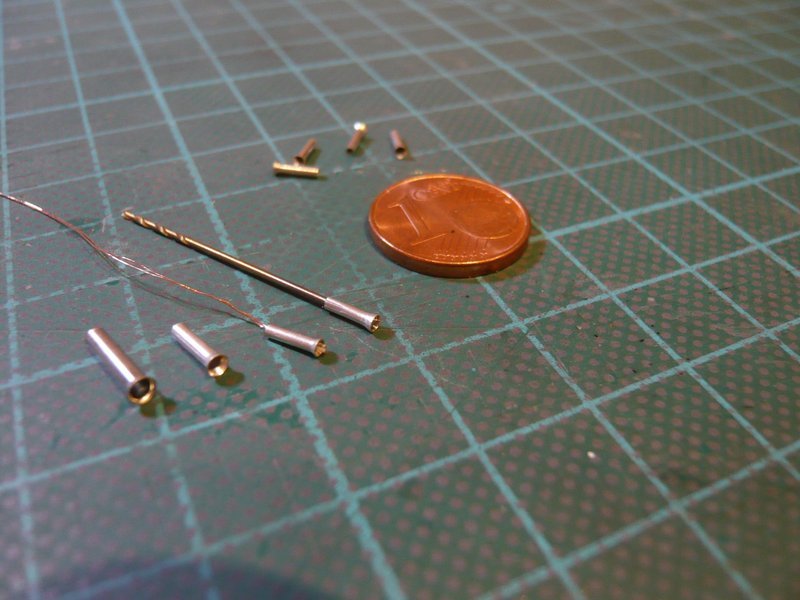
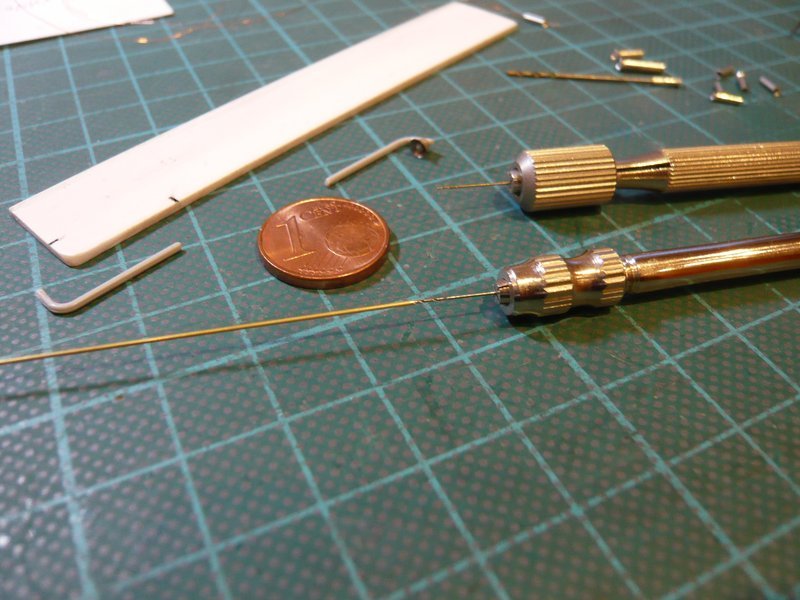
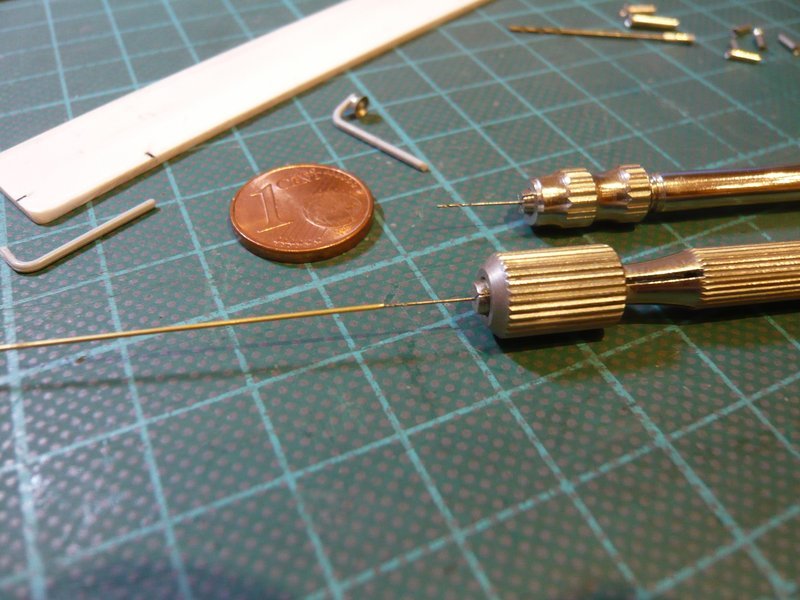
That I have tried with my thinnest drills, first with a drill Ø 0,3 mm, which did not fit into the opening, but hopefully has served for deburring,

and then with a drill Ø 0,25 mm for cleaning.

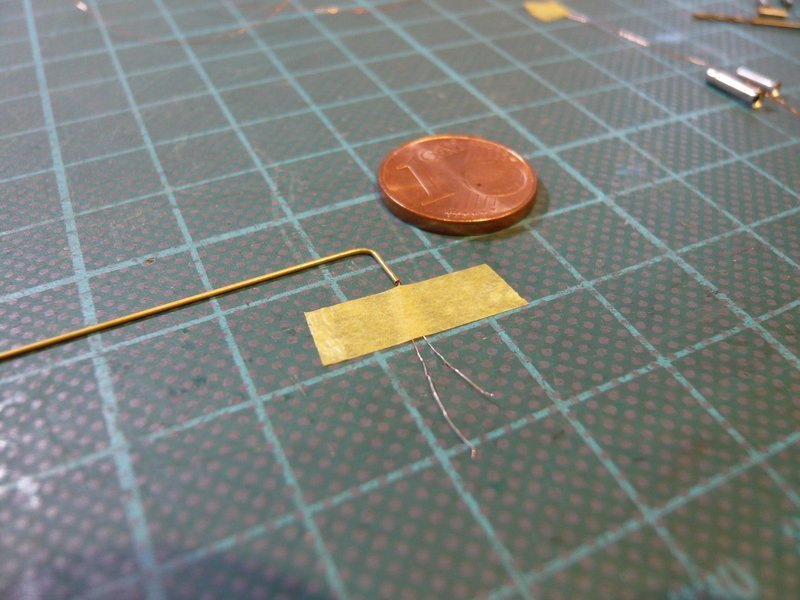
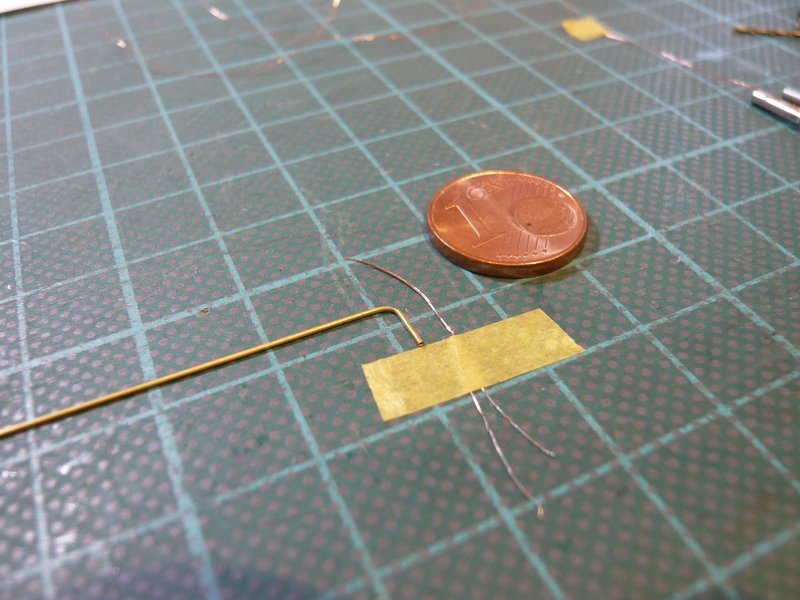
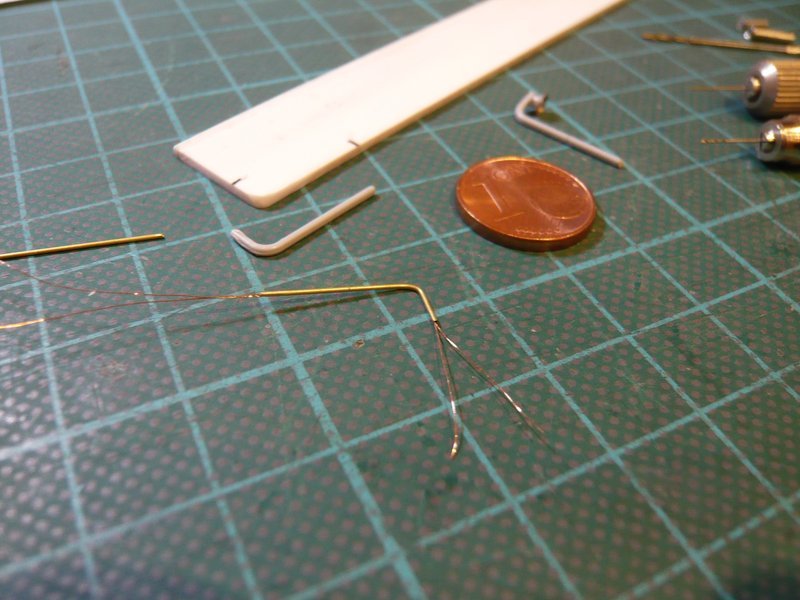
Then I have cut my first bent tube to length, also deburred the ends, and then tried to thread in both 0,1mm wires one at a time to test whether or not the bow can be run through. https://www.britmodeller.com/forums/public/style_emoticons/default/hmmm.gif

That was the expected tricky affair, and threading alone was not for the faint of eyes.

In the process, I first have slided the one wire from the long side into the opening and carefully felt my way to the bending so as not to unnecessarily bend the wire out of shape, which worked out well. And after a short standstill it went around the arch and out at the other end.

The second wire then made some more problems and only progressed a few millimeters, then I had to grasp again. But as one can see, it finally came to the fore again at the other end.

Whether the threading would be easier from the short side, I do not know what one could try.

In any case, the soldering on the tube could be avoided this way. https://forum.raumfahrer.net/Smileys/yabb/huh.gif

That’s it for now, maybe there are still useful tips from this round. https://images.raumfahrer.net/up040577.gif

3 Likes

Hello everybody,

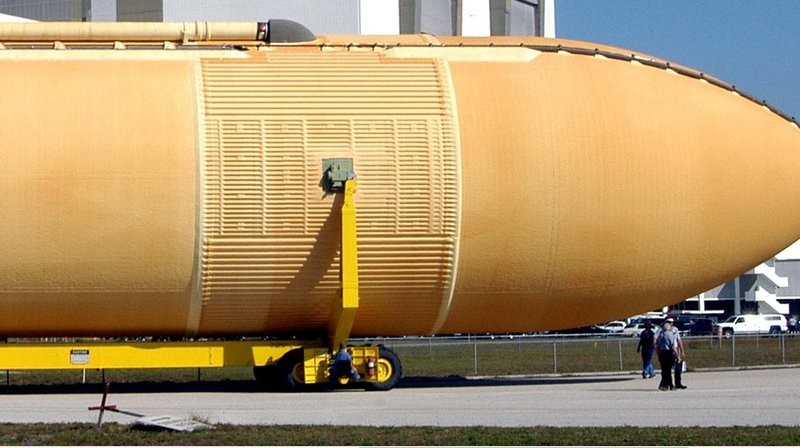
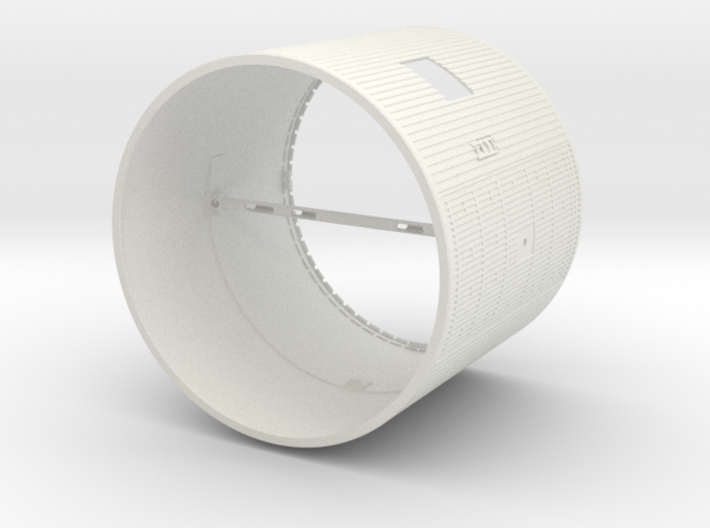
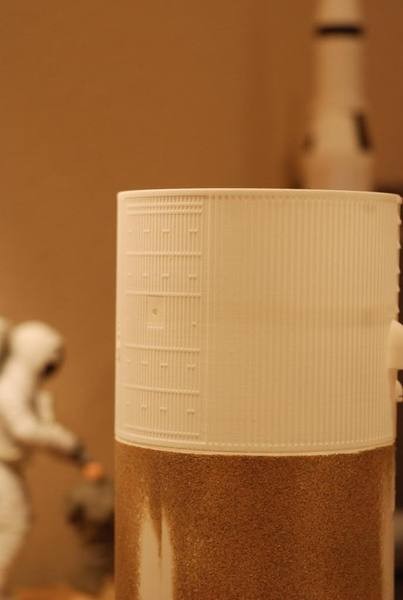
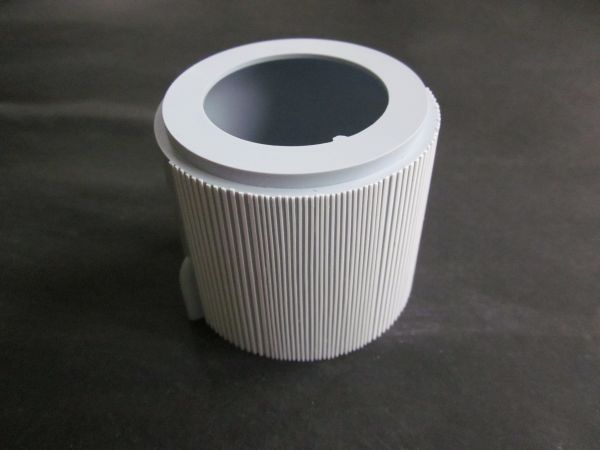
in the meantime, I went to another building site again and took care of the Intertank of the External Tank (ET), for which I’d like to use a 3D print (1:144), if I can find a modeler and manufacturer for it. cool1


Source: NASA

Here is the 3D model by my friend Bill (niParts) from the ARC Forum, but unfortunately only in 1:72 scale, https://forum.raumfahrer.net/Smileys/yabb/rolleyes.gif


Source: arcforums.com (niart17)

as well as here with the installation of the finished 3D-Intertank at his ET (1:72), where the part comes out great, in my opinion.


Source: arcforums.com (niart17)

And he also offers the matching mounts (Ice Frost Ramps) for the GH2 and GO2 pressure lines (1:72).


Source: arcforums.com (niart17)

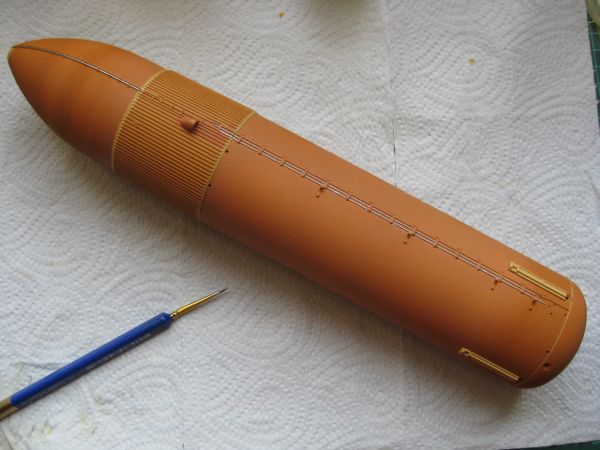
A charming alternative to this is the Scratch building by using thin Evergreen strips for the Stringers,


Source: raumfahrer.net (inselaner)

as it was successfully and impressively realized by my friend (inselaner) in the Raumcon forum at the ET of his Airfix Shuttle Stack.


Source: raumfahrer.net (inselaner)

So far, I have also flirted with the idea of this scratch-building variant, in case I can not find a suitable 3D-printed ET. https://www.britmodeller.com/forums/public/style_emoticons/default/hmmm.gif

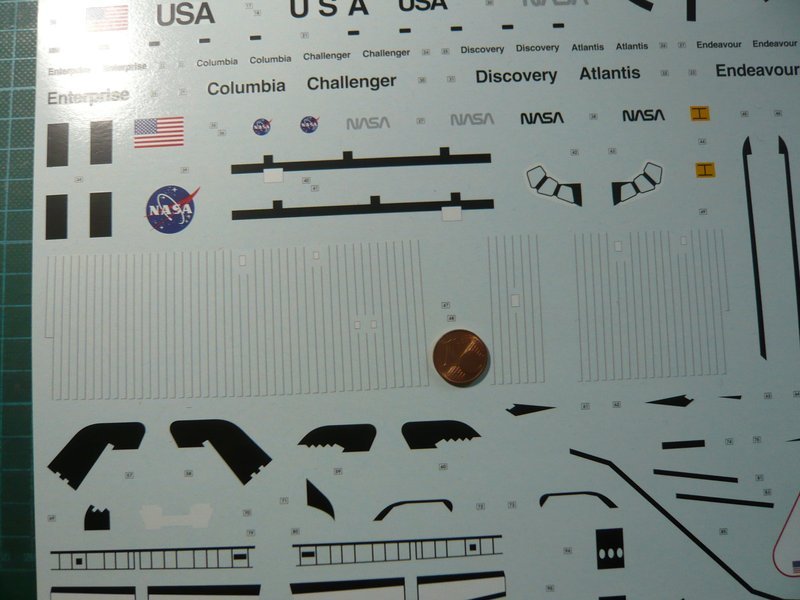
In the Airfix kit, the Intertank stringers are only hinted at by these simple decals and are therefore only 2D, which I can not make friends with.

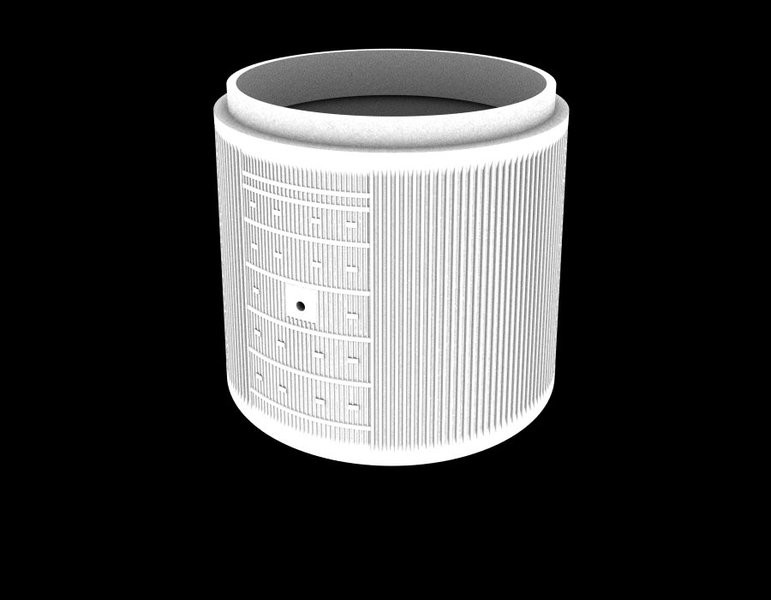
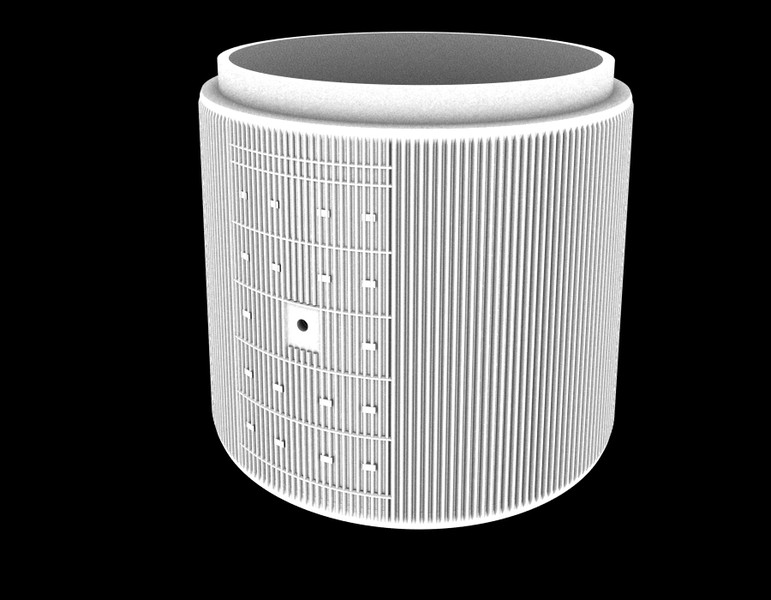
So I’m still trying to get a 3D Intertank (1:144), with that Michael Key (The Aerospace Place) had been starting in a hopeful way,


Source: The Aerospace Place (Michael Key)

on whose update I’m still waiting.

That’s why I’ve been more in-depth with the Stringers, if I have to scratch them myself, which I did not intend to do. https://forum.raumfahrer.net/Smileys/yabb/huh.gif


Source: NASA

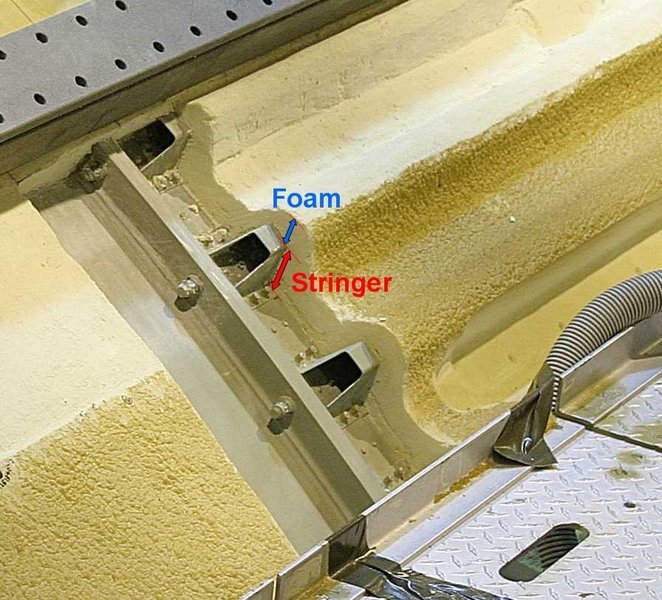
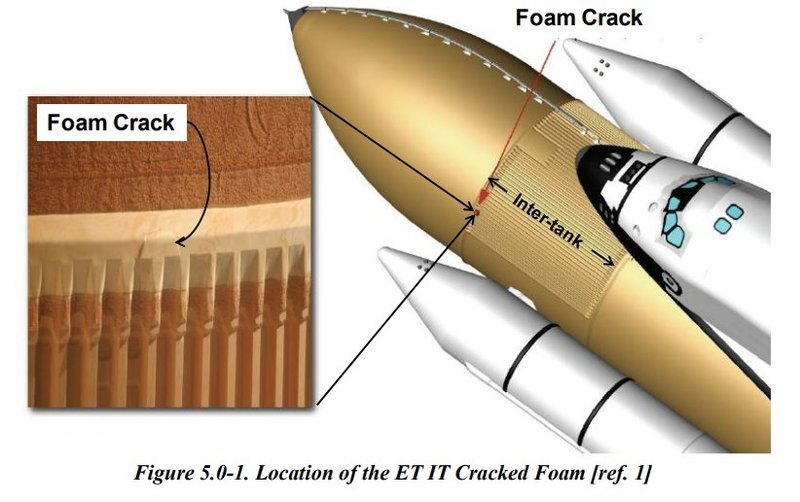
So far, unfortunately, I had no dimensions of the stringers, but rather I have always tried to estimate it myself. At first, these images helped me, where cracks in the insulating foam on the Intertank before the mission STS-133 had been investigated,


Source: NASA

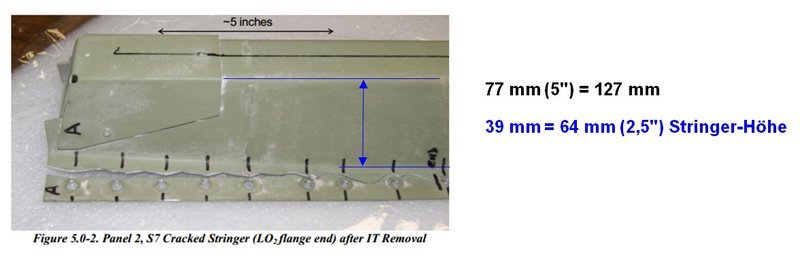
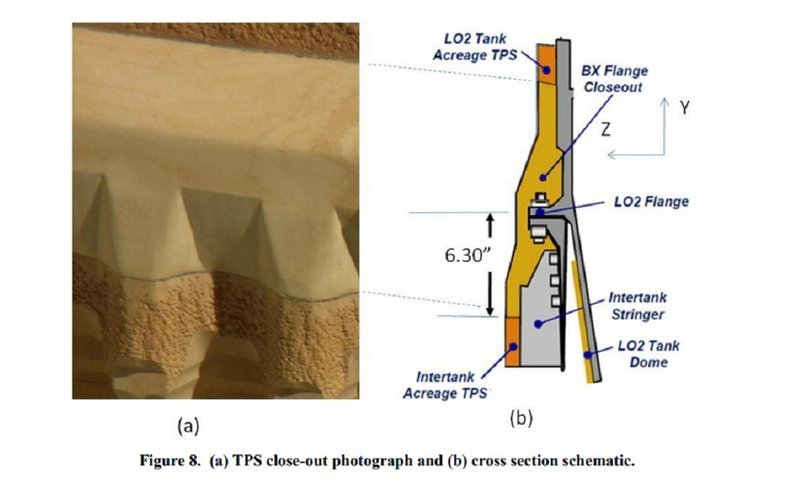
which were caused by a broken stringer, which can be seen here. And thus the height of the stringers should be about 2,5’'.


Source: NASA

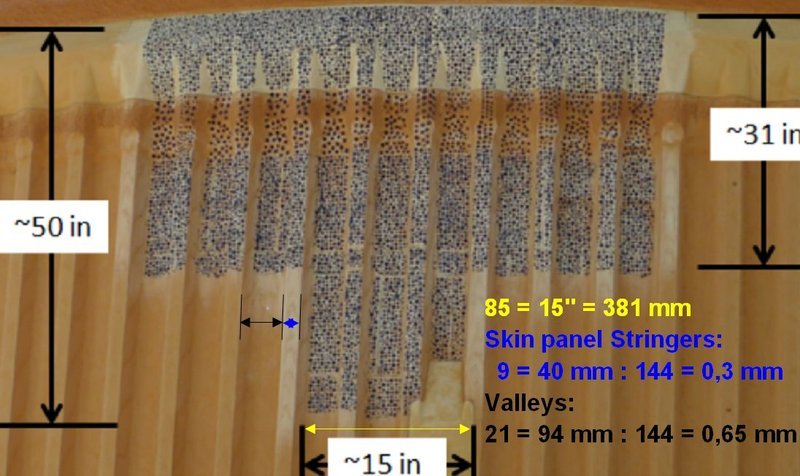
From another image of this study after the repair of this stringer area then I have determined the widths of the Stringer (0,3 mm) and the Valleys (0,65 mm) for 1:144 scale, which would be a suitable basis for scratch building.


Source: NASA

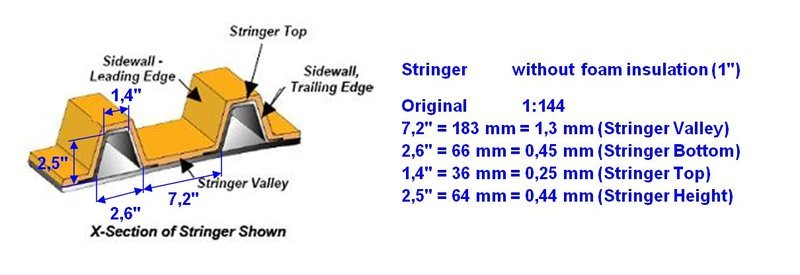
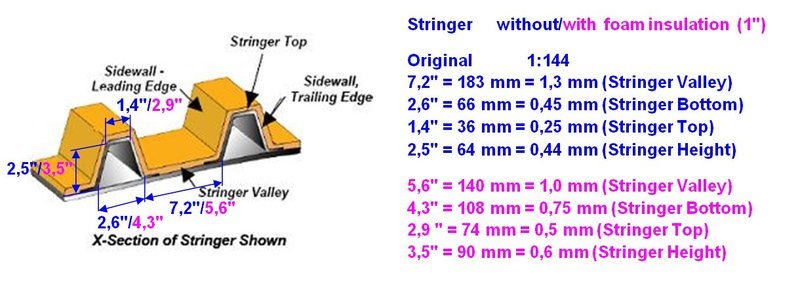
So far so good, but then I’ve actually found even more detailed information about stringer geometry in another NASA document (ntrs.nasa.gov),


Source: NASA

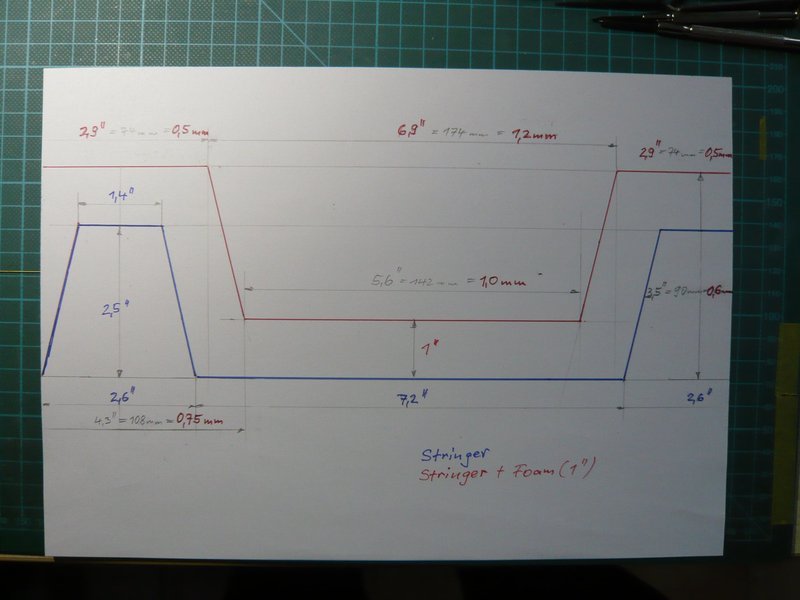
with which I made this sketch (1:1), which was then supplemented by the 1’’ thick foam insulation (red),

And these dimensions with foam insulation could now, if one would like, be taken as a basis for scratch building, which is summarized here again.


Source: NASA

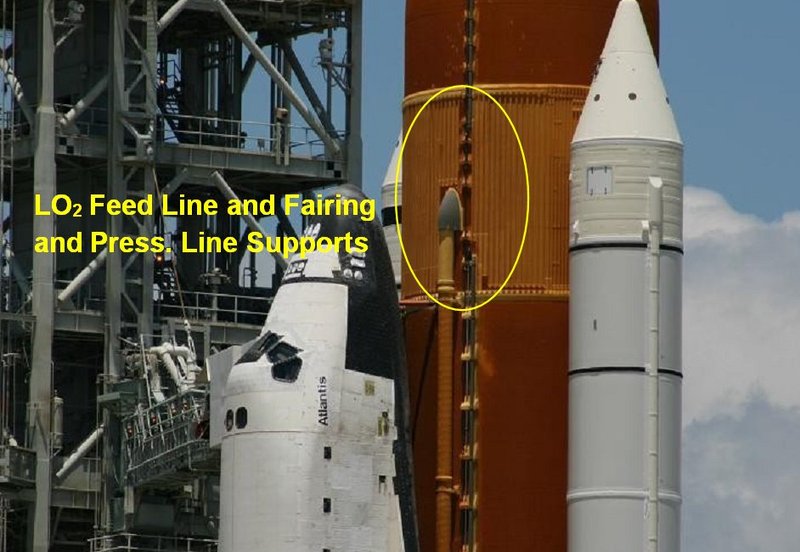
But I still hope that Michael Key keeps on the line. At first he wanted to know the diameter and the exact position of the LO2-Feed Line as well as the Forward SRB Attachment Point in the Intertank,


Source: NASA

what I still have to determine now. https://images.raumfahrer.net/up040577.gif

4 Likes

Hello everyone,

and my hope was not disappointed. Yesterday Michael Key came up with a new update in which he took into account some of my correction hints. cool1

On the one hand,he has reduced his previous, somewhat too large number of stringer in the two Thrust Panel to 26, as well as the perpendicularly extending circumferential segment rings somewhat narrower made, which looks much better.


Source: The Aerospace Place (Michael Key)

And on the other hand, he has adapted the geometry of the front and rear transitions from the Intertank to the ET better to the original.


Source: NASA

as you can see here, all respect.


Source: The Aerospace Place (Michael Key)

In order to be able to continue modeling, he now needs the exact location of the SRB Forward Attachment Points, as well as the location of the LO2 Feedline (Ø 17’') and of the GO2 and GH2 Pressure Lines (Ø 2’'), shown in this drawing.


Source: Lockheed Martin (System Definition Handbook SLWT - Vol. II)

The only question is whether or how well the details of the Shuttle Stack from the Airfix Kit match this original drawing, or not. https://www.britmodeller.com/forums/public/style_emoticons/default/hmmm.gif

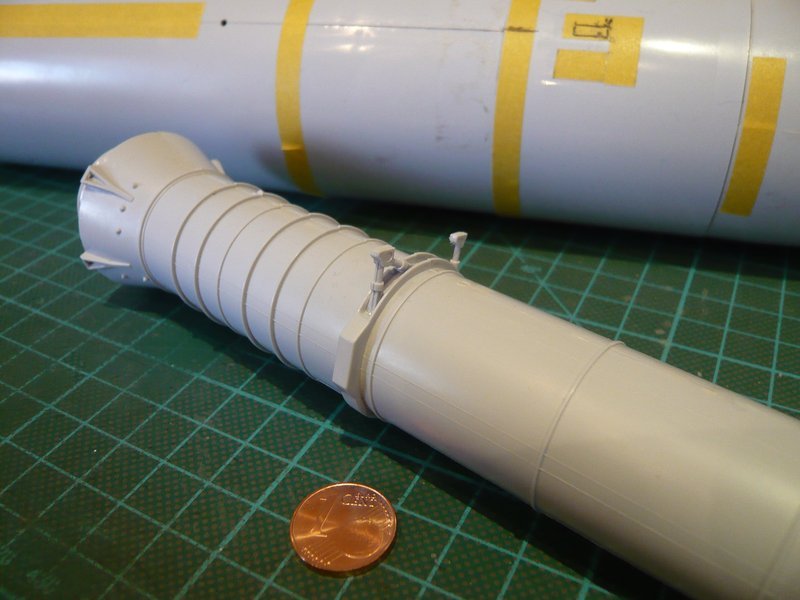
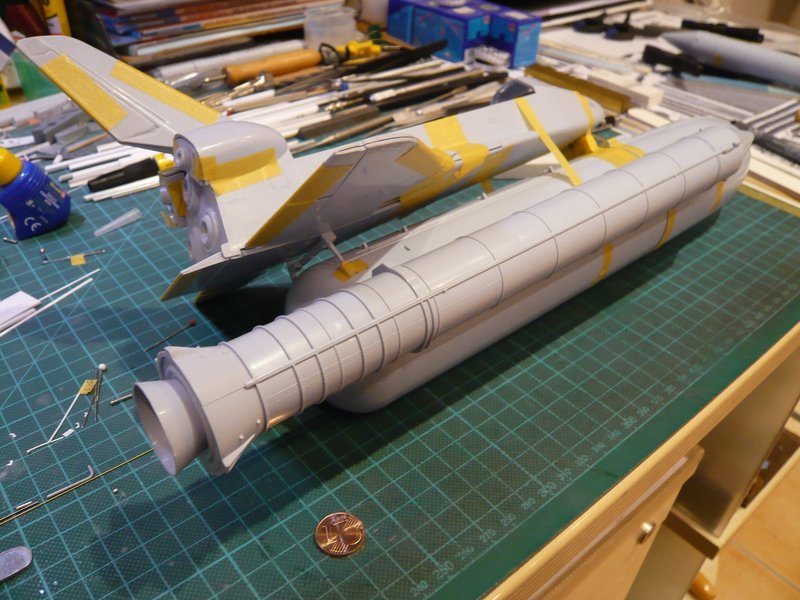
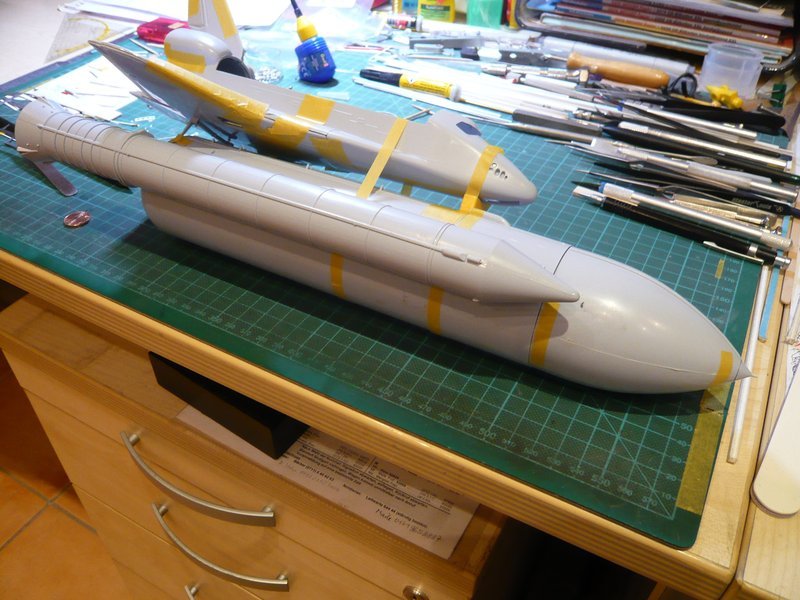
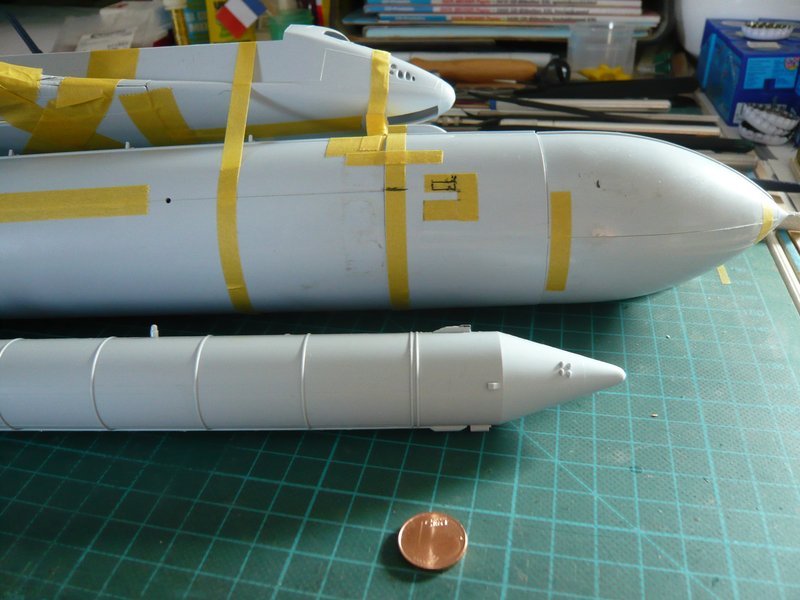
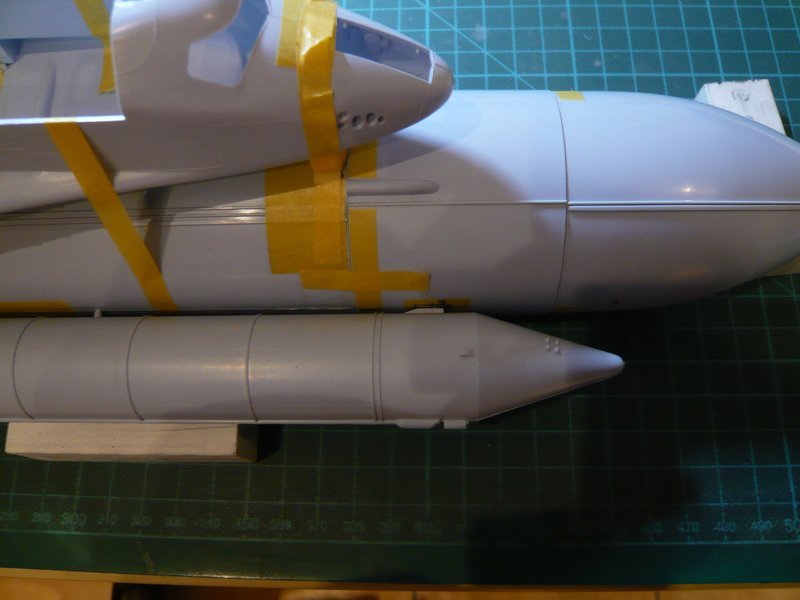
In order to be able to check these details on the shuttle stack, I had to disassemble my previously provisionally taped Test-stack https://forum.raumfahrer.net/Smileys/yabb/rolleyes.gif and then to attach the kit supports at the SRB on the ET Attachment Ring to determine the exact position of the coupling point on the Intertank.

With the glued supports, the location of the SRB on the ET was now fixed exactly,

and could be marked again.

After that, I was amazed that my border of the front SRB docking pad, previously marked with tape on the test stack, was sitting actually a bit too deep, https://forum.raumfahrer.net/Smileys/yabb/huh.gif which could now be corrected.

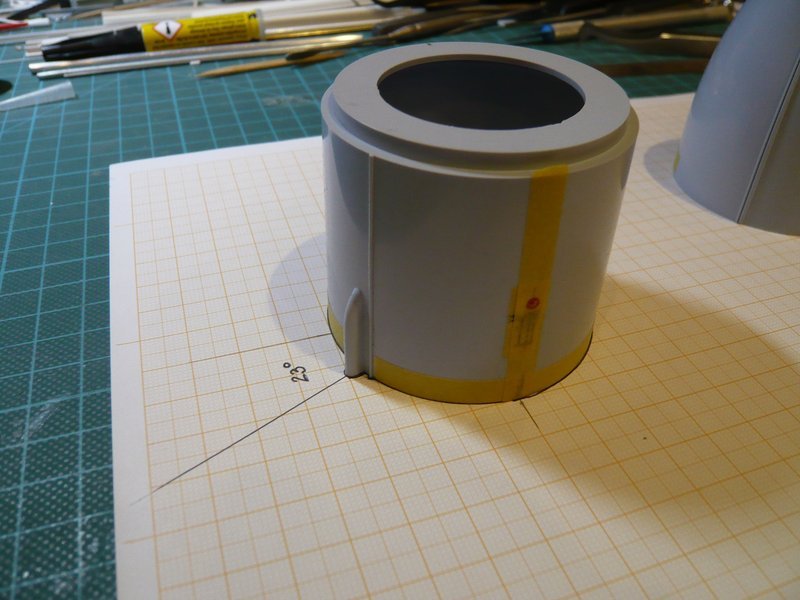
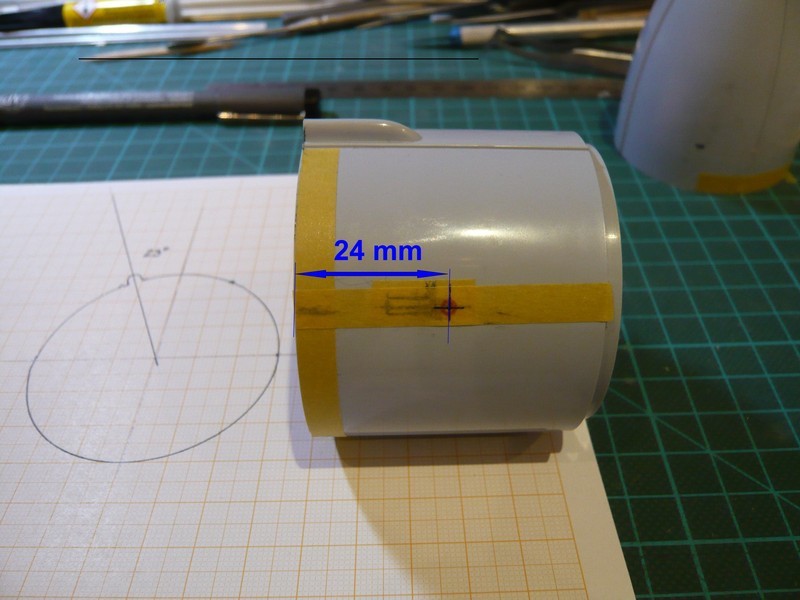
Then I still determined the location of the LO2 feedline on the Intertank and was pleasantly surprised that the angle of 23° matches with the value in the above drawing.

However, what is less consistent with the original is the spartan version of the feedline itself and the lack of coverage (Fairing).


Source: NASA

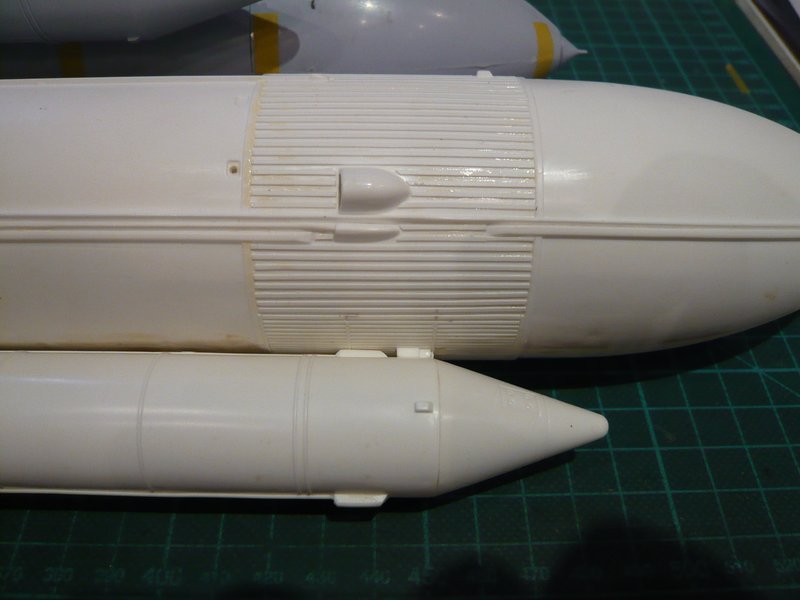
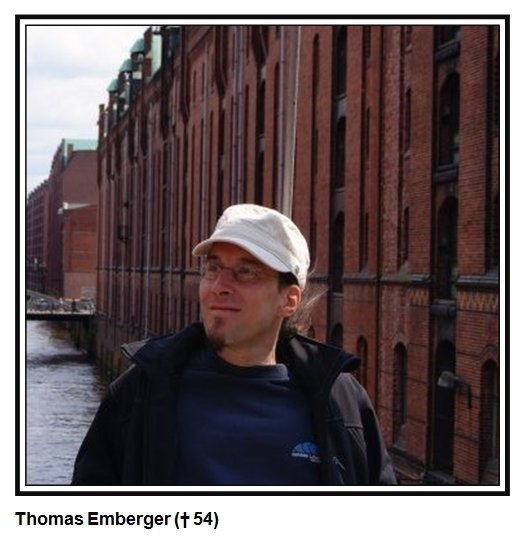
This has been realized much better by Revell on their ET Intertank, as you can see here at the ET of my recently unexpectedly deceased friend Thomas from Bavaria, whose Real Space Modeling Estate was taken over by me. https://www.britmodeller.com/forums/public/style_emoticons/default/hmmm.gif
In view of this, after careful consideration and in coordination with his wife and son, I have come to the conclusion that it would be also in his sense to at least partly preserve his model-building heritage, when I would integrate some of his assemblies and parts, e.g. the already LED illuminated FSS platforms and the Hammerhead Crane as well as the PE staircases for the tower, etc. into my model and would thus be able to document and honor his awesome modeling work and skills for everyone visibly posthumously. R.I.P.

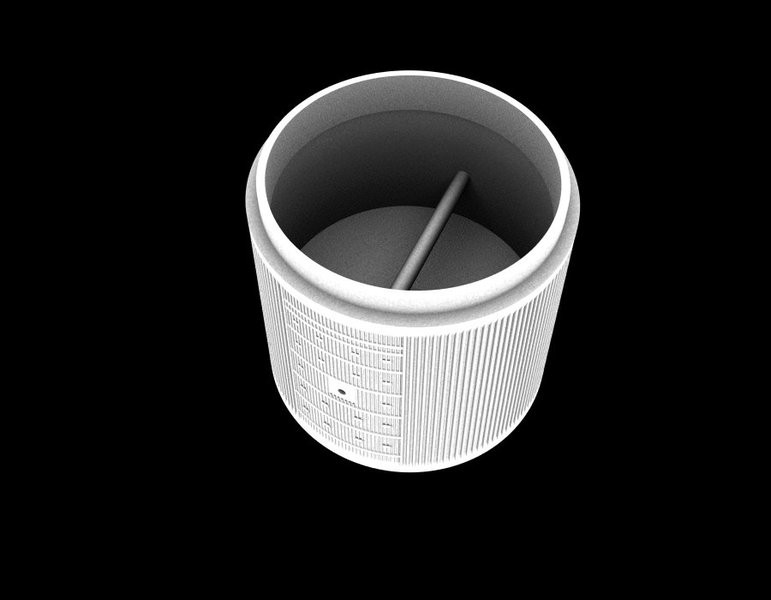
And here finally the distance of the coupling point for Michael Key, which lies approximately in the middle.
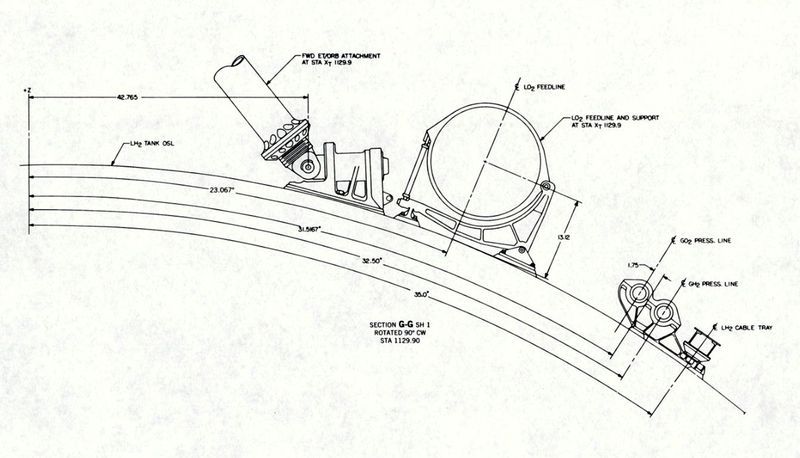
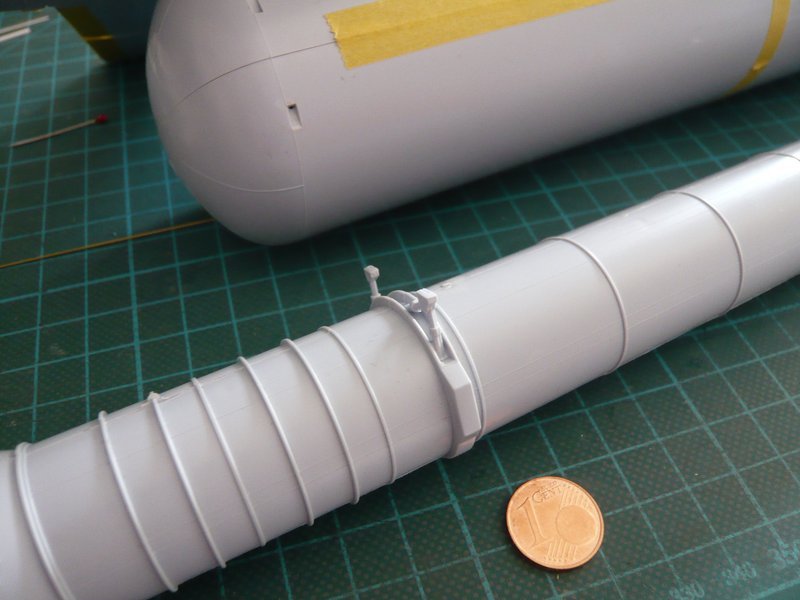
At this point, a continuous inner tube is foreseen into which I will later insert a brass rod (Ø 2 mm) to support the SRBs.

Source: The Aerospace Place (Michael Key)

That’s it for today. https://images.raumfahrer.net/up040577.gif

5 Likes

Hello everybody,

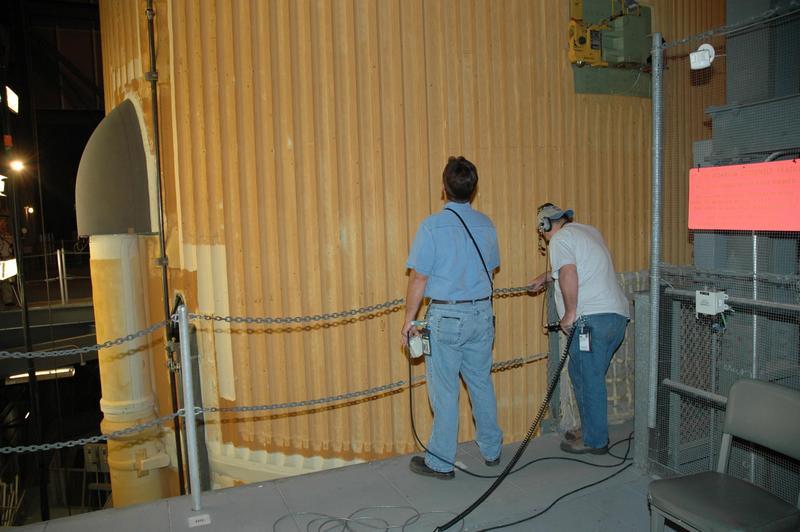
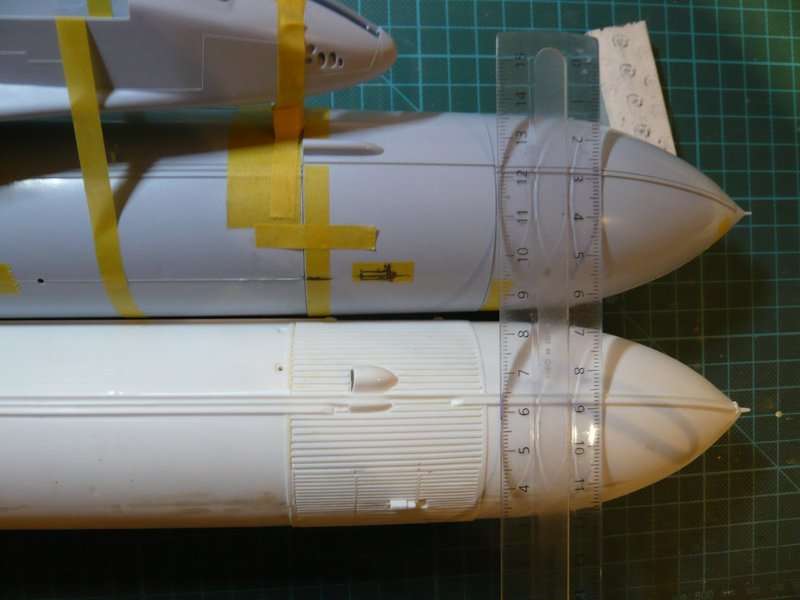
in the direct comparison of the two ETs I noticed that the Revell IT is about three millimeters further back than on the Airfix ET, https://forum.raumfahrer.net/Smileys/yabb/huh.gif while the lengths and diameters are almost identical.

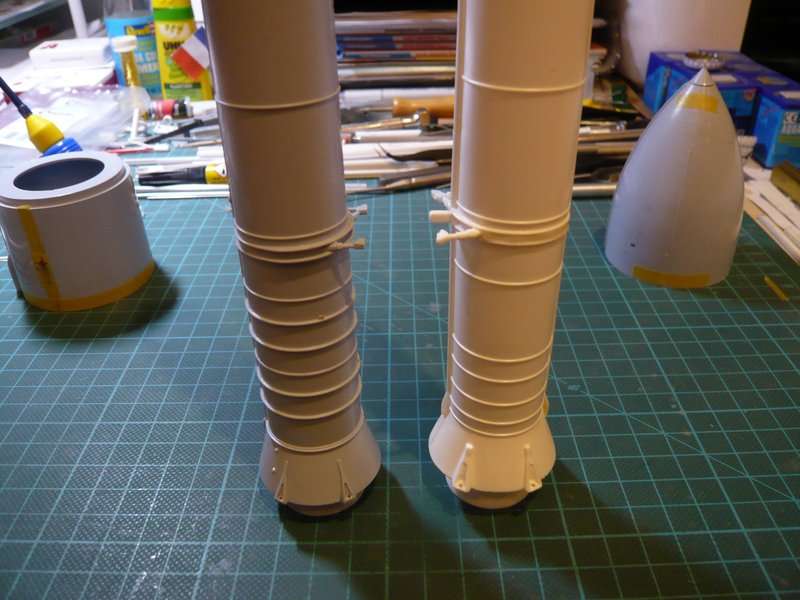
And because we are comparing the two stack kits, I also looked at the SRBs a bit more closely and also found some differences. cool1

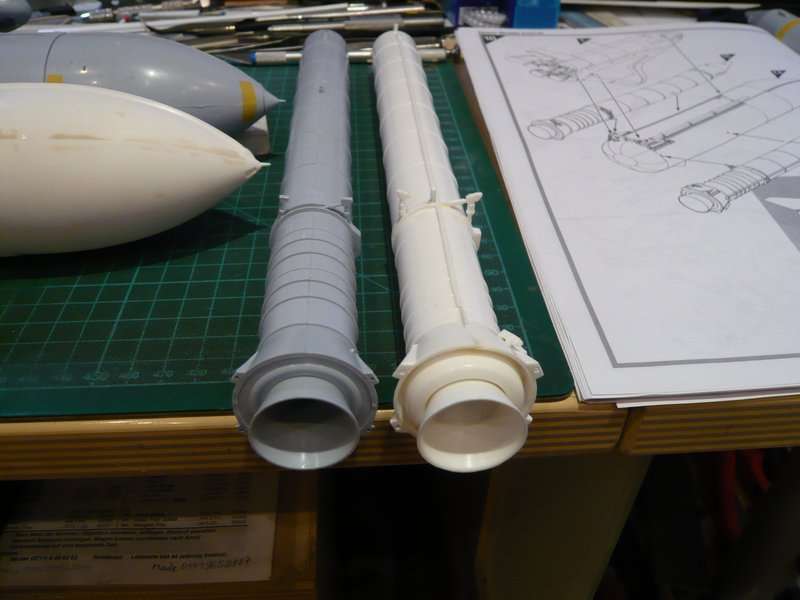
Apart from the smaller number of lower rings, the Revell SRB appears less filigree than the Airfix SRB, particularly caused by the larger Aft Skirt Hold-down Posts and the sturdier supports on the ET Attachment Ring, although the diameters are comparable.

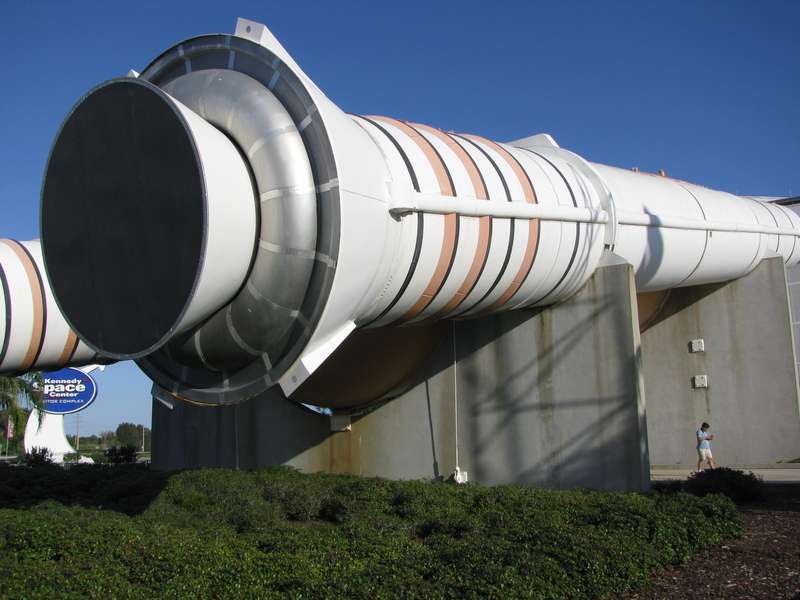
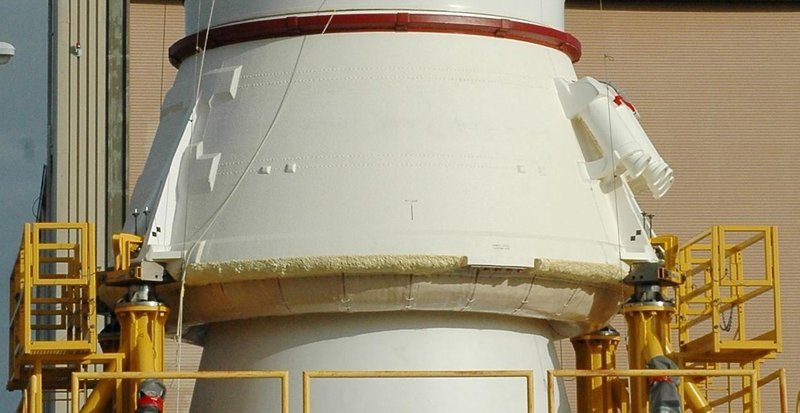
If one compares the two undersides of the Aft Skirts, one will notice that the ring-shaped heat shield on the Airfix SRB is too narrow-breasted, which Revell has not solve optimally, but at least better,

what the comparison with this image makes clear, even if it is just a Mock-up on the KSC grounds. https://forum.raumfahrer.net/Smileys/yabb/rolleyes.gif


Source: NASA

Probably that has animated my ARC friend Bill (niart17) to 3D modeling of his Heat shields (1:72).


Source: ARC (niParts)

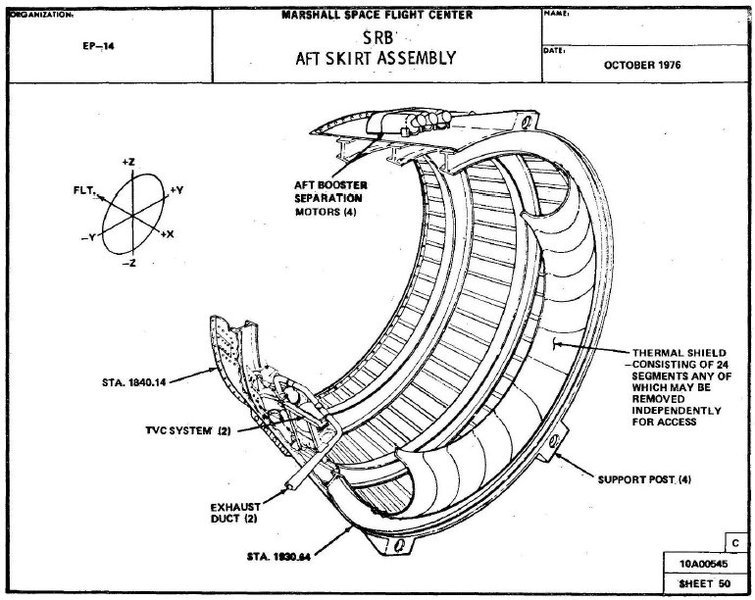
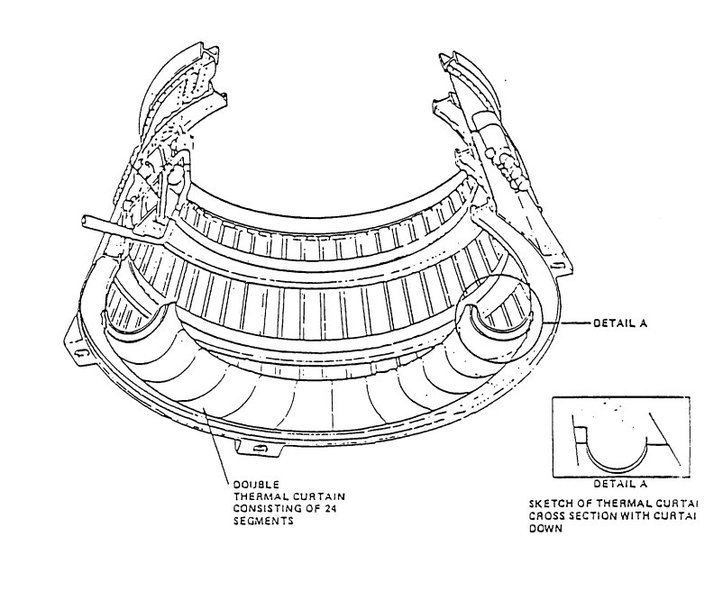
But neither the heat shield of the Mock-up nor the 3D printing are perfect, as the original consists of 24 segments, as one can see in this drawing.


Source: Space Transportation System - HAER No. TX-116

And so it is also with the kits, no one is perfect, everyone has their advantages and disadvantages. https://images.raumfahrer.net/up040577.gif

5 Likes

Hello everybody,

how great it is to have helpful friends who are also familiar with 3D modeling like my friend Joe from the ARC Forum, who has offered his help to try to model this part for 3D printing (1:144).

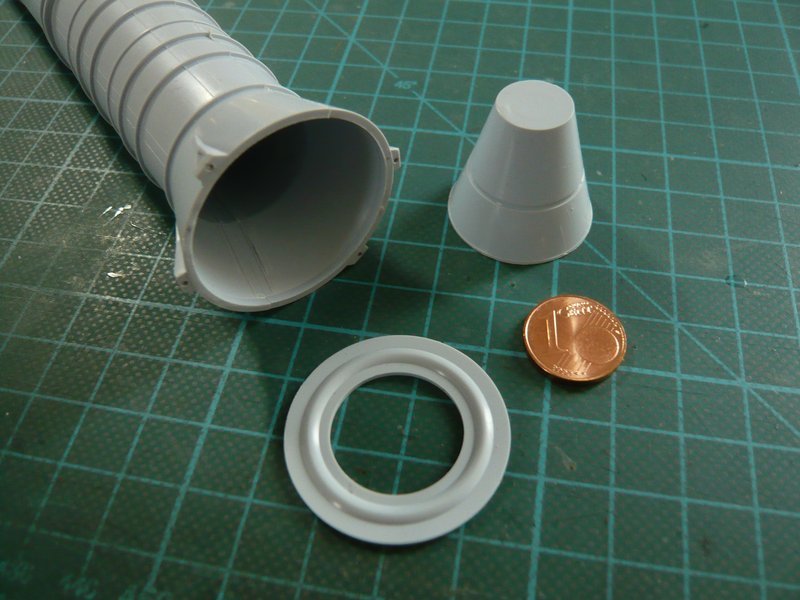
These are the parts of the Airfix SRB & Aft Skirt,

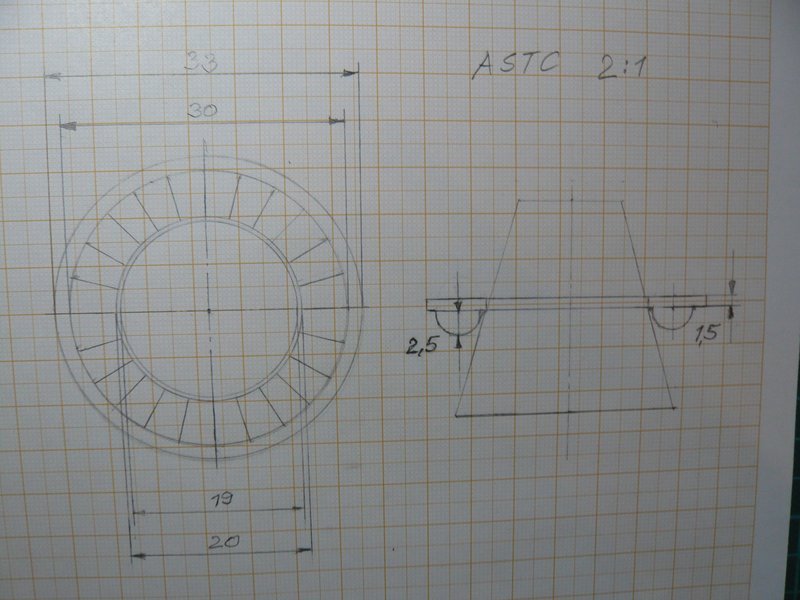
and here is my little sketch of the ASTC, technically known as the Aft Skirt Thermal Curtain, which is desribed in this interesting report SRB Thermal Curtain Design Support.

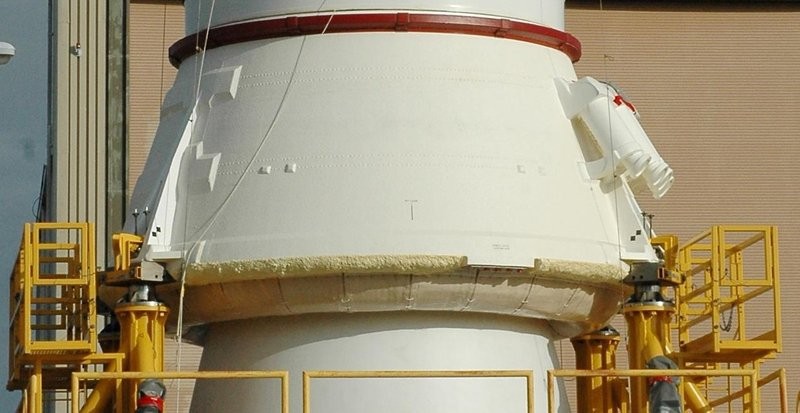
The ASTC is a flexible, high temperature, cloth and insulation composite that is used to protect the hardware located inside the aft skirt of the SRB, which consists of nine layers of insulating materials and is 2,58 inches thick. The ASTC is made up of twenty four segments, which are hand sewn together during installation on the aft skirt, https://images.raumfahrer.net/up037692.gif what one can see here.


Source: NASA

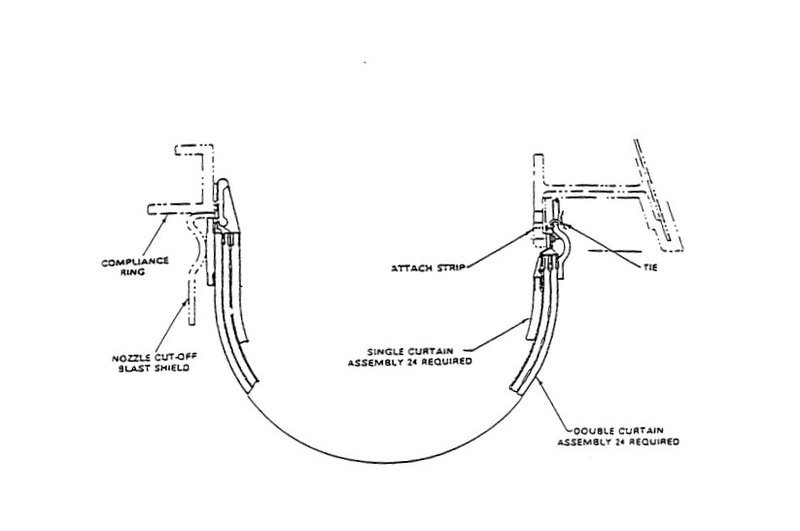
In this report there are some interesting drawings oft the ASTC, which might be helpful during 3D modeling of this detail.

That’s why I’m thinking, that the segments should be more curved than in my friend Bill’s 3D model (1:72), where they are more flat. https://www.britmodeller.com/forums/public/style_emoticons/default/hmmm.gif


Source: arcforums (niart17)

In my opinion White Strong & Flexible should be a good choise for the Shapeways’ 3D print.

Now I can only hope, that my friend Joe can come up with a good approach.

4 Likes

Hello everybody,

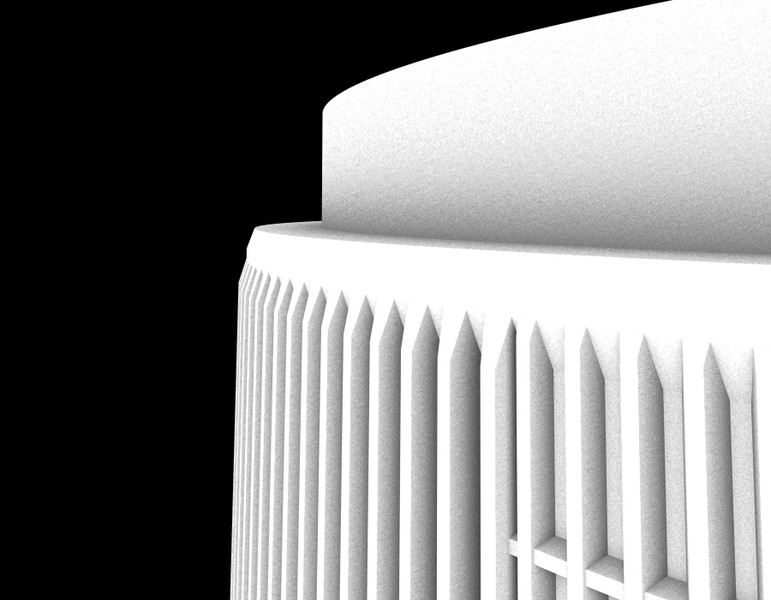
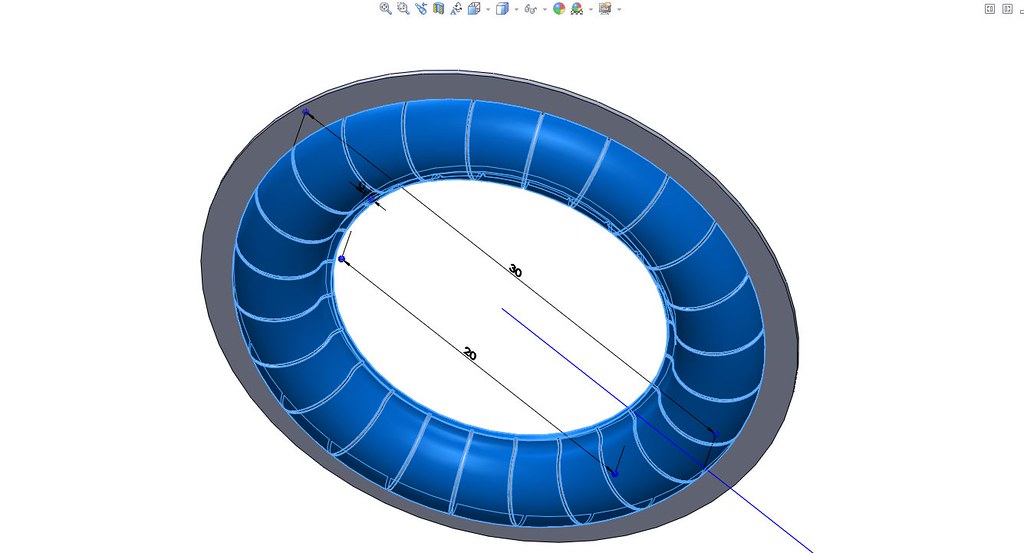
and my ARC friend Joe (crackerjazz) wanted to model these pieces in 1:144 for 3D printing by Shapeways. cool1

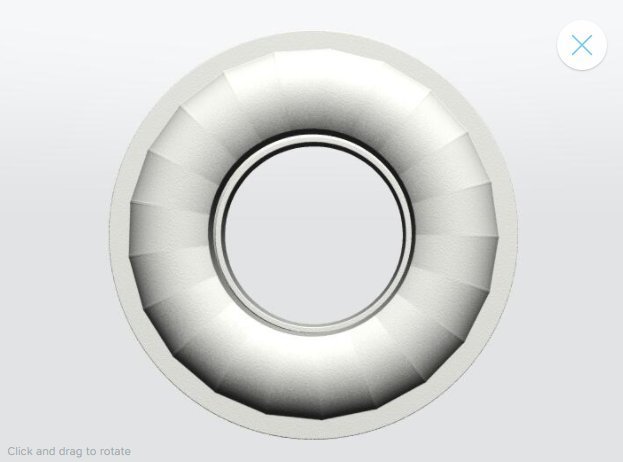
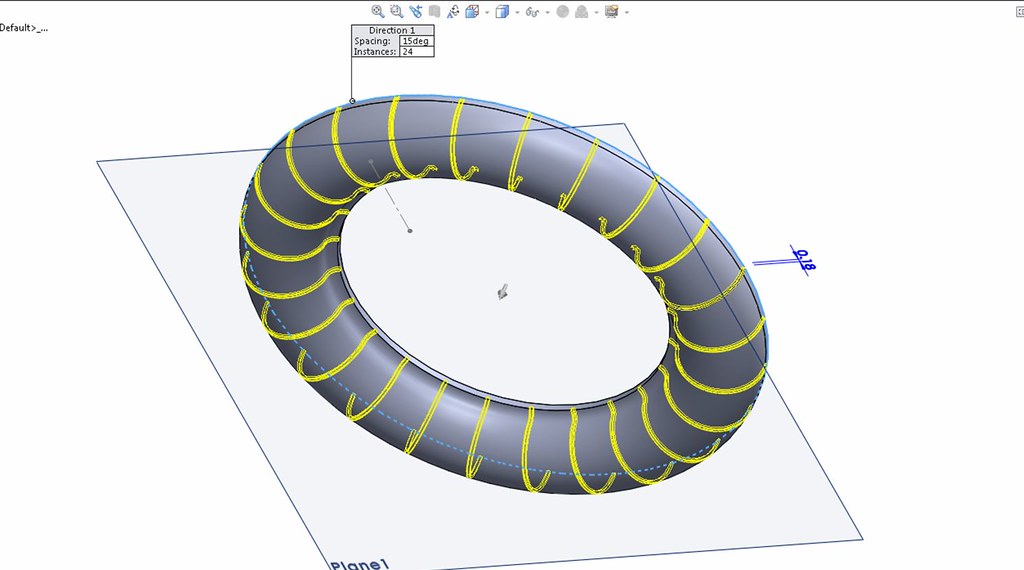
And he actually has kept his word and presented his first 3D models, which look quite passable.


Source: arcforums.com (crackerjazz)


Source: arcforums.com (crackerjazz)

Since the initially intended quality White Strong & Flexible (WSF) might be too grainy for these small parts, Frosted Ultra Detail (FUD) might be more favourable, although a bit more expensive. https://forum.raumfahrer.net/Smileys/yabb/huh.gif

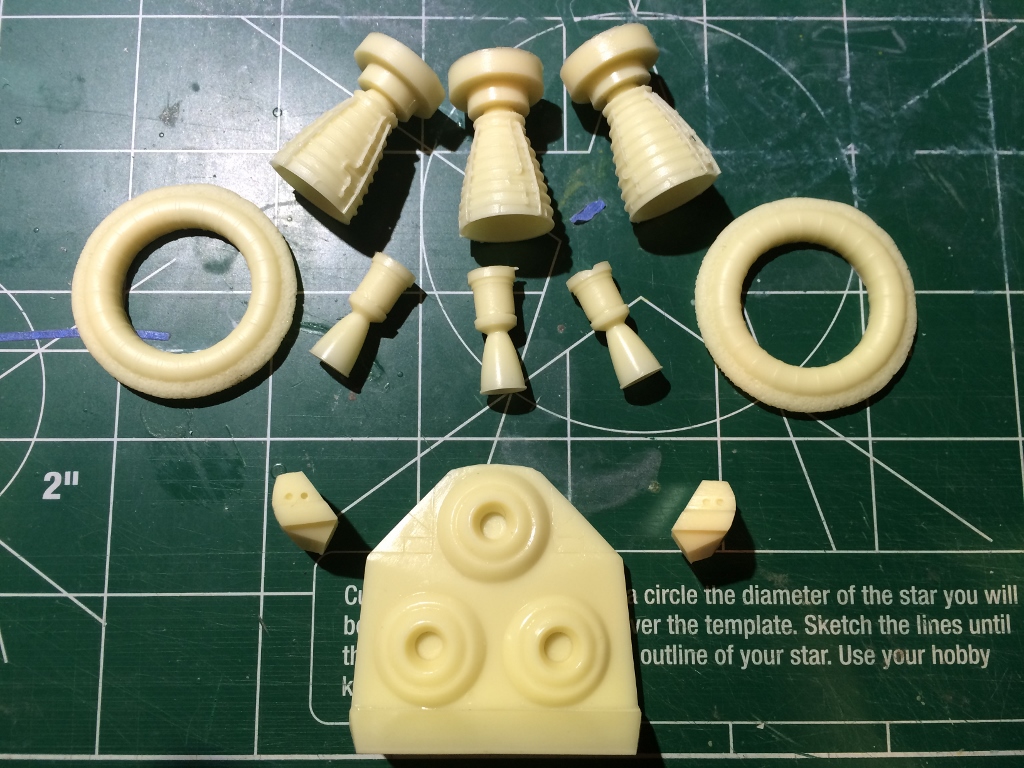
The ASTC rings from the Newware-Enhancement Kit (NW131) for the Revell Stack (1:144) look like these, which was used by another ARC friend.


Source: arcforums.com (egt95)

The width of the seams between the 24 segments I measured once again in this Hi-Res photo and should be only approx. 0,1 mm in 1:144, https://images.raumfahrer.net/up037692.gif which might be indicated by fine grooves. https://www.britmodeller.com/forums/public/style_emoticons/default/hmmm.gif


Source: NASA

My friend wants to upload his 3D model to Shapeways, and then we’ll see how much it’ll turn out … cool1

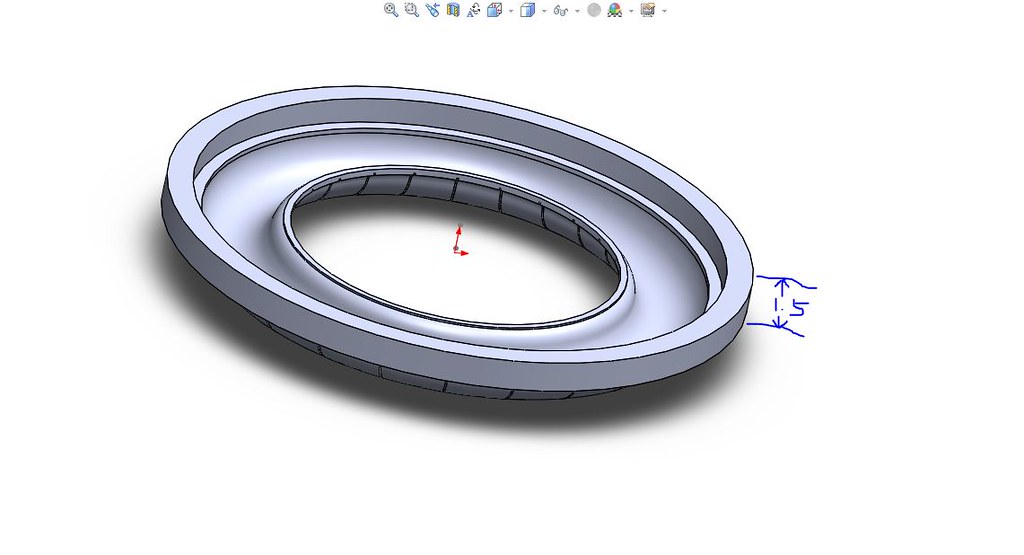
Before uploading to Shapeways he had only one question to the height of the AFTC ring, https://www.britmodeller.com/forums/public/style_emoticons/default/hmmm.gif


Source: arcforums.com (crackerjazz)

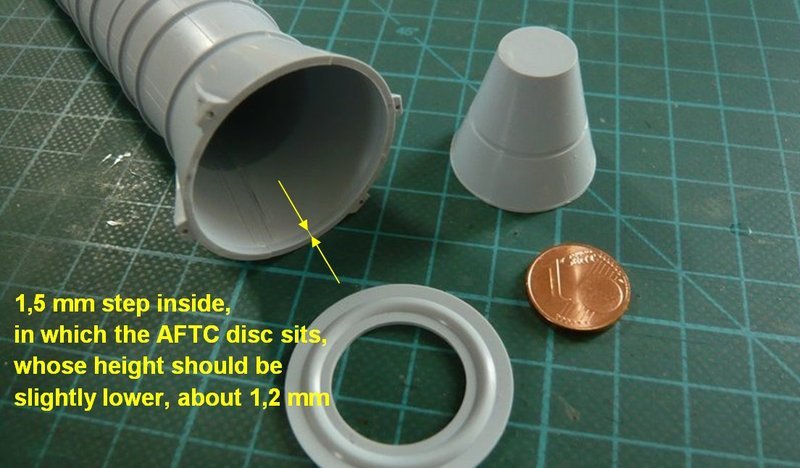
which was quickly answered, after I had still again measured exactly the height of the small step inside the Aft Skirt, which is 1,5 mm. Consequently, the height of the printed disc should be slightly lower, if possible ≤ 1,2 mm.

Now please keep your fingers crossed that Shapeways can realize that as well. https://images.raumfahrer.net/up050224.gif

2 Likes